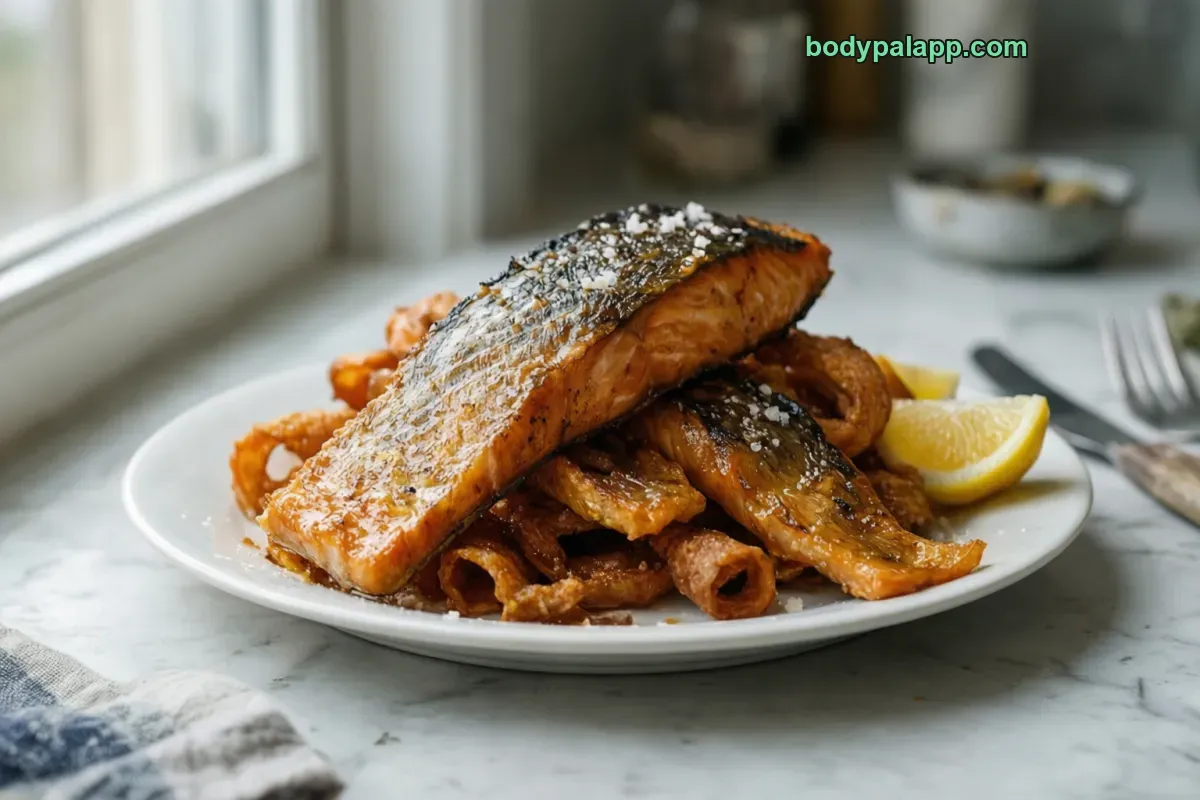
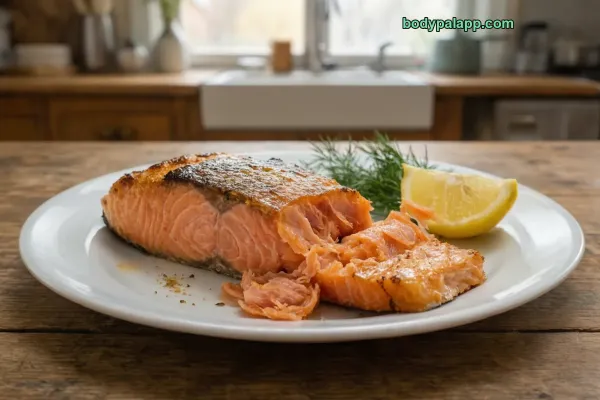
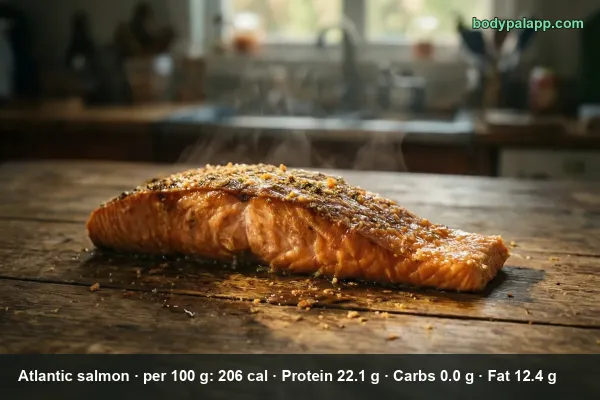
Salmon skin calories come to 175 for a 3 oz portion (85 g) of cooked, farmed, skin-on salmon, and 206 per 100 g. The figure to notice is the fat: it supplies 56% of the calories, more than protein does, yet that 3 oz portion still delivers 18.8 g of protein for 9% of a day's calories.
175kcal
1 3 oz portion · 85 g, cooked, skin on, farmed
44%protein
18.8 gProtein
0 gCarbs
10.5 gFat
How to burn off 175 kcal
—Walking, brisk
—Jogging
—Cycling, moderate
—Swimming
Skip the math. BodyPal counts these calories from your steps and workouts automatically.
Nutrition facts
Cooked, skin on, farmed · per 85 g
Calories
175 kcal
Protein
18.8 g
Carbohydrate
0 g
Fat
10.5 g
Saturated fat
2 g
Cholesterol
54 mg
Sodium
52 mg
Potassium
326 mg
Iron
0.3 mg
Source: USDA FoodData Central
🛡️
Verified nutrition data
Numbers on this page come from USDA FoodData Central, the U.S. Department of Agriculture’s food composition database, and from manufacturer labels where a branded product is named. Last verified September 2026. How we verify our data →
Salmon skin: calories, protein and sodium by serving
Percent of daily value uses the FDA reference of 2,000 kcal a day.
Serving
kcal
Protein
Carbs
Fat
Sodium
% DV kcal
3 oz portion (85 g)
175
18.8 g
0 g
10.5 g
52 mg
9%
Half fillet (178 g)
367
39.3 g
0 g
22 g
109 mg
18%
Wild caught (85 g)
155
21.6 g
0 g
6.9 g
48 mg
8%
100 g
206
22.1 g
0 g
12.4 g
61 mg
10%
3 × 3 oz portion (85 g)
525
56.4 g
156 mg
5 × 3 oz portion (85 g)
876
93.9 g
259 mg
A half fillet is a 367-calorie plate
The USDA reference behind this page is farmed Atlantic salmon cooked by dry heat with the skin left on, so the figures describe skin and flesh eaten together. A 3 oz portion (85 g) is the standard label serving, and it lands at 175 calories. That is 9% of a 2000-calorie daily value, with 38% of the daily protein target riding along.
Home portions rarely stop at 3 oz. A half fillet weighs 178 g and comes to 367 calories, or 18% of the daily value, with 39.3 g of protein. Two standard portions total 350 calories and three reach 525. Bake a family tray of five portions, 425 g, and it holds 876 calories.
The totals scale cleanly because there are no carbs or sugars in the mix, only protein and fat. If you estimate by eye, the half fillet is the handiest anchor: roughly double the 3 oz figure. Weigh one fillet once and every later guess gets sharper.
Fat supplies more than half the calories
Per 100 g, skin-on farmed salmon carries 22.1 g of protein, 12.4 g of fat and 0 g of carbohydrate. In the calorie split, fat accounts for 56% of the energy and protein for 44%. Nothing comes from carbs, sugar or fiber, so this is a two-macro food.
That fat share is why salmon with skin reads higher than many people expect from fish. Gram for gram, fat carries more than twice the calories of protein, so a modest 12.4 g of fat ends up outweighing 22.1 g of protein on the calorie ledger. Leaving the skin on keeps the fatty layer beneath it on the plate too.
Most of that fat is not the saturated kind. Saturated fat comes to 2.4 g per 100 g, measured against a 20 g daily value, while a 3 oz portion holds 10.5 g of total fat. If you track saturated fat closely, salmon leaves you plenty of room.
Sodium stays low until the seasoning goes on
A 3 oz portion holds only 52 mg of sodium, 2% of the 2300 mg daily value. Even a half fillet stays at 109 mg, or 5%, and three standard portions reach just 156 mg. Plain salmon barely registers in a sodium budget.
What you actually eat depends on the pan. Crisp skin usually starts with salt rubbed into it, and glazes, soy-based marinades or smoked and cured versions can push sodium well past what this page shows. If you watch sodium, season the flesh side lightly and taste before salting at the table.
Two other rows are worth a glance. Cholesterol runs 63 mg per 100 g against a 300 mg daily value, and potassium comes to 384 mg per 100 g against 4700 mg. Neither number is extreme; they matter mainly if you already track those rows. For most plates, the seasoning decides the sodium story, not the fish.
Zero carbs lets the sides steer the meal
Salmon brings protein and fat and nothing else, so the sides decide what kind of meal it becomes. Pair a 3 oz portion with roasted vegetables or a green salad and the plate stays light. Add rice, potatoes or bread and you supply the carbs the fish lacks. Neither choice is wrong; it depends on the rest of your day.
Because fat already supplies 56% of the fish's calories, go easy on butter sauces and oily dressings if you are counting. Lemon, herbs, mustard or a yogurt-based sauce add flavor without stacking more fat onto a plate that already has plenty. Crisping the skin in a dry nonstick pan also beats a generous pour of oil.
Packaged skin-on fillets such as Great Value Atlantic Salmon Skin-On Portions, Patagonia Salmon Skin-On Steakhouse or Great Value Wild Caught Pink Salmon Skin-On Fillets vary by species and cut, so check the package weight against what lands on your plate. BodyPal can log the food from a photo if you would rather skip the scale.
How does salmon skin compare?
Here is how skin-on farmed salmon stacks up against cooked salmon, Atlantic salmon and raw salmon, per 100 g and per usual serving.
Verdict: For the fewest calories, pick cooked salmon at 156 per 100 g, with more protein (26.5 g) and less than half the fat (5.6 g) of the skin-on fillet. Choose skin-on salmon at 206 per 100 g when you want the richer, crispier bite and can spare the extra fat.
Most popular salmon skin brands in the United States
Packaged fillets are labeled by raw weight and swing widely by species, from 98 calories per 100 g for wild pink to 223 for farmed Atlantic. Source: manufacturer labels / USDA FoodData Central.
Salmon skin FAQs
How many calories are in salmon skin?
A 3 oz skin-on salmon portion is 175 calories, and 100 g is 206 calories. Most of that comes from 12.4 g of fat per 100 g.
Is salmon skin good for weight loss?
A 3 oz portion has 175 calories, 18.8 g of protein and no carbs. Wild salmon is leaner at 155 calories for the same 3 oz.
Does farmed salmon skin have more calories than wild?
Yes, farmed Atlantic salmon is 206 calories per 100 g cooked against 182 for wild, because it carries 12.4 g of fat per 100 g versus 8.1 g.
How much protein is in salmon skin?
Cooked skin-on salmon has 22.1 g of protein per 100 g, which is 18.8 g in a 3 oz portion and 39.3 g in a half fillet.
What are the macros of salmon skin?
Per 100 g, skin-on farmed salmon has 22.1 g of protein, 12.4 g of fat and 0 g of carbs. Fat supplies 56% of the calories and protein 44%, so it is a protein-and-fat food with no carbohydrate.
Does salmon skin have a lot of fat?
A 3 oz portion of skin-on salmon has 10.5 g of fat, and 100 g has 12.4 g. Only 2.4 g per 100 g is saturated, but fat still supplies 56% of the calories.
How many calories are in 100 g of salmon with skin?
100 g of cooked, farmed salmon with skin has 206 calories, 10% of a 2000-calorie daily value. The same 100 g brings 22.1 g of protein and 61 mg of sodium.
Is salmon skin high in calories?
It is moderate: skin-on salmon has 206 calories per 100 g, compared with 156 on our cooked salmon page. The gap comes from fat, 12.4 g per 100 g versus 5.6 g.
What are the nutrition facts for salmon skin?
Per 100 g, skin-on farmed salmon has 206 calories, 22.1 g protein, 12.4 g fat, 0 g carbs, 61 mg sodium, 63 mg cholesterol and 384 mg potassium. Sugar and fiber are both 0.