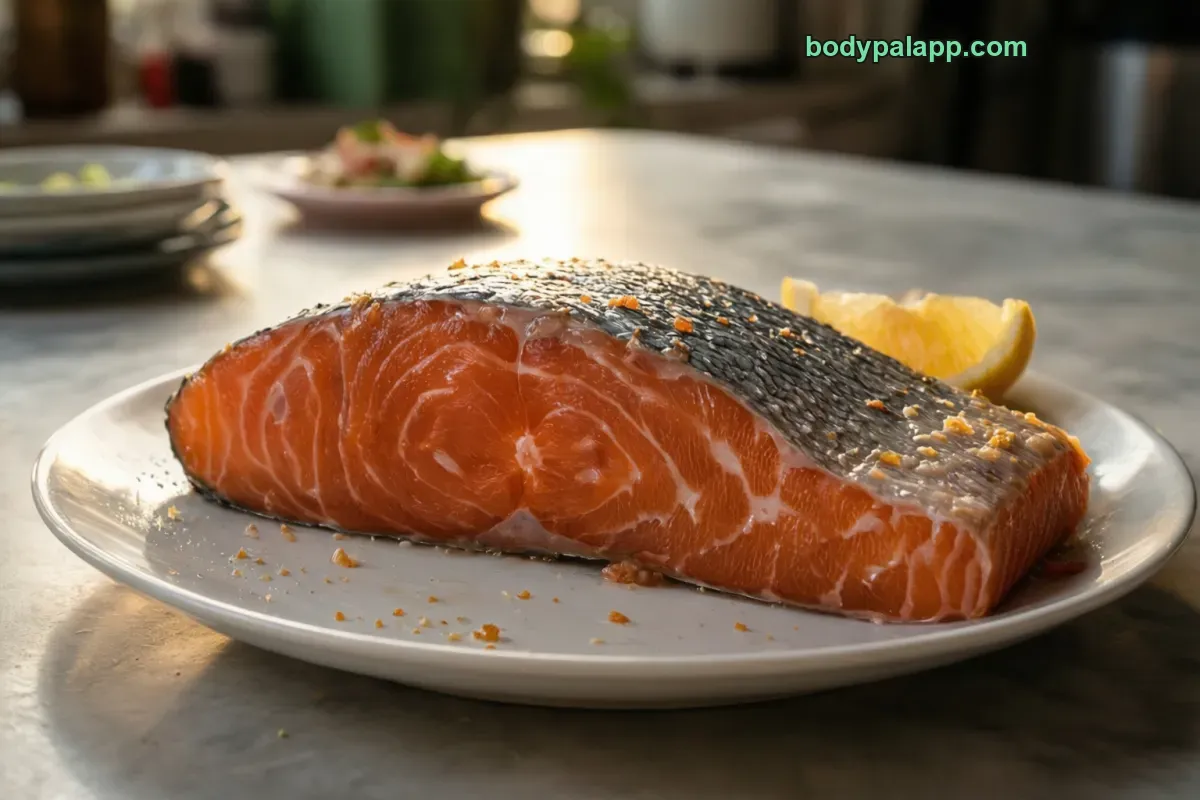
Raw salmon calories come to 354 for a 6 oz fillet (170 g) and 208 per 100 g of farmed Atlantic salmon. Fat supplies 60% of those calories, so the kind of salmon matters: a wild fillet of the same weight lists 241. Protein is the payoff, with 34.7 g in that fillet.
354kcal
1 6 oz fillet · 170 g, Atlantic, farmed, raw
40%protein
35 gProtein
0 gCarbs
23 gFat
How to burn off 354 kcal
—Walking, brisk
—Jogging
—Cycling, moderate
—Swimming
Skip the math. BodyPal counts these calories from your steps and workouts automatically.
Nutrition facts
Atlantic, farmed, raw · per 170 g
Calories
354 kcal
Protein
35 g
Carbohydrate
0 g
Fat
23 g
Saturated fat
5.2 g
Cholesterol
94 mg
Sodium
100 mg
Potassium
617 mg
Iron
0.6 mg
Source: USDA FoodData Central
🛡️
Verified nutrition data
Numbers on this page come from USDA FoodData Central, the U.S. Department of Agriculture’s food composition database, and from manufacturer labels where a branded product is named. Last verified September 2026. How we verify our data →
Raw salmon: calories, protein and sodium by serving
Percent of daily value uses the FDA reference of 2,000 kcal a day.
Serving
kcal
Protein
Carbs
Fat
Sodium
% DV kcal
6 oz fillet (170 g)
354
34.7 g
0 g
22.8 g
100 mg
18%
Wild fillet (170 g)
241
33.7 g
0 g
10.8 g
75 mg
12%
3 oz portion (85 g)
177
17.4 g
0 g
11.4 g
50 mg
9%
100 g
208
20.4 g
0 g
13.4 g
59 mg
10%
3 × 6 oz fillet (170 g)
1,061
104.1 g
301 mg
5 × 6 oz fillet (170 g)
1,768
173.6 g
502 mg
A 6 oz fillet is a 354-calorie main
The default serving here is a 6 oz fillet (170 g), and it carries 354 calories, about 18% of the daily value. That is a full dinner portion of fish before any oil, butter or rice joins the plate. A 3 oz portion (85 g) halves it to 177 calories, which suits a salad topping or a lighter plate.
Totals climb fast once you cook for more than one person or go back for seconds. Two fillets (340 g) add up to 707 calories, three (510 g) reach 1,061, and five (850 g) come to 1,768. If you portion a whole side of salmon by eye, weigh it first, because a fillet that looks like 6 oz can easily run heavier.
Protein scales the same way, and that is the reason most people buy salmon. One 6 oz fillet delivers 34.7 g, or 69% of the daily value. Even the 3 oz portion still gives 17.4 g, enough to anchor a meal on its own.
Fat supplies 60% of the calories
Farmed Atlantic salmon is not a lean fish. Per 100 g it holds 13.4 g of fat and 20.4 g of protein, with 0 g of carbs, sugar or fiber. Because fat carries more calories per gram than protein, the split works out to 60% of calories from fat and 40% from protein.
Saturated fat is a smaller slice: 3.1 g per 100 g, measured against a daily value of 20 g. The bigger number is total fat. A 6 oz fillet brings 22.8 g, against a daily value of 78 g, so the oil or butter in the pan stacks on top of a food that is already fat-rich.
None of this makes salmon a poor choice. It means the calories are dense and come almost entirely from two sources. Portion size, not carbs, decides the total, and the cooking fat decides how far past the base number you go.
Wild salmon is the leaner fillet
The main numbers on this page come from the USDA row for farmed Atlantic salmon, raw. Swap in a wild fillet of the same 170 g and the count drops from 354 to 241 calories. That is 12% of the daily value instead of 18%, a real gap for one piece of fish.
Almost all of that difference is fat. The wild fillet lists 10.8 g of fat against 22.8 g for farmed, while protein barely moves: 33.7 g versus 34.7 g. Sodium is a little lower too, at 75 mg versus 100 mg.
If you buy salmon to hit a protein target on fewer calories, wild is the better pick. If the package does not say which it is, logging it as farmed keeps you from undercounting. The difference matters most for people who eat salmon several times a week.
Low sodium leaves room on the plate
Raw salmon itself is low in sodium: 59 mg per 100 g and 100 mg in a 6 oz fillet, just 4% of the daily value. The salt arrives with what you add. Soy sauce, cures and seasoning blends can outweigh the fish many times over, which is why smoked salmon reads so differently in the table below.
Other rows worth a glance are 55 mg of cholesterol and 363 mg of potassium per 100 g. With 0 g of carbs, salmon pairs naturally with a starch and vegetables to round out a meal. Rice, potatoes or a grain bowl supply the carbs, and greens add volume for few calories.
Because the fish is already rich, lighter dressings keep the plate in check. BodyPal can log the fillet from a photo, which helps on nights when the portion never sees a scale.
How does raw salmon compare?
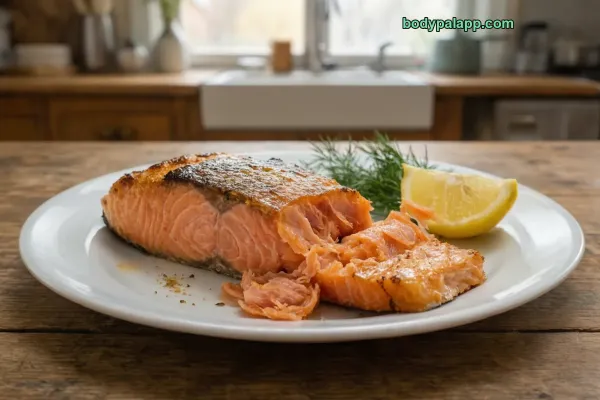
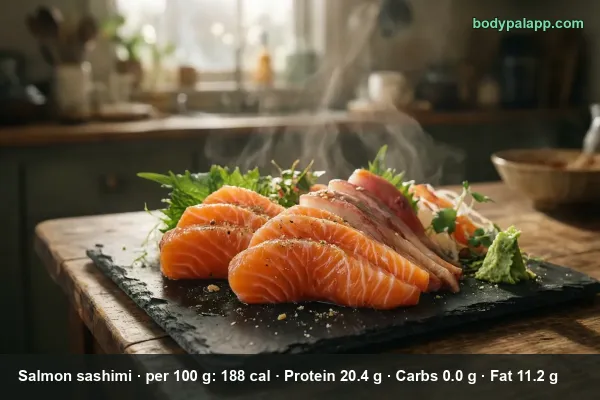
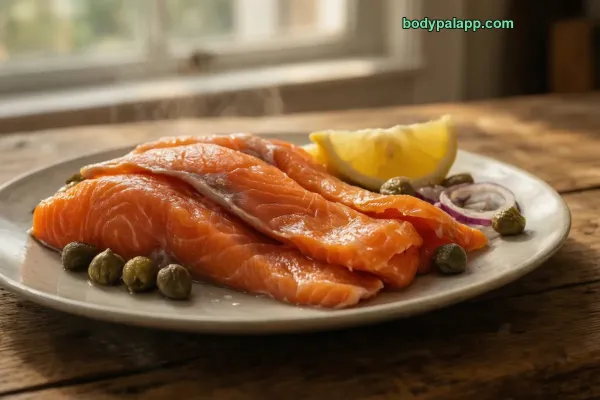
This table sets raw farmed salmon against cooked salmon, salmon sashimi and smoked salmon, per 100 g and per usual serving.
Verdict: For the fewest calories pick smoked salmon at 117 per 100 g, but only if sodium is not a concern, since it carries 672 mg against 59 mg for raw. For protein per calorie, cooked salmon wins with 26.5 g of protein at 156 calories per 100 g, compared with 20.4 g at 208 for raw.
Most popular raw salmon brands in the United States
Ranked by popularity in the BodyPal database
# Productkcal / 100 g
1Foppen Smoked Norwegian Salmon Slices2 oz · 56 g214 kcal
3Foppen Traditional Smoked Norwegian Atlantic Salmon Slices2 oz · 56 g196 kcal
4Blue Hill Bay Smoked Salmon2 oz · 56 g125 kcal
5Trans-Ocean Smoked Salmon2 oz · 57 g123 kcal
6Blue Hill Bay Herb Smoked Salmon2 oz · 56 g125 kcal
Packaged salmon in stores is cured and cold-smoked, so those labels cover salted, smoked fillet rather than plain raw salmon. Source: manufacturer labels / USDA FoodData Central.
Raw salmon FAQs
How many calories are in raw salmon?
Raw farmed Atlantic salmon is 208 calories per 100 g, so a 6 oz fillet (170 g) is 354 calories and a 3 oz portion (85 g) is 177.
Is raw salmon good for weight loss?
A 6 oz fillet is 354 calories with 34.7 g protein and zero carbs. Wild Atlantic salmon is lighter at 142 calories per 100 g against 208 for farmed.
Raw salmon vs salmon sashimi calories?
Salmon sashimi is listed at 188 calories per 100 g, a little under raw farmed Atlantic salmon at 208 per 100 g. Wild raw salmon is lower still at 142.
How much protein is in raw salmon?
Raw salmon has 20.4 g protein per 100 g, so a 6 oz fillet (170 g) carries 34.7 g protein along with 22.8 g fat.
Is raw salmon high in calories?
At 208 calories per 100 g, raw farmed salmon sits on the higher side for fish, mostly because 60% of its calories come from fat. A 6 oz fillet is 354 calories, about 18% of the daily value.
What are the macros in raw salmon?
Per 100 g, raw salmon has 20.4 g of protein, 13.4 g of fat and 0 g of carbs. That works out to 40% of calories from protein and 60% from fat, with 3.1 g of saturated fat.
How many calories are in a whole salmon fillet?
A 6 oz farmed salmon fillet (170 g) has 354 calories. A wild fillet of the same weight comes to 241, and a 3 oz portion (85 g) of farmed salmon is 177.
What are the nutrition facts for raw salmon?
Per 100 g, raw farmed salmon lists 208 calories, 13.4 g of fat, 3.1 g of saturated fat, 20.4 g of protein, 59 mg of sodium, 55 mg of cholesterol and 363 mg of potassium. It has 0 g of carbs, sugar and fiber.
How many calories are in 340 g of raw salmon?
Two 6 oz fillets, 340 g in total, come to 707 calories and 69.4 g of protein. Sodium stays modest at 201 mg, so a bigger portion mainly adds calories and fat.