
How many calories are in salmon sashimi?
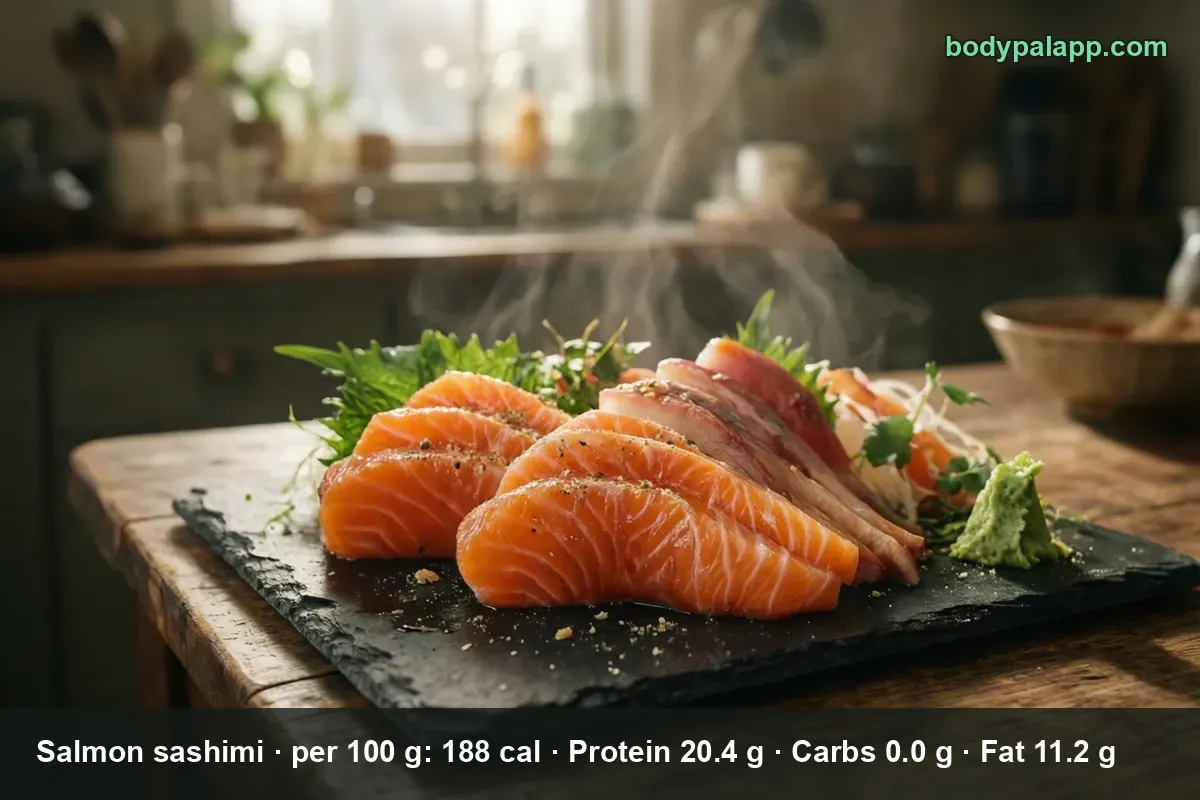
A 3 oz plate of salmon sashimi is 160 calories. Raw salmon runs 188 calories per 100 g, and every one of those calories comes from fat and protein: 11.16 g of fat, 20.44 g of protein, zero carbohydrate. The rice under nigiri is what changes that math, not the fish.
On this page
- Salmon sashimi quick facts
- US servings from one ounce to a full cup
- Raw, grilled, smoked and nigiri
- Protein is the row that matters here
- How does salmon sashimi compare?
- Most popular salmon sashimi brands
- Salmon sashimi FAQs
Salmon sashimi quick facts
Sashimi is raw fish and nothing else, so the record that fits it is the USDA FNDDS entry 2706284, "Fish, salmon, raw" — salmon as eaten, uncooked, with household measures attached. It is not a species-specific line, which is exactly why it works here: the salmon on a sashimi plate can be farmed Atlantic, sockeye or king, and this record sits in the middle of them.
The number checks out against what the industry prints. Wixter Seafood's frozen salmon sashimi lists 188 calories per 100 g, the same figure USDA publishes, with 211 calories on its 4 oz (112 g) label serving. Genji, the grocery-counter sushi brand, runs a little leaner at 159 per 100 g and 205 on its 4.6 oz (129 g) tray.
| Nutrient | Per 100 g | Per 3 oz (85 g) | % Daily Value |
|---|---|---|---|
| Calories | 188 | 160 | — |
| Total fat | 11.16 g | 9.5 g | 12% |
| Saturated fat | 2.49 g | 2.1 g | 11% |
| Carbohydrate | 0 g | 0 g | 0% |
| Dietary fiber | 0 g | 0 g | 0% |
| Total sugars | 0 g | 0 g | — |
| Protein | 20.44 g | 17.4 g | 35% |
| Sodium | 63 mg | 54 mg | 2% |
| Cholesterol | 53 mg | 45 mg | 15% |
| Potassium | 364 mg | 309 mg | 7% |
% Daily Value is based on a 2,000-calorie diet.
Verified nutrition data
Numbers on this page come from USDA FoodData Central, the U.S. Department of Agriculture’s food composition database, and from manufacturer labels where a branded product is named. Last verified September 2026. How we verify our data →
Two rows you would see on a packaged label are missing above: added sugars and trans fat. USDA does not publish either value for raw salmon in this record, and no one adds sugar to a slice of raw fish anyway. Percent Daily Values follow the FDA reference amounts printed on US packages.
US servings from one ounce to a full cup
| Serving | Weight | Calories |
|---|---|---|
| 1 oz | 28 g | 53 kcal |
| 3 oz, restaurant plate | 85 g | 160 kcal |
| 4 oz, retail tray | 113 g | 212 kcal |
| 1 cup, sliced | 135 g | 254 kcal |
| Per 100 g | 100 g | 188 kcal |
The 3 oz plate, the cup and the 100 g line are USDA household measures. The 1 oz and 4 oz rows are our own arithmetic from the USDA 100 g figure, not USDA servings, which is why they land on clean multiples: raw salmon works out to 1.88 calories per gram.
That cup row is the trap. A USDA cup of sliced raw salmon weighs 135 g and carries 254 calories, 59% more than the 3 oz portion most people picture when they say "a serving of sashimi." Sashimi is dense, wet and heavy for its volume, so it fills a cup fast. If you are logging by eye rather than by scale, a plate that looks like a modest starter is closer to 4 oz than to 3.
USDA also publishes no weight for a single slice, and no two sushi bars cut the same. Six pieces from a neighborhood spot and six pieces from a hotel omakase can differ by 40 g. Weighing the plate once, then reusing that number, beats counting pieces every time.
Raw, grilled, smoked and nigiri
| Version | Per 100 g | Typical piece | Calories |
|---|---|---|---|
| Salmon sashimi, raw | 188 kcal | 3 oz (85 g) | 160 kcal |
| Sockeye salmon, raw | 131 kcal | 3 oz (85 g) | 111 kcal |
| Atlantic salmon, farmed, raw | 208 kcal | 3 oz (85 g) | 177 kcal |
| Grilled salmon | 259 kcal | 3 oz (85 g) | 220 kcal |
| Baked or broiled salmon | 274 kcal | 3 oz (85 g) | 233 kcal |
| Smoked salmon, lox style | 117 kcal | 3 oz (85 g) | 99 kcal |
| Salmon nigiri sushi | 107 kcal | 3 oz (85 g) | 91 kcal |
Raw versus cooked is the split that costs people the most calories, and it works backwards from what you would guess. Cooking adds nothing to salmon, but it drives off water, so the same 100 g of fish shrinks and what is left is more concentrated. Raw salmon is 188 per 100 g; grilled is 259; baked or broiled is 274. On a 3 oz portion that is 160 raw against 220 grilled and 233 baked. Order the sashimi and you are eating the same fish minus about 60 calories per plate.
Species matters almost as much. Sockeye, the deep-red fish that shows up on plenty of US sashimi menus, is the leanest of the common cuts at 131 calories per 100 g and 4.69 g of fat. Farmed Atlantic, the pale-orange standard at most sushi counters, is 208 with 13.42 g of fat. That is 59% more calories per 100 g for the farmed fish, or 66 calories on a 3 oz plate, from nothing but the species on the board.
Two things at the sushi counter look like sashimi and are not. Salmon nigiri, at 107 calories per 100 g, is the lightest line here, because the rice under the fish is bulk without much fat. And smoked salmon at 117 per 100 g looks like a bargain until you read the sodium row.
Protein is the row that matters here
A 3 oz plate of sashimi hands you 17.4 g of protein for 160 calories, 35% of the Daily Value from a starter-sized portion. A full cup pushes that to 27.6 g. There is no carbohydrate and no fiber anywhere on the plate, so on a food-logging app the entire entry is fat and protein.
The sodium contrast is the sharper find. Raw salmon carries 54 mg of sodium in a 3 oz serving, 2% of the Daily Value, less than a twentieth of a teaspoon of table salt. Take the same 3 oz as smoked salmon and it becomes 571 mg — our own arithmetic from the USDA figure of 672 mg per 100 g — or 25% of a day's sodium from one small pile of fish. Soy sauce then piles more on top of whichever you chose. If you are watching sodium, sashimi with a light dip is the better pick by a wide margin.
The federal Dietary Guidelines put seafood at about 8 oz a week for adults. Meeting that entirely with raw salmon would come to roughly 427 calories across the whole week, our own arithmetic from the 188 per 100 g figure. Very few protein sources cost that little for that much. Raw fish does carry handling risk that cooked fish does not, and the FDA's advice about eating fish covers who should be careful with it.
How does salmon sashimi compare?
| Salmon dish | Per 100 g | US serving | Calories |
|---|---|---|---|
| Salmon sashimi, raw | 188 kcal | 3 oz (85 g) | 160 kcal |
| Grilled salmon | 259 kcal | 3 oz (85 g) | 220 kcal |
| Smoked salmon | 117 kcal | 3 oz (85 g) | 99 kcal |
| Salmon nigiri sushi | 107 kcal | 3 oz (85 g) | 91 kcal |
Our take: only grilled salmon is denser than raw sashimi in this table, and it beats it by 60 calories on the same 3 oz. For weight control at a sushi restaurant, sashimi is the pick — the calories all buy protein and fat, and the plate has no rice, no mayo and no tempura hiding in it. For sheer fullness per calorie, nigiri wins on paper at 91 calories per 3 oz, but that number is mostly rice: 11.4 g of carbohydrate and only 7.6 g of protein in the same 85 g, so you will eat more pieces to feel done. Smoked salmon is the one to think twice about, not for its 99 calories but for the 571 mg of sodium that comes with them.
Most popular salmon sashimi brands in the United States
Ranked by how widely each product appears among foods sold in the United States, from the BodyPal food database of over 3.3 million products. Calories are the figures printed on each Nutrition Facts label, checked against USDA FoodData Central.
| Product | Calories (per 100 g) |
|---|---|
| Wixter Seafood Salmon Sashimi | 188 cal |
| Genji Salmon Sashimi | 159 cal |
Brand popularity: BodyPal food database. Nutrition: manufacturer labels / USDA FoodData Central.
Salmon sashimi FAQs
How many calories are in salmon sashimi?
A 3 oz (85 g) serving of salmon sashimi carries 160 calories, and 100 g of raw salmon runs 188. That figure comes from the USDA FNDDS record for raw salmon, the same 188 per 100 g printed on the Wixter Seafood sashimi label. Carbohydrate is zero.
How many calories in 6 pieces of salmon sashimi?
Raw salmon runs 1.88 calories per gram, so a 6-piece plate weighing 85 g is 160 calories and a 135 g plate is 254. USDA does not publish a weight for one slice, so weigh the plate or ask; cuts vary widely between restaurants.
Is salmon sashimi lower in calories than cooked salmon?
Yes, and by a wide margin: three ounces of raw salmon is 160 calories against 220 for the same weight grilled and 233 baked. Cooking drives off water, so the fish shrinks and the calories concentrate: 188 per 100 g raw becomes 259 grilled. Nothing is added; the portion just gets denser.
How much protein is in salmon sashimi?
A 3 oz (85 g) serving delivers 17.4 g of protein, 35% of the Daily Value, and a full cup (135 g) gives 27.6 g. Per 100 g raw salmon holds 20.44 g. That is one of the highest protein-to-calorie ratios on a sushi menu, since the fish carries no carbohydrate.
Salmon sashimi vs salmon nigiri calories?
Nigiri is lighter by weight: sushi topped with salmon is 107 calories per 100 g against 188 for plain sashimi, so 85 g of nigiri is 91 calories versus 160. The rice dilutes the fish rather than replacing it, and it brings 11.4 g of carbohydrate to that same 85 g.
Does salmon sashimi have carbs?
Zero grams: USDA lists 0 g of carbohydrate, 0 g of fiber and 0 g of total sugars in raw salmon, at 100 g and at every serving size. Carbs only appear when rice, sauce or tempura crumbs join the plate: salmon nigiri brings 13.39 g per 100 g.
Is salmon sashimi high in sodium?
No: 54 mg in a 3 oz serving, just 2% of the 2,300 mg Daily Value and less than a twentieth of a teaspoon of table salt. Smoked salmon is the opposite at 672 mg per 100 g, so 3 oz carries 571 mg, 25% of the day from one small pile.
Is salmon sashimi good for weight loss?
At 160 calories and 17.4 g of protein per 3 oz, sashimi is one of the more filling ways to spend 160 calories, with no carbohydrate and no breading. Watch what travels with it: rice, spicy mayo and tempura add more than the fish does. Grilled salmon runs 220 for the same 3 oz.
Similar foods
- Salmon Sashimi — 160 cal for 3 oz
- Tuna Salad — 462 cal per cup
- Shrimp Salad — 357 cal per cup
- Imitation Crab Salad — 410 cal per cup
- Tuna In Oil — 339 cal per can
- Fried Herring — 290 cal per fillet
Count it without the math
Point the camera at the plate and BodyPal counts the sashimi for you, slice by slice.


How long does it take to burn off salmon sashimi?
A 3 oz (85 g) serving is 160 kcal. Enter your weight and the amount you ate to see how long it takes you to burn that off:
lb
| Activity | Time to burn 160 kcal |
|---|---|
| Walking, brisk | 32 min |
| Cycling, moderate | 20 min |
| Swimming, moderate | 23 min |
| Jogging | 19 min |
| Weight training, moderate | 36 min |
Times are for a 155 lb adult at a steady pace; change the weight to see yours. The amount is set to the portion in the text (85 g); change it to what you actually ate. BodyPal works this out from your steps automatically.
This table assumes you know your daily total. If you do not, the daily calorie calculator works it out from five numbers.