
How many calories are in salmon sashimi?
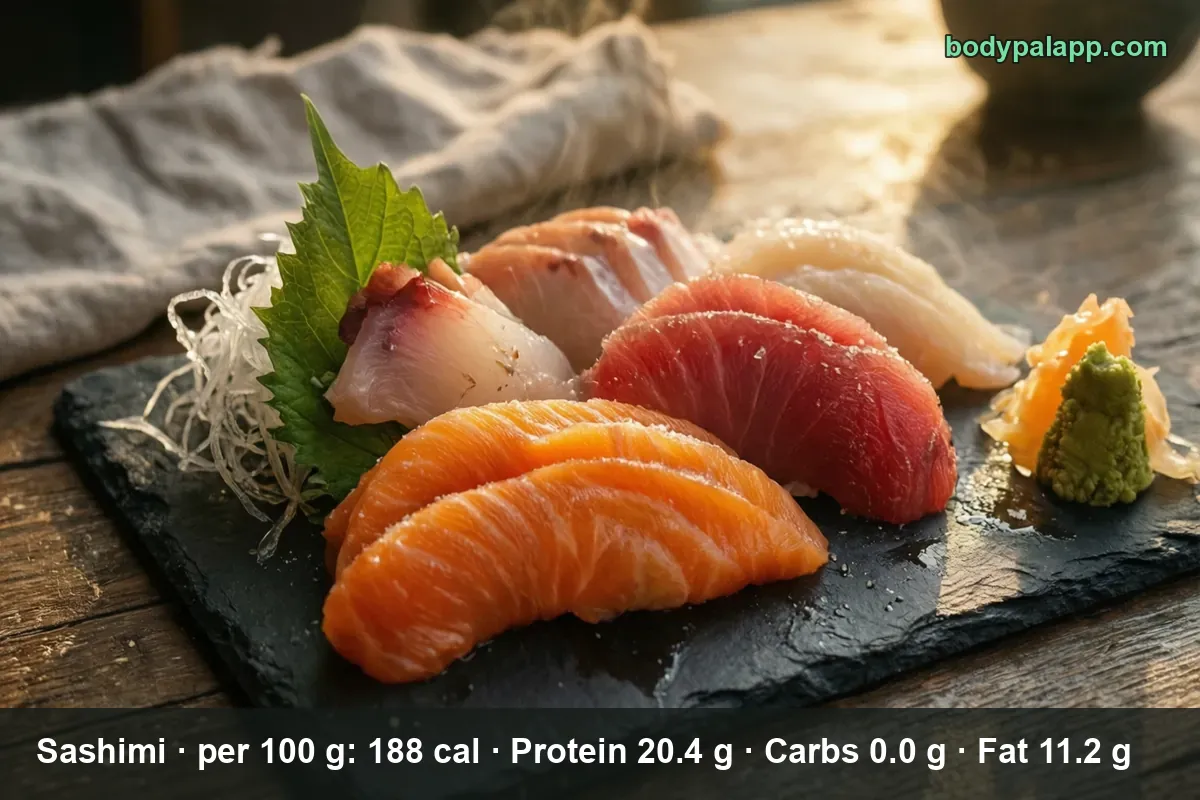
A 3 oz (85 g) sashimi order cut from salmon carries 160 calories, and raw salmon runs 188 calories per 100 g. Nothing else is on the plate: no rice, no batter, no sauce until you add it. That 160 is 17.4 g of protein and 9.5 g of fat, and zero carbohydrate.
On this page
- Salmon sashimi quick facts
- US servings, from 1 ounce to a cup of slices
- Tuna, sockeye and toro on the same plate
- Farmed or wild is a 66-calorie question
- The soy sauce out-salts the fish 16 to 1
- How does sashimi compare?
- Most popular sashimi brands
- FAQ
Salmon sashimi quick facts
Sashimi is fish and only fish: a fillet sliced raw, served without rice and without a sauce built into the portion. The USDA record that matches that plate is FNDDS 2706284, "Fish, salmon, raw", the survey line for unspecified raw salmon. Salmon is what most people are counting here, since "calories in salmon sashimi" is searched more than the generic term.
The Branded records filed under "sushi" or "sashimi" were skipped on purpose. Those are packaged trays, and their numbers fold in rice, garnish and dressing, so a 100 g figure from one of them describes a lunch box rather than the fish.
| Nutrient | Per 100 g | Per 3 oz (85 g) | % Daily Value |
|---|---|---|---|
| Calories | 188 | 160 | — |
| Total fat | 11.16 g | 9.5 g | 12% |
| Saturated fat | 2.49 g | 2.1 g | 11% |
| Carbohydrate | 0 g | 0 g | 0% |
| Dietary fiber | 0 g | 0 g | 0% |
| Total sugars | 0 g | 0 g | — |
| Protein | 20.44 g | 17.4 g | 35% |
| Sodium | 63 mg | 54 mg | 2% |
| Cholesterol | 53 mg | 45 mg | 15% |
| Potassium | 364 mg | 309 mg | 7% |
% Daily Value is based on a 2,000-calorie diet.
Verified nutrition data
Numbers on this page come from USDA FoodData Central, the U.S. Department of Agriculture’s food composition database, and from manufacturer labels where a branded product is named. Last verified September 2026. How we verify our data →
Two rows you would see on a package label are missing here. USDA does not publish added sugars or trans fat for this record, which is the expected result for a raw fillet: nothing is added to it and nothing is hydrogenated in it. Daily Value percentages follow the FDA reference amounts for a 2,000-calorie day.
The row worth staring at is protein. One 3 oz order covers 35% of the day's 50 g reference, which is a lot of the label for 160 calories, and it does it without a gram of carbohydrate.
US servings, from 1 ounce to a cup of slices
A restaurant order is usually described in pieces, but pieces are not a weight. Ounces are, and 3 oz is the size most sashimi orders land near.
| Serving | Weight | Calories |
|---|---|---|
| 1 oz | 28 g | 53 kcal |
| 3 oz, typical sashimi order | 85 g | 160 kcal |
| 4 oz | 113 g | 212 kcal |
| 1 cup, sliced | 135 g | 254 kcal |
| Per 100 g | 100 g | 188 kcal |
The 3 oz plate and the 1 cup of sliced fish come straight from the USDA record's household measures. The 1 oz and 4 oz lines are our own arithmetic from the USDA 100 g figure, not USDA servings, which is fine for a food this uniform: raw fish has no crust, no filling and no air pocket, so calories scale off weight almost perfectly.
That is also the safest way to handle a piece count. If a six-piece order weighs about 90 g, it is near 169 calories, again our own scaling rather than a published serving. Cut the slices thicker and the number climbs with the grams, not with the count.
Tuna, sockeye and toro on the same plate
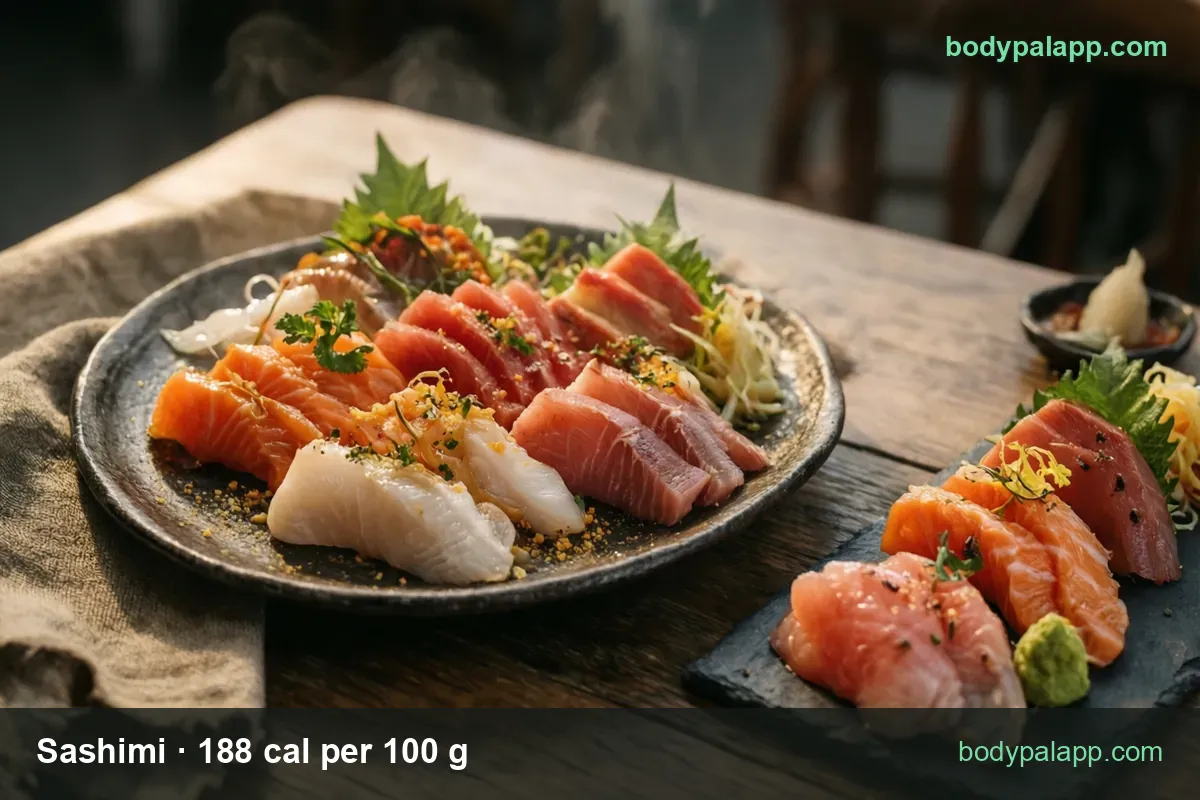
Order a mixed plate and you are eating three or four different calorie densities. Fat is the only thing that moves, since every one of these fish is 0 g carbohydrate.
| Version | Per 100 g | Typical piece | Calories |
|---|---|---|---|
| Salmon sashimi, the main record | 188 kcal | 3 oz (85 g) | 160 kcal |
| Tuna (maguro) sashimi | 109 kcal | 3 oz (85 g) | 93 kcal |
| Farmed Atlantic salmon sashimi | 208 kcal | 3 oz (85 g) | 177 kcal |
| Wild Atlantic salmon sashimi | 142 kcal | 3 oz (85 g) | 121 kcal |
| Sockeye salmon sashimi | 131 kcal | 3 oz (85 g) | 111 kcal |
| Bluefin (toro-grade) tuna sashimi | 144 kcal | 3 oz (85 g) | 122 kcal |
| Smoked salmon, not raw | 117 kcal | 3 oz (85 g) | 99 kcal |
Lean yellowfin tuna is the lightest thing on the board at 93 calories for 3 oz, and bluefin, the fish the toro cuts come from, sits at 122 for the same weight. Sockeye behaves like a lean salmon rather than a rich one.
One of these rows is not raw fish at all. Smoked salmon shows up on plenty of "sashimi style" trays, and while its 99 calories per 3 oz look friendly, it is cured, not raw. Packaged sashimi trays sold in US grocery stores land between 100 and 188 calories per 100 g depending on how much salmon versus tuna is in the box, which is exactly the spread you would predict from the table above.
Farmed or wild is a 66-calorie question
Here is the split almost nobody prices out. Farmed Atlantic salmon is 208 calories per 100 g. Wild Atlantic salmon is 142. Same species, same menu word, 66 calories apart per 100 g, or 177 against 121 on a 3 oz plate.
Fat explains all of it: 13.42 g per 100 g in the farmed fish against 6.34 g in the wild one, and saturated fat runs 3.05 g against 0.98 g. American sashimi is overwhelmingly farmed, so if you are logging a restaurant order and want one number, the higher end of that range is the honest guess.
The main record we use, 188 per 100 g, sits between the two. That is the point of an unspecified survey line: it averages what people actually eat rather than picking a side.
The soy sauce out-salts the fish 16 to 1
Raw salmon is barely salted at all: 63 mg of sodium per 100 g, or 54 mg in a 3 oz order, which is 2% of the Daily Value. Then the dish arrives with a dish of soy sauce.
One tablespoon (18 g) of soy sauce for sashimi carries 870 mg of sodium, 38% of the day's 2,300 mg limit. That single dip brings about sixteen times the sodium of the fish it is seasoning, and most people use more than one tablespoon across a plate. If sodium is what you are managing, the sauce is the lever, not the salmon. Diluting the soy sauce with a squeeze of citrus, or dipping the edge of the slice instead of soaking it, changes the sodium math far more than switching fish does. Federal Dietary Guidelines put sodium among the nutrients most Americans overshoot, and this is a textbook example of where it hides.
How does sashimi compare?
| Fish | Per 100 g | US serving | Calories |
|---|---|---|---|
| Salmon sashimi | 188 kcal | 3 oz, 85 g | 160 kcal |
| Sockeye salmon | 131 kcal | 3 oz, 85 g | 111 kcal |
| Smoked salmon | 117 kcal | 3 oz, 85 g | 99 kcal |
| Yellowfin tuna | 109 kcal | 3 oz, 85 g | 93 kcal |
Our take: salmon is the richest of these four per 100 g and yellowfin the leanest, and the whole 79-calorie gap between them is fat. If you are cutting calories, order the tuna: 93 calories for 3 oz with 24.4 g of protein per 100 g, which is more protein than the salmon carries, is close to the best protein-per-calorie deal in a restaurant. If you want the plate to hold you for hours, salmon's fat is the reason it does, and 160 calories is a cheap price for that. A mixed order of both is the sensible default, and it is also why protein foods guidance puts seafood in its own recommended slot.
Most popular sashimi brands in the United States
Ranked by how widely each product appears among foods sold in the United States, from the BodyPal food database of over 3.3 million products. Calories are the figures printed on each Nutrition Facts label, checked against USDA FoodData Central.
| Product | Calories (per 100 g) |
|---|---|
| Yummi Sushi Sashimi (Salmon) | 100 cal |
| Yummi Sushi Tuna and Salmon Sashimi | 138 cal |
| Yummi Sushi Sashimi | 102 cal |
| Sushi Sara Raw Sashimi | 129 cal |
| Wixter Seafood Salmon Sashimi | 188 cal |
| Genji Salmon Sashimi | 159 cal |
Brand popularity: BodyPal food database. Nutrition: manufacturer labels / USDA FoodData Central.
Sashimi FAQs
How many calories are in salmon sashimi?
A standard 3 oz (85 g) sashimi order made from salmon is 160 calories, based on raw salmon at 188 calories per 100 g. That order also carries 17.4 g of protein, 9.5 g of fat and no carbohydrate at all, which is why sashimi lands so much lighter than a comparable plate of nigiri.
How many calories in one piece of sashimi?
About 28 calories for a slice near 15 g, which is our own arithmetic from the USDA figure of 188 calories per 100 g, not a USDA serving. Slice thickness is the whole story here, since the calories scale straight off the weight of the fish. If you can weigh the plate, count grams rather than pieces.
How many calories in a 6-piece sashimi order?
A six-piece salmon order weighing about 90 g comes to roughly 169 calories, our own arithmetic from the USDA 188 per 100 g rather than a USDA serving. Order the same six pieces in tuna and you are near 98 calories instead. Six pieces is not a fixed weight, so treat it as a range.
Tuna sashimi vs salmon sashimi: which has fewer calories?
Tuna wins on calories: 93 for a 3 oz (85 g) order against 160 for salmon. The gap is fat, not protein. Yellowfin carries 0.49 g of fat per 100 g against 11.16 g in salmon, while protein actually runs higher in tuna, 24.4 g per 100 g against 20.44 g.
How much protein is in sashimi?
A 3 oz (85 g) salmon order gives 17.4 g of protein, 35% of the FDA Daily Value of 50 g. Tuna sashimi does better at 20.7 g for the same 3 oz, about 41% DV, both of which are our arithmetic from the USDA per-100-g protein figures. Very few 160-calorie plates do that.
Does sashimi have carbs?
Zero: raw salmon carries 0 g of carbohydrate, 0 g of fiber and 0 g of total sugars per 100 g, so a 3 oz order of plain sashimi contributes nothing to a carb count. Everything changes the moment rice, ponzu or a sweet eel glaze joins the plate.
How much sodium does sashimi have with soy sauce?
The fish brings 54 mg of sodium in a 3 oz (85 g) order, only 2% of the Daily Value. One tablespoon (18 g) of soy sauce adds 870 mg, or 38% DV, so the dip carries roughly sixteen times the sodium of the sashimi it is meant to season.
Is sashimi good for weight loss?
A 160-calorie plate with 17.4 g of protein and no carbohydrate is a strong pick if you are watching calories, and tuna sashimi at 93 per 3 oz is stronger still. The catch is what comes alongside: rice, tempura garnish and a sweet sauce can outweigh the fish on the same plate.
Similar foods
- Salmon Sashimi — 160 cal for 3 oz
- Tuna Salad — 462 cal per cup
- Shrimp Salad — 357 cal per cup
- Imitation Crab Salad — 410 cal per cup
- Tuna In Oil — 339 cal per can
- Fried Herring — 290 cal per fillet
Count it without the math
Point the camera at the plate and BodyPal counts the slices for you, salmon and tuna apart.


How long does it take to burn off salmon sashimi?
A 3 oz (85 g) serving is 160 kcal. Enter your weight and the amount you ate to see how long it takes you to burn that off:
lb
| Activity | Time to burn 160 kcal |
|---|---|
| Walking, brisk | 32 min |
| Cycling, moderate | 20 min |
| Swimming, moderate | 23 min |
| Jogging | 19 min |
| Weight training, moderate | 36 min |
Times are for a 155 lb adult at a steady pace; change the weight to see yours. The amount is set to the portion in the text (85 g); change it to what you actually ate. BodyPal works this out from your steps automatically.
Want the bigger picture? Calculate your daily calorie needs — your maintenance figure, a target for losing or gaining, and the date you get there.