
How many calories are in tuna salad?
A deli cup of tuna salad, 238 g of flaked tuna bound with mayonnaise, carries 462 calories. Per 100 g the same mix runs 194 calories. The dressing does most of that work: the fish brings 24.0 g of protein to the cup, and the mayonnaise brings 37.7 g of fat.
On this page
- Tuna salad quick facts
- US servings from one ounce to a full cup
- Light mayo creamy dressing and fat-free versions
- Tuna salad with egg cheese or the older USDA recipe
- Sodium runs the other way from the fat
- How does tuna salad compare?
- Most popular tuna salad brands
- Tuna salad FAQs
Tuna salad quick facts
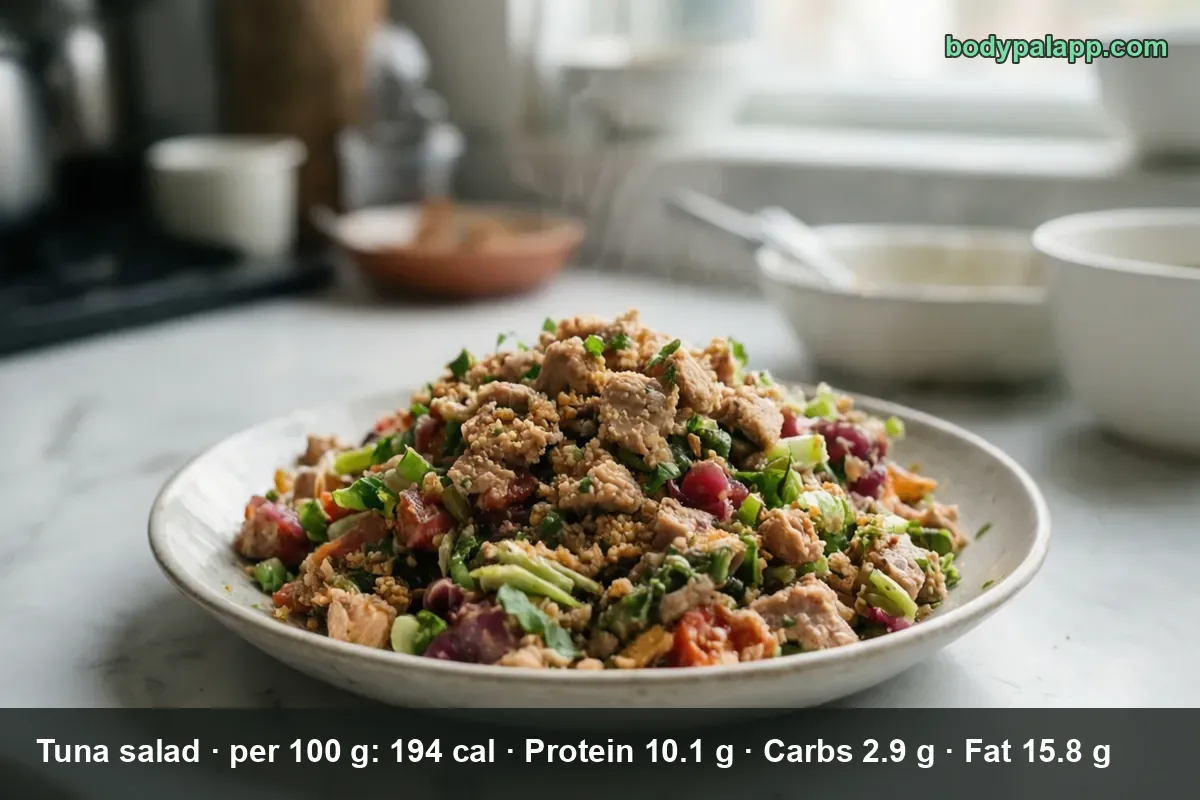
The record behind this page is FNDDS 2706828, "Tuna salad, made with mayonnaise", from the 2021–2023 survey release. That is the one an American actually has in hand: the scoop from the supermarket deli case, the tub in the refrigerator door, the filling in a lunch sandwich. Tuna flaked onto greens with a squeeze of lemon is a different food with a different number, and the photo above shows that leaner style, not the mayonnaise-bound mix the calories describe.
USDA gives this record a household measure of 1 cup, 238 g. That is a big serving by the standard of a sandwich, and a fair one by the standard of a deli container.
| Nutrient | Per 100 g | Per 1 cup (238 g) | % Daily Value |
|---|---|---|---|
| Calories | 194 | 462 | — |
| Total fat | 15.84 g | 37.7 g | 48% |
| Saturated fat | 2.52 g | 6.0 g | 30% |
| Carbohydrate | 2.89 g | 6.9 g | 3% |
| Dietary fiber | 0.4 g | 1.0 g | 3% |
| Total sugars | 2.07 g | 4.9 g | — |
| Protein | 10.07 g | 24.0 g | 48% |
| Sodium | 418 mg | 995 mg | 43% |
% Daily Value is based on a 2,000-calorie diet.
Verified nutrition data
Numbers on this page come from USDA FoodData Central, the U.S. Department of Agriculture’s food composition database, and from manufacturer labels where a branded product is named. Last verified September 2026. How we verify our data →
Two label rows are missing on purpose. Added sugars and trans fat are not published for this record in the FNDDS release, so listing them would mean inventing them. Cholesterol and potassium are published: 27 mg and 155 mg per 100 g, which works out to 64 mg of cholesterol (21% DV) and 369 mg of potassium (8% DV) in a cup. Daily Values come from the FDA Nutrition Facts label.
US servings from one ounce to a full cup
| Serving | Weight | Calories |
|---|---|---|
| 1 oz on a cracker | 28 g | 55 kcal |
| 3 oz deli scoop | 85 g | 165 kcal |
| 4 oz sandwich fill | 113 g | 219 kcal |
| 1/2 cup | 119 g | 231 kcal |
| 1 cup, USDA household measure | 238 g | 462 kcal |
| Per 100 g | 100 g | 194 kcal |
Only the 1-cup line is a USDA serving. The ounce, scoop, half-cup and 4 oz rows are our own arithmetic from the USDA 100 g figure, not USDA servings, scaled straight off 194 calories per 100 g.
This is where the cup-versus-ounce trap sits. A cup sounds like a portion size and an ounce sounds like a portion size, but they are eight times apart. Spread 1 oz on a cracker and you have logged 55 calories. Scoop the same salad into a bowl with a serving spoon and you are closer to 462. Most people who guess wrong on tuna salad guess wrong on volume, never on the fish.
The practical middle is the 3 oz scoop at 165 calories, which is roughly what a deli hand scoop drops onto a roll, or the half cup at 231, which is what most retail tubs print on the back.
Light mayo creamy dressing and fat-free versions
Change nothing about the amount you eat and change only the jar you reach for, and the number moves more than any other decision on this page.
| Version | Per 100 g | Serving | Calories |
|---|---|---|---|
| Made with mayonnaise | 194 kcal | 1 cup (238 g) | 462 kcal |
| Made with light mayonnaise | 106 kcal | 1 cup (238 g) | 252 kcal |
| Made with creamy dressing | 148 kcal | 1 cup (238 g) | 352 kcal |
| Made with fat-free dressing | 72 kcal | 1 cup (238 g) | 171 kcal |
Light mayonnaise takes the cup from 462 to 252 calories. That is a 210-calorie cut with the same fish, the same celery and the same size bowl, because the fat falls from 15.84 g to 5.4 g per 100 g. Creamy dressing lands in between at 352. Fat-free dressing takes it all the way down to 171 calories a cup, which is a whole different food to eat: the protein stays near 9.6 g per 100 g, but so little fat is left that the salad tastes closer to dressed fish than to a spread.
Retail tubs sit all over that range too. USDA's branded records list a Bumble Bee tuna salad at 80 calories per 100 g and an Archer Farms tuna salad at 390 calories per 100 g, nearly a fivefold gap between two products with the same three words on the lid. Read the panel on the tub you actually bought before you trust any generic figure, including this one.
Tuna salad with egg cheese or the older USDA recipe
| Version | Per 100 g | Serving | Calories |
|---|---|---|---|
| With egg | 190 kcal | 1 cup (238 g) | 452 kcal |
| With cheese | 214 kcal | 1 cup (238 g) | 509 kcal |
| SR Legacy tuna salad | 187 kcal | 1 oz (28 g) | 53 kcal |
Chopped egg is close to free here. It adds protein, 10.28 g per 100 g against 10.07 g, and takes the cup down slightly to 452 calories, because egg is less energy-dense than the mayonnaise it displaces. Cheese goes the other way: 509 calories a cup, and the saturated fat climbs to 4.11 g per 100 g, well above the 2.52 g in the plain version.
The SR Legacy record is worth knowing about because it is the number a lot of older calorie apps still carry. It describes a leaner formula, 187 calories per 100 g with 16.04 g of protein and only 9.26 g of fat, which is a recipe with far less dressing than the modern survey version. Same food name, different kitchen. This page uses the current FNDDS record because it reflects how tuna salad is actually made in US households today.
Sodium runs the other way from the fat
Here is the part almost nobody flags. When you cut the fat, the sodium does not follow it down. The classic mayonnaise version carries 418 mg of sodium per 100 g. The light mayonnaise version carries 464 mg, the creamy dressing version 460 mg, and the fat-free dressing version 460 mg. The three lighter dressings are all saltier per gram than the classic one.
At full size that matters. A 1-cup serving of the classic mix is 995 mg of sodium, 43% of the Daily Value, or a bit under half a teaspoon of table salt in one bowl of lunch. If you are watching sodium, the lever is the serving size, not the dressing: the half cup at 231 calories brings about 497 mg instead.
The protein side is the good news. That same cup delivers 24.0 g of protein, 48% of the Daily Value, which is why tuna salad holds up as a lunch that keeps you full to dinner. Canned tuna also counts toward the seafood recommendation in the Dietary Guidelines for Americans, and it sits in the protein foods group on MyPlate. The fish is doing fine. The jar is what you are budgeting for.
How does tuna salad compare?
| Deli salad | Per 100 g | US serving | Calories |
|---|---|---|---|
| Tuna salad | 194 kcal | 1 cup (238 g) | 462 kcal |
| Seafood salad | 190 kcal | 1 oz (28 g) | 54 kcal |
| Crab salad | 188 kcal | 1 oz (28 g) | 53 kcal |
| Shrimp salad | 196 kcal | 1 oz (28 g) | 56 kcal |
Our take: all four of these are the same food with a different animal in it, and the spread across them is eight calories per 100 g. Crab salad is the lightest of the four and shrimp salad the heaviest, but nobody is going to feel a 4% difference. Tuna beats crab salad on the row that actually matters for lunch, protein, at 10.07 g per 100 g against 9.4 g, and trails shrimp salad at 10.68 g. Pick by taste and by price, then spend your attention on how much of it lands in the bowl.
Most popular tuna salad brands in the United States
Ranked by how widely each product appears among foods sold in the United States, from the BodyPal food database of over 3.3 million products. Calories are the figures printed on each Nutrition Facts label, checked against USDA FoodData Central.
| Product | Calories (per 100 g) |
|---|---|
| Bumble Bee Tuna Salad | 80 cal |
| Market 32 Tuna Salad | 276 cal |
| Farm Ridge Foods Tuna Salad | 150 cal |
| Fresh Foods Market Tuna Salad | 195 cal |
| Archer Farms Tuna Salad | 390 cal |
Brand popularity: BodyPal food database. Nutrition: manufacturer labels / USDA FoodData Central.
Tuna salad FAQs
How many calories are in 1 cup of tuna salad?
462 calories in a 1-cup serving, which USDA weighs at 238 g. That cup also brings 24.0 g of protein, 37.7 g of fat and 995 mg of sodium. It is a full lunch on its own, not a side, so treat it as the main event on the plate.
How many calories in a scoop of deli tuna salad?
About 165 calories for a 3 oz scoop, or 231 for a half cup at 119 g. Both are our own arithmetic from the USDA figure of 194 calories per 100 g, not USDA servings. Deli scoops vary, so weigh yours once and you will know your number for good.
How much protein is in tuna salad?
24.0 g of protein in a 1-cup serving, which is 48% of the Daily Value, and 10.07 g per 100 g. A 3 oz deli scoop gives you about 8.6 g. That protein per calorie ratio is the best argument for tuna salad, and it barely changes when you switch dressings.
How many calories does light mayo save in tuna salad?
210 calories per cup. The mayonnaise version is 462 calories for 238 g, and the light mayonnaise version is 252 for exactly the same weight. Per 100 g that is 194 against 106. It is the single biggest change you can make without eating any less salad.
How much sodium is in tuna salad?
995 mg in a 1-cup serving, 43% of the Daily Value, from 418 mg per 100 g. A half cup is roughly 497 mg. Oddly, the lighter dressings are saltier per gram: the light mayonnaise version carries 464 mg per 100 g, more than the full-fat one.
Does tuna salad have carbs?
Barely: 6.9 g of carbohydrate in a 1-cup serving, or 2.89 g per 100 g, which is 3% of the Daily Value. Sugars account for 4.9 g of that cup, mostly from the dressing and any sweet relish. The bread, the crackers or the roll is where the carbs actually arrive.
Is tuna salad good for weight loss?
Yes, if you control two things. A half cup at 231 calories delivers about 12 g of protein and fits inside a 350 to 450 calorie lunch with greens. Made with fat-free dressing, a full cup is only 171 calories. A full cup of the classic mix, at 462, does not fit as easily.
How many calories in a tuna salad sandwich?
USDA lists a tuna salad sandwich on white bread at 218 calories per 100 g, with 18.33 g of carbohydrate. The record does not publish a weight for a whole sandwich, so we will not invent one. Build it yourself instead: two slices of bread plus your measured scoop of filling.
Similar foods
- Shrimp Salad — 357 cal per cup
- Imitation Crab Salad — 410 cal per cup
- Tuna In Oil — 339 cal per can
- Salmon Sashimi — 160 cal for 3 oz
- Salmon Sashimi — 160 cal for 3 oz
- Fried Herring — 290 cal per fillet
Count it without the math
Point the camera at the bowl and BodyPal counts the tuna salad for you, dressing and all.


How long does it take to burn off tuna salad?
A 1-cup (238 g) serving is 462 kcal. Enter your weight and the amount you ate to see how long it takes you to burn that off:
lb
| Activity | Time to burn 462 kcal |
|---|---|
| Walking, brisk | 1 hr 32 min |
| Cycling, moderate | 58 min |
| Swimming, moderate | 1 hr 6 min |
| Jogging | 54 min |
| Weight training, moderate | 1 hr 43 min |
Times are for a 155 lb adult at a steady pace; change the weight to see yours. The amount is set to the portion in the text (238 g); change it to what you actually ate. BodyPal works this out from your steps automatically.
This table assumes you know your daily total. If you do not, the daily calorie calculator works it out from five numbers.