
How many calories are in cod?
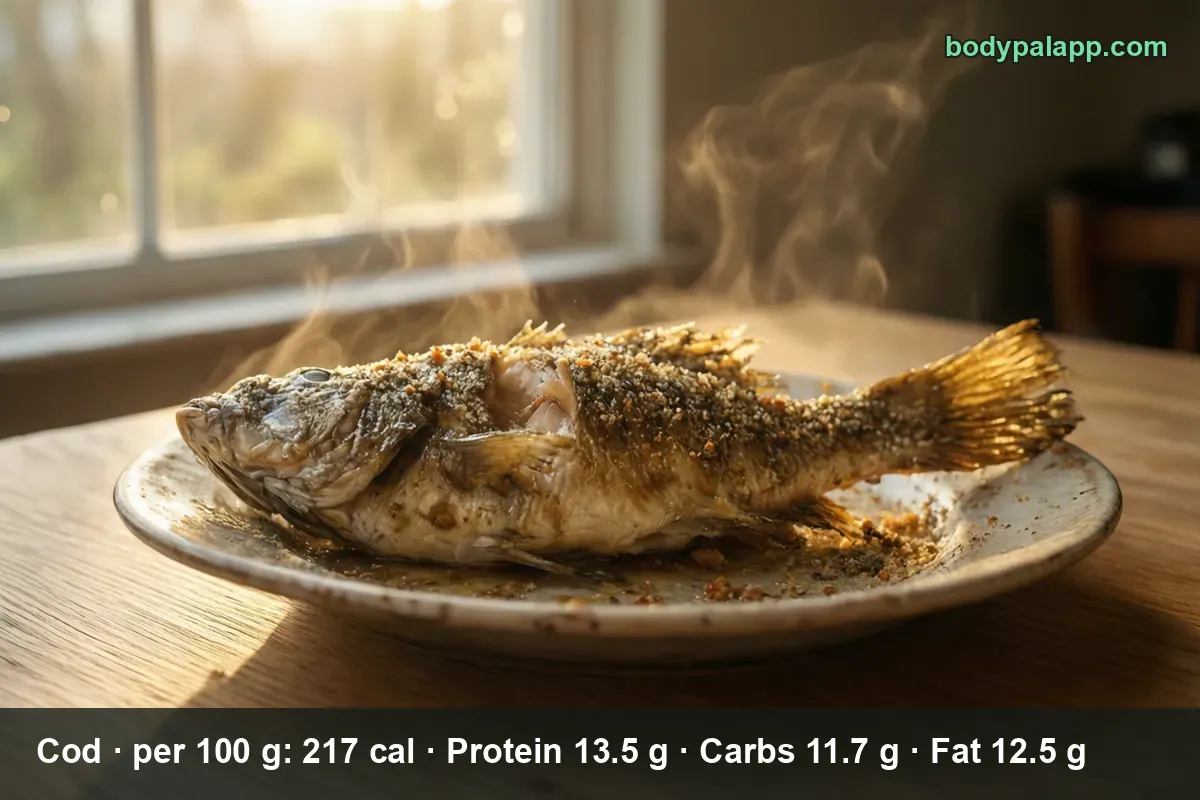
One small-to-regular cod fillet weighs 140 g and carries 304 calories, or 217 calories per 100 g. That is cod the way most Americans actually eat it: coated and fried. Cook the same fish on a grill and 100 g drops to 108 calories, with more protein in it.
On this page
- Cod quick facts
- US servings, from one ounce to a whole fish
- Fried, baked, grilled, steamed and raw
- Sodium is the row to watch
- How does cod compare?
- Most popular cod brands
- Cod FAQs
Cod quick facts
When someone types "calories in cod" without saying how it was cooked, the honest answer is the unspecified survey record: FNDDS 2706240, "Fish, cod, NFS". Its numbers line up exactly with the separate "Fish, cod, fried" record, which tells you something about how the country eats cod. The fish itself is famously lean. The plate in front of you usually is not.
The household measure USDA attaches to that record is a small or regular fillet at 140 g, so that is the serving in the right-hand column here.
| Nutrient | Per 100 g | Per one small fillet (140 g) | % Daily Value |
|---|---|---|---|
| Calories | 217 | 304 | — |
| Total fat | 12.48 g | 17.5 g | 22% |
| Saturated fat | 1.73 g | 2.4 g | 12% |
| Carbohydrate | 11.72 g | 16.4 g | 6% |
| Dietary fiber | 0.5 g | 0.7 g | 2% |
| Total sugars | 0.2 g | 0.3 g | — |
| Protein | 13.52 g | 18.9 g | 38% |
| Sodium | 426 mg | 596 mg | 26% |
% Daily Value is based on a 2,000-calorie diet.
Verified nutrition data
Numbers on this page come from USDA FoodData Central, the U.S. Department of Agriculture’s food composition database, and from manufacturer labels where a branded product is named. Last verified September 2026. How we verify our data →
Two label rows are missing on purpose. USDA does not publish added sugars or trans fat for survey foods, so there is nothing to report for either. Cholesterol and potassium do exist here: 42 mg and 203 mg per 100 g, which works out to 59 mg of cholesterol (20% of the Daily Value) and 284 mg of potassium (6%) in the 140 g fillet.
Look at the carbohydrate row for a second. Fish has no carbohydrate. The 16.4 g in that fillet is entirely breading, and it is the single clearest sign that the calorie count belongs to the coating as much as to the cod.
US servings, from one ounce to a whole fish
| Serving | Weight | Calories |
|---|---|---|
| 1 oz | 28.4 g | 62 kcal |
| Per 100 g | 100 g | 217 kcal |
| 1 cup, flaked | 135 g | 293 kcal |
| One small or regular fillet | 140 g | 304 kcal |
| One large fillet | 210 g | 456 kcal |
| One whole fish, any size | 420 g | 911 kcal |
Four of those are USDA household measures for this record: the whole fish, the large fillet, the small fillet and the cup of flaked cod. The 1 oz line is our own arithmetic from the USDA 100 g figure, not a USDA serving, and it is the number worth memorizing if you log by ounces at the counter.
The gap between the two fillet sizes is where most logging errors live. A large fillet is 150% of a small one, so calling a 210 g piece "a fillet" and logging 304 undercounts by 152 calories in one entry. A whole fried fish at 420 g is 911 calories before a single fry or spoon of tartar sauce joins it.
The cup of flaked cod is a useful sanity check too. At 135 g it is 293 calories, which means a cup of cod is not far off a whole fillet. Fish flakes loosely and a cup fills fast.
Fried, baked, grilled, steamed and raw
Cod is one of the few foods where the cooking method matters more than the portion. USDA keeps a separate record for each treatment, and they spread across a factor of nearly three.
| Version | USDA record | Per 100 g | Typical portion | Calories |
|---|---|---|---|---|
| Fried or battered cod | FNDDS 2706244 | 217 kcal | one small fillet, 140 g | 304 kcal |
| Baked or broiled, coated | FNDDS 2706243 | 152 kcal | 3 oz, 85 g | 129 kcal |
| Baked or broiled, plain | FNDDS 2706241 | 126 kcal | 3 oz, 85 g | 107 kcal |
| Grilled cod | FNDDS 2706242 | 108 kcal | one small fillet, 140 g | 151 kcal |
| Atlantic cod, cooked dry heat | SR Legacy 171956 | 105 kcal | 3 oz, 85 g | 89 kcal |
| Steamed cod | FNDDS 2706245 | 87 kcal | 3 oz, 85 g | 74 kcal |
| Atlantic cod, raw | SR Legacy 171955 | 82 kcal | 4 oz raw, 113 g | 93 kcal |
Every 3 oz and 4 oz figure in that table is our own arithmetic from the USDA 100 g values rather than a USDA serving size; the two fillet lines are USDA household measures.
Two of the seven records sit under 100 calories per 100 g, and both of them are the versions with nothing added: steamed at 87 and raw Atlantic cod at 82. Steamed is the lightest cooked record on the list. Fried is nearly two and a half times steamed, and the difference is batter and frying fat, not fish.
Raw versus cooked deserves its own line. Raw Atlantic cod is 82 calories per 100 g and cooked dry heat is 105, but the fish did not gain calories in the oven — it lost water. Four ounces of raw cod at 113 g is 93 calories and will plate up closer to 3 oz once it is done, so weighing raw and logging a cooked entry inflates the count. Weigh at the stage you log.
Grilled cod is the quiet winner. At 108 calories per 100 g it delivers 19.36 g of protein, which is 43% more protein than the fried record for half the calories. A 140 g grilled fillet is 151 calories with 27.1 g of protein, 54% of the Daily Value for protein in something that costs less than a bagel.
Store freezer aisles land in the same range. USDA Branded records put Sea Cuisine Beer Battered Cod Fillets at 199 calories per 100 g, with a 146 g portion at 291, SeaPak Beer Battered Cod at 232 per 100 g and 320 for two pieces (138 g), and Bantry Bay Cod Fillets with Lemon Pepper at 124 per 100 g, or 140 calories for a 4 oz (113 g) serving. Raw frozen fillets such as Orca Bay Alaska Cod come in at 71 per 100 g, 80 calories for 4 oz.
Sodium is the row to watch
Cod's calorie problem is optional. Its sodium problem is easier to miss.
A 140 g fried fillet carries 596 mg of sodium, 26% of the FDA Daily Value of 2,300 mg. That is about a quarter teaspoon of table salt in one piece of fish. Plain cooked Atlantic cod, measured in a lab without seasoning, is 78 mg per 100 g, and raw is 54 mg. The fried record is more than five times the plain one.
So the coating brings three things at once: the carbohydrate, most of the fat, and nearly all of the salt. If you are watching sodium, moving from a fried fillet to a grilled one is a bigger single change than swapping the side dish.
The fat picture is friendlier. Saturated fat is 2.4 g in a fried fillet, 12% of the Daily Value, which is modest for something that came out of a fryer, because cod has almost no saturated fat of its own. Cholesterol at 59 mg per fillet is 20% of the DV. Seafood twice a week is the pattern recommended in the Dietary Guidelines for Americans, and cod counts toward the MyPlate protein foods group whichever way it is cooked — the cooking just decides what else comes along.
How does cod compare?
Cod turns up most often in composed dishes, and USDA tracks several of them. Here is the unspecified fillet against three cod dishes with their own records.
| Dish | Per 100 g | US serving | Calories |
|---|---|---|---|
| Cod, unspecified (fried) | 217 kcal | one small fillet, 140 g | 304 kcal |
| Biscayne codfish, Puerto Rican style | 190 kcal | 1 cup, 175 g | 333 kcal |
| Codfish salad, Serenata | 183 kcal | 1 cup, 145 g | 265 kcal |
| Codfish with starchy vegetables | 135 kcal | 1 cup, 173 g | 234 kcal |
Our take: the plain fried fillet is the densest of the four per gram at 217 calories per 100 g, yet the cup of Biscayne codfish beats it on the plate at 333, purely because a cup holds 175 g. That is the trap with cod dishes — the sauce or the starch dilutes the calories per gram while the serving size quietly grows. If you want cod to be a light meal, the number to chase is not the dish but the method: grilled at 108 per 100 g or steamed at 87 does the job, and a 140 g grilled fillet at 151 calories leaves room for everything else on the plate. If cod is dinner and you want to be full, a coated baked fillet at 152 per 100 g is the compromise worth taking, since it keeps the crust and skips the fryer.
Most popular cod brands in the United States
Ranked by how widely each product appears among foods sold in the United States, from the BodyPal food database of over 3.3 million products. Calories are the figures printed on each Nutrition Facts label, checked against USDA FoodData Central.
| Product | Calories (per 100 g) |
|---|---|
| Sea Cuisine Beer Battered Cod Fillets | 199 cal |
| Pacific Beer Battered Cod | 190 cal |
| Hook Line and Savor Everything Crusted Cod Fillets | 146 cal |
| Bantry Bay Cod Fillets with Lemon Pepper | 124 cal |
| Orca Bay Alaska Cod Fillets | 71 cal |
| SeaPak Beer Battered Cod | 232 cal |
Brand popularity: BodyPal food database. Nutrition: manufacturer labels / USDA FoodData Central.
Cod FAQs
How many calories are in a cod fillet?
A small or regular fillet weighs 140 g and carries 304 calories, at 217 calories per 100 g. A large fillet of 210 g comes to 456. Those figures are for cod the way most people eat it in the US, coated and fried, not for a plain baked piece.
How many calories in fried cod?
Fried cod runs 217 calories per 100 g, so one small fillet of 140 g is 304 calories and a 3 oz piece is 184 by our own scaling. Almost all of the 16.4 g of carbohydrate in that fillet comes from the coating, since plain baked cod carries 0.01 g per 100 g.
How many calories in baked cod?
Plain baked or broiled cod is 126 calories per 100 g, so a 3 oz portion is 107 calories, scaled from the USDA 100 g figure. Add a coating and the same fish climbs to 152 per 100 g, or 129 calories for 3 oz. The crust costs about 22 calories per 3 oz.
How many calories in 4 oz of cod?
Four ounces is 113 g. Fried, that is 245 calories; plain baked or broiled, 142; grilled, 122; and raw Atlantic cod, 93. All four are our own arithmetic from the USDA 100 g figures rather than USDA serving sizes, and raw weight shrinks once the fish hits the pan.
How much protein is in cod?
A 140 g fried fillet gives 18.9 g of protein, 38% of the Daily Value. Grilled cod is denser: 19.36 g per 100 g, which is 27.1 g in a 140 g fillet, or 54% of the DV, for 151 calories. Plain cooked Atlantic cod reaches 22.83 g per 100 g.
Is cod good for weight loss?
Cooked without batter, yes: steamed cod is 87 calories per 100 g and grilled 108, so a 140 g fillet lands at 122 or 151 calories by our own scaling, with more than 19 g of protein per 100 g. Fried, the same fish is 217 per 100 g. The cooking method decides it.
Is cod high in sodium?
Fried cod carries 426 mg of sodium per 100 g, and a 140 g fillet is 596 mg, 26% of the 2,300 mg Daily Value, or about a quarter teaspoon of table salt. The salt sits in the coating: plain cooked Atlantic cod is 78 mg per 100 g and raw is 54 mg.
How many calories in beer battered cod?
USDA Branded records put beer battered cod between 190 and 232 calories per 100 g. Sea Cuisine's 146 g portion is 291 calories, SeaPak's two pieces at 138 g are 320, and Pacific's 3.5 oz portion is 190. Package weights differ more than the batters do.
Similar foods
- Fish Fry — 304 cal per small/regular fillet
- Fish And Chips — 372 cal for 2 fried fish pieces
- Fish Fillet — 237 cal per fillet
- Fish Ball — 208 cal for 7 fish balls
- Shrimp Toast — 213 cal per slice
- Raw Salmon — 354 cal per fillet
Count it without the math
Point the camera at the plate and BodyPal counts the cod for you, batter and all.


How long does it take to burn off cod?
One small fillet (140 g) is 304 kcal. Enter your weight and the amount you ate to see how long it takes you to burn that off:
lb
| Activity | Time to burn 304 kcal |
|---|---|
| Walking, brisk | 1 hr 1 min |
| Cycling, moderate | 38 min |
| Swimming, moderate | 43 min |
| Jogging | 36 min |
| Weight training, moderate | 1 hr 8 min |
Times are for a 155 lb adult at a steady pace; change the weight to see yours. The amount is set to the portion in the text (140 g); change it to what you actually ate. BodyPal works this out from your steps automatically.
Burning it off is one side of it. The other is knowing your number: work out how many calories you need a day, with macros and a goal date.