
How Many Calories Are in Fish and Chips?
One restaurant serving of battered, fried fish weighs 226 g and carries 495 calories. Per 100 g the fried fillet runs 219 calories. Add a 4 oz side of thick-cut fries at 167 and the plate lands at 662, which is our own arithmetic from the two USDA rows rather than a single USDA record.
On this page
- Fish and chips quick facts
- US servings from one ounce to a full plate
- Battered fish breaded fish and the chain version
- Thick-cut fries versus regular-cut fries
- Sodium runs out before fat does
- How does fish and chips compare?
- Most popular battered fried fish brands
- Fish and chips FAQs
Fish and chips quick facts
The row this page is built on is SR Legacy 169846, "Restaurant, family style, fish fillet, battered or breaded, fried". That is the fish most people actually have in front of them: a fillet in beer batter or breading, deep fried, plated in a sit-down restaurant, with no single chain attached to it. USDA also publishes a Denny's version of the same food. It is a good record, but it describes one company's batter, so it stays in the variants table lower down instead of driving the headline number.
Two rows you would see on a package label are missing here. Added sugars and trans fat are not published in the SR Legacy edition for restaurant foods, so neither line appears in the table below rather than being guessed at.
| Nutrient | Per 100 g | Per 1 restaurant serving (226 g) | % Daily Value |
|---|---|---|---|
| Calories | 219 | 495 | — |
| Total fat | 10.79 g | 24.4 g | 31% |
| Saturated fat | 1.88 g | 4.2 g | 21% |
| Carbohydrate | 16.89 g | 38.2 g | 14% |
| Dietary fiber | 0.9 g | 2.0 g | 7% |
| Total sugars | 0.45 g | 1.0 g | — |
| Protein | 13.49 g | 30.5 g | 61% |
| Sodium | 561 mg | 1268 mg | 55% |
% Daily Value is based on a 2,000-calorie diet.
Verified nutrition data
Numbers on this page come from USDA FoodData Central, the U.S. Department of Agriculture’s food composition database, and from manufacturer labels where a branded product is named. Last verified September 2026. How we verify our data →
Two more numbers sit outside the label block. The same serving carries 81 mg of cholesterol, 27% of the FDA Daily Value, and 567 mg of potassium, or 12%. Sugar is a rounding error at 1.0 g, which is what you would expect from flour, oil and fish.
US servings from one ounce to a full plate
| Serving | Weight | Calories |
|---|---|---|
| 1 oz | 28 g | 61 kcal |
| 3 oz, roughly one piece | 85 g | 186 kcal |
| One fillet, about half a plate | 113 g | 247 kcal |
| Two fried fish pieces | 170 g | 372 kcal |
| One restaurant serving | 226 g | 495 kcal |
| Per 100 g | 100 g | 219 kcal |
Only the 226 g line is a USDA household serving. The ounce weights, the single fillet and the two-piece portion are our own arithmetic from the USDA 100 g figure, scaled straight off 219 calories per 100 g.
That matters more here than with most foods, because "a piece of fish" is not a fixed object. A basket at a bar might hold two slim 85 g pieces; a family-style plate might hold one slab the size of your hand. Weigh the fish once, on a kitchen scale, and you will know which of these lines your usual order matches. Guessing is where the 200-calorie errors come from.
Battered fish breaded fish and the chain version
| Version | Per 100 g | Typical portion | Calories |
|---|---|---|---|
| Fried battered fish, family-style restaurant | 219 kcal | 1 serving (226 g) | 495 kcal |
| Chain-restaurant battered fillet, Denny's | 234 kcal | 1 serving (201 g) | 470 kcal |
| Breaded fried catfish fillet | 229 kcal | 3 oz (85 g) | 195 kcal |
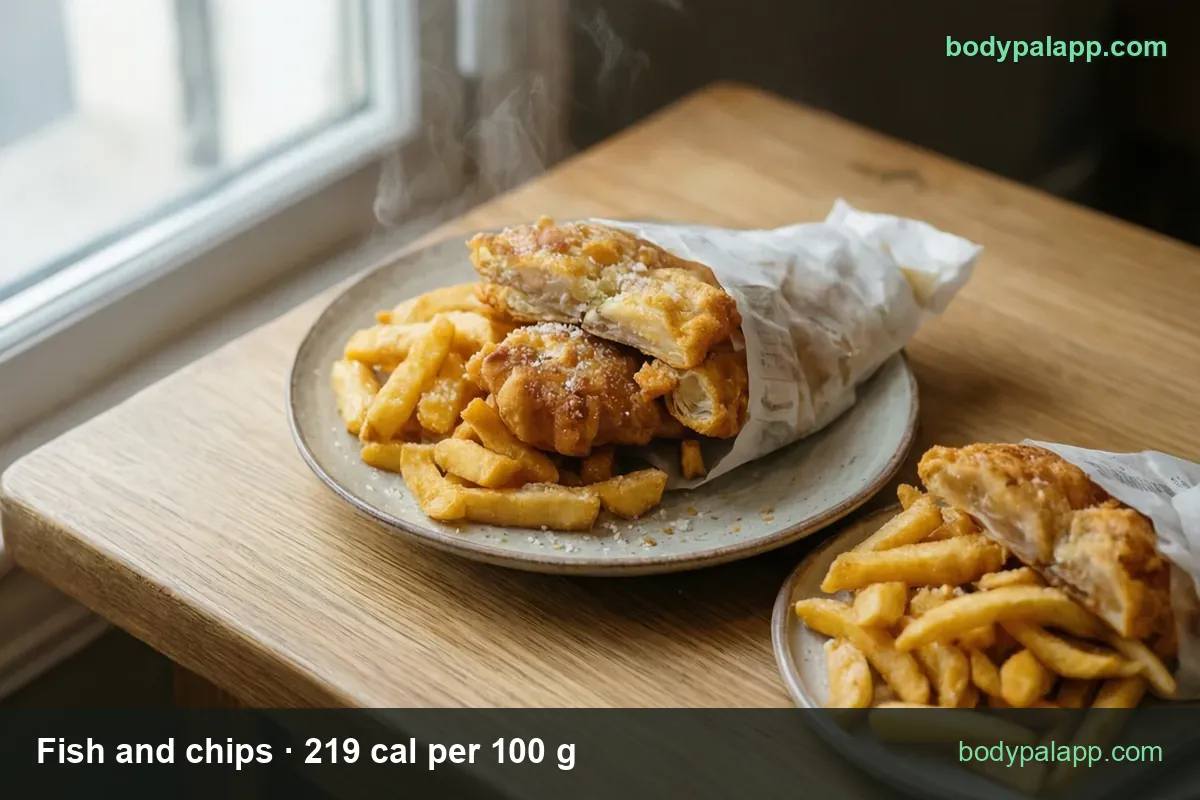
Here is the part nobody puts on a menu. Batter dilutes the protein. The family-style battered fillet gives 13.49 g of protein per 100 g; the breaded catfish gives 18.09 g, about a third more, because breadcrumbs cling in a thin layer while beer batter puffs into a shell of starch and oil. Calories per 100 g barely move between the two, 219 against 229. What you get for those calories does.
The chain fillet is the denser of the restaurant rows at 234 per 100 g, yet its serving lands lower at 470, simply because the plate is 201 g instead of 226 g. Portion size beats recipe here.
Frozen battered fillets from the freezer aisle spread wider than any of this. USDA's branded records for US supermarket fillets run from 170 calories per 100 g for Matlaw's Crispy Battered Cod up to 275 for American Pride Beer Battered Wild Alaska Pollock. A single Gorton's Cod Pub Style Beer Batter fillet, 148 g, is 330 calories on its own label, while two Van de Kamp's Beer Battered Fillets at 108 g total 220.
Thick-cut fries versus regular-cut fries
| Fries | Per 100 g | Typical portion | Calories |
|---|---|---|---|
| Steak fries, frozen, oven-heated | 148 kcal | 4 oz (113 g) | 167 kcal |
| Regular-cut fries, frozen, oven-heated | 158 kcal | 4 oz (113 g) | 179 kcal |
| Onion rings as the side instead | 276 kcal | 3 oz (85 g) | 235 kcal |
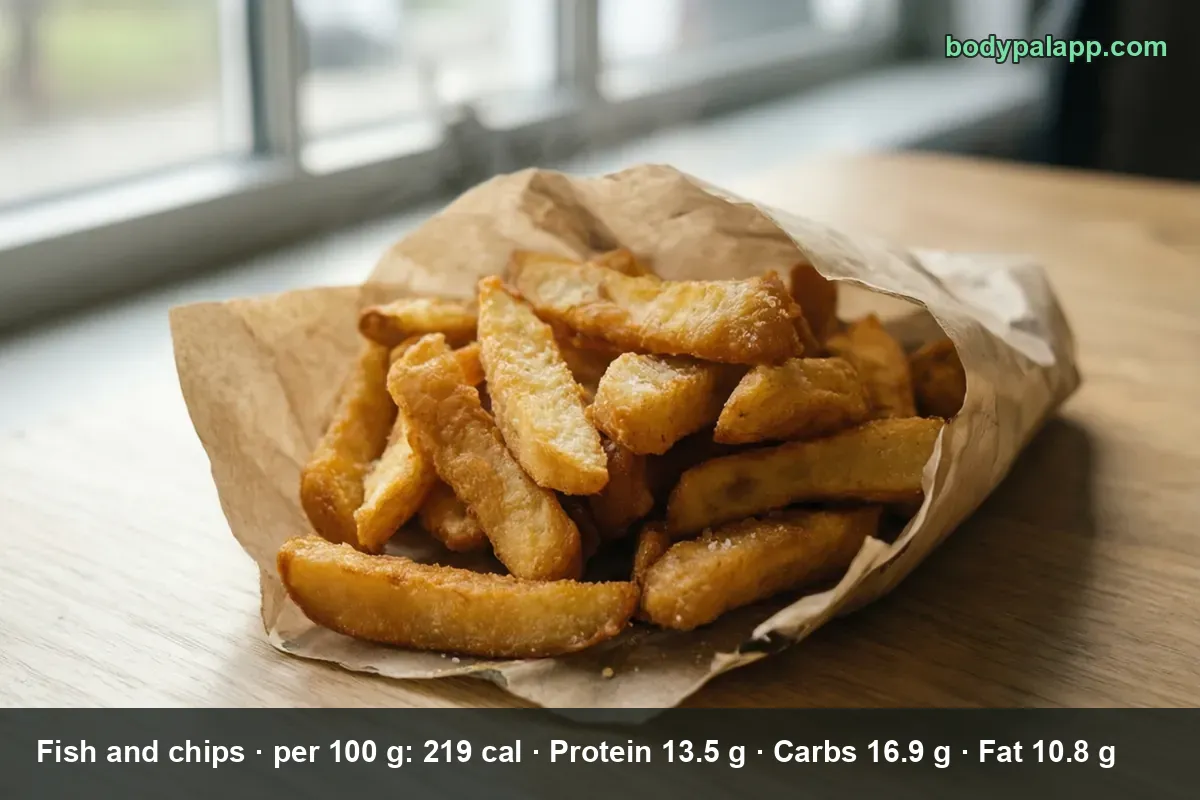
The cut of the potato moves the number more than the cooking does. Thick steak fries sit at 148 calories per 100 g; the same frozen potato in shoestring form is 194 per 100 g, out of the same oven. Thin fries have more surface for oil to land on, so a fat chip is the lighter chip, gram for gram. Regular-cut lands between the two at 158.
Swapping fries for onion rings is the expensive move: 235 calories for a 3 oz side against 126 for the same weight of steak fries, nearly double.
Sodium runs out before fat does
Most people brace for the fat on this plate. The row that actually runs out first is salt. One restaurant serving of the fish alone delivers 1,268 mg of sodium, 55% of the 2,300 mg Daily Value, against 31% for total fat and 21% for saturated fat. That is a little over half a teaspoon of table salt before the fries arrive.
Add a 4 oz side of steak fries and the plate reaches about 1,689 mg, roughly 73% of the day's sodium, by our own arithmetic from the two USDA rows. The Dietary Guidelines for Americans put the limit at 2,300 mg a day for adults, so one lunch has taken most of it. If sodium is the thing you are watching, this is the meal to plan the rest of the day around rather than the one to add a pickle to.
The upside is real too. That serving carries 30.5 g of protein, 61% of the Daily Value, which is most of a day's target for what MyPlate calls a protein food in a single plate. Fried fish is not a light meal, but it is not empty either.
How does fish and chips compare?
| Food | Per 100 g | US serving | Calories |
|---|---|---|---|
| Battered fried fish | 219 kcal | 3 oz (85 g) | 186 kcal |
| Breaded fried catfish | 229 kcal | 3 oz (85 g) | 195 kcal |
| Steak fries, oven-heated | 148 kcal | 3 oz (85 g) | 126 kcal |
| Onion rings, oven-heated | 276 kcal | 3 oz (85 g) | 235 kcal |
Our take: at 3 oz apiece, the fries are the lightest thing on this list and the onion rings the heaviest, with both fish rows in between. If you are cutting calories, cut the fish portion, not the potato, because the fried fillet is where the money is spent and the piece size varies most. If you are eating for fullness on a fixed budget, do the opposite and keep the fish, since 3 oz of it brings roughly 11 g of protein while 3 oz of fries brings about 2 g. Either way, the swap that costs you nothing is ordering fries instead of rings.
Most popular battered fried fish brands in the United States
Ranked by how widely each product appears among foods sold in the United States, from the BodyPal food database of over 3.3 million products. Calories are the figures printed on each Nutrition Facts label, checked against USDA FoodData Central.
| Product | Calories (per 100 g) |
|---|---|
| American Pride Beer Battered Wild Alaska Pollock Fillets | 275 cal |
| Gorton's Classic Crispy Battered Fish Fillets | 241 cal |
| Gorton's Beer Battered Fish Tenders | 232 cal |
| Gorton's Cod Pub Style Beer Batter | 223 cal |
| Van de Kamp's Beer Battered Fillets | 204 cal |
| Matlaw's Crispy Battered Cod Fish Fillets | 170 cal |
Brand popularity: BodyPal food database. Nutrition: manufacturer labels / USDA FoodData Central.
Fish and chips FAQs
How many calories are in fish and chips?
495 calories for one restaurant serving of battered fried fish weighing 226 g, at 219 calories per 100 g. Add a 4 oz side of thick-cut fries at 167 and the full plate comes to about 662 calories, which is our own arithmetic combining two separate USDA rows.
How many calories are in one piece of battered fish?
About 186 calories for a 3 oz piece weighing 85 g, scaled from the USDA figure of 219 calories per 100 g. Two pieces of that size, 170 g in total, come to 372. A single thick fillet closer to 113 g works out at 247 calories.
Is fish and chips high in sodium?
Yes, one 226 g restaurant serving of the fish alone carries 1,268 mg of sodium, 55% of the 2,300 mg Daily Value, or a little over half a teaspoon of table salt. With a 4 oz side of steak fries the plate reaches roughly 1,689 mg by our own arithmetic, about 73%.
How much protein is in fish and chips?
30.5 g of protein in one 226 g restaurant serving of battered fried fish, which is 61% of the Daily Value. Per 100 g that is 13.49 g. Breaded fillets carry more, since USDA's breaded fried catfish reaches 18.09 g per 100 g with a thinner coating.
Are fish and chips healthier baked or fried?
USDA does not publish a plain baked version of this 219-calorie restaurant fillet, so there is no like-for-like number to quote here. What the records do show is the coating effect: battered fish is 219 calories per 100 g with 13.49 g of protein, breaded catfish 229 with 18.09 g.
How many calories are in a portion of fries?
167 calories for a 4 oz side of thick-cut steak fries, 113 g, oven-heated from frozen at 148 calories per 100 g. The same weight of regular-cut fries is 179, and a smaller 3 oz side of steak fries is 126. All three are our own scaling from the USDA 100 g figures.
Is beer battered cod worse than breaded cod?
Not by calories: battered restaurant fish is 219 per 100 g and breaded fried catfish 229, so the batter is slightly lighter. The gap shows up elsewhere: protein is 13.49 g against 18.09 g, and sodium is 561 mg against 280 mg per 100 g, double for the battered version.
How many calories are in frozen battered fish fillets?
US supermarket fillets run from 170 to 275 calories per 100 g in USDA's branded records. One Gorton's Cod Pub Style Beer Batter fillet of 148 g is 330 calories, two Van de Kamp's Beer Battered Fillets at 108 g total 220, and Matlaw's lists 190 for a 4 oz portion.
Similar foods
- Fish Fillet — 237 cal per fillet
- Cod — 911 cal per whole fish
- Fish Fry — 304 cal per small/regular fillet
- Shrimp Toast — 213 cal per slice
- Fish Ball — 208 cal for 7 fish balls
- Raw Salmon — 354 cal per fillet
Count it without the math
Point the camera at the plate and BodyPal counts the fish and the fries separately.


How long does it take to burn off fish and chips?
One restaurant serving (226 g) is 495 kcal. Enter your weight and the amount you ate to see how long it takes you to burn that off:
lb
| Activity | Time to burn 495 kcal |
|---|---|
| Walking, brisk | 1 hr 39 min |
| Cycling, moderate | 1 hr 2 min |
| Swimming, moderate | 1 hr 11 min |
| Jogging | 58 min |
| Weight training, moderate | 1 hr 50 min |
Times are for a 155 lb adult at a steady pace; change the weight to see yours. The amount is set to the portion in the text (226 g); change it to what you actually ate. BodyPal works this out from your steps automatically.
One food is easy to picture; a whole day is harder. See how many calories you need a day and what a deficit actually looks like.