
How Many Calories Are in Salmon?
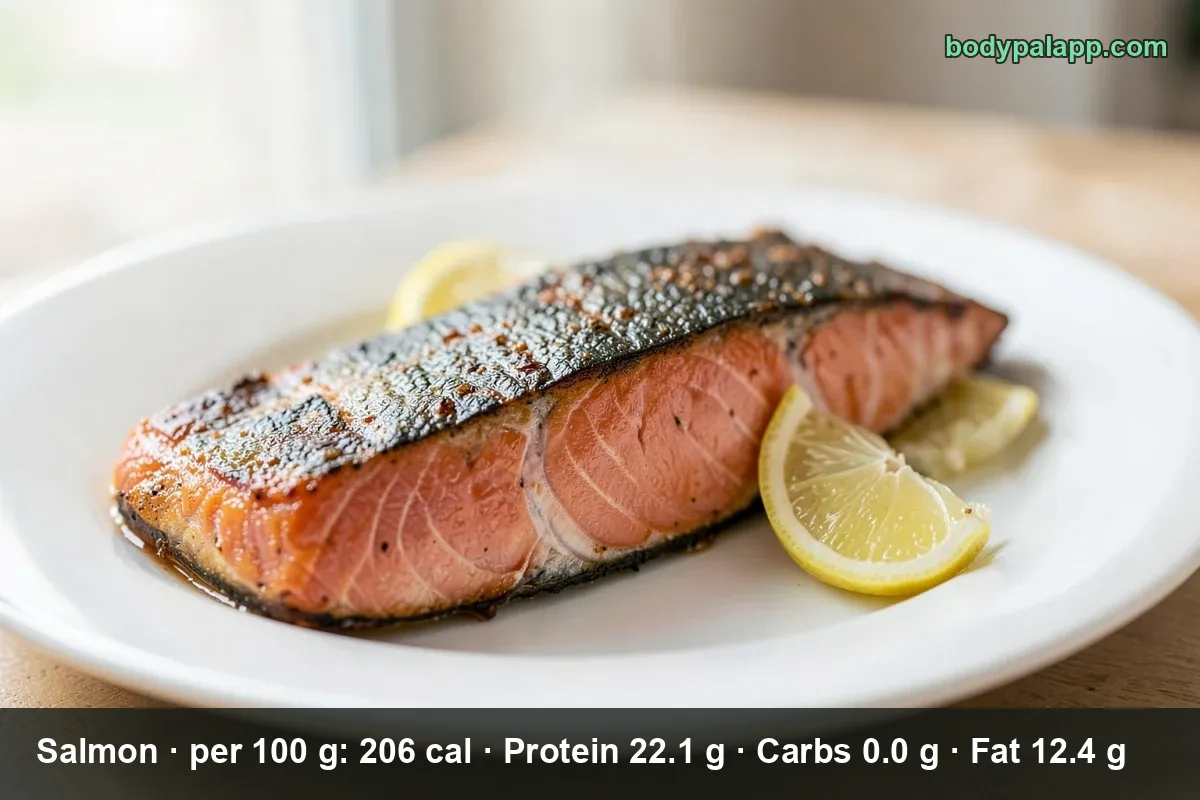
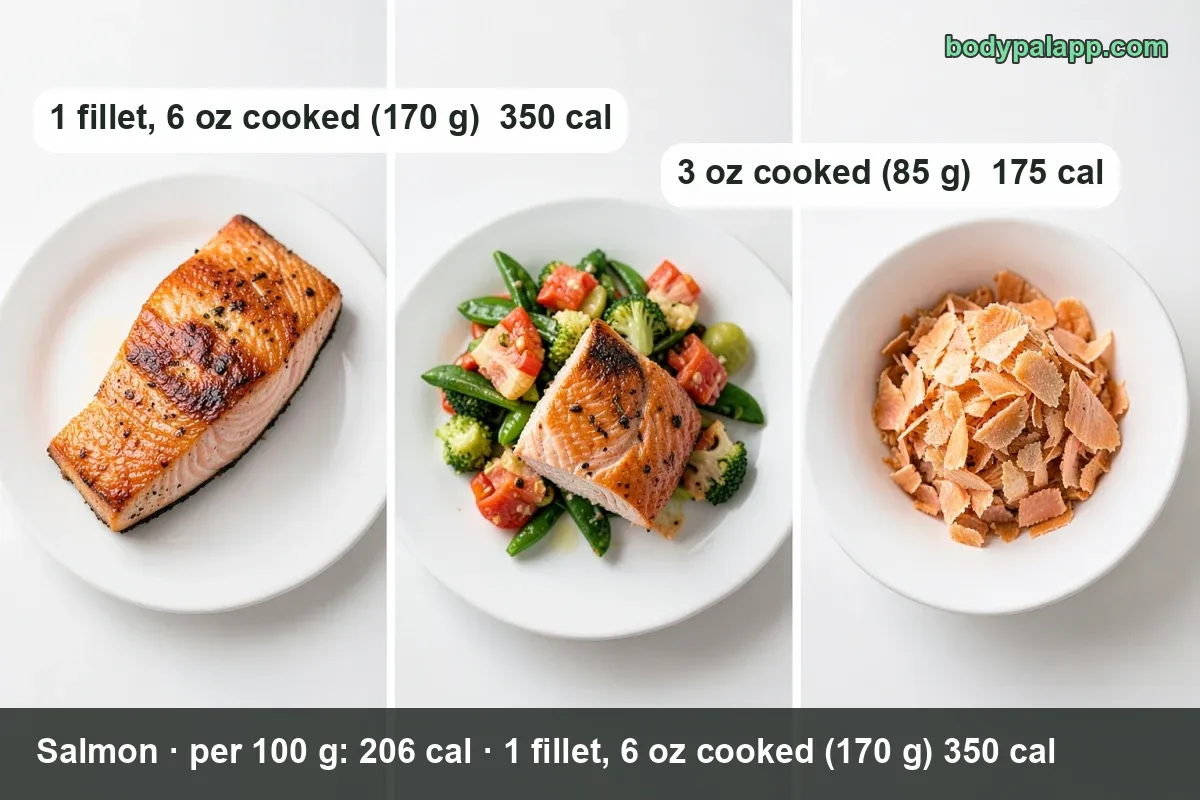
A 3 oz cooked salmon fillet, the standard restaurant portion, carries 175 calories, and per 100 g farmed Atlantic salmon runs 206 calories. Stretch that to the 6 oz fillet most home cooks buy and you are at 350 calories, with 37.6 g of protein and no carbs at all.
On this page
- Salmon quick facts
- US servings from one ounce to a six ounce fillet
- Raw salmon versus cooked salmon
- Every kind of salmon in one table
- How baking and grilling move the number
- Protein and sodium are the rows to watch
- How does salmon compare
- Most popular salmon brands
- Salmon FAQs
Salmon quick facts
Almost all the salmon sold fresh in American supermarkets is farmed Atlantic salmon, and almost all of it gets cooked with dry heat: oven, broiler, air fryer, dry pan. So the reference row here is SR Legacy 175168, "Fish, salmon, Atlantic, farmed, cooked, dry heat". That is the fish on the plate, cooked, with nothing added to it.
Every number below is the fish alone. Oil, butter, glaze and marinade get counted separately, and the section on baked and grilled salmon shows how much they add.
| Nutrient | Per 100 g | Per 3 oz (85 g) | % Daily Value |
|---|---|---|---|
| Calories | 206 | 175 | — |
| Total fat | 12.35 g | 10.5 g | 13% |
| Saturated fat | 2.4 g | 2.0 g | 10% |
| Carbohydrate | 0 g | 0 g | 0% |
| Dietary fiber | 0 g | 0 g | 0% |
| Total sugars | 0 g | 0 g | — |
| Protein | 22.1 g | 18.8 g | 38% |
| Sodium | 61 mg | 52 mg | 2% |
% Daily Value is based on a 2,000-calorie diet.
Verified nutrition data
Numbers on this page come from USDA FoodData Central, the U.S. Department of Agriculture’s food composition database, and from manufacturer labels where a branded product is named. Last verified September 2026. How we verify our data →
Two label rows are missing on purpose. USDA does not publish added sugars or trans fat for this SR Legacy record, and a plain fillet with no breading and no glaze has nothing to add sugar to. Two rows that do exist are worth naming: 3 oz of cooked salmon holds 54 mg of cholesterol, 18% of the Daily Value, and 326 mg of potassium, 7%.
US servings from one ounce to a six ounce fillet
| Serving | Weight | Calories |
|---|---|---|
| 1 oz cooked | 28 g | 58 kcal |
| 3 oz cooked, USDA portion | 85 g | 175 kcal |
| 4 oz cooked | 113 g | 233 kcal |
| 1 fillet, 6 oz cooked | 170 g | 350 kcal |
| Per 100 g | 100 g | 206 kcal |
Only the 3 oz line is a USDA household measure. The 1 oz, 4 oz and 6 oz rows are our own arithmetic from the USDA 100 g figure, not USDA servings, and they matter because nobody buys salmon in 3 oz pieces. A single skin-on fillet from the fish counter usually lands between 5 and 7 oz cooked, which is why the 6 oz row, at 350 calories, is the honest answer for most dinner plates.
The trap is the doubling. Three ounces looks like a deck of cards. Six ounces looks like a normal piece of fish. The distance between them is 175 calories, roughly a slice of bread with butter, and it disappears entirely if you log "salmon, 1 fillet" without a weight.
Raw salmon versus cooked salmon
Here is a result that surprises people who cook a lot of meat. Raw farmed Atlantic salmon is 208 calories per 100 g and the cooked record is 206. Practically the same. With beef or chicken the cooked figure jumps well above the raw one, because water leaves and the remaining gram is denser. Salmon barely moves, since some fat renders out along with the water.
That does not mean the two weights are interchangeable. Weigh raw, use the raw number; weigh cooked, use the cooked number. Four ounces of raw fillet is 235 calories and plates out as roughly 3 oz cooked, which the cooked record puts at 175. Those are two separate USDA analyses of a fish that lost water and a little fat in between, so do not expect them to reconcile to the gram.
The practical rule: buy 4 oz raw per person if you want a 3 oz cooked portion, and 8 oz raw if you want the 6 oz fillet.
Every kind of salmon in one table
"Salmon" covers five fish and several processes, and the spread is wide, from 117 to 259 calories per 100 g.
| Version | Per 100 g | Typical serving | Calories |
|---|---|---|---|
| Farmed Atlantic, cooked | 206 kcal | 3 oz (85 g) | 175 kcal |
| Farmed Atlantic, raw | 208 kcal | 4 oz raw (113 g) | 235 kcal |
| Wild Atlantic, cooked | 182 kcal | 3 oz (85 g) | 155 kcal |
| Sockeye, cooked | 156 kcal | 3 oz (85 g) | 133 kcal |
| Canned pink, drained | 136 kcal | 3 oz (85 g) | 116 kcal |
| Smoked salmon, lox | 117 kcal | 2 oz (57 g) | 67 kcal |
| Grilled salmon, as eaten | 259 kcal | 3 oz (85 g) | 220 kcal |
Canned pink salmon is the quiet bargain: 116 calories for 3 oz with 20.9 g of protein, a little over half of what the same weight of grilled salmon costs. It arrives salted, though, at 321 mg of sodium per 3 oz against 52 mg for the fresh fillet.
Smoked salmon is the lightest of the lot per gram, and retail brands split into two clear bands. USDA's Branded rows put Blue Hill Bay and Trans-Ocean around 123 to 125 calories per 100 g, roughly 70 calories in a 2 oz serving, while the Foppen and Nathan's Nova slices run 179 to 196 per 100 g, or 100 to 110 calories in the same 2 oz. Read the package weight, not the number of slices.
How baking and grilling move the number
The main row on this page is the fish. The FNDDS "as eaten" rows are the dish, and they include what the cook put in the pan. Baked or broiled salmon is 274 calories per 100 g, which works out to 233 calories in a 3 oz portion. Grilled salmon lands at 259 per 100 g, or 220 for 3 oz.
Neither figure contradicts the 206 on the plain record. The difference, 68 calories per 100 g on the baked row, is oil, butter and salt. It shows up in the fat, 18.4 g per 100 g against 12.35 g, and in the sodium, 294 mg against 61 mg.
So pick your row deliberately. Salmon you cooked dry, in an air fryer or on a sheet pan with a spritz, logs closer to 175 for 3 oz. Salmon that came off a restaurant grill glossy with butter logs closer to 220, and a 6 oz restaurant fillet is then in the neighborhood of 440.
Protein and sodium are the rows to watch
A 3 oz portion delivers 18.8 g of protein, 38% of the Daily Value of 50 g, for 175 calories. The 6 oz fillet takes that to 37.6 g, three quarters of a day, and salmon is one of the seafood choices MyPlate points to for exactly this reason.
Saturated fat is smaller than the total fat number suggests. The 3 oz portion carries 10.5 g of fat but only 2.0 g of it saturated, 10% of the Daily Value, and the rest is mostly unsaturated. That ratio is the argument for salmon over a same-size portion of fatty red meat.
Sodium is where the version you buy decides everything. Fresh cooked salmon is 52 mg per 3 oz, 2% of a day. The same 3 oz of cold smoked salmon is 571 mg, 25%, because salt is how it is cured. If you are following the sodium limits in the Dietary Guidelines, lox is a garnish rather than a protein serving. Two ounces on a bagel is 383 mg, 17% of the day, before the cream cheese and the capers. Both smoked sodium figures are our arithmetic from the USDA 100 g row, not USDA servings.
How does salmon compare
| Fish | Per 100 g | US serving | Protein | Calories |
|---|---|---|---|---|
| Farmed Atlantic salmon, cooked | 206 kcal | 3 oz (85 g) | 18.8 g | 175 kcal |
| Wild Atlantic salmon, cooked | 182 kcal | 3 oz (85 g) | 21.6 g | 155 kcal |
| Sockeye salmon, cooked | 156 kcal | 3 oz (85 g) | 22.5 g | 133 kcal |
| Pink salmon, cooked | 153 kcal | 3 oz (85 g) | 20.9 g | 130 kcal |
Our take: the farmed Atlantic fillet in the case is the highest-calorie and lowest-protein of these four, and the leanest, pink salmon, gives you 2.1 g more protein for 45 fewer calories in the same 3 oz. If you are cutting calories and want the protein, buy sockeye or pink and cook it gently, because leaner fish dries out faster. If you are eating for satiety and for the fat itself, farmed Atlantic earns its extra 45 calories, and the 2.0 g of saturated fat per 3 oz is not the part to worry about. None of these four is a bad choice; the size of the fillet decides far more than the species does.
Most popular salmon brands in the United States
Ranked by how widely each product appears among foods sold in the United States, from the BodyPal food database of over 3.3 million products. Calories are the figures printed on each Nutrition Facts label, checked against USDA FoodData Central.
| Product | Calories (per 100 g) |
|---|---|
| FOPPEN Smoked Norwegian Salmon Slices | 181 cal |
| FOPPEN Traditional Smoked Norwegian Atlantic Salmon | 196 cal |
| FOPPEN Flame Roasted Smoked Norwegian Salmon | 179 cal |
| Blue Hill Bay Smoked Salmon | 125 cal |
| Trans-Ocean Smoked Salmon | 123 cal |
| Nathan's Classic Smoked Nova Salmon | 196 cal |
Brand popularity: BodyPal food database. Nutrition: manufacturer labels / USDA FoodData Central.
Salmon FAQs
How many calories in 3 oz of salmon?
175 calories in a 3 oz (85 g) cooked fillet of farmed Atlantic salmon, the USDA reference portion. That same piece brings 18.8 g of protein, 10.5 g of fat, zero carbs and 52 mg of sodium. Wild Atlantic salmon at the same weight is lighter, at 155 calories.
How many calories are in a 6 oz salmon fillet?
About 350 calories for 6 oz (170 g) of cooked farmed Atlantic salmon. That is our own arithmetic from the USDA 100 g figure of 206 calories, not a USDA serving. The same fillet delivers 37.6 g of protein, 21.0 g of fat and 104 mg of sodium.
How many calories in baked salmon?
A 3 oz portion of salmon baked or broiled the way it is usually served comes to 233 calories, from the USDA record of 274 calories per 100 g for the finished dish. The gap against plain cooked salmon, 175 calories, is the oil and butter added in the pan.
Is farmed salmon higher in calories than wild salmon?
Yes, by 24 calories per 100 g: 206 for farmed Atlantic salmon against 182 for wild. On a 3 oz portion that is 175 against 155 calories, and the fat gap is 10.5 g versus 6.9 g. Wild salmon also carries more protein per ounce, 21.6 g per 3 oz.
How much protein is in a salmon fillet?
A 6 oz cooked fillet holds about 37.6 g of protein, three quarters of the 50 g Daily Value. A 3 oz portion gives 18.8 g, or 38%. Sockeye is denser still at 22.5 g per 3 oz, so the leaner species buy you more protein for fewer calories.
How many calories in smoked salmon?
Only 67 calories in a 2 oz (57 g) serving of cold smoked salmon, which is 117 calories per 100 g. Cold smoking adds no fat, so lox is the lightest salmon here. The catch is sodium: that same 2 oz carries 383 mg, 17% of a day's value.
How many calories in canned salmon?
116 calories in 3 oz (85 g) of drained canned pink salmon, against 175 for a cooked fresh farmed fillet. Draining removes the packing liquid but not the salt: 321 mg of sodium per 3 oz, 14% of the Daily Value, versus 52 mg for the fresh fish.
Is salmon high in sodium?
Fresh salmon is not: 52 mg per 3 oz cooked, just 2% of the 2,300 mg Daily Value. Processing changes that completely. The same 3 oz of smoked salmon holds 571 mg, 25% of a day, and canned pink salmon 321 mg. Buy it fresh when sodium matters to you.
Similar foods
- Atlantic Salmon — 367 cal per baked fillet
- Salmon Skin — 175 cal per 3 oz
- Tuna Patty — 247 cal per patty
- Raw Salmon — 354 cal per fillet
- Fish Ball — 208 cal for 7 fish balls
- Shrimp Salad — 357 cal per cup
Count it without the math
Point the camera at the plate and BodyPal counts the fillet for you, skin, glaze and all.


How long does it take to burn off salmon?
A 3 oz (85 g) cooked fillet is 175 kcal. Enter your weight and the amount you ate to see how long it takes you to burn that off:
lb
| Activity | Time to burn 175 kcal |
|---|---|
| Walking, brisk | 35 min |
| Cycling, moderate | 22 min |
| Swimming, moderate | 25 min |
| Jogging | 21 min |
| Weight training, moderate | 39 min |
Times are for a 155 lb adult at a steady pace; change the weight to see yours. The amount is set to the portion in the text (85 g); change it to what you actually ate. BodyPal works this out from your steps automatically.
Burning it off is one side of it. The other is knowing your number: work out how many calories you need a day, with macros and a goal date.