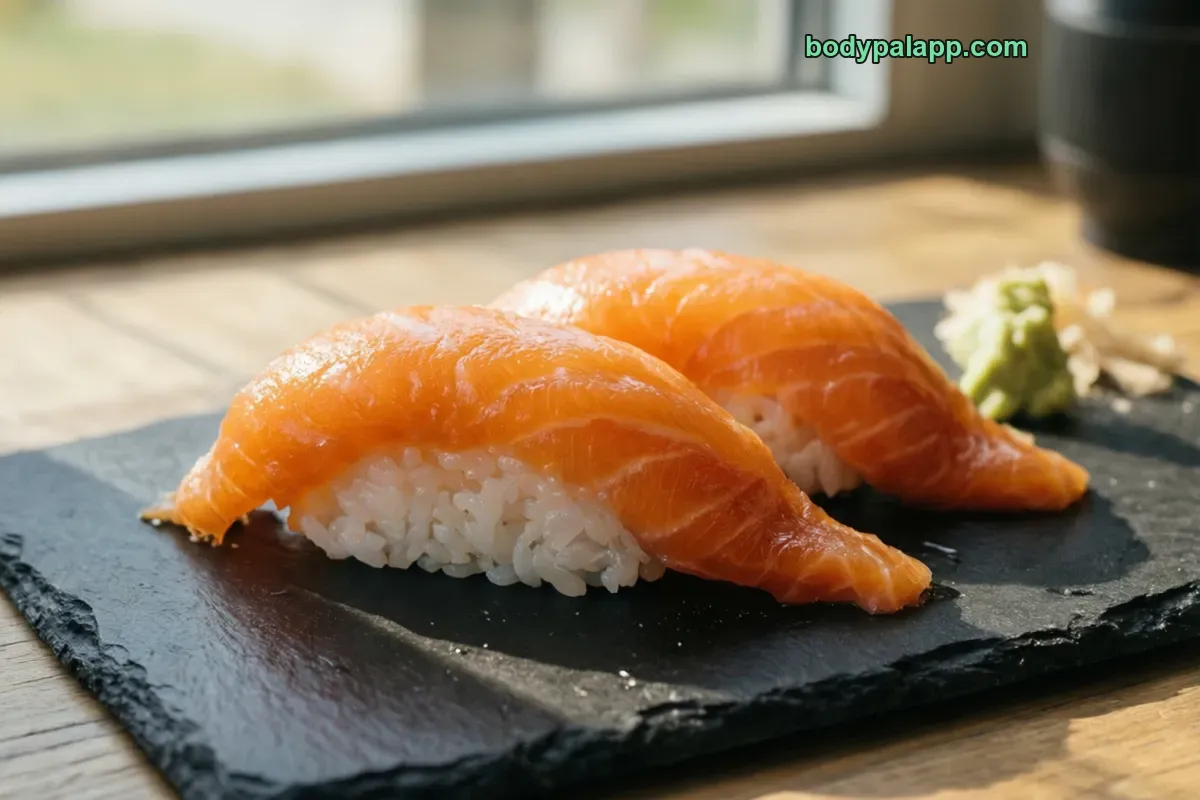
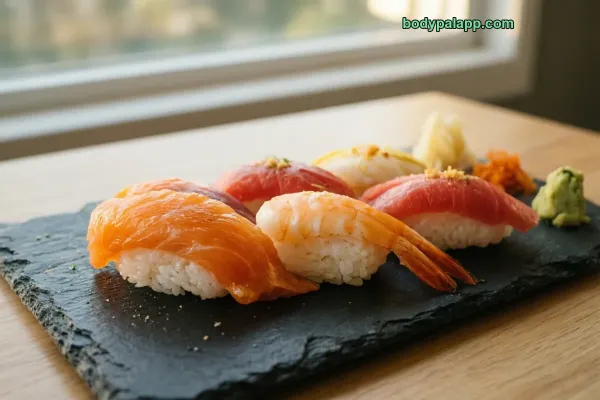
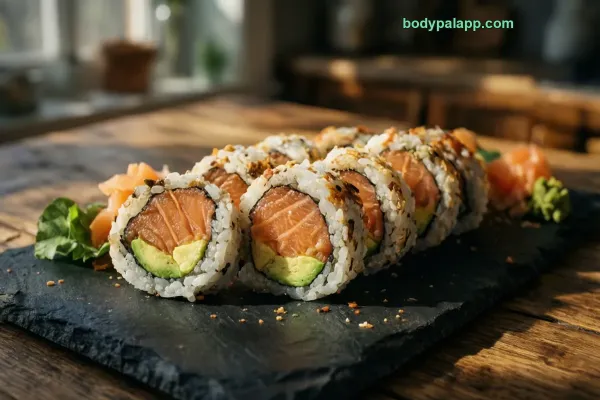
Salmon nigiri calories come to 430 for one combo pack (239 g) and 180 per 100 g, based on a packaged salmon nigiri and roll combo. The rice drives the number: carbs supply 59% of the calories, while the pack's 808 mg of sodium covers 35% of the daily value before you add soy sauce.
430kcal
1 combo pack · 239 g, packaged, per label
17%protein
18 gProtein
64 gCarbs
12 gFat
How to burn off 430 kcal
—Walking, brisk
—Jogging
—Cycling, moderate
—Swimming
Skip the math. BodyPal counts these calories from your steps and workouts automatically.
Nutrition facts
Packaged, per label · per 239 g
Calories
430 kcal
Protein
18 g
Carbohydrate
64 g
Fat
12 g
Saturated fat
2 g
Cholesterol
36 mg
Sodium
808 mg
Potassium
289 mg
Source: USDA FoodData Central
🛡️
Verified nutrition data
Numbers on this page come from USDA FoodData Central, the U.S. Department of Agriculture’s food composition database, and from manufacturer labels where a branded product is named. Last verified September 2026. How we verify our data →
Salmon nigiri: calories, protein and sodium by serving
Percent of daily value uses the FDA reference of 2,000 kcal a day.
Serving
kcal
Protein
Carbs
Fat
Sodium
% DV kcal
1 combo pack (239 g)
430
18 g
64 g
12 g
808 mg
22%
100 g
180
7.5 g
26.8 g
5 g
338 mg
9%
3 mixed-fish pieces (85 g)
110
7 g
17 g
1 g
10 mg
5%
3 × 1 combo pack (239 g)
1,291
54 g
2,423 mg
5 × 1 combo pack (239 g)
2,151
90 g
4,039 mg
One combo pack is a 430-calorie meal
The serving that matters here is the full combo pack. At 239 g it delivers 430 calories, 18 g of protein, 64 g of carbs and 12 g of fat. That is 22% of a 2000-calorie day in a box that many people treat as a light lunch.
The total climbs quickly if you share a party tray or grab a second pack. Two packs (478 g) reach 860 calories and 36 g of protein. Three packs (717 g) come to 1,291 calories, and a five-pack spread for a group adds up to 2,151 calories with 90 g of protein.
Restaurant pieces run lighter than a packaged combo. A USDA plate of 3 mixed-fish pieces (85 g) lists 110 calories and 7 g of protein, so a few pieces at a sushi bar sit well below the store pack. Count your pieces, because portion size moves this food more than anything else on the label.
Rice supplies most of the calories
Salmon gets the billing, but the rice does most of the work. Per 100 g, this combo holds 26.8 g of carbs against 7.5 g of protein and 5 g of fat. In calorie terms that is 59% from carbs, 25% from fat and 17% from protein.
The fat share is real but moderate. Salmon is a fattier fish than tuna, and it shows: 5 g of fat per 100 g here compared with 0.3 g for tuna nigiri. Saturated fat stays low at 0.8 g per 100 g, so most of that fat is not the kind the label flags.
Protein is decent rather than high. One pack gives 18 g, or 36% of the daily value, which makes it a reasonable protein source for a meal. If you want a meal built mainly on protein, though, the rice-heavy ratio works against you.
Sodium is the row to watch
A combo pack carries 808 mg of sodium, which is 35% of the 2300 mg daily value. That figure comes from the label before any soy sauce, and dipping adds more on top. Two packs push sodium to 1,616 mg, and three reach 2,423 mg, past a full day's value.
Sugar is the quieter surprise. Sushi rice is seasoned with sugar and vinegar, and the pack lists 12 g of sugars. Per 100 g that works out to 5 g, a modest but noticeable amount for a savory meal.
Fiber is low, at 3.1 g per pack. If you watch sodium, go light on soy sauce and skip extra salty sides. If you want the meal to keep you full longer, adding vegetables on the side helps more than adding another pack.
Pair it to fill the gaps
Salmon nigiri works as a meal centerpiece when you plan around its weak spots: low fiber, middling protein and a high sodium count. A side salad, edamame or steamed vegetables add volume and fiber without adding many calories.
For a lighter sushi order, mix in leaner fish. Tuna nigiri comes to 97 calories per 100 g, about half of the salmon combo's 180. Keeping the salmon pieces and swapping a few for tuna trims the total without losing the flavor you came for.
Logging sushi is easy to get wrong because pieces vary in size. BodyPal can log the food from a photo, which helps when a tray mixes nigiri and rolls.
How does salmon nigiri compare?
Here is how salmon nigiri stacks up against other sushi on our pages, per 100 g and per usual serving.
Verdict: For the fewest calories pick tuna nigiri at 97 per 100 g, about half of salmon nigiri's 180, or plain sushi nigiri at 129. A salmon avocado roll at 179 per 100 g saves you nothing, so choose salmon nigiri when you want the salmon and keep the piece count in check.
Most popular salmon nigiri brands in the United States
Ranked by popularity in the BodyPal database
# Productkcal / 100 g
1Inku Sushi Co Raw Maguro Roll & Salmon Nigiri7.19 oz · 204 g221 kcal
2Sushi Avenue Tuna & Salmon Rolls with Tuna & Salmon Nigiri8.82 oz · 250 g132 kcal
3Mai All Salmon Nigiri/Roll Combo239 g180 kcal
4Mai Tuna & Salmon Nigiri/Roll Combo236 g169 kcal
5Yummi Sushi Tuna and Salmon Jumbo Nigiri Combo354 g144 kcal
A packaged salmon nigiri and roll combo (239 g) has 430 calories, which is 180 calories per 100 g.
Is salmon nigiri good for weight loss?
Per 100 g it has 180 calories, 7.5 g protein, 26.8 g carbs and 5.0 g fat, so a 239 g pack comes to 430 calories.
Salmon nigiri vs tuna nigiri: which has fewer calories?
Tuna nigiri has 97 calories per 100 g, compared with 180 for the salmon nigiri combo.
How much protein is in salmon nigiri?
The salmon combo has 7.5 g protein per 100 g, about 18.0 g in a 239 g pack.
How many calories are in one piece of nigiri?
A single piece of sushi nigiri (28 g) has about 36 calories. USDA lists 3 mixed-fish pieces (85 g) at 110 calories, so one restaurant piece usually lands in the 30s.
What are the nutrition facts for salmon nigiri per 100 g?
Per 100 g, salmon nigiri has 180 calories, 7.5 g of protein, 26.8 g of carbs, 5 g of fat and 338 mg of sodium. Carbs from the rice supply 59% of the calories.
How many calories are in maguro (tuna) nigiri?
One piece of tuna nigiri (30 g) has 29 calories, or 97 per 100 g. That is about half the calories of salmon nigiri per 100 g, because tuna has only 0.3 g of fat.
How many calories are in sushi nigiri in general?
Sushi nigiri averages 129 calories per 100 g and 36 per piece (28 g). Salmon nigiri runs higher at 180 per 100 g, mostly because salmon carries more fat than leaner fish.
How much sodium is in salmon nigiri?
One combo pack of salmon nigiri has 808 mg of sodium, 35% of the daily value, before soy sauce. Per 100 g it contains 338 mg.