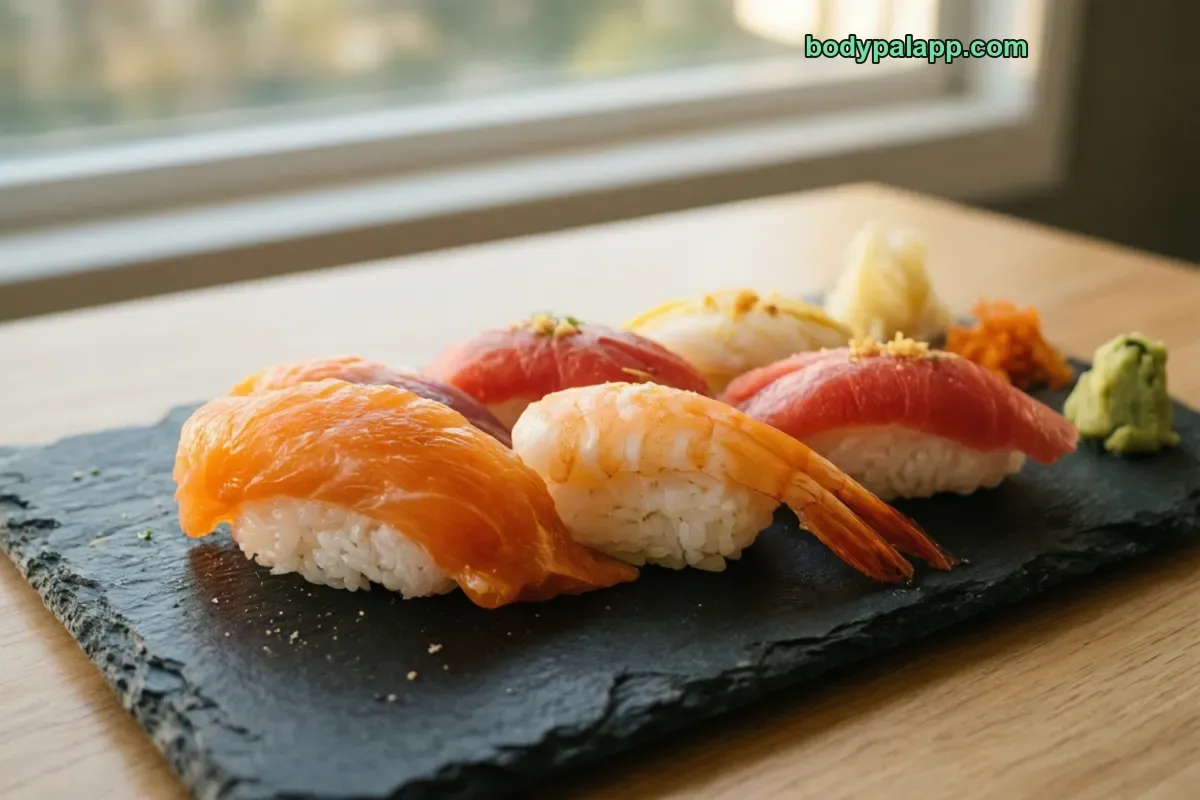
Sushi nigiri calories come to 36 for one 28 g piece and 129 per 100 g, based on a packaged label. The detail worth noticing is the carb share: rice supplies 65% of the calories and the fish 27%, so the number of pieces you eat drives the total far more than anything else on the plate.
36kcal
1 piece · 28 g, packaged, per label
27%protein
2.3 gProtein
6 gCarbs
0.3 gFat
How to burn off 36 kcal
—Walking, brisk
—Jogging
—Cycling, moderate
—Swimming
Skip the math. BodyPal counts these calories from your steps and workouts automatically.
Nutrition facts
Packaged, per label · per 28 g
Calories
36 kcal
Protein
2.3 g
Carbohydrate
5.6 g
Fat
0.3 g
Saturated fat
0 g
Cholesterol
3 mg
Sodium
3 mg
Source: USDA FoodData Central
🛡️
Verified nutrition data
Numbers on this page come from USDA FoodData Central, the U.S. Department of Agriculture’s food composition database, and from manufacturer labels where a branded product is named. Last verified September 2026. How we verify our data →
Sushi nigiri: calories, protein and sodium by serving
Percent of daily value uses the FDA reference of 2,000 kcal a day.
Serving
kcal
Protein
Carbs
Fat
Sodium
% DV kcal
1 piece (28 g)
36
2.3 g
5.6 g
0.3 g
3 mg
2%
3 pieces (85 g)
110
7 g
17 g
1 g
10 mg
5%
100 g
129
8.2 g
20 g
1.2 g
12 mg
6%
3 × 1 piece (28 g)
108
6.9 g
10 mg
5 × 1 piece (28 g)
181
11.5 g
17 mg
Three pieces make a 110-calorie plate
One 28 g piece of nigiri carries 36 calories, about 2% of the daily calorie value. The packaged three-piece serving weighs 85 g and lands at 110 calories with 7 g of protein. That is a light plate by any measure, closer to a snack than a full meal.
The total climbs in a straight line as you add pieces. Two pieces (56 g) come to 72 calories, three loose pieces (84 g) to 108, and five pieces (140 g) to 181 calories with 11.5 g of protein. The small gap between 108 and the label's 110 is rounding on the package serving, not a different food.
That steady math makes nigiri easy to log. Count the pieces, multiply by 36, and you are close to the real number. The harder part is stopping. Each piece is small and goes down in a bite or two, so decide on the count before the plate arrives rather than after.
Rice supplies about two thirds of the calories
Per 100 g, this nigiri holds 20 g of carbs, 8.2 g of protein and 1.2 g of fat. Converted to calories, carbs account for 65%, protein for 27% and fat for 9%. The rice base, not the slice of fish, does most of the work on the energy side.
Protein is still respectable for the calories. Three pieces deliver 7 g, which is 14% of the 50 g daily value, while using only 5% of the daily calorie value. A single piece gives 2.3 g, or 5% of daily protein, alongside 5.6 g of carbs.
Fat barely registers at 0.3 g per piece, and the label lists 0 g saturated fat, 0 g sugars and 0 g fiber. That zero on the fiber line is the gap in this food. If staying full matters to you, plan to pair nigiri with something that brings fiber, because this label brings none.
Sodium on this label is close to zero
The packaged nigiri behind these numbers lists just 12 mg of sodium per 100 g. Three pieces carry 10 mg, which rounds to 0% of the daily value. Even five pieces reach only 17 mg, and cholesterol is equally modest at 12 mg per 100 g.
That sodium figure is low next to our other sushi pages. Tuna nigiri lists 342 mg per 100 g, sushi rolls 350 mg and maki 428 mg. Recipes and labels differ, so treat the 12 mg figure as this product's number rather than a rule for every nigiri you will meet at a counter or in a grocery case.
The label also covers only what sits in the package. Soy sauce, dipping sauces and other add-ons are not counted in it. If you watch sodium, the sauce dish is where your total changes, so measure or limit what you pour rather than assuming the fish and rice tell the whole story.
Build a fuller plate around a few pieces
At 110 calories for three pieces, nigiri leaves plenty of room in a meal. The real question is what to put next to it, since the label shows 0 g fiber and only 1 g of fat per three-piece serving. On its own it is lean and light, but also thin on bulk.
A side of vegetables, a salad or edamame brings fiber and volume that the rice and fish do not. If you want more protein instead, adding pieces works in a predictable way: five pieces reach 11.5 g of protein for 181 calories. Mixing nigiri with a roll changes the math, so check the compare table below before you order a combo.
If you track what you eat, snap the plate and BodyPal can log the nigiri from a photo. Then adjust the piece count so the total matches what actually ended up on your plate.
How does sushi nigiri compare?
Here is how this nigiri stacks up against tuna nigiri, maki sushi and a sushi roll, per 100 g and per usual serving.
Verdict: For the fewest calories per bite, pick tuna nigiri at 97 per 100 g and 29 per piece, against 129 per 100 g for this nigiri. For protein and low sodium, this nigiri leads the group with 8.2 g of protein and just 12 mg of sodium per 100 g, while the others list 342 to 428 mg.
Most popular sushi nigiri brands in the United States
How many calories are in one piece of sushi nigiri?
About 36 calories for a single piece of roughly 28 g. A standard 3-piece serving (85 g) comes to 110 calories.
Is sushi nigiri good for weight loss?
A 3-piece serving has 110 calories, 7 g of protein and only 1 g of fat, so it is light for a rice-based food.
Sushi nigiri vs tuna nigiri: which has fewer calories?
Tuna nigiri is 97 calories per 100 g, while this mixed fish nigiri is 129 calories per 100 g, a gap of 32 calories per 100 g.
How much protein is in sushi nigiri?
8.2 g of protein per 100 g, which is about 7 g in a 3-piece serving (85 g) and 2.3 g in a single piece.
How many calories are in 3 pieces of sushi nigiri?
Three pieces of nigiri (85 g) have 110 calories on the package label, with 7 g of protein, 17 g of carbs and 1 g of fat. Counted as three separate 28 g pieces, the total is 108 calories.
What are the nutrition facts for nigiri per 100 g?
Per 100 g, nigiri has 129 calories, 20 g of carbs, 8.2 g of protein and 1.2 g of fat. The label lists 0 g sugars, 0 g fiber, 12 mg of sodium and 12 mg of cholesterol.
What are the carbs, protein and fat in one piece of nigiri?
One 28 g piece of nigiri has 5.6 g of carbs, 2.3 g of protein and 0.3 g of fat, for 36 calories. Carbs from the rice supply 65% of those calories.
What are the macros of tuna nigiri?
Tuna nigiri has 97 calories per 100 g, with 15.3 g of carbs, 7.4 g of protein and 0.3 g of fat. One 30 g piece comes to 29 calories, a little lighter than this nigiri.