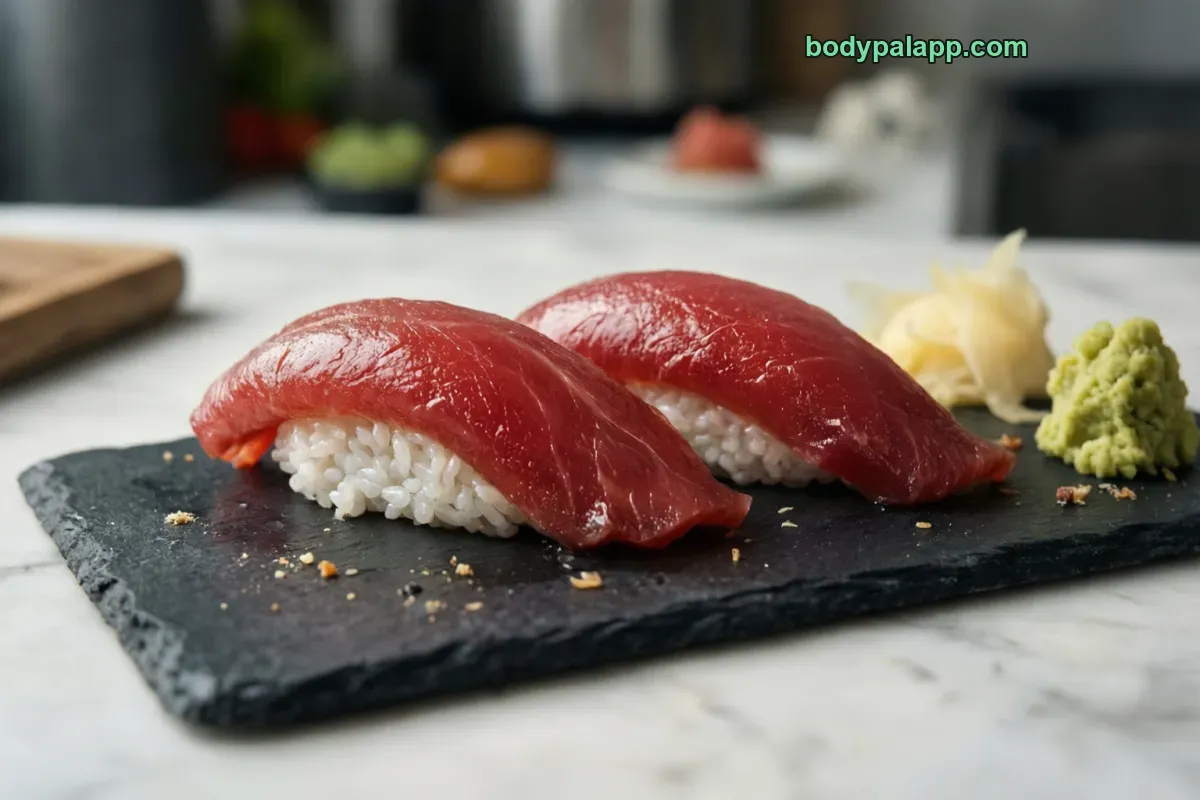
Tuna nigiri calories come to 29 for one 30 g piece and 97 per 100 g. The number to notice is sodium, not calories: one piece carries 103 mg, and a typical 180 g serving reaches 616 mg, or 27% of the daily value, before any dipping sauce touches it.
29kcal
1 piece · 30 g, tuna sushi with rice
32%protein
2.2 gProtein
5 gCarbs
0.1 gFat
How to burn off 29 kcal
—Walking, brisk
—Jogging
—Cycling, moderate
—Swimming
Skip the math. BodyPal counts these calories from your steps and workouts automatically.
Nutrition facts
Tuna sushi with rice · per 30 g
Calories
29 kcal
Protein
2.2 g
Carbohydrate
4.6 g
Fat
0.1 g
Saturated fat
0 g
Cholesterol
3 mg
Sodium
103 mg
Potassium
36 mg
Iron
0.1 mg
Source: USDA FoodData Central
🛡️
Verified nutrition data
Numbers on this page come from USDA FoodData Central, the U.S. Department of Agriculture’s food composition database, and from manufacturer labels where a branded product is named. Last verified September 2026. How we verify our data →
Tuna nigiri: calories, protein and sodium by serving
Percent of daily value uses the FDA reference of 2,000 kcal a day.
Serving
kcal
Protein
Carbs
Fat
Sodium
% DV kcal
1 piece (30 g)
29
2.2 g
4.6 g
0.1 g
103 mg
1%
Typical serving (180 g)
175
13.3 g
27.5 g
0.5 g
616 mg
9%
100 g
97
7.4 g
15.3 g
0.3 g
342 mg
5%
3 × 1 piece (30 g)
87
6.7 g
308 mg
5 × 1 piece (30 g)
146
11.1 g
513 mg
Five pieces come to 146 calories
One piece of tuna nigiri weighs about 30 g and comes to 29 calories, with 2.2 g of protein and 4.6 g of carbs. That is 1% of the daily calorie value. A single piece barely registers, so how many pieces you eat decides your total. Few people stop at one.
Two pieces add up to 58 calories, three to 87, and five to 146. The climb is steady because each slice of fish and pad of rice is roughly the same size. A typical restaurant serving of 180 g lands at 175 calories and 13.3 g of protein, about 9% of the daily calorie value.
Counting is the easiest way to track this food. Order a set, count the pieces, multiply by 29, and you will be close. Hand-pressed rice varies from one chef to the next, so treat the per-piece figure as an average, not a guarantee. If counting at the table feels fussy, BodyPal can log the plate from a photo.
Rice supplies two thirds of the calories
Per 100 g, tuna nigiri carries 15.3 g of carbs, 7.4 g of protein and just 0.3 g of fat. In calorie terms that is 66% carbs, 32% protein and 3% fat. The fish is lean. The rice underneath does most of the work.
That split surprises people who think of sushi as a protein dish. Tuna on its own is mostly protein, but in nigiri form each slice sits on a pad of rice that contributes more calories than the fish does. Sugars are low at 0.9 g per 100 g, and fiber is modest at 0.7 g.
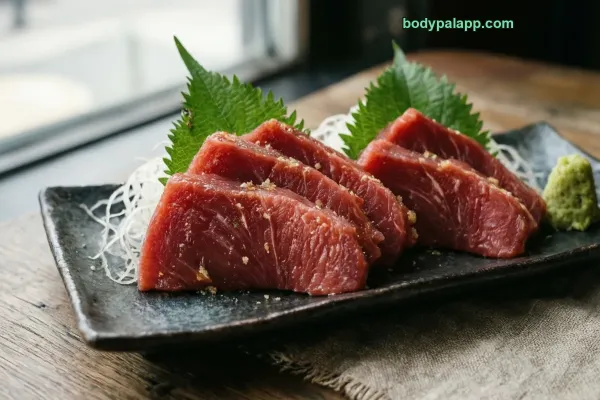
The upside is that fat stays close to zero: 0.1 g per piece and 0.5 g in a 180 g serving, with saturated fat at 0.1 g per 100 g. If you want more protein per calorie, the fix is simple. Swap some nigiri for sashimi, which drops the rice entirely.
Sodium is the row to watch
Tuna nigiri has 342 mg of sodium per 100 g. That is 15% of the daily value in an amount that supplies only 5% of daily calories. On that measure sodium outpaces calories about three to one.
One piece holds 103 mg, or 4% of the daily value. Three pieces reach 308 mg, five reach 513 mg, and a typical 180 g serving brings 616 mg, 27% of the daily value. Those figures come from the USDA's tuna sushi row and cover the sushi itself. Dipping sauce comes on top of them.
If you watch sodium, the plate is where the decision gets made. Dip sparingly, keep an eye on the piece count, and balance the rest of the day with lower-sodium foods. The other rows are calm: cholesterol is 10 mg per 100 g and potassium sits at 119 mg.
Nigiri needs a side that brings fiber
A typical serving of tuna nigiri gives 13.3 g of protein, 27% of the daily value, for 175 calories. That makes a reasonable light meal, but fiber is thin at 1.3 g, so the plate depends on what you put beside it.
Sides that add fiber and volume without much sodium round it out: a plain green salad, steamed vegetables, or edamame if you also want more protein. Miso soup and salty sauces push sodium higher, so if that row matters to you, choose one rather than both.
For a lighter order, mix nigiri with sashimi. For a fuller one, add more nigiri rather than switching to rolls with sauce. Packaged spicy tuna rolls from brands such as Pada Sushi, Yummi Sushi and American Fresh Sushi are a different product with their own labels, so check those separately.
How does tuna nigiri compare?
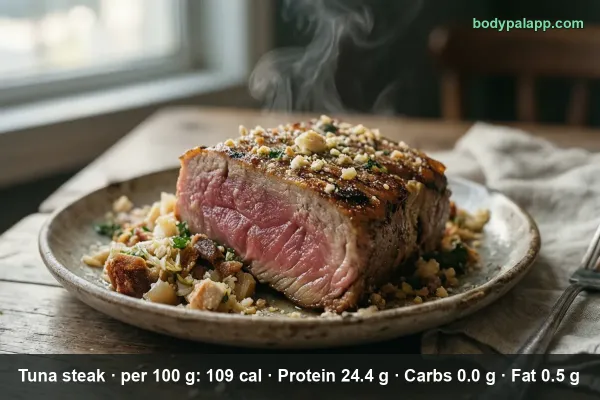
Here is how tuna nigiri stacks up against tuna sashimi, a salmon roll and a tuna steak, per 100 g and per usual serving.
Verdict: For the fewest calories per bite, tuna nigiri wins at 97 per 100 g, against 103 for a salmon roll and 109 for tuna sashimi. For protein and low sodium, pick tuna sashimi: it has 24.4 g of protein and 45 mg of sodium per 100 g, compared with 7.4 g and 342 mg for nigiri.
Most popular tuna nigiri brands in the United States
Packaged sushi products are dressed with mayo, sauce or sweetened rice, so they read higher per 100 g than plain tuna sushi. Source: manufacturer labels / USDA FoodData Central.
Tuna nigiri FAQs
How many calories are in one piece of tuna nigiri?
About 29 calories for a 30 g piece. Six pieces (180 g) come to 175 calories.
Is tuna nigiri good for weight loss?
A 180 g serving is 175 calories with 13.3 g protein and only 0.5 g fat, so it is light for its size.
Is tuna nigiri lower in calories than salmon sushi?
Yes, slightly. Tuna sushi is 97 calories per 100 g and salmon sushi is 103, a difference of 6 calories.
How much protein is in tuna nigiri?
7.4 g of protein per 100 g, which is about 2.2 g in one 30 g piece and 13.3 g in a 180 g serving.
What are the macros in tuna nigiri?
Per 100 g, tuna nigiri has 7.4 g of protein, 15.3 g of carbs and 0.3 g of fat for 97 calories. Carbs supply 66% of the calories, protein 32% and fat 3%.
What is the full nutrition for one piece of tuna nigiri?
One 30 g piece has 29 calories, 2.2 g of protein, 4.6 g of carbs, 0.1 g of fat and 103 mg of sodium. Fiber is 0.2 g and sugars 0.3 g, so the piece is mostly rice and lean fish.
How many calories are in a plate of tuna nigiri?
Two pieces of tuna nigiri come to 58 calories, three to 87 and five to 146. Each piece adds about 29, so count the pieces on the plate and multiply.
How many calories are in a typical serving of tuna nigiri?
A typical 180 g serving has 175 calories, 9% of the daily value. It also provides 13.3 g of protein, 27.5 g of carbs and 616 mg of sodium.
How much sodium is in tuna nigiri?
Tuna nigiri has 342 mg of sodium per 100 g, which is 15% of the daily value. One piece holds 103 mg, and five pieces reach 513 mg before any dipping sauce.