
How Many Calories in a Tuna Steak?
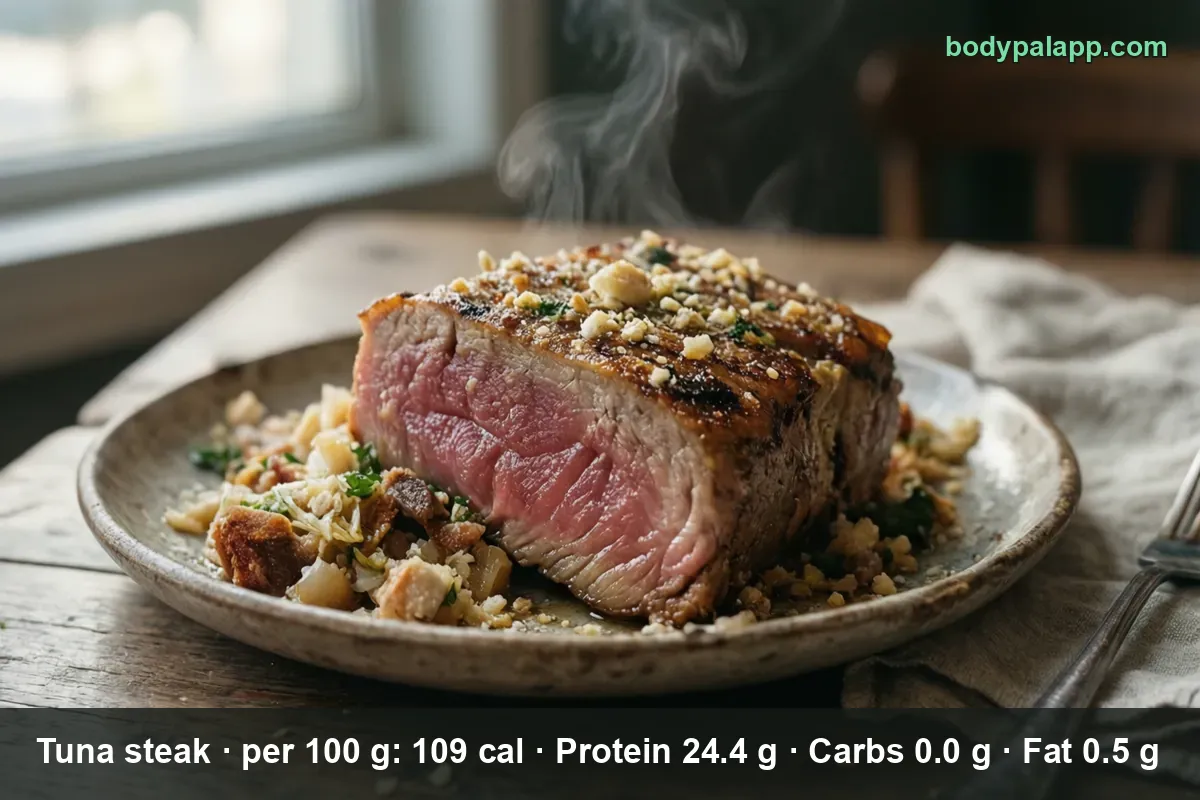
A 6 oz tuna steak, 170 g of raw yellowfin, is 185 calories — 109 calories per 100 g. The 4 oz portion most supermarkets sell comes to 123, and a 3 oz restaurant-plate serving is 93. Almost none of that is fat: the whole steak carries 0.8 g of it.
On this page
- Tuna steak quick facts
- Cooking removes water, not calories
- US portions, ounce by ounce
- Yellowfin, bluefin and skipjack
- Canned tuna steak is a different food
- What a marinade adds
- Protein per calorie
- How does tuna steak compare?
- Most popular tuna steak brands
- FAQ
Tuna steak quick facts
The reference here is the steak as you buy it: fresh or thawed yellowfin, sold by raw weight, which is how every label at the fish counter is written. That is USDA SR Legacy entry 175159, and the serving is one 6 oz steak, 170 g.
| Nutrient | Per 100 g | Per 1 steak, 6 oz (170 g) | % Daily Value |
|---|---|---|---|
| Calories | 109 kcal | 185 kcal | — |
| Total fat | 0.49 g | 0.8 g | 1% |
| Saturated fat | 0.17 g | 0.3 g | 1% |
| Carbohydrate | 0 g | 0 g | 0% |
| Dietary fiber | 0 g | 0 g | 0% |
| Total sugars | 0 g | 0 g | — |
| Protein | 24.4 g | 41.5 g | 83% |
| Sodium | 45 mg | 77 mg | 3% |
% Daily Value is based on a 2,000-calorie diet.
Verified nutrition data
Numbers on this page come from USDA FoodData Central, the U.S. Department of Agriculture’s food composition database, and from manufacturer labels where a branded product is named. Last verified September 2026. How we verify our data →
Read that table from the bottom and it stops looking like an ordinary piece of meat. One steak covers 83% of the day's protein and 1% of the day's fat. There is no added sugars row, and that is deliberate rather than an oversight: plain fish carries none, and this USDA entry has no value for it, so the line has been left out instead of filled with a zero we cannot source.
Two numbers sit outside the label block and both are larger than people expect. Cholesterol is 39 mg per 100 g, so 66 mg in the steak — 22% of the Daily Value. Potassium is 441 mg per 100 g, 750 mg in the steak, which is 16%. Trans fat is 0.02 g per 100 g, effectively nothing.
Cooking removes water, not calories
This is the single most expensive mistake in a tuna log, and it runs in one direction.
Raw yellowfin is 109 calories per 100 g. The same fish cooked with dry heat is 130. Searing did not add 21 calories to every 100 grams of fish — it drove off water, so what is left weighs less and reads denser.
Follow one steak through and the two entries agree. A 170 g raw steak is 185 calories. It leaves the pan at roughly 130 g, and 130 g against the cooked entry is 169 calories. The gap is the juice and the trace of fat left in the skillet, not a disagreement between two databases.
Cross the two and it falls apart. Weigh the steak raw at 170 g, then log it against the cooked figure, and you get 221 calories. That is 36 calories invented out of evaporated water, on a food where 36 calories is a fifth of the meal. The rule is short: raw weight with the raw entry, cooked weight with the cooked entry.
Most people should use the raw number, because most people weigh the steak before it hits the grill and because that is what the package says. If you only ever weigh food on the plate, use 130 per 100 g and be consistent about it.
US portions, ounce by ounce
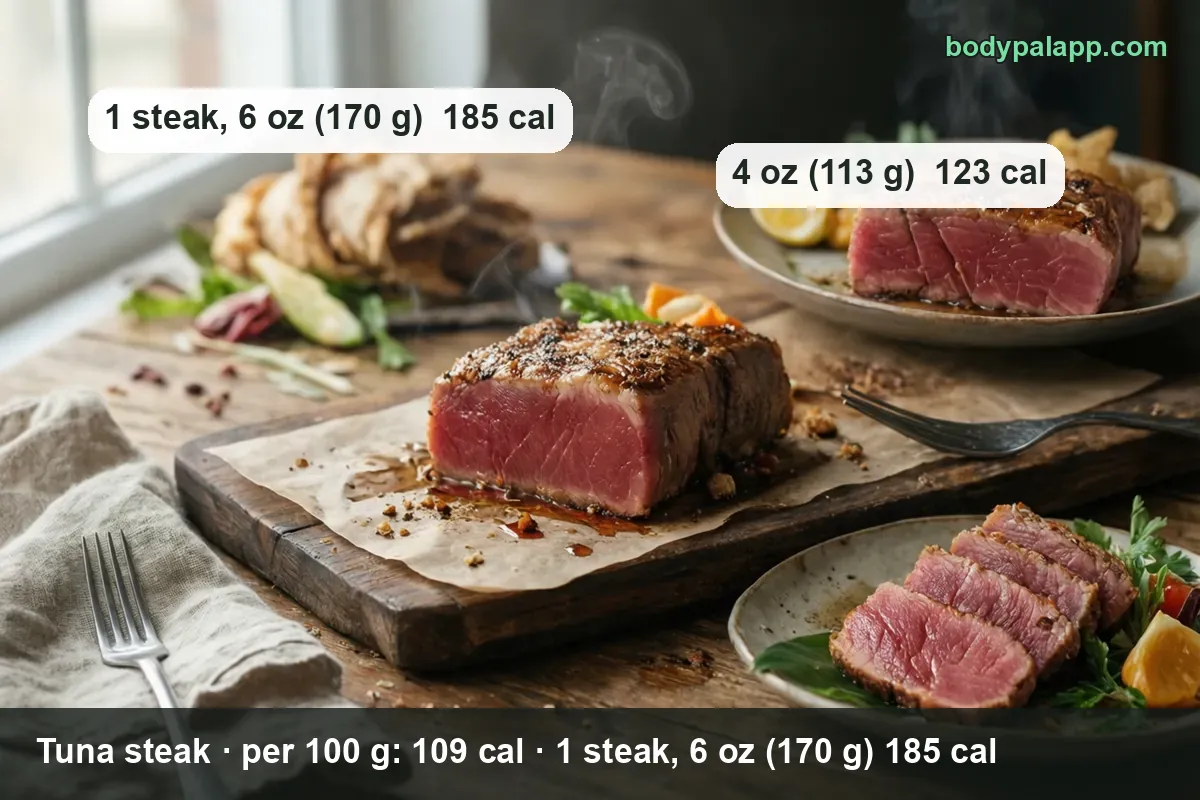
| Portion | Weight | Calories |
|---|---|---|
| 1 oz | 28 g | 31 cal |
| 3 oz | 85 g | 93 cal |
| 4 oz portion | 113 g | 123 cal |
| 1 steak, 6 oz | 170 g | 185 cal |
| 8 oz restaurant steak | 227 g | 247 cal |
| 100 g | 100 g | 109 cal |
The 4 oz row is the one that matters at the store. Nearly every frozen yellowfin pack in an American freezer aisle is portioned to 4 oz raw, 113 g, and the label prints that serving rather than a 100 g column — Sea Delight, 365, Full Circle and Great American all use it.
The number to keep in your head is 31 calories an ounce. An 8 oz steak off a restaurant grill is about 247, which is less than a single slice of most things it gets served with. Even the biggest portion here does not break 250.
Store labels back the USDA figure up almost exactly. The eight plain fresh and frozen tuna steaks in our database run 106 to 125 calories per 100 g, with protein between 22 and 25 g, zero carbohydrate and sodium in the 35 to 45 mg range. Bumble Bee's ANOVA ahi steak prints 190 calories for its 6 oz piece against the 185 above — a 3% difference on a whole steak, which is as close as a label and a database ever get.
Yellowfin, bluefin and skipjack
"Tuna steak" in an American store means yellowfin, sold as ahi. The other two species you might meet are not the same food on a calorie sheet.
| Species (cooked, dry heat) | Per 100 g | 3 oz (85 g) | Protein per 100 g | Fat per 100 g |
|---|---|---|---|---|
| Yellowfin (ahi) | 130 cal | 111 cal | 29.15 g | 0.59 g |
| Skipjack | 132 cal | 112 cal | 28.21 g | 1.29 g |
| Bluefin | 184 cal | 156 cal | 29.91 g | 6.28 g |
Yellowfin and skipjack are two calories apart per 100 g. Nobody needs to care which one is on the plate.
Bluefin is a different proposition. At 184 calories per 100 g it carries 6.28 g of fat where yellowfin carries 0.59 — more than ten times as much — and that fat is the whole of the 54-calorie gap, because protein is nearly identical at 29.91 g against 29.15. A 6 oz bluefin steak lands at 313 calories against 185 for the yellowfin one. You will rarely buy bluefin at a supermarket counter; you will meet it in a sushi restaurant, where the fatty belly cuts are the point.
Raw ahi, the sashimi-grade fish in a poke bowl, is the main entry on this page: 109 calories per 100 g, so a 4 oz scoop of cubed raw tuna is 123 calories before any rice, sauce or avocado.
Canned tuna steak is a different food
The word "steak" appears on cans and pouches too, and it means something else entirely there.
Take a solid wild tuna pouch sold as a steak. It is packed in brine, and it runs 411 mg of sodium per 100 g against 45 mg in fresh tuna — more than nine times as much, for a food with almost the same calorie count. Its serving is 2 oz, 56 g, not 6 oz, so the per-serving figure on the front of the pack looks small while the sodium density is the highest thing about it.
That is not an argument against canned tuna, which is cheap, shelf-stable and mostly protein. It is an argument against logging one as the other. The FDA sets the Daily Value for sodium at 2,300 mg; a fresh 6 oz steak uses 77 mg of it, or 3%. Swap in an equivalent weight of brined tuna and you are into three figures of sodium before you have added a thing.
If you are searching for calories in tuna steak and the packet in your hand has a pull tab, you want the canned tuna numbers, not these.
What a marinade adds
Freezer-aisle tuna increasingly comes pre-glazed, and the glaze is where the calories hide.
| Store steak, 5 oz (140 g) | Per 100 g | Per portion |
|---|---|---|
| Plain yellowfin | 109 cal | 153 cal |
| Teriyaki and ginger | 114 cal | 160 cal |
| Sweet chili | 121 cal | 169 cal |
| Mediterranean tomato and olive | 271 cal | 379 cal |
The first two are a rounding error. Teriyaki adds five calories per 100 g, sweet chili twelve, and if that buys you a fish dinner you actually want to eat, it is the cheapest flavor on this page. Sweet chili does bring 10.71 g of carbohydrate per 100 g, so a zero-carb food stops being one.
The oil-based version is the outlier: 271 calories per 100 g is two and a half times the plain fish, at 20 g of fat and 550 mg of sodium per 100 g. A 5 oz piece of it is 379 calories against 153 for the same weight of plain steak. The tuna underneath has not changed; the oil and olives around it have added 226 calories.
Read the panel on the sleeve, not the fish. A marinated steak is a sauce with fish in it, priced in calories accordingly.
Protein per calorie
Here is the number that makes tuna steak worth the counter price: 22 g of protein per 100 calories.
Almost nothing else in the fish case beats that ratio, and very little in the meat case does either. One 6 oz steak delivers 41.5 g of protein for 185 calories, which is 83% of the Daily Value in a single piece of fish that most people will finish in five minutes. Mahimahi, the nearest lean white fish here, ties it on calories at a 3 oz serving, 93 either way, and comes in half a gram of protein behind at 20.2 g against 20.7.
Bluefin shows what the ratio costs when fat enters. It carries a little more protein per 100 g, 29.91 g, but needs 184 calories to deliver it — around 16 g of protein per 100 calories, well short of yellowfin's 22.
The seafood angle is worth a line too. The Dietary Guidelines for Americans put adult seafood intake at about 8 oz a week, and two 4 oz tuna steaks cover that week in 246 calories total. MyPlate counts it in the protein foods group, where an ounce of cooked seafood counts as one ounce-equivalent.
One caveat that belongs next to the praise: the cholesterol figure of 66 mg in a steak is 22% of the Daily Value, high for a food this lean, because there is so little else in the fish to dilute it.
How does tuna steak compare?
Every row below is a USDA entry measured at the same household unit, 3 oz (85 g), so the numbers are directly comparable.
| Fish (3 oz, 85 g) | Calories | Protein | Carbs | Fat |
|---|---|---|---|---|
| Tuna steak, yellowfin, raw | 93 cal | 20.7 g | 0 g | 0.4 g |
| Tuna steak, yellowfin, seared | 111 cal | 24.8 g | 0 g | 0.5 g |
| Skipjack tuna, cooked | 112 cal | 24.0 g | 0 g | 1.1 g |
| Bluefin tuna, cooked | 156 cal | 25.4 g | 0 g | 5.3 g |
| Mahimahi, cooked | 93 cal | 20.2 g | 0 g | 0.8 g |
Our take: for a lean high-protein plate, seared yellowfin is the pick — 111 calories for 24.8 g of protein at 3 oz beats everything else in the table on protein per calorie, including bluefin, which costs 45 more calories for half a gram more protein. Mahimahi is the honest alternative if tuna is expensive that week; it lands within a gram of protein at the same 93 calories. Bluefin earns its 156 calories only if you are eating it for the fat, which is exactly what people order it for.
The wider point is that the calorie question barely separates these fish. Four of the five rows sit between 93 and 112 calories for a 3 oz serving. What changes the number on a tuna plate is the sauce, the oil in the pan and the rice underneath, not the species.
Most popular tuna steak brands in the United States
Ranked by how widely each product appears among foods sold in the United States, from the BodyPal food database of over 3.3 million products. Calories are the figures printed on each Nutrition Facts label, checked against USDA FoodData Central.
| Product | Calories (per 100 g) |
|---|---|
| Bumble Bee ANOVA Ahi Tuna Steaks | 112 cal |
| Bumble Bee ANOVA Ahi Tuna Steaks 4 oz | 110 cal |
| JAVA Tuna Steaks | 125 cal |
| Great American Seafood Tuna Steaks | 106 cal |
| Hawaiian Select Ahi Tuna Steak | 106 cal |
| 365 Whole Foods Market Wild-Caught Yellowfin Tuna Steaks | 106 cal |
Brand popularity: BodyPal food database. Nutrition: manufacturer labels / USDA FoodData Central.
Tuna steak FAQs
How many calories in a tuna steak?
185 calories in a 6 oz steak, 170 g of raw yellowfin, at 109 calories per 100 g. A 4 oz portion is 123 calories and a 3 oz serving is 93. An 8 oz restaurant steak comes to 247. Only 0.8 g of the 6 oz steak is fat.
How many calories in a 4 oz tuna steak?
123 calories for 113 g of raw yellowfin. That is the portion size printed on most frozen tuna packs in American stores, and store labels land between 120 and 140 calories for it. It carries about 27.6 g of protein and 51 mg of sodium.
How much protein is in a tuna steak?
41.5 g in a 6 oz steak, which is 83% of the Daily Value, at 24.4 g per 100 g. That works out to about 22 g of protein for every 100 calories, the best ratio at the fish counter. A 4 oz portion carries 27.6 g.
How many calories in seared ahi tuna?
111 calories for a 3 oz serving of cooked yellowfin, at 130 calories per 100 g. A 170 g raw steak seared down to about 130 g on the plate is 169 calories. The searing itself adds nothing; the higher per-100 g figure is lost water.
Does cooking change the calories in a tuna steak?
No, but it changes the weight. Raw yellowfin is 109 calories per 100 g and cooked is 130, because roughly a quarter of the water leaves. Weigh raw and log raw, or weigh cooked and log cooked. Mixing them turns a 185-calorie steak into 221 on paper.
Is tuna steak good for weight loss?
It is one of the highest-protein foods per calorie you can buy: 41.5 g of protein for 185 calories in a 6 oz steak, with zero carbohydrate and 0.8 g of fat. Nothing about a single food guarantees a result, but on protein per calorie tuna steak is hard to beat.
Tuna steak or canned tuna — what is the difference?
Sodium, mostly. A canned or pouched tuna sold as a steak runs about 411 mg of sodium per 100 g against 45 mg in a fresh steak, more than nine times as much, at a similar calorie count. Canned servings are also 2 oz rather than 6 oz.
Is bluefin tuna higher in calories than ahi?
Yes, by 54 calories per 100 g: bluefin is 184 cooked against 130 for yellowfin ahi. The whole gap is fat, 6.28 g against 0.59 g, since protein is nearly identical. A 3 oz serving is 156 calories for bluefin and 111 for ahi.
Similar foods
- Deli Turkey Breast — 31 cal per slice
- Canadian Bacon — 63 cal for 2 slices
- Curried Chicken — 257 cal per cup
- Deli Ham — 30 cal per slice
- Turkey Tenderloin — 120 cal per 4 oz
- Turkey deli meat — 89 cal for 3 slices
Count it without the math
Point the camera at the plate and BodyPal reads the steak, sizes the portion and logs the calories and the protein for you.


How long does it take to burn off tuna steak?
A 6 oz steak (170 g) is 185 kcal. Enter your weight and the amount you ate to see how long it takes you to burn that off:
lb
| Activity | Time to burn 185 kcal |
|---|---|
| Walking, brisk | 37 min |
| Cycling, moderate | 23 min |
| Swimming, moderate | 26 min |
| Jogging | 22 min |
| Weight training, moderate | 41 min |
Times are for a 155 lb adult at a steady pace; change the weight to see yours. The amount is set to the portion in the text (170 g); change it to what you actually ate. BodyPal works this out from your steps automatically.
This table assumes you know your daily total. If you do not, the daily calorie calculator works it out from five numbers.