
How many calories are in Canadian bacon?
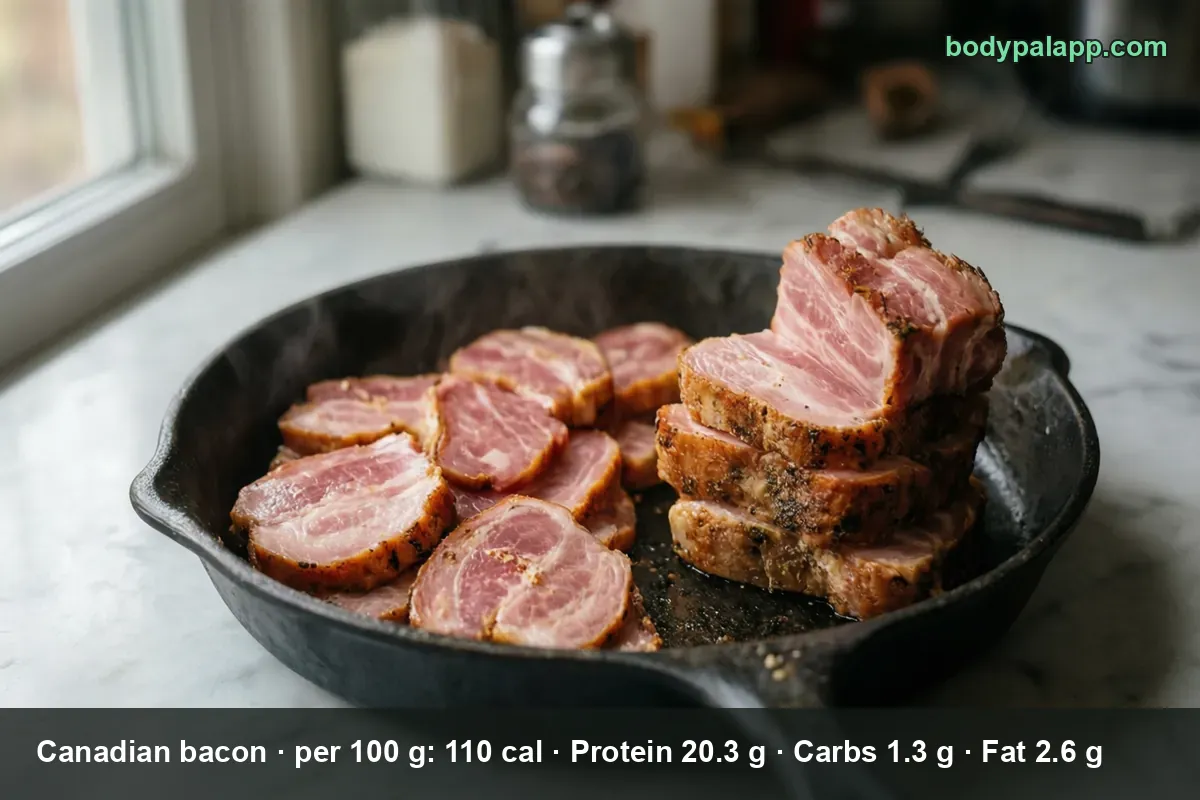
Two slices of Canadian bacon weigh 57 g and carry 63 calories. Per 100 g the unprepared meat runs 110 calories, and almost all of that is protein — 20.31 g per 100 g against 2.62 g of fat. That makes it the leanest thing most people call bacon, and frying changes it less than the label suggests.
On this page
- Canadian bacon quick facts
- US servings, from one slice to a six-ounce package
- Pan-fried, cooked and on an English muffin
- Sodium, not calories, is the row to watch
- How does Canadian bacon compare?
- Most popular canadian bacon brands
- Canadian bacon FAQs
Canadian bacon quick facts
The row behind these figures is SR Legacy 167869, "Canadian bacon, unprepared". That choice is deliberate. American Canadian bacon reaches the store already cured and cooked, sliced into rounds, and most people eat it straight from the package or warm it for a minute in a dry pan. The unprepared record is the food in your hand at the moment you log it, and the retail labels on the Jones and Hormel uncured packs, 118 to 125 calories per 100 g, sit closer to it than to the pan-fried record further down this page.
USDA's own serving for this record is two slices, six to a six-ounce package. That is the portion in the middle column below.
| Nutrient | Per 100 g | Per 2 slices (57 g) | % Daily Value |
|---|---|---|---|
| Calories | 110 | 63 | — |
| Total fat | 2.62 g | 1.5 g | 2% |
| Saturated fat | 0.9 g | 0.5 g | 3% |
| Carbohydrate | 1.34 g | 0.8 g | 0% |
| Dietary fiber | 0 g | 0 g | 0% |
| Total sugars | 0.9 g | 0.5 g | — |
| Protein | 20.31 g | 11.6 g | 23% |
| Sodium | 751 mg | 428 mg | 19% |
% Daily Value is based on a 2,000-calorie diet.
Verified nutrition data
Numbers on this page come from USDA FoodData Central, the U.S. Department of Agriculture’s food composition database, and from manufacturer labels where a branded product is named. Last verified September 2026. How we verify our data →
There is no added sugars row here because USDA does not publish added sugars for this SR Legacy record; the 0.9 g of total sugars per 100 g comes with the cure. Cholesterol runs 48 mg per 100 g, or 27 mg in the two-slice serving, 9% of the Daily Value. Potassium is 683 mg per 100 g, 389 mg per serving, 8% of the Daily Value. Both are optional rows on a US label, and neither one is a reason to eat or skip this meat.
The shape of the numbers is unusual for a cured pork product. Twenty-three percent of a day's protein for 63 calories is a ratio you normally get from skinless chicken breast or canned tuna, not from something sold beside the bacon.
US servings, from one slice to a six-ounce package
| Serving | Weight | Calories |
|---|---|---|
| 1 slice | 28.5 g | 31 kcal |
| 1 oz | 28.35 g | 31 kcal |
| 2 slices, 6 per 6-oz package | 57 g | 63 kcal |
| 3 oz | 85 g | 94 kcal |
| 1 package, 6 oz | 170 g | 187 kcal |
| Per 100 g | 100 g | 110 kcal |
The two-slice, three-ounce and full-package lines are USDA household measures for this record. The single slice and the one-ounce line are our own arithmetic from the USDA 100 g figure, not USDA servings.
That first pair is a useful accident. A standard slice from a six-ounce pack weighs about 28.5 g and an ounce weighs 28.35 g, so a slice and an ounce land on the same 31 calories. If a recipe calls for two ounces of Canadian bacon and all you have is a package of rounds, two slices is close enough to stop measuring.
The number people underestimate is the package. Six ounces of Canadian bacon is 187 calories — less than a bagel — which is why it disappears into omelets and breakfast bowls without anyone noticing. Calories are not the reason to slow down there. Sodium is, and that comes further down.
Pan-fried, cooked and on an English muffin
| Version | Per 100 g | Typical piece | Calories |
|---|---|---|---|
| Unprepared, from the package | 110 kcal | 2 slices (57 g) | 63 kcal |
| Pan-fried | 146 kcal | 1 slice (13.8 g) | 20 kcal |
| Cooked, USDA household ounce | 146 kcal | 1 oz cooked (28.35 g) | 41 kcal |
| Cooked slice | 146 kcal | 1 slice (23 g) | 34 kcal |
| Egg, cheese and Canadian bacon English muffin | 228 kcal | 1 sandwich (126 g) | 287 kcal |
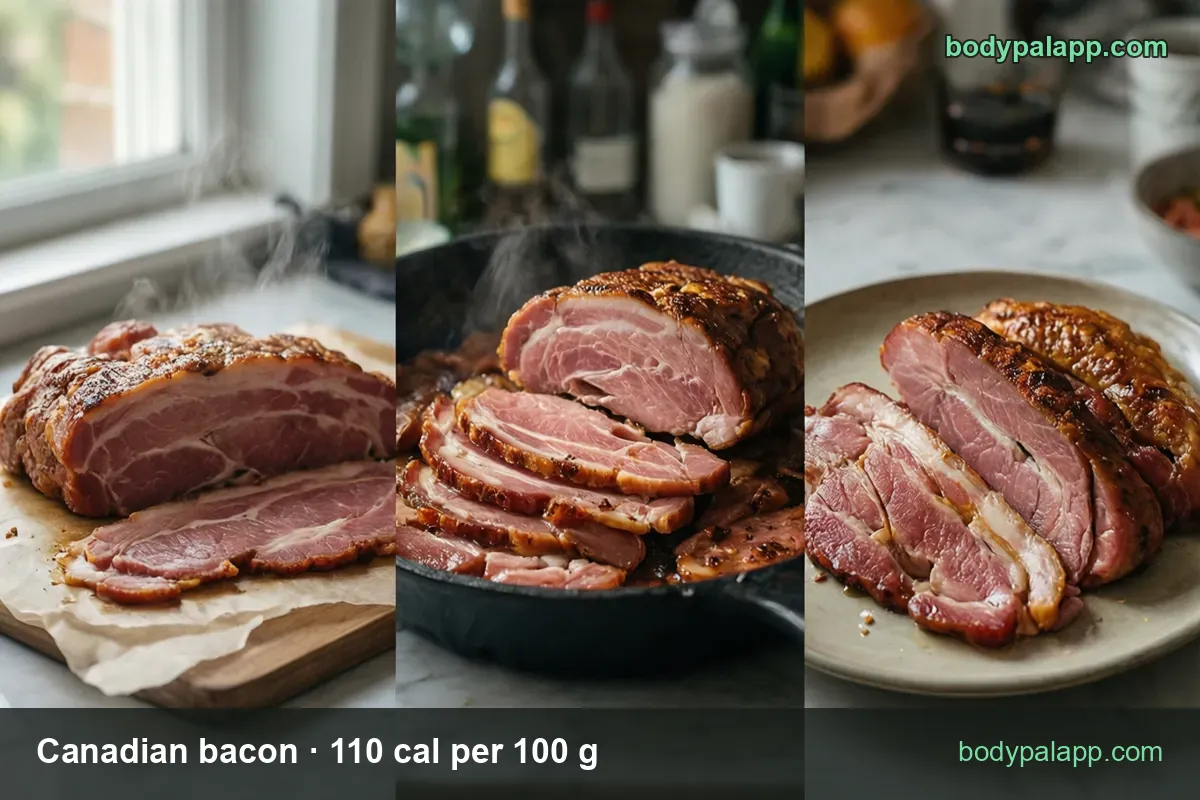
The jump from 110 to 146 calories per 100 g looks like frying loaded the meat with fat. It did not. Fat goes from 2.62 g to 2.78 g across those two records — a difference of 0.16 g, well inside the noise of any home pan. What changed is water. Cooked slices are lighter and denser, so every gram carries more of everything, including the salt.
Follow one slice through instead of one hundred grams and the story flips. Raw, a 28.5 g slice is 31 calories. Cooked, that same slice weighs about 23 g and reads 34 calories. Three calories. The pan-fried record's own slice is smaller again at 13.8 g and 20 calories, which is what a thin-cut round shrinks to. Whichever slice you start with, browning it is close to free.
The English muffin sandwich is the outlier and it is not a meat number at all. At 287 calories for a 126 g sandwich, the muffin, the egg and the cheese supply almost everything above the 34 calories of bacon inside it. Carbohydrate climbs to 21.67 g per 100 g and fat to 9.66 g. If your log says "Canadian bacon breakfast" and the total looks high, this is usually what happened.
Retail labels sit around the same place with different math. Jones Dairy Farm prints 3 slices at 51 g and 60 calories; Hormel's uncured pack prints 3 slices at 64 g and 80 calories; Smithfield lists 2 slices at 34 g and 30 calories. Per 100 g the brands span 88 to 143 calories, and their label servings differ just as much, from 34 g for two Smithfield slices to 64 g for three from Hormel, which is why "three slices" is not a portion size until you know the brand.
Sodium, not calories, is the row to watch
Two slices deliver 428 mg of sodium for 63 calories — 19% of the Daily Value against 3% of a 2,000-calorie day. That is the trade this food asks you to make. Nearly a fifth of a day's salt allowance rides on a portion small enough to vanish inside an omelet.
Scale it up and the gap widens. A whole six-ounce package at 170 g works out to roughly 1,277 mg of sodium, about 56% of the 2,300 mg daily limit named in the Dietary Guidelines for Americans — our own arithmetic from the USDA 100 g figure, not a USDA serving. In plain terms, that is a little over half a teaspoon of table salt, for 187 calories of meat.
Frying does not help. The pan-fried record carries 993 mg of sodium per 100 g, so a 23 g cooked slice lands near 228 mg by our arithmetic, roughly the same salt as the raw slice it came from, concentrated into less food. Rinsing does nothing either; the cure is through the meat, not on it.
None of that makes Canadian bacon a bad choice. It makes it a specific one. If you are building a high-protein breakfast and your sodium budget is loose, 23% of a day's protein for 63 calories is hard to beat. If you already eat canned soup, deli meat or restaurant food most days, this is the item to portion at two slices and leave there.
How does Canadian bacon compare?
| Meat | Per 100 g | US serving | Protein per 100 g | Calories |
|---|---|---|---|---|
| Canadian bacon | 110 kcal | 2 slices, 57 g | 20.31 g | 63 kcal |
| Cured ham, water added, lean only | 110 kcal | 3 oz, 85 g | 17.34 g | 94 kcal |
| Cured ham with natural juices, lean only | 111 kcal | 3 oz, 85 g | 19.44 g | 94 kcal |
| Pork tenderloin, lean, raw | 109 kcal | 4 oz, 113 g | 20.95 g | 123 kcal |
Our take: on calories these four are the same food. The whole spread is 109 to 111 calories per 100 g, a two-calorie range, so anyone choosing between Canadian bacon and sliced deli ham on calorie grounds is choosing on nothing. Protein is where they separate. Canadian bacon and pork tenderloin both clear 20 g per 100 g while water-added ham drops to 17.34 g, the difference being how much brine the product is allowed to hold. For an everyday breakfast we would take the Canadian bacon and control the portion at two slices; for a dinner protein where the salt matters more, tenderloin gives you the same protein with none of the cure. The one thing worth remembering is that a serving of ham is usually poured at three ounces and a serving of Canadian bacon at two slices, and that alone is a 31-calorie difference before either meat hits the pan.
Most popular canadian bacon brands in the United States
Ranked by how widely each product appears among foods sold in the United States, from the BodyPal food database of over 3.3 million products. Calories are the figures printed on each Nutrition Facts label, checked against USDA FoodData Central.
| Product | Calories (per 100 g) |
|---|---|
| Jones Dairy Farm Hickory Smoked Canadian Bacon | 118 cal |
| Hormel Canadian Bacon | 143 cal |
| Hormel Uncured Canadian Bacon | 125 cal |
| Niman Ranch Uncured Canadian Bacon | 136 cal |
| Smithfield Naturally Hickory Smoked Canadian Bacon | 88 cal |
| Jones Dairy Farm Cherrywood Smoked Uncured Canadian Bacon | 118 cal |
Brand popularity: BodyPal food database. Nutrition: manufacturer labels / USDA FoodData Central.
Canadian bacon FAQs
How many calories are in 2 slices of Canadian bacon?
63 calories for two slices weighing 57 g, the serving printed on a standard 6-ounce package of six. That works out to 110 calories per 100 g. The same two slices bring 11.6 g of protein, 1.5 g of fat and 0.8 g of carbohydrate, so the calories are almost entirely lean meat.
Is Canadian bacon healthier than regular bacon?
It is far leaner: 2.62 g of fat and 20.31 g of protein per 100 g, because Canadian bacon is cut from the pork loin rather than the belly. The catch is salt. USDA lists 751 mg of sodium per 100 g, so two slices already cover 19% of the daily limit.
How much protein is in Canadian bacon?
20.31 g per 100 g unprepared, which is 11.6 g in a two-slice 57 g serving and 23% of the Daily Value. Pan-fried, the figure concentrates to 28.31 g per 100 g as water cooks off. Per calorie it is one of the densest protein sources at the breakfast table.
How much sodium is in Canadian bacon?
751 mg per 100 g, or 428 mg in a two-slice serving, 19% of the 2,300 mg daily limit for only 63 calories. A whole 6-ounce package works out to 1,277 mg, 56% of the day. Pan-frying concentrates it further, to 993 mg per 100 g, so a fried portion of the same weight carries more salt, not less.
Is Canadian bacon already cooked?
The 110 calories per 100 g on this page come from a record labeled unprepared, but US Canadian bacon is sold fully cured and cooked, ready to eat straight from the package. Heating is for texture and browning. Frying only drives off water, so a 23 g cooked slice is 34 calories.
How does Canadian bacon compare to ham on calories?
They are within 1 calorie per 100 g. Canadian bacon is 110, lean boneless ham with water added is 110, and ham with natural juices is 111. A 3-ounce serving of either ham is 94 calories, exactly what 3 ounces of Canadian bacon comes to. Protein separates them: 20.31 g against 17.34 g.
Does frying Canadian bacon add calories?
Pan-fried Canadian bacon reads 146 calories per 100 g against 110 unprepared, but fat only moves from 2.62 g to 2.78 g. The gap is evaporated water, not added grease. Cooked slices weigh less, so one slice goes from about 31 calories raw to 34 cooked in a dry pan.
How many carbs are in Canadian bacon?
1.34 g per 100 g, which is 0.8 g in a two-slice serving and 0% of the Daily Value. There is no fiber at all, and total sugars are 0.9 g per 100 g, or 0.5 g per serving. USDA does not publish added sugars for this SR Legacy record.
Similar foods
- Deli Turkey Breast — 31 cal per slice
- Tuna steak — 185 cal per steak, 6 oz
- Curried Chicken — 257 cal per cup
- Deli Ham — 30 cal per slice
- Turkey Tenderloin — 120 cal per 4 oz
- Turkey deli meat — 89 cal for 3 slices
Count it without the math
Point the camera at the plate and BodyPal counts the slices for you, package portion and all.


How long does it take to burn off Canadian bacon?
Two slices (57 g) is 63 kcal. Enter your weight and the amount you ate to see how long it takes you to burn that off:
lb
| Activity | Time to burn 63 kcal |
|---|---|
| Walking, brisk | 13 min |
| Cycling, moderate | 8 min |
| Swimming, moderate | 9 min |
| Jogging | 7 min |
| Weight training, moderate | 14 min |
Times are for a 155 lb adult at a steady pace; change the weight to see yours. The amount is set to the portion in the text (57 g); change it to what you actually ate. BodyPal works this out from your steps automatically.
This table assumes you know your daily total. If you do not, the daily calorie calculator works it out from five numbers.