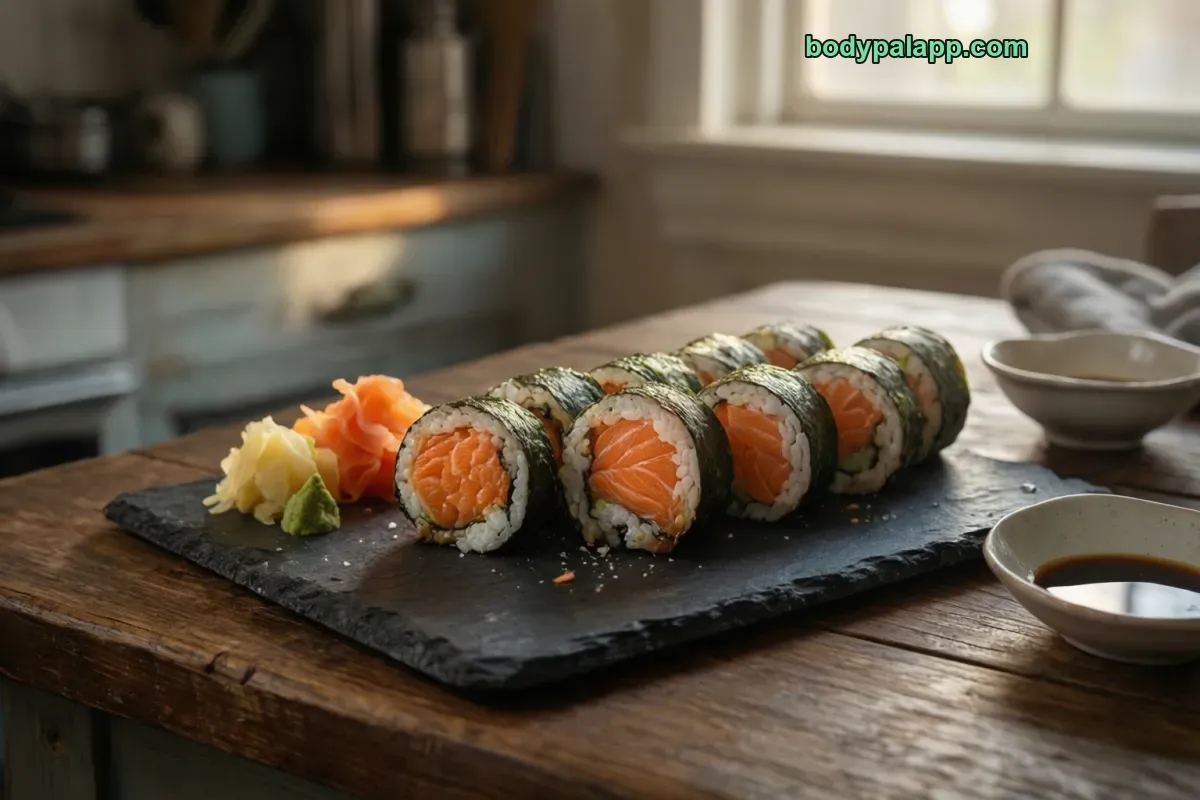
Salmon roll calories come to 185 for a whole roll (180 g) and 103 per 100 g, or 31 per piece. It is a light, rice-led food: carbs supply 61% of the calories. The number to notice is sodium, at 630 mg per roll, 27% of the daily value before any soy sauce.
185kcal
1 6-piece roll · 180 g, salmon maki with rice
27%protein
12.4 gProtein
28 gCarbs
2.3 gFat
How to burn off 185 kcal
—Walking, brisk
—Jogging
—Cycling, moderate
—Swimming
Skip the math. BodyPal counts these calories from your steps and workouts automatically.
Nutrition facts
Salmon maki with rice · per 180 g
Calories
185 kcal
Protein
12.4 g
Carbohydrate
28 g
Fat
2.3 g
Saturated fat
0.4 g
Cholesterol
22 mg
Sodium
630 mg
Potassium
182 mg
Iron
0.4 mg
Source: USDA FoodData Central
🛡️
Verified nutrition data
Numbers on this page come from USDA FoodData Central, the U.S. Department of Agriculture’s food composition database, and from manufacturer labels where a branded product is named. Last verified September 2026. How we verify our data →
Salmon roll: calories, protein and sodium by serving
Percent of daily value uses the FDA reference of 2,000 kcal a day.
Serving
kcal
Protein
Carbs
Fat
Sodium
% DV kcal
Whole roll (180 g)
185
12.4 g
27.5 g
2.3 g
630 mg
9%
1 piece (30 g)
31
2.1 g
4.6 g
0.4 g
105 mg
2%
100 g
103
6.9 g
15.3 g
1.3 g
350 mg
5%
3 × Whole roll (180 g)
556
37.2 g
1,890 mg
5 × Whole roll (180 g)
927
61.9 g
3,150 mg
One roll is 185 calories, three are a 556-calorie meal
A standard salmon maki roll weighs about 180 g and is usually sliced into 6 pieces. Each piece of roughly 30 g carries 31 calories, 2.1 g of protein and 4.6 g of carbs. The whole roll lands at 185 calories, just 9% of the daily value for energy, which makes it one of the lighter items on a sushi menu.
The catch is that rolls rarely come alone. Two rolls reach 371 calories and 24.8 g of protein. Three reach 556 calories and 37.2 g of protein, which is a full dinner by most standards. A five-roll platter, the kind meant for sharing but sometimes finished solo, totals 927 calories.
Counting pieces is the easiest way to keep the total honest. Grams are hard to judge at a restaurant, but pieces are not, and each one adds about 31 calories. If you would rather skip the math, BodyPal can log the roll from a photo.
Rice supplies most of the energy, salmon most of the protein
Carbs make up 61% of the calories in a salmon roll, protein 27% and fat only 11%. That split is the signature of maki: a slim strip of fish wrapped in a lot of rice. Per 100 g you get 15.3 g of carbs against 6.9 g of protein.
The protein is still worth noticing. A whole roll delivers 12.4 g, which covers 25% of the daily value for just 185 calories. Fat stays low at 2.3 g per roll, and saturated fat is a mere 0.2 g per 100 g, because the fish is a small share of the weight and plain maki has no sauce or cheese.
What the roll lacks is fiber. You get 1.3 g per roll and 1.7 g of sugars, so nearly all the carbs come from the rice itself. If protein is your priority, salmon beats the vegetable rolls on that count by a wide margin.
Sodium is the row to watch
A single roll carries 630 mg of sodium, 27% of the daily value, while its calories sit at only 9%. That gap is the real story: the roll is light on energy and heavy on salt for its size. Per 100 g the figure is 350 mg.
Portions multiply it quickly. Two rolls bring 1,260 mg, three bring 1,890 mg, and a five-roll platter reaches 3,150 mg, more than the full daily value in one sitting. Few people think of sushi as a salty meal, but the numbers say otherwise once you order a second roll.
These figures cover the roll alone. Soy sauce for dipping comes on top, so if you watch sodium, dip lightly or ask for a reduced-sodium bottle. The rest of the label is quiet: cholesterol is 12 mg per 100 g and potassium is 101 mg, so sodium is the one line that deserves your attention.
Pair one roll with protein, not more rice
One roll at 185 calories works as a light lunch or a snack. Two rolls, at 371 calories with 24.8 g of protein, look more like a complete meal for most appetites. Past that, the extra calories come mostly from rice, and the sodium keeps climbing with every roll.
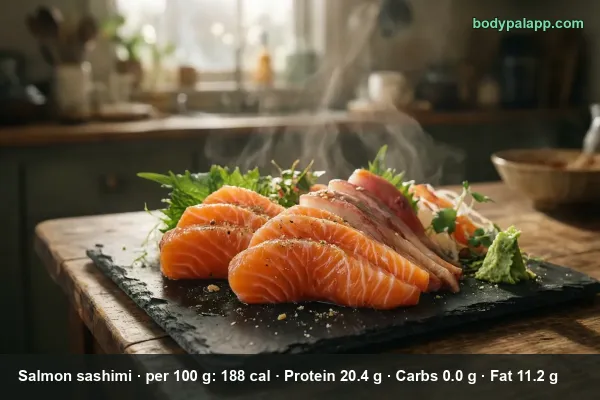
To add staying power without more starch, pair a roll with salmon sashimi, which has 20.4 g of protein per 100 g and no carbs. A plain vegetable side adds volume the roll does not have. Both options let you eat more food without doubling the rice.
Watch the variety you order. Spicy, baked and cream cheese rolls, such as the Gowasabi Sushi Spicy Salmon Roll or the Samurai Sushi Philly Smoked Salmon Roll, add sauce or fat that plain maki does not carry. Log those as their own item rather than borrowing the numbers on this page, which describe a simple salmon maki with rice.
How does salmon roll compare?
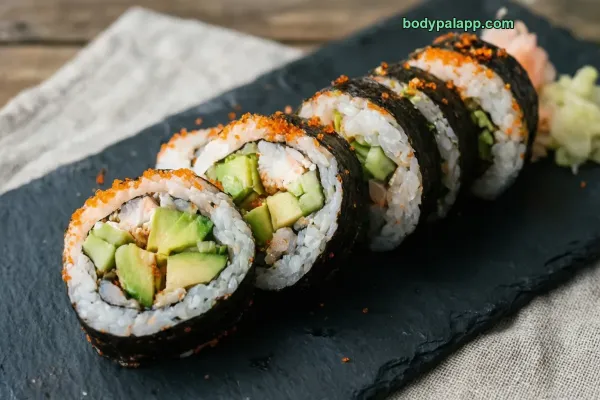
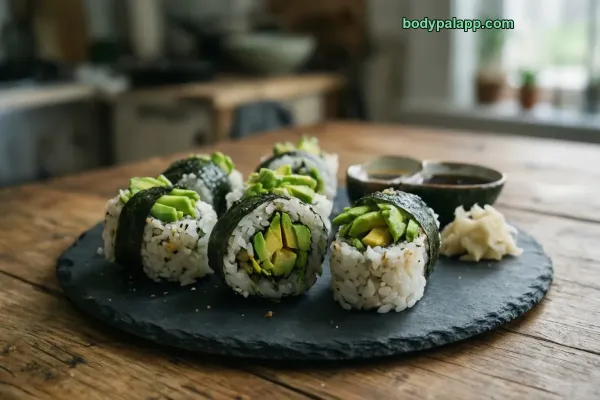
Here is how a salmon roll stacks up against a California roll, an avocado roll and salmon sashimi, per 100 g and per usual serving.
Verdict: For the fewest calories per serving, the avocado roll at 167 and the California roll at 169 edge out salmon at 185, but the salmon roll gives far more protein, 6.9 g per 100 g against 2.9 and 1.8. If staying full matters most, pick salmon sashimi: 20.4 g of protein per 100 g and no rice, though at 188 calories per 100 g it is the denser choice.
Most popular salmon roll brands in the United States
Ranked by popularity in the BodyPal database
# Productkcal / 100 g
1Pada Sushi Salmon Roll with Imitation Crab, Cucumber and Avocado4 pieces · 125 g152 kcal
2Gowasabi Sushi Spicy Salmon Roll1 roll · 266 g165 kcal
Packaged rolls usually add spicy mayo, cream cheese or avocado, so they read higher per 100 g than the plain salmon maki above. Source: manufacturer labels / USDA FoodData Central.
Salmon roll FAQs
How many calories are in a salmon roll?
A six-piece salmon roll weighs about 180 g and has about 185 calories. One piece is about 31 calories.
Is a salmon roll good for weight loss?
One 180 g roll is 185 calories with 12.4 g protein, 27.5 g carbs and only 2.3 g fat, since most of the weight is rice.
Salmon roll or California roll: which has fewer calories?
A California roll has 94 calories per 100 g against 103 for a salmon roll, so a 180 g portion is about 169 calories versus 185.
How much protein is in a salmon roll?
About 6.9 g of protein per 100 g, which works out to 12.4 g in a 180 g roll and 2.1 g in a single piece.
How many calories are in a 6-piece salmon roll?
A 6-piece salmon roll weighing about 180 g has 185 calories. Each piece adds roughly 31 calories, so a roll cut into more or fewer slices still totals about the same for the same weight.
What are the macros of a salmon roll?
A whole salmon roll has 12.4 g of protein, 27.5 g of carbs and 2.3 g of fat. By calories that is 61% carbs, 27% protein and 11% fat, so the rice drives most of the energy.
How many calories are in one piece of salmon sushi?
One piece of salmon maki, about 30 g, has 31 calories, with 2.1 g of protein and 4.6 g of carbs. Salmon sashimi without rice runs 188 calories per 100 g because of its 11.2 g of fat.
What are the total calories and protein in two salmon rolls?
Two salmon rolls total 371 calories and 24.8 g of protein. Three rolls come to 556 calories and 37.2 g of protein, so each extra roll adds about 185 calories and 12.4 g of protein.
What else does salmon maki nutrition include?
A 180 g salmon maki roll has 630 mg of sodium, which is 27% of the daily value, plus 1.3 g of fiber and 1.7 g of sugars. Saturated fat is minimal at 0.2 g per 100 g.