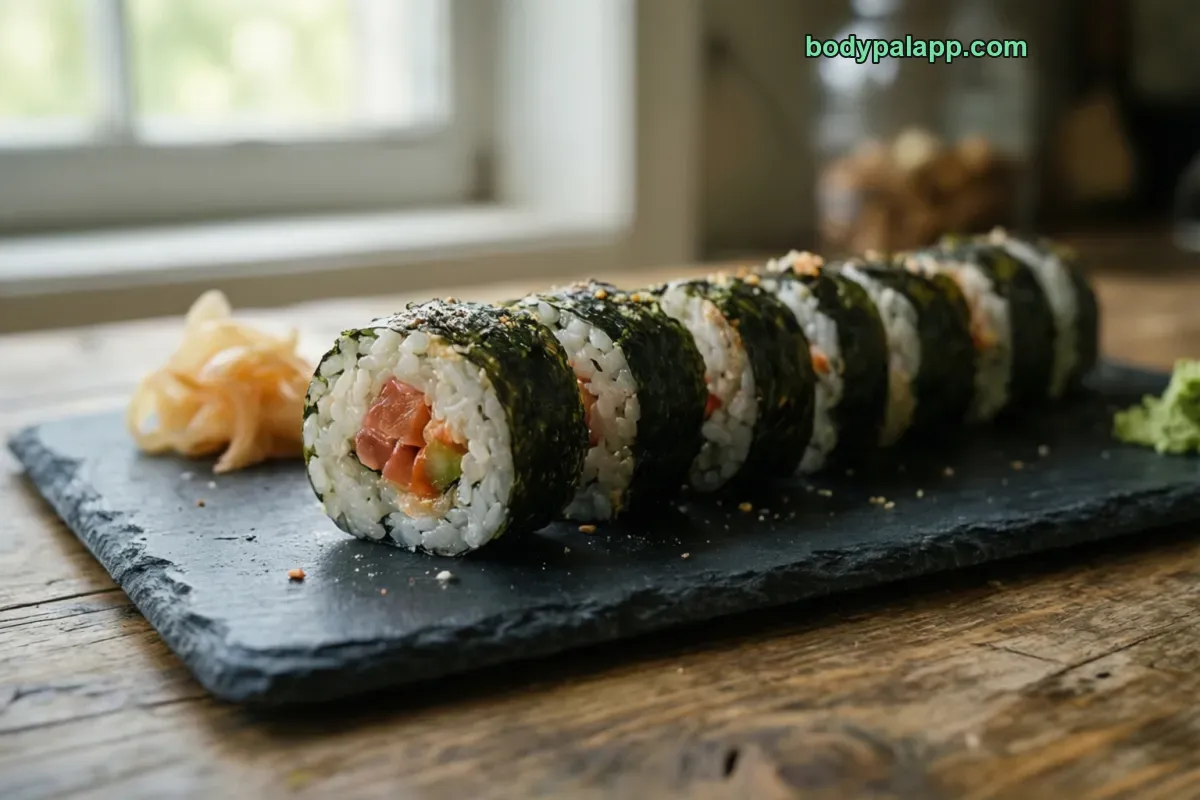
Maki sushi calories come to 169 for a standard roll of 6 pieces (180 g) and 94 per 100 g, so a single piece is about 28. The number is modest. What stands out is the balance: carbs supply 81% of the energy, protein only 13%, and one roll already carries 770 mg of sodium.
169kcal
1 6-piece roll · 180 g, prepared, filling not specified
13%protein
5.3 gProtein
33 gCarbs
1.2 gFat
How to burn off 169 kcal
—Walking, brisk
—Jogging
—Cycling, moderate
—Swimming
Skip the math. BodyPal counts these calories from your steps and workouts automatically.
Nutrition facts
Prepared, filling not specified · per 180 g
Calories
169 kcal
Protein
5.3 g
Carbohydrate
33 g
Fat
1.2 g
Saturated fat
0.2 g
Cholesterol
7 mg
Sodium
770 mg
Potassium
86 mg
Iron
0.4 mg
Source: USDA FoodData Central
🛡️
Verified nutrition data
Numbers on this page come from USDA FoodData Central, the U.S. Department of Agriculture’s food composition database, and from manufacturer labels where a branded product is named. Last verified September 2026. How we verify our data →
Maki sushi: calories, protein and sodium by serving
Percent of daily value uses the FDA reference of 2,000 kcal a day.
Serving
kcal
Protein
Carbs
Fat
Sodium
% DV kcal
6 pieces (180 g)
169
5.3 g
33.1 g
1.2 g
770 mg
8%
1 piece (30 g)
28
0.9 g
5.5 g
0.2 g
128 mg
1%
Salmon roll, 6 pieces (180 g)
185
12.4 g
27.5 g
2.3 g
630 mg
9%
100 g
94
2.9 g
18.4 g
0.7 g
428 mg
5%
3 × 6 pieces (180 g)
508
15.8 g
2,311 mg
5 × 6 pieces (180 g)
846
26.3 g
3,852 mg
One roll is a snack, three rolls are a meal
A plain maki roll cut into 6 pieces weighs about 180 g and lands at 169 calories, roughly 8% of a 2000-calorie daily value. Each 30 g piece adds about 28 calories, which makes maki one of the easier foods to count at the table: you can tally pieces rather than guess at a plate.
The trouble is that few people stop at one roll. Two rolls (360 g) reach 338 calories, three rolls (540 g) climb to 508, and a party platter of 5 rolls (900 g) totals 846. The per-piece number stays small, but the total moves quickly once the rolls arrive in pairs and threes.
If you are tracking, decide on the number of rolls before you order. Three rolls is a realistic restaurant dinner and still sits near 508 calories, which is lighter than many takeout meals. The calorie count is rarely the problem with maki. The sodium and the thin protein are, as the next sections show.
Carbs supply 81% of the calories
Maki is mostly rice. Per 100 g it carries 18.4 g of carbs, 2.9 g of protein and just 0.7 g of fat. Put in calorie terms, carbs make up 81% of the energy, protein 13% and fat 7%. Saturated fat is close to zero at 0.1 g per 100 g.
That profile explains why a roll feels light but does not keep everyone full for long. A 6-piece roll gives 33.1 g of carbs against only 5.3 g of protein, which is 11% of the daily value. Fiber is modest at 1.8 g per roll, and sugars sit at 3.8 g, partly from the seasoned rice.
The low fat is a real advantage for anyone counting calories, because it keeps the energy density at 94 per 100 g. If you want the meal to hold you longer, the fix is not fewer rolls but a protein side, or picking a fish-filled roll over a plain one.
Sodium is the row to watch
At 428 mg per 100 g, maki is a salty food before anything is added. One 6-piece roll carries 770 mg, which is 33% of the 2300 mg daily value. A single piece holds 128 mg, about 6% of the day.
The numbers stack fast. Two rolls bring 1,541 mg, and three rolls reach 2,311 mg, slightly over the full daily value in one sitting. A 5-roll platter adds up to 3,852 mg. These figures cover the sushi itself, so any soy sauce you dip into lands on top.
If you watch sodium, treat maki as the salty part of the day and keep the other meals plainer. Dipping lightly, or skipping the soy sauce on some pieces, is the simplest lever you have. Pairing the rolls with unsalted sides such as fresh vegetables or plain edamame helps keep the day's total in check.
A salmon roll more than doubles the protein
The card's default is maki with an unspecified filling, and the filling matters. A salmon roll of 6 pieces (180 g) comes to 185 calories, only slightly more than the plain roll's 169. The protein jumps from 5.3 g to 12.4 g, or 25% of the daily value.
The salmon version also shifts the rest of the profile in a useful direction. Carbs drop to 27.5 g, sodium falls to 630 mg (27% of the daily value), and sugars come in at 1.7 g. Fat rises to 2.3 g, still a small number.
For anyone choosing between rolls, this is the clearest trade on the menu. A few extra calories buy more than twice the protein and less sodium. If you log your sushi, BodyPal can identify the roll from a photo, which makes it easier to tell a plain roll from a fish-filled one in your diary.
How does maki sushi compare?
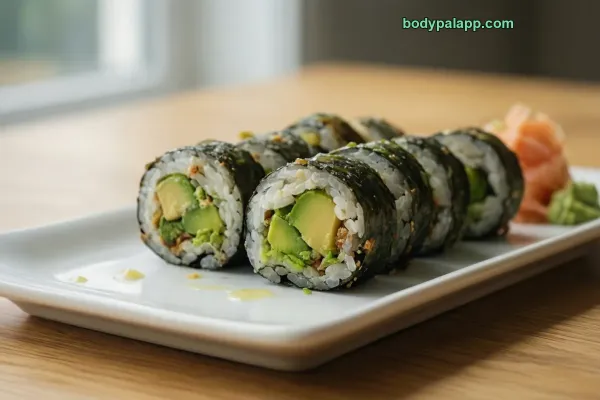
Here is how maki stacks up against a generic sushi roll, nigiri and avocado sushi, per 100 g and per usual serving.
Verdict: For the fewest calories per 100 g, maki at 94 and avocado sushi at 93 are the lightest picks, while nigiri runs to 129. For protein and low sodium, nigiri wins clearly with 8.2 g of protein and just 12 mg of sodium per 100 g, against maki's 2.9 g and 428 mg.
Most popular maki sushi brands in the United States
Ranked by popularity in the BodyPal database
# Productkcal / 100 g
1Yummi Sushi Hoso Maki262 g153 kcal
The packaged roll is labeled per its full 262 g pack, so its numbers cover more than one roll. Source: manufacturer labels / USDA FoodData Central.
Maki sushi FAQs
How many calories are in maki sushi?
A 6-piece maki roll of 180 g is about 169 calories, or 28 calories for one piece. Per 100 g maki sushi has 94 calories.
Is maki sushi good for weight loss?
One 6-piece roll is 169 calories and 1.2 g of fat, so two rolls come to 338 calories. The same roll carries 770 mg of sodium.
Maki sushi vs a sushi roll: which has more calories?
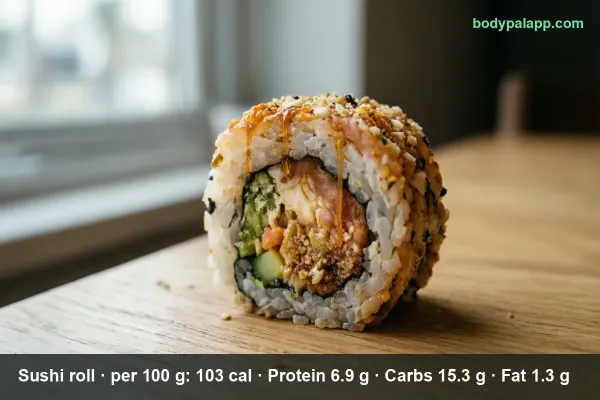
A sushi roll has 103 calories per 100 g against 94 for maki sushi, so a 180 g sushi roll is 185 calories instead of 169.
How much protein is in maki sushi?
A 6-piece roll has 5.3 g of protein and 33.1 g of carbs. Per 100 g that is 2.9 g of protein and 18.4 g of carbs.
How many calories are in one piece of maki?
One piece of maki (30 g) has about 28 calories. It also brings 0.9 g of protein, 5.5 g of carbs and 128 mg of sodium, so counting pieces is a quick way to track a sushi meal.
How much does a maki roll weigh?
A standard maki roll of 6 pieces weighs about 180 g, so each piece is around 30 g. At that weight the roll comes to 169 calories and 770 mg of sodium.
How many kcal are in 100 g of maki?
Maki has 94 kcal per 100 g. That 100 g serving holds 18.4 g of carbs, 2.9 g of protein, 0.7 g of fat and 428 mg of sodium, which is 19% of the daily value.
How many calories are in two or three maki rolls?
Two maki rolls (360 g) come to 338 calories and three rolls (540 g) to 508. Sodium climbs to 1,541 mg and 2,311 mg, so three rolls slightly exceed the 2300 mg daily value.
How many calories are in a salmon maki roll?
A salmon maki roll of 6 pieces (180 g) has 185 calories. It carries 12.4 g of protein and 630 mg of sodium, more protein and less sodium than a plain 169-calorie roll.