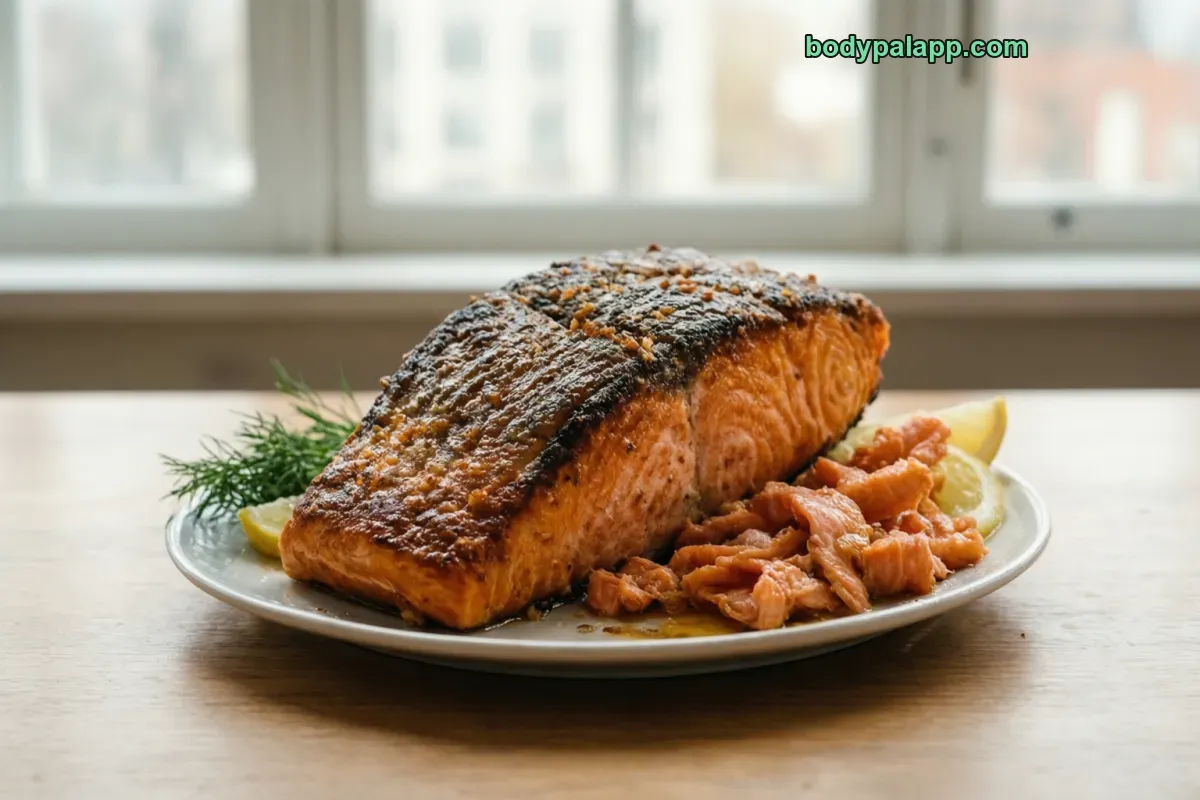
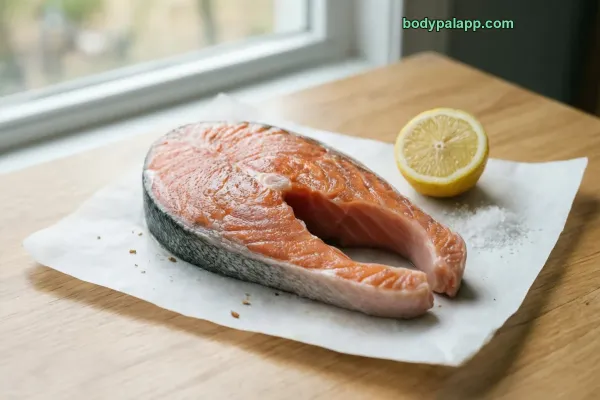
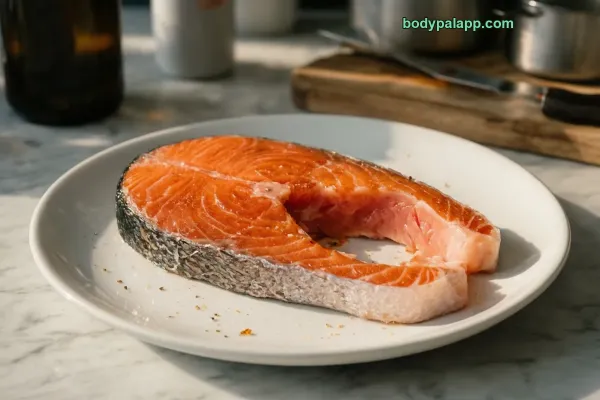
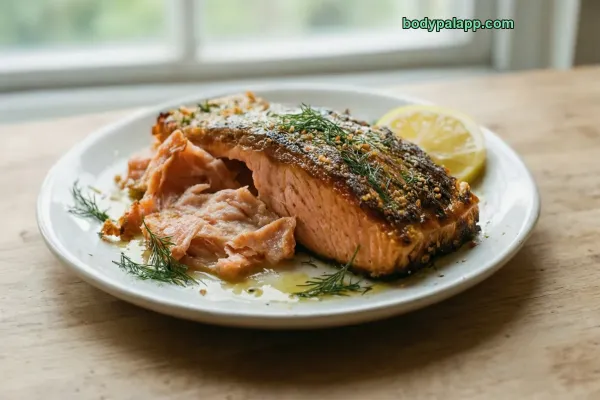
Salmon portion calories come to 310 for a 4 oz portion (113 g) and 274 per 100 g, baked or broiled. The surprise is the split: fat supplies 62% of those calories and protein 38%, so salmon behaves like a rich main rather than a lean one, and fillet size swings the total fast.
310kcal
1 4 oz portion · 113 g, baked or broiled
38%protein
29 gProtein
0 gCarbs
21 gFat
How to burn off 310 kcal
—Walking, brisk
—Jogging
—Cycling, moderate
—Swimming
Skip the math. BodyPal counts these calories from your steps and workouts automatically.
Nutrition facts
Baked or broiled · per 113 g
Calories
310 kcal
Protein
29 g
Carbohydrate
0 g
Fat
21 g
Saturated fat
4.8 g
Cholesterol
78 mg
Sodium
332 mg
Potassium
511 mg
Iron
0.5 mg
Source: USDA FoodData Central
🛡️
Verified nutrition data
Numbers on this page come from USDA FoodData Central, the U.S. Department of Agriculture’s food composition database, and from manufacturer labels where a branded product is named. Last verified September 2026. How we verify our data →
Salmon portion: calories, protein and sodium by serving
Percent of daily value uses the FDA reference of 2,000 kcal a day.
Serving
kcal
Protein
Carbs
Fat
Sodium
% DV kcal
4 oz portion (113 g)
310
28.7 g
0 g
20.8 g
332 mg
15%
Small fillet (140 g)
384
35.6 g
0 g
25.8 g
412 mg
19%
Large fillet (210 g)
575
53.3 g
0 g
38.6 g
617 mg
29%
100 g
274
25.4 g
0 g
18.4 g
294 mg
14%
3 × 4 oz portion (113 g)
929
86.1 g
997 mg
5 × 4 oz portion (113 g)
1,548
143.5 g
1,661 mg
A large fillet is a 575-calorie plate
The 4 oz portion (113 g) is the reference serving on this page, and it lands at 310 calories with 28.7 g of protein. That is 15% of the daily value for calories and 57% for protein. For the energy it costs, that is a compact and filling main.
Real fillets often run bigger than that neat number. A small fillet (140 g) brings 384 calories, and a large fillet (210 g) reaches 575, or 29% of the daily calorie value. The large piece also carries 38.6 g of fat against 20.8 g in the 4 oz portion. If you eyeball portions, the fillet you pick decides more than the recipe does.
Cooking for a household scales the same way. Two 4 oz portions (226 g) total 619 calories, three come to 929, and a tray of five adds up to 1,548 calories with 143.5 g of protein. Weigh the pack once when you buy it, and the math stays honest all week.
Fat supplies 62% of the calories, protein the rest
Salmon gets filed with lean proteins, but the calorie split says otherwise. Per 100 g there are 25.4 g of protein, 18.4 g of fat and 0 g of carbs, which puts 62% of the calories in fat and 38% in protein. There is no sugar and no fiber, so every calorie comes from those two macros.
That fat is why a 4 oz portion sits at 310 calories instead of something leaner. Most of it is not saturated: saturated fat is 4.3 g of the 18.4 g per 100 g, against a daily value of 20 g. So the fat row is high, but the saturated row is modest.
Protein still pulls its weight. A 4 oz portion covers 57% of the daily value for protein, a small fillet 71%, and a large fillet 107%, more than the full reference amount on a single plate. If you want the protein with fewer calories, the smaller cut gets you most of the way there.
Sodium is moderate until the sauce arrives
Baked or broiled salmon in the USDA data carries 294 mg of sodium per 100 g. A 4 oz portion brings 332 mg, which is 14% of the daily value, and a large fillet reaches 617 mg, or 27%. That is noticeable for a plain piece of fish, though far from a salty processed food.
Those numbers come before any glaze. Marinades, soy-based sauces and flavored retail packs such as Mowi Sweet Bourbon Atlantic Salmon Portion or Mowi Essential Tuscan Herb Atlantic Salmon Portion carry their own seasoning, so read the label on anything pre-flavored. If you watch sodium, plain portions with lemon and herbs keep you near the base figures.
Cholesterol is 69 mg per 100 g against a daily value of 300 mg, and potassium comes in at 452 mg per 100 g. Neither is the headline here, but both are worth a glance if you track them alongside calories.
Zero carbs leave the rest of the plate open
With 0 g of carbs, a salmon portion gives you full freedom on the sides. Roasted vegetables, a green salad, rice or potatoes fill out the plate without touching the fish numbers. The sides decide whether dinner stays light or turns heavy.
Because fat already provides 62% of the calories, go easy on butter, cream sauces and oily dressings on top. A drizzle is fine; a pool doubles down on the macro that is already high. Lemon, herbs, mustard and salsa add flavor with far less weight.
If you split a large fillet (210 g) across two meals, each half lands close to the 4 oz portion, so leftovers are easy to log. BodyPal can log the salmon from a photo, which helps when the fillet size is a guess and the sides are piled around it.
How does salmon portion compare?
Here is how a salmon portion stacks up against our salmon fillet, salmon steak and baked salmon pages, per 100 g and per usual serving.
Verdict: Every cut here lands at 274 calories per 100 g, so the name changes nothing and the serving size changes everything, from 384 for a 140 g baked fillet to 575 for a 210 g steak. On a tight calorie budget pick the smaller fillet; for a big protein dinner, the 6 oz fillet at 466 or the steak earns its place.
Most popular salmon portion brands in the United States
Ranked by popularity in the BodyPal database
# Productkcal / 100 g
1Marine Harvest Atlantic Salmon Portion4 oz · 113 g195 kcal
2Pacific Seafood Sockeye Salmon Portions4 oz · 113 g142 kcal
3Great American Seafood Sockeye Salmon Portions4 oz · 113 g90 kcal
4Marine Harvest Canadian Atlantic Salmon Portion4 oz · 113 g177 kcal
These portions are sold raw and labeled per raw weight, so they read lower than the baked or broiled numbers above. Source: manufacturer labels / USDA FoodData Central.
Salmon portion FAQs
How many calories are in a salmon portion?
A 4 oz (113 g) salmon portion is about 310 calories baked or broiled. Per 100 g that is 274 calories.
Is salmon portion good for weight loss?
A 4 oz portion has 310 calories with about 28.7 g of protein, which is high relative to its calories, and 20.8 g of fat.
Salmon portion vs baked salmon: are the calories different?
Both come to 274 calories per 100 g since this page uses the same baked or broiled preparation, so a 4 oz (113 g) portion is 310 calories either way.
How much protein is in a salmon portion?
A 4 oz (113 g) salmon portion has about 28.7 g of protein. Per 100 g that is 25.4 g of protein and 18.4 g of fat.
How many grams is 4 oz of salmon?
A 4 oz salmon portion weighs 113 g. Baked or broiled, that piece has 310 calories, 28.7 g of protein and 20.8 g of fat, with 0 g of carbs.
How many calories are in a small piece of salmon?
A small fillet of 140 g has 384 calories, 19% of the daily value. It also delivers 35.6 g of protein and 25.8 g of fat, with no carbs or sugar.
What is a typical portion size for salmon?
This page uses a 4 oz portion (113 g) at 310 calories as the reference. Small fillets run about 140 g and large ones about 210 g, at 384 and 575 calories.
How much protein is in 100 g of salmon?
There are 25.4 g of protein in 100 g of baked or broiled salmon, 51% of the daily value. The same 100 g holds 274 calories and 18.4 g of fat.
What nutrition does a salmon portion have besides calories?
A 4 oz portion (113 g) has 28.7 g of protein, 20.8 g of fat, 0 g of carbs, 0 g of sugar and 332 mg of sodium. Saturated fat is 4.3 g per 100 g.