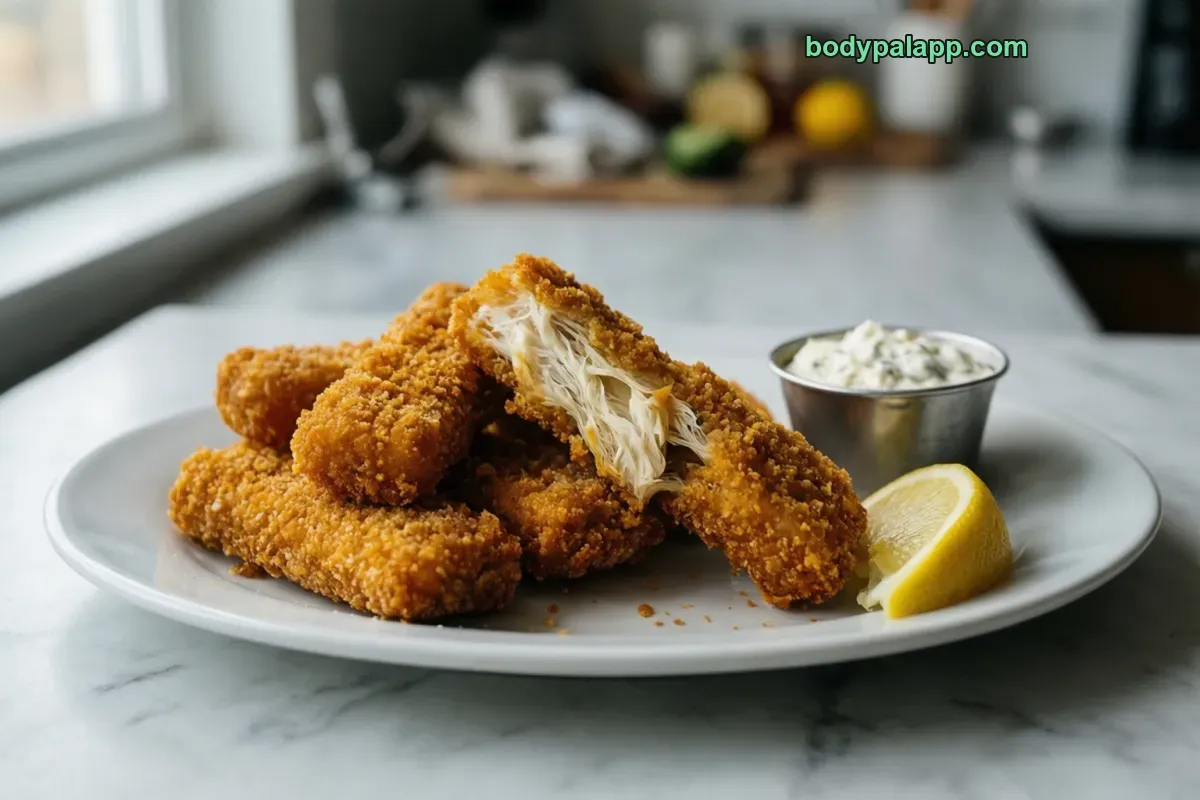
Fish stick calories come to 78 for one 28 g stick and 277 per 100 g of the frozen, prepared kind. The number to notice is where those calories come from: fat supplies 53% of them, while protein, the reason most people reach for fish, covers only 16%. Portions swing the total fast.
78kcal
1 stick · 28 g, frozen, prepared
16%protein
3.1 gProtein
6 gCarbs
4.5 gFat
How to burn off 78 kcal
—Walking, brisk
—Jogging
—Cycling, moderate
—Swimming
Skip the math. BodyPal counts these calories from your steps and workouts automatically.
Nutrition facts
Frozen, prepared · per 28 g
Calories
78 kcal
Protein
3.1 g
Carbohydrate
6.1 g
Fat
4.5 g
Saturated fat
1 g
Cholesterol
8 mg
Sodium
113 mg
Potassium
52 mg
Iron
0.2 mg
Source: USDA FoodData Central
🛡️
Verified nutrition data
Numbers on this page come from USDA FoodData Central, the U.S. Department of Agriculture’s food composition database, and from manufacturer labels where a branded product is named. Last verified September 2026. How we verify our data →
Fish stick: calories, protein and sodium by serving
Percent of daily value uses the FDA reference of 2,000 kcal a day.
Serving
kcal
Protein
Carbs
Fat
Sodium
% DV kcal
1 stick (28 g)
78
3.1 g
6.1 g
4.5 g
113 mg
4%
1 large piece (57 g)
158
6.3 g
12.3 g
9.3 g
229 mg
8%
3 oz portion (85 g)
235
9.4 g
18.4 g
13.8 g
342 mg
12%
100 g
277
11 g
21.7 g
16.2 g
402 mg
14%
3 × 1 stick (28 g)
233
9.2 g
338 mg
5 × 1 stick (28 g)
388
15.4 g
563 mg
Five sticks turn a snack into a 388-calorie plate
A single stick weighs 28 g and carries 78 calories, about 4% of the daily value. That looks small enough to ignore, and that is the trap. Almost nobody eats one fish stick. The box is built for handfuls, and the total climbs in a straight line with every stick you add.
Two sticks come to 155 calories at 56 g. Three reach 233 calories at 84 g, which lines up almost exactly with a 3 oz portion (85 g) at 235 calories, or 12% of the daily value. Five sticks weigh 140 g and land at 388 calories. That is a full meal's worth of energy before anything else touches the plate.
Larger cuts follow the same math. One large piece of 57 g is 158 calories, about the same as two standard sticks. If your brand cuts thicker or longer sticks, the weight on the box tells you more than the count does. And remember that fries, tartar sauce and ketchup sit outside every one of these numbers, so log them on their own.
Fat, not fish, supplies most of the calories
Per 100 g, fish sticks hold 16.2 g fat, 21.7 g carbs and 11 g protein. Run that through the calorie split and fat accounts for 53% of the energy, carbs 31% and protein just 16%. The coating, not the fish inside, shapes this profile.
That makes fish sticks a modest protein source for what they cost in calories. One stick gives 3.1 g protein, 6% of the daily value, for 78 calories. Five sticks reach 15.4 g protein, but it takes 388 calories to get there. If protein per calorie is what you are after, plain fish does the job with far less fat attached.
The rest of the label is quieter. Saturated fat is 3.7 g per 100 g, and sugars stay low at 1.7 g, or 0.5 g per stick. Fiber is 1.5 g per 100 g, about 0.4 g per stick, so the carbs arrive with very little fiber. Read as a whole, this is the profile of a breaded snack food more than a lean fish dish, and it is worth counting that way.
Sodium is mild per stick and real per plate
Each stick carries 113 mg sodium, 5% of the 2300 mg daily value. Per 100 g the figure is 402 mg, or 17%. Neither number is alarming on its own, but sodium scales with the stick count just like calories do.
A 3 oz portion brings 342 mg, 15% of the daily value. Three sticks come to 338 mg, and five sticks reach 563 mg. That is still before the sauce. Tartar sauce, ketchup, seasoned fries and a bun all bring their own sodium, and in a typical fish stick dinner they can matter as much as the sticks themselves.
If you watch sodium, the practical move is to keep the stick count at three or so and log the condiments separately rather than guessing. The other minerals on the card are not a reason to choose or avoid fish sticks: cholesterol is low at 28 mg per 100 g, and potassium sits at 185 mg per 100 g. Sodium is the row worth a glance; the rest can stay in the background.
Pair fish sticks with volume, not more breading
Fish sticks are calorie-dense at 277 per 100 g, with fat doing most of the work. The easiest way to make the plate feel bigger without pushing the total up much is to put vegetables next to them instead of another fried side. A salad, green beans or slaw with a light dressing add bulk and fiber, which the sticks barely supply.
If protein matters to you, three sticks give 9.2 g. A glass of milk, a scoop of beans or a yogurt-based dip in place of tartar sauce builds on that without making the meal heavier on fat. Swapping fries for a baked potato or rice keeps the plate familiar for kids and adults alike.
The values here are for frozen sticks, prepared. Brands such as Gorton's, Ian's and Trident Seafoods sell their own versions with different sizes and coatings, so check the box weight against the 28 g stick on this page before you assume your count matches. If you would rather not weigh anything, BodyPal can log the plate from a photo.
How does fish stick compare?
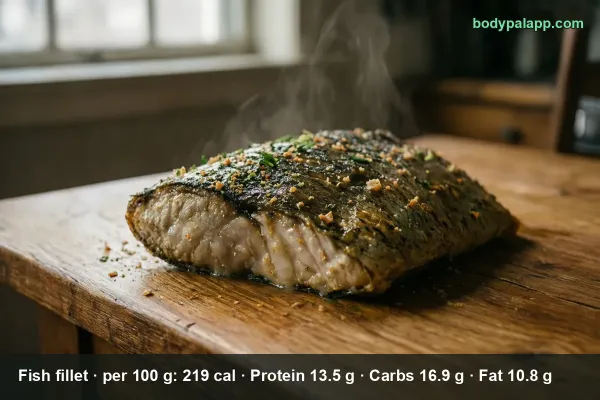
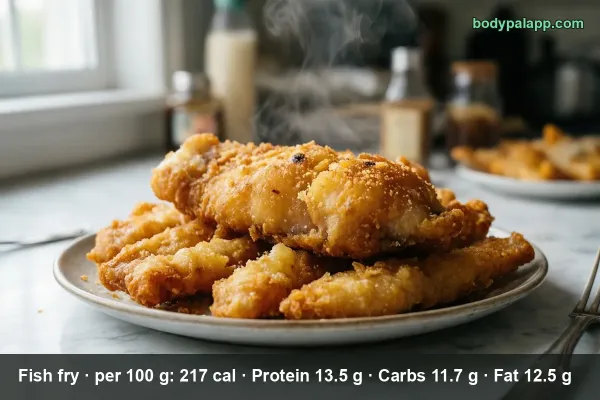
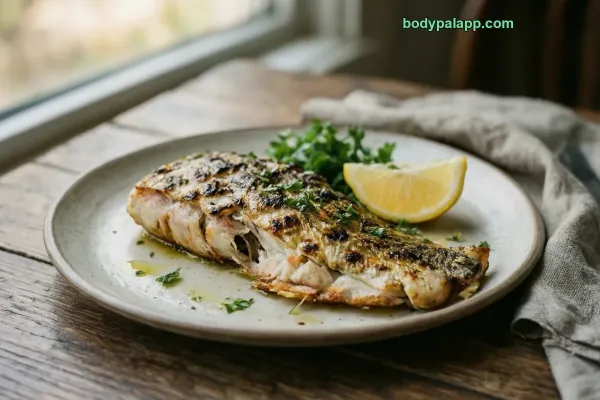
Here is how fish sticks stack up against a fish fillet, fried fish and grilled fish, per 100 g and per usual serving.
Verdict: For weight loss, grilled fish wins easily at 108 calories per 100 g with 19.4 g protein, against 277 for fish sticks. If you want the crunch, fish fry and the fish fillet both come in lower at 217 and 219 per 100 g, though the fillet carries more sodium at 561 mg.
Most popular fish stick brands in the United States
Ranked by popularity in the BodyPal database
# Productkcal / 100 g
1Trident Seafoods The Ultimate Fish Stick3 pieces · 85 g188 kcal
6Gorton's Minced Fish Sticks6 sticks · 91 g220 kcal
7Gorton's Tilapia Fish Sticks4 sticks · 116 g216 kcal
Package numbers are for the sticks as packed frozen, so they read lower than the 277 calories per 100 g for prepared sticks. Source: manufacturer labels / USDA FoodData Central.
Fish stick FAQs
How many calories are in one fish stick?
One prepared fish stick of 28 g has about 78 calories. A larger piece of 57 g has 158 calories.
Are fish sticks good for weight loss?
A 3 oz portion of 85 g is 235 calories with 9.4 g protein and 13.8 g fat. The breading also brings 21.7 g carbs per 100 g, so fish sticks are denser than plain baked fish.
Fish sticks vs a plain fish fillet: which is lower in calories?
Breaded fish sticks are 277 calories per 100 g, while a plain fish fillet is 219 per 100 g, a difference of 58 calories.
How much protein is in fish sticks?
Fish sticks have 11 g protein per 100 g. One 28 g stick gives 3.1 g protein, and a 3 oz portion of 85 g gives 9.4 g.
How many calories are in 3 fish sticks?
Three fish sticks have 233 calories, based on 28 g per stick and 84 g total. They also bring 9.2 g protein and 338 mg sodium, close to a 3 oz portion at 235 calories.
How many calories are in 5 fish sticks?
Five fish sticks come to 388 calories for 140 g. That plate supplies 15.4 g protein and 563 mg sodium, before tartar sauce, ketchup or fries are added.
How many carbs are in fish sticks?
One fish stick has 6.1 g carbs, and 100 g has 21.7 g. Carbs supply 31% of the calories, with just 0.5 g sugars and 0.4 g fiber per stick, so most of it comes from the coating.
What are the macros of fish sticks?
Per 100 g, fish sticks have 16.2 g fat, 21.7 g carbs and 11 g protein. By calories that is 53% fat, 31% carbs and 16% protein, so fat is the biggest source of energy.
What are the main nutrition facts for fish sticks?
Per 100 g, fish sticks give 277 calories, 16.2 g fat, 3.7 g saturated fat, 402 mg sodium and 28 mg cholesterol. A single 28 g stick is 78 calories with 113 mg sodium.