
How Many Calories in a Sausage Link?
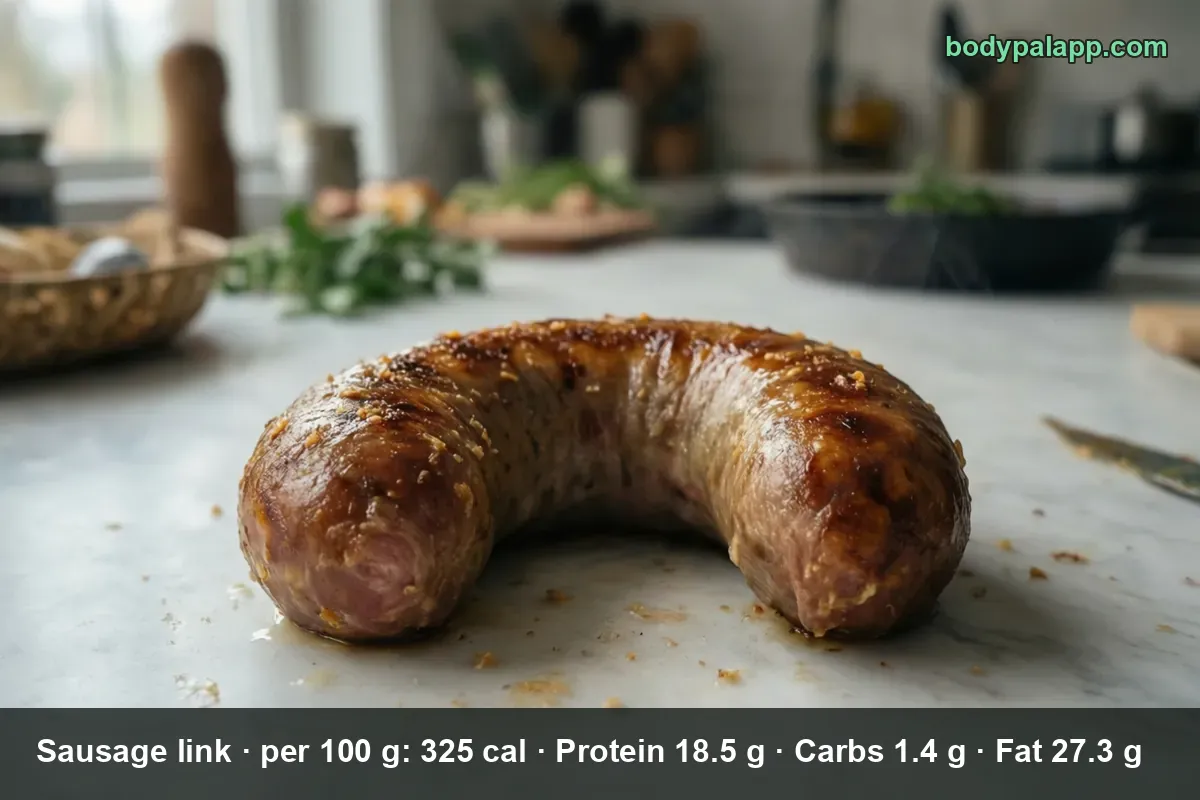
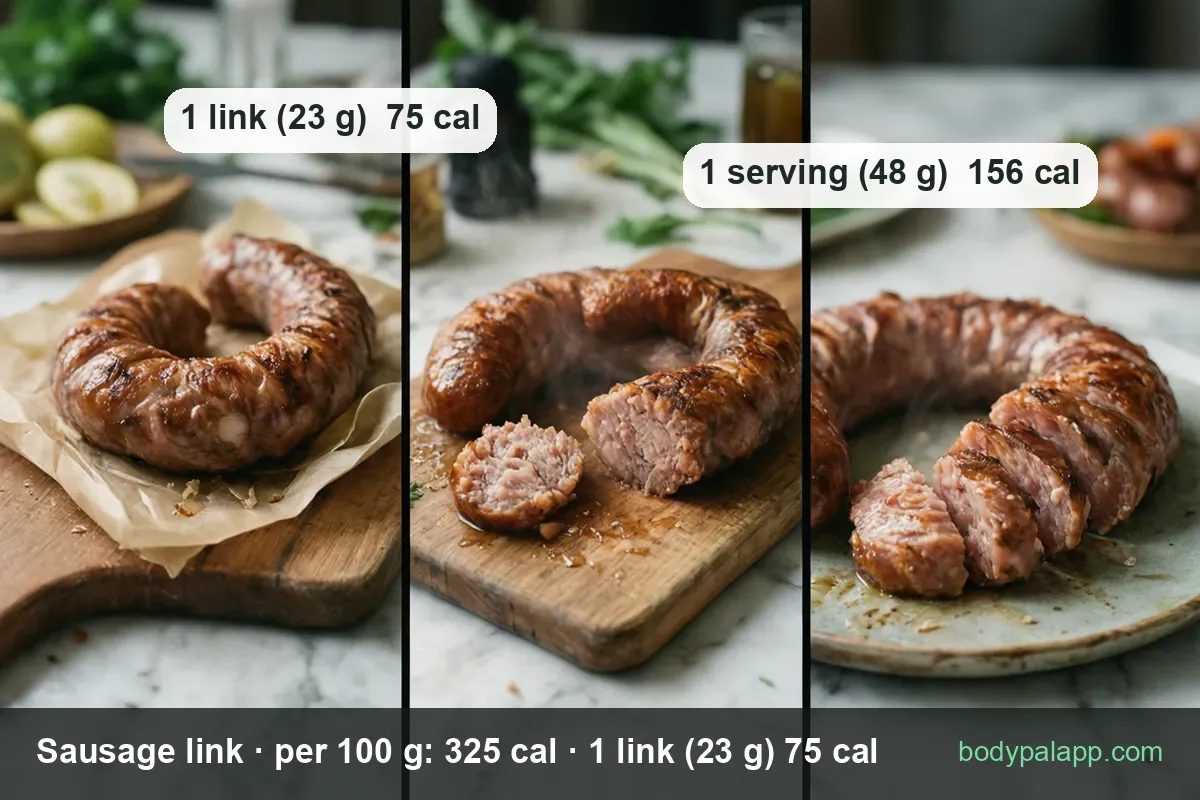
One cooked pork sausage link is 75 calories. That is a 23 g breakfast link out of the skillet, which works out to 325 calories per 100 g. Three links beside your eggs come to 224 calories. A turkey breakfast link is smaller and leaner: 39 calories each.
On this page
- Sausage link quick facts
- What one link actually weighs
- Pork, turkey and chicken links side by side
- The pan, the microwave and the raw link
- Sodium and saturated fat outrun the calories
- How a sausage link compares
- Most popular sausage link brands
- FAQ
Sausage link quick facts
The reference here is the one people actually eat: a pork breakfast link, pan-fried, 23 g on the plate. That is the USDA pan-fried pork link record, which carries its own 23 g link portion rather than leaving you to guess.
| Nutrient | Per 100 g | Per 1 link (23 g) | % Daily Value |
|---|---|---|---|
| Calories | 325 | 75 | — |
| Total fat | 27.3 g | 6.3 g | 8% |
| Saturated fat | 8.8 g | 2.0 g | 10% |
| Carbohydrate | 1.4 g | 0.3 g | 0% |
| Dietary fiber | 0 g | 0 g | 0% |
| Total sugars | 1.1 g | 0.3 g | — |
| Protein | 18.5 g | 4.3 g | 9% |
| Sodium | 814 mg | 187 mg | 8% |
% Daily Value is based on a 2,000-calorie diet.
Verified nutrition data
Numbers on this page come from USDA FoodData Central, the U.S. Department of Agriculture’s food composition database, and from manufacturer labels where a branded product is named. Last verified September 2026. How we verify our data →
There is no added-sugars line above, and that is deliberate. The USDA release behind these numbers records no added-sugars value for any pork link row, so printing one would mean inventing it. Maple links obviously contain some; the honest place to read that figure is the package in your hand.
The two rows worth staring at are saturated fat and sodium. One small link, barely three bites, already spends 10% of the day's saturated fat.
What one link actually weighs
Most calorie charts hand you 325 and stop. That number belongs to 100 g of sausage, which is roughly four and a third breakfast links, and almost nobody eats that in one sitting.
| Portion | Weight | Calories |
|---|---|---|
| 1 link | 23 g | 75 |
| 1 patty | 27 g | 88 |
| 1 oz | 28.35 g | 92 |
| 1 USDA serving (about 2 links) | 48 g | 156 |
| 3 links, a normal breakfast | 69 g | 224 |
| 100 g | 100 g | 325 |
USDA supplies the 23 g link, the 27 g patty and the 48 g serving itself; the 1 oz and 3-link rows are our own scaling from the 100 g figure.
The patty row is the quiet surprise. A patty from the same product weighs 27 g against the link's 23 g, so swapping shapes costs 13 extra calories per piece without anything else changing. Two patties instead of two links is a 26-calorie decision, which is to say no decision at all.
Three links at 224 calories is the portion to memorize. It sits inside a normal breakfast, it delivers 12.8 g of protein, and it leaves room for eggs.
Pork, turkey and chicken links side by side
| Version | Per 100 g | Typical piece | Calories |
|---|---|---|---|
| Pork link, pan-fried | 325 | 1 link (23 g) | 75 |
| Turkey or chicken link, breakfast size | 193 | 1 link (20 g) | 39 |
| Turkey or chicken link, bun size | 193 | 1 griller (75 g) | 145 |
| Reduced-fat pork link, pan-fried | 267 | 3 oz (85 g) | 227 |
| Beef breakfast sausage, pre-cooked | 327 | — | — |
Poultry is the real lever. Turkey or chicken sausage runs 193 calories per 100 g against 325 for pork, a 41% cut, and it comes with slightly more protein per 100 g (19.7 g against 18.5 g). At the breakfast size the link itself is smaller too, so 39 calories a piece is the practical figure. Both poultry rows, and every 3 oz figure on this page, are our scaling from the per 100 g numbers.
One thing to say plainly, because the search results will not: USDA does not separate chicken links from turkey links. There is a single combined row for both. So the answer to "calories in a chicken sausage link" is the same 39 for a breakfast link, 145 for a bun-size griller, and anyone quoting a distinct chicken figure is quoting a specific brand's label, not a reference database.
Retail turkey links spread wider than the database row suggests, from about 125 to 216 calories per 100 g depending on the maker, so the package beats the average when you have it. The reduced-fat pork line is the middle path: 267 calories per 100 g with 20.9 g protein, better protein-to-calorie math than regular pork, though it lands closer to standard sausage than to turkey.
Beef breakfast sausage is a near-twin of pork at 327 calories per 100 g, and it is sold pre-cooked, so that figure is before it hits your pan.
The pan, the microwave and the raw link
Here is the finding that surprised us. How the link is prepared moves the number further than what animal it came from.
| Preparation | Per 100 g | One link | Calories |
|---|---|---|---|
| Raw, out of the package | 288 | 25 g | 72 |
| Pan-fried | 325 | 23 g | 75 |
| Fully cooked, eaten cold from the pack | 392 | 23 g | 90 |
| Fully cooked, reheated in the microwave | 438 | 21 g | 92 |
Per 100 g that is a 52% spread, from 288 up to 438. Same product family, same USDA description, four ways of getting it to the plate.
The mechanism is fat and water. A raw link dropped into a skillet leaks both, so what is left is denser than what went in. A fully cooked link finished in the microwave leaks almost nothing, which is why it tops the table.
Now count links instead of grams and the whole drama collapses. Raw link, 25 g: 72 calories. Pan-fried link, 23 g: 75. Three calories apart. The cooked link is denser but lighter, and the two effects nearly cancel.
That is the practical rule for logging sausage. If you weigh, weigh after cooking and use the cooked figure. If you count pieces, one link is roughly one link, however it got hot. The one exception is the microwave-reheated fully cooked link at 92 calories, which is genuinely nearly a quarter heavier than the skillet version.
Sodium and saturated fat outrun the calories
Calories are why people look sausage up. They are also the least interesting number on the label.
Three links, 69 g, the standard plate:
- 224 calories — 11% of a 2,000-calorie day
- 6.1 g saturated fat — 30% of the Daily Value
- 562 mg sodium — 24% of the Daily Value
- 12.8 g protein — 26% of the Daily Value
Calories at 11%, saturated fat at 30%. The gap is the point. The FDA's Daily Values put saturated fat at 20 g and sodium at 2,300 mg for the day, and the Dietary Guidelines for Americans hold saturated fat under 10% of calories. Breakfast sausage spends against those two budgets two to three times faster than it spends against your calorie budget.
Sodium deserves its own note, because the obvious swap does not fix it. Turkey sausage carries 705 mg per 100 g against pork's 814 mg — a 13% cut, next to a 41% cut in calories. Switching to poultry solves the fat problem and barely touches the salt problem, which matters when most American sodium comes from packaged and prepared foods rather than the shaker.
The rest of the link is unremarkable in a good way: 20 mg cholesterol (7% DV) and 79 mg potassium (2% DV) per link, no fiber at all, and 4.3 g of complete protein. As a protein food it is real but expensive — you pay 75 calories and 187 mg of sodium for 4.3 g.
How a sausage link compares
| Item | Per 100 g | US serving | Calories | P / C / F |
|---|---|---|---|---|
| Pork sausage link, pan-fried | 325 | 1 link (23 g) | 75 | 4.3 / 0.3 / 6.3 |
| Turkey or chicken sausage | 193 | 1 link (20 g) | 39 | 3.9 / 0.2 / 2.4 |
| Reduced-fat pork link, pan-fried | 267 | 3 oz (85 g) | 227 | 17.8 / 0.1 / 17.3 |
| Pork link, fully cooked, unheated | 392 | 1 link (23 g) | 90 | 3.1 / 0.2 / 8.6 |
| Kielbasa, fully cooked, unheated | 325 | 3 oz (85 g) | 276 | 9.2 / 3.2 / 25.2 |
Our take: for the best protein per calorie at breakfast, the turkey or chicken link wins outright — 3.9 g of protein for 39 calories beats every pork row here, and it is the row where fat takes the smallest share of the calories. If you want pork and you want the numbers to behave, pan-fry raw links rather than reheating fully cooked ones; that single habit is the difference between 75 and 92 calories a piece, and 90 versus 75 if you eat them straight from the pack. Kielbasa is the trap on this table: the same 325 calories per 100 g as a breakfast link, but it is sold in slices four times the size, so a 3 oz portion is 276 calories with only 9.2 g of protein.
Most popular sausage link brands in the United States
Ranked by how widely each product appears among foods sold in the United States, from the BodyPal food database of over 3.3 million products. Calories are the figures printed on each Nutrition Facts label, checked against USDA FoodData Central.
| Product | Calories (per 100 g) |
|---|---|
| Jimmy Dean Turkey Sausage Links | 191 cal |
| Jennie-O Turkey Breakfast Sausage Links | 125 cal |
| Johnsonville Turkey Fully Cooked Breakfast Sausage Links | 200 cal |
| Shady Brook Farms Turkey Sausage Links | 216 cal |
| Bob Evans Original Pork Sausage Links | 275 cal |
| Bob Evans Maple Pork Sausage Links | 333 cal |
Brand popularity: BodyPal food database. Nutrition: manufacturer labels / USDA FoodData Central.
Sausage link FAQs
How many calories in a sausage link?
75 calories for one 23 g pork breakfast link, pan-fried, at 325 calories per 100 g. USDA's 48 g serving, about two links, is 156 and three links are 224. A turkey or chicken breakfast link is smaller and lighter at 39 calories, and a raw pork link before cooking is 72.
How many calories in a turkey sausage link?
39 calories for a 20 g breakfast-size turkey link, at 193 calories per 100 g. A bun-size griller link of 75 g is 145 calories. That is 41% below pork per 100 g, with slightly more protein at 19.7 g against 18.5 g.
How many calories in a breakfast sausage link?
75 calories for a standard 23 g pork breakfast link. USDA's own serving of 48 g, about two links, is 156 calories. Beef breakfast sausage is close to pork at 327 calories per 100 g, and turkey breakfast links run 39 calories each.
How many calories in a pork sausage link?
75 calories per 23 g link, pan-fried, or 325 per 100 g. One ounce is 92 calories and a pork patty from the same product weighs 27 g and comes to 88. Reduced-fat pork links drop to 267 calories per 100 g, or 227 for a 3 oz portion.
How many calories in a chicken sausage link?
39 calories for a 20 g breakfast link. USDA keeps one combined record for turkey and chicken sausage, so both give 193 calories per 100 g and there is no separate chicken figure. A bun-size chicken griller of 75 g works out to 145 calories.
How many calories in 2 or 3 sausage links?
USDA's 48 g serving, about two links, is 156 calories and three links are 224. Three links weigh 69 g and bring 12.8 g of protein, 6.1 g of saturated fat and 562 mg of sodium. Three turkey breakfast links come to about 117 calories instead.
How much sodium is in a sausage link?
187 mg per 23 g pork link, which is 8% of the 2,300 mg Daily Value. Three links reach 562 mg, or 24% of the day. Turkey sausage carries 705 mg per 100 g against pork's 814 mg, so switching cuts calories far more than it cuts sodium.
Do sausage links lose calories when you cook them?
Per link, hardly at all — a raw 25 g link is 72 calories and the pan-fried 23 g link is 75. Per 100 g the cooked figure looks higher, 325 against 288, because the link loses water and shrinks. Count pieces and the difference is three calories.
Similar foods
- Jimmy Dean Sausage — 88 cal per patty
- Pork Sausage — 150 cal for 2 links
- Pork Sausage Link — 75 cal per cooked link
- Sausage Patty — 88 cal per patty
- Sausage Patty Breakfast — 88 cal per patty
- Hot Dog Without Bun — 155 cal per hot dog
Count it without the math
Point the camera at the plate and BodyPal counts the links, the fat and the sodium in one shot.


How long does it take to burn off a sausage link?
One pan-fried pork link (23 g) is 75 kcal. Enter your weight and the amount you ate to see how long it takes you to burn that off:
lb
| Activity | Time to burn 75 kcal |
|---|---|
| Walking, brisk | 15 min |
| Cycling, moderate | 9 min |
| Swimming, moderate | 11 min |
| Jogging | 9 min |
| Weight training, moderate | 17 min |
Times are for a 155 lb adult at a steady pace; change the weight to see yours. The amount is set to the portion in the text (23 g); change it to what you actually ate. BodyPal works this out from your steps automatically.
Want the bigger picture? Calculate your daily calorie needs — your maintenance figure, a target for losing or gaining, and the date you get there.