
How many calories are in a pork sausage link?
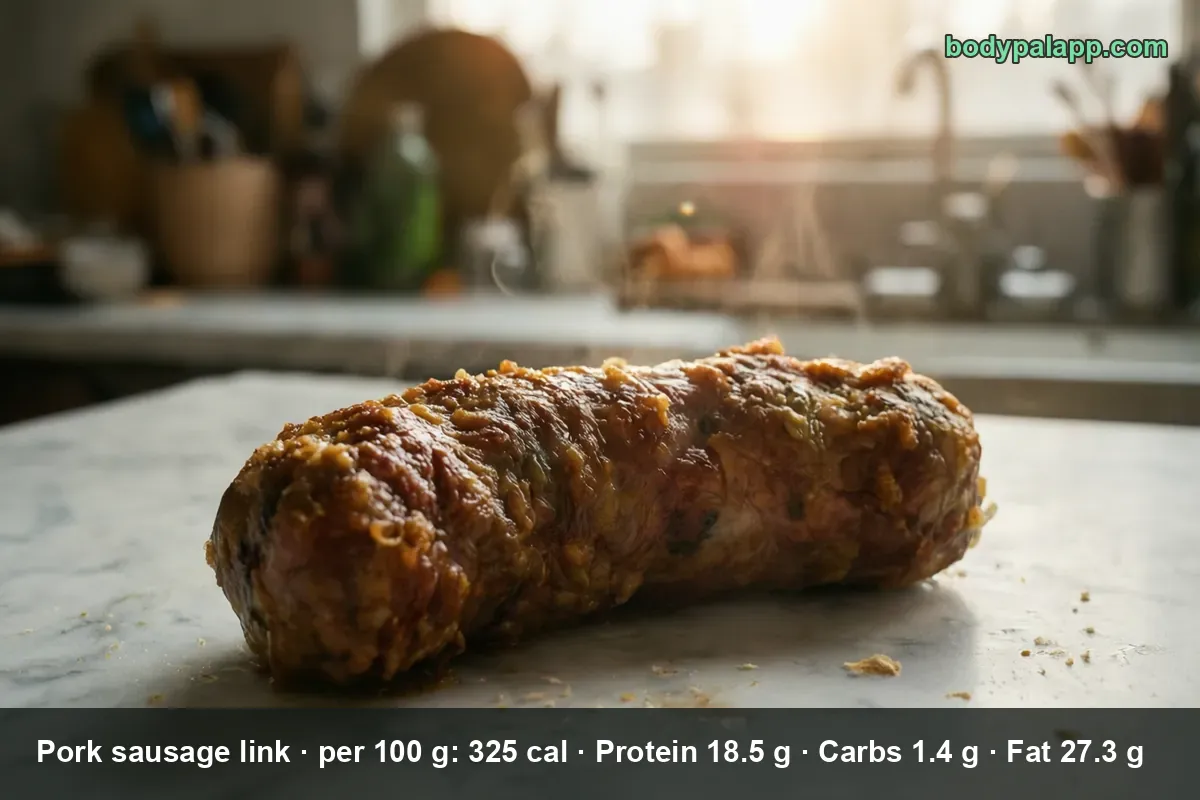
Two pan-fried pork sausage links weigh 46 g together and carry 150 calories, off a base of 325 calories per 100 g of cooked meat. One link on its own is 75. The pieces are small, so the count climbs quietly — three links, the serving most brand labels print, comes to 224 calories.
On this page
- Pork sausage link quick facts
- US servings, from one link to a three-link plate
- Cooked from raw, fully cooked, or straight from the package
- Reduced-fat links and pork sausage patties
- Saturated fat and sodium are the rows to watch
- How do pork sausage links compare?
- Most popular pork sausage links brands
- FAQ
Pork sausage link quick facts
The record that matches a breakfast plate is SR Legacy 174578, "Pork sausage, link/patty, cooked, pan-fried". That is raw seasoned pork, shaped into links, browned in a skillet — the version people buy in a tube or a chilled tray and cook themselves. USDA also publishes fully cooked links meant for reheating, and those are a different food nutritionally, so they live in their own section below rather than getting averaged in here.
The column that matters most is the middle one. Two links is what lands next to eggs, and at 46 g it is a genuinely small piece of food that still spends a real share of the day's fat budget.
| Nutrient | Per 100 g | Per 2 links (46 g) | % Daily Value |
|---|---|---|---|
| Calories | 325 | 150 | — |
| Total fat | 27.25 g | 12.5 g | 16% |
| Saturated fat | 8.83 g | 4.1 g | 20% |
| Carbohydrate | 1.42 g | 0.7 g | 0% |
| Dietary fiber | 0 g | 0 g | 0% |
| Total sugars | 1.09 g | 0.5 g | — |
| Protein | 18.53 g | 8.5 g | 17% |
| Sodium | 814 mg | 374 mg | 16% |
| Cholesterol | 86 mg | 40 mg | 13% |
| Potassium | 342 mg | 157 mg | 3% |
% Daily Value is based on a 2,000-calorie diet.
Verified nutrition data
Numbers on this page come from USDA FoodData Central, the U.S. Department of Agriculture’s food composition database, and from manufacturer labels where a branded product is named. Last verified September 2026. How we verify our data →
There is no added sugars row on this page because the SR Legacy edition does not publish added sugars for this food, and no trans fat row for the same reason. The 1.09 g of total sugars per 100 g comes from the seasoning mix and the small amount of dextrose most pork sausage recipes use; it is not enough to matter to anyone counting carbs.
US servings, from one link to a three-link plate
| Serving | Weight | Calories |
|---|---|---|
| 1 cooked link | 23 g | 75 kcal |
| 1 oz | 28 g | 91 kcal |
| 2 cooked links | 46 g | 150 kcal |
| 1 cooked patty | 27 g | 88 kcal |
| 1 serving, USDA | 48 g | 156 kcal |
| 3 cooked links | 69 g | 224 kcal |
| Per 100 g | 100 g | 325 kcal |
The single link at 23 g, the patty at 27 g and the 48 g serving are USDA household measures for this record. The two-link and three-link rows are our own arithmetic from the USDA 100 g figure, not USDA servings — but they are the ones people actually eat, and three links is the number printed on most American labels.
Brand packages scatter around the generic record even once you match the weight. Jimmy Dean Original lists 170 calories for three cooked links at 53 g, Bob Evans Original 140 for three pan-fried links at 51 g, and Dutch Farms Maple 270 for three cooked links at 56 g. The spread between those three is bigger than the spread between any of them and USDA, which tells you the recipe and the link size move the number more than the data source does.
One practical trap: a cooked link and a raw link are not the same object on the scale. If you weigh the tray before cooking and log the cooked figure, you overcount by roughly a tenth. Weigh after the skillet, or log the raw record.
Cooked from raw, fully cooked, or straight from the package
This is the split that catches most people. "Fully cooked" links — the ones you microwave for 40 seconds — are made and cooked at the plant, and the fat that would have run into your skillet stays in the meat. USDA measures them at 438 calories per 100 g after microwaving, against 325 for links you brown yourself from raw. That is 113 calories more per 100 g for what looks like the same breakfast.
| Version | Per 100 g | Typical piece | Calories |
|---|---|---|---|
| Pan-fried from raw | 325 kcal | 1 link, 23 g | 75 kcal |
| Fully cooked, microwaved | 438 kcal | 1 link, 21 g | 92 kcal |
| Fully cooked, unheated | 392 kcal | 1 link, 23 g | 90 kcal |
| Raw, uncooked | 288 kcal | 1 link, 25 g | 72 kcal |
Per piece the gap narrows, because fully cooked links are usually a little smaller: 92 calories against 75 for a link you cooked yourself. Two of them is 184 rather than 150. Over a five-day work week that difference is about 170 calories, which is not dramatic, but it is invisible if you assume all sausage links read alike.
The raw row is the other one worth knowing. Raw links measure 288 calories per 100 g, lower than cooked, and that is not because cooking adds anything — it is water leaving the meat and concentrating what stays. A 25 g raw link becomes roughly a 23 g cooked link, 72 calories before, 75 after. The rise is real but small.
Reduced-fat links and pork sausage patties
Reduced-fat pork sausage is the one substitution here that actually moves the number. Pan-fried, it runs 267 calories per 100 g against 325, with 6.03 g saturated fat instead of 8.83 g. Two reduced-fat links, our own 46 g scaling of the USDA 100 g figure, come to 123 calories with 2.8 g saturated fat and 321 mg sodium — 27 calories and 1.3 g of saturated fat less than the standard pair, for the same skillet and the same plate.
| Version | Per 100 g | Typical piece | Calories |
|---|---|---|---|
| Reduced-fat, pan-fried | 267 kcal | 3 oz, 85 g | 227 kcal |
| Reduced-fat, raw | 217 kcal | 3 oz, 85 g | 184 kcal |
| Pork sausage patty, pan-fried | 325 kcal | 1 patty, 27 g | 88 kcal |
Patties are not a different food. USDA files links and patties under the same record, so per 100 g they are identical at 325 calories; a patty simply weighs more than a link, 27 g against 23 g, which is why it reads 88 rather than 75. Anyone swapping links for patties to save calories is trading on nothing but portion size — a fair trade, as long as you know that is what it is.
Saturated fat and sodium are the rows to watch
Calories are the least interesting thing about this food. Two links are 150 calories, about 7.5% of a 2,000-calorie day, but they carry 20% of the Daily Value for saturated fat and 16% for sodium. The Dietary Guidelines for Americans put saturated fat under 10% of daily calories, and a small breakfast side is already spending a fifth of that allowance.
Three links push it further: 6.1 g saturated fat, 30% of the Daily Value, and 562 mg sodium, 24%. That 374 mg in two links is roughly a sixth of a teaspoon of table salt, which sounds trivial until it sits next to bacon, cheese or a biscuit on the same plate. The FDA Daily Value reference is the yardstick used throughout this page.
The upside is protein density with a caveat. Two links give 8.5 g of protein, 17% of the Daily Value — a better protein-per-calorie showing than most breakfast meats — but per 100 g there is still 27.25 g of fat against 18.53 g of protein. If protein is the goal, MyPlate's protein foods guidance points toward leaner cuts; if you are watching sodium specifically, the reduced-fat links at 698 mg per 100 g are the better pick of the sausage options.
How do pork sausage links compare?
| Sausage | Per 100 g | US serving | Calories |
|---|---|---|---|
| Pork sausage link, pan-fried | 325 kcal | 1 oz, 28 g | 91 kcal |
| Italian pork sausage, mild, pan-fried | 324 kcal | 1 oz, 28 g | 91 kcal |
| Bratwurst, pork and beef | 323 kcal | 1 oz, 28 g | 90 kcal |
| Beef breakfast sausage, pre-cooked | 327 kcal | 1 oz, 28 g | 92 kcal |
Our take: all four sit within 4 calories per 100 g of each other, so choosing between sausages by type is choosing between nothing. What separates them is protein — 18.53 g per 100 g in the pork breakfast link, 14.30 g in bratwurst, 12.90 g in the beef breakfast sausage — and size, since one bratwurst weighs three or four times what a breakfast link does. Pick the pork link if you want the most protein per calorie of the four. Pick by weight if you want to eat less, because the piece in your hand decides this, not the label on the package.
Most popular pork sausage links brands in the United States
Ranked by how widely each product appears among foods sold in the United States, from the BodyPal food database of over 3.3 million products. Calories are the figures printed on each Nutrition Facts label, checked against USDA FoodData Central.
| Product | Calories (per 100 g) |
|---|---|
| Bob Evans Original Pork Sausage Links | 275 cal |
| Bob Evans Maple Pork Sausage Links | 333 cal |
| Bob Evans Original Fully Cooked Pork Sausage Links | 289 cal |
| Dutch Farms Pork Sausage Links Maple | 482 cal |
| Jimmy Dean Original Pork Sausage Links | 321 cal |
| Jimmy Dean Original Pork Sausage Links (raw) | 426 cal |
Brand popularity: BodyPal food database. Nutrition: manufacturer labels / USDA FoodData Central.
Pork sausage link FAQs
How many calories are in one pork sausage link?
One pan-fried link weighs about 23 g and holds 75 calories. That comes from the USDA figure of 325 calories per 100 g of cooked pork sausage. The link also carries 4.3 g protein, 6.3 g fat and 187 mg sodium, so it is a small piece with a heavy footprint.
How many calories are in 2 pork sausage links?
Two links, 46 g on the plate, come to 150 calories. That is our own arithmetic from the USDA 100 g figure rather than a listed USDA serving. The pair brings 8.5 g protein, 12.5 g fat, 4.1 g saturated fat and 374 mg sodium.
How much protein is in a pork sausage link?
Two links carry 8.5 g of protein, 17% of the 50 g Daily Value, and one link 4.3 g. Per 100 g cooked pork sausage runs 18.5 g protein against 27.3 g fat, so most of the calories here are fat, not protein.
How much sodium is in pork sausage links?
Two links hold 374 mg of sodium, 16% of the 2,300 mg Daily Value, and three links 562 mg. That is roughly a sixth of a teaspoon of table salt for two links. Per 100 g the cooked sausage measures 814 mg, one of the saltiest parts of a breakfast plate.
Do pork sausage links lose calories when pan-fried?
Per 100 g they gain: raw links measure 288 calories, pan-fried ones 325, because water leaves the meat faster than fat does. Per piece the change is small, since a raw 25 g link shrinks to about 23 g: 72 calories before the skillet, 75 after.
Which has fewer calories, pork sausage links or patties?
A link wins on size, not on density: 75 calories for a 23 g link against 88 for a 27 g patty. Both come from the same USDA record at 325 calories per 100 g, so the shape changes nothing — only the weight of the piece you pick up does.
How many calories in Jimmy Dean pork sausage links?
Jimmy Dean Original Pork Sausage Links list 170 calories for three cooked links, 53 g, which is 321 calories per 100 g — within a few calories of the generic USDA record. The raw-link package reads higher, 290 calories for three links at 68 g, because that weight is measured before cooking.
How many calories in Bob Evans pork sausage links?
Bob Evans Original Pork Sausage Links are labeled 140 calories for three pan-fried links, 51 g, and the maple version 170 for the same weight. Both sit under the 224 calories in three generic USDA links at 69 g, partly a lighter link and, in the original, a leaner recipe at 275 calories per 100 g.
Similar foods
- Jimmy Dean Sausage — 88 cal per patty
- Pork Sausage — 150 cal for 2 links
- Sausage Link — 75 cal per link
- Sausage Patty — 88 cal per patty
- Sausage Patty Breakfast — 88 cal per patty
- Hot Dog Without Bun — 155 cal per hot dog
Count it without the math
Point the camera at the plate and BodyPal counts the links for you, skillet fat and all.


How long does it take to burn off 150 kcal of pork sausage link?
Two cooked links (46 g) is 150 kcal. Enter your weight and the amount you ate to see how long it takes you to burn that off:
lb
| Activity | Time to burn 150 kcal |
|---|---|
| Walking, brisk | 30 min |
| Cycling, moderate | 19 min |
| Swimming, moderate | 21 min |
| Jogging | 18 min |
| Weight training, moderate | 33 min |
Times are for a 155 lb adult at a steady pace; change the weight to see yours. The amount is set to the portion in the text (46 g); change it to what you actually ate. BodyPal works this out from your steps automatically.
One food is easy to picture; a whole day is harder. See how many calories you need a day and what a deficit actually looks like.