
How many calories in an Italian sub?
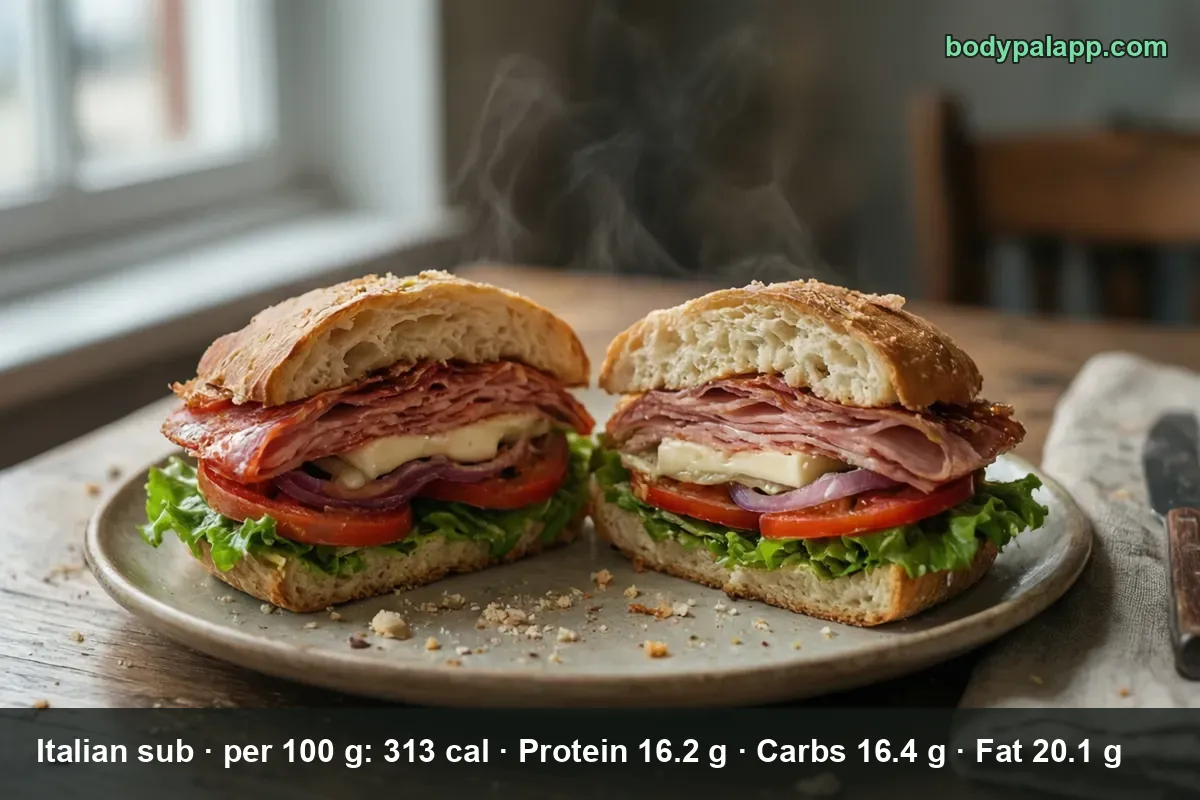
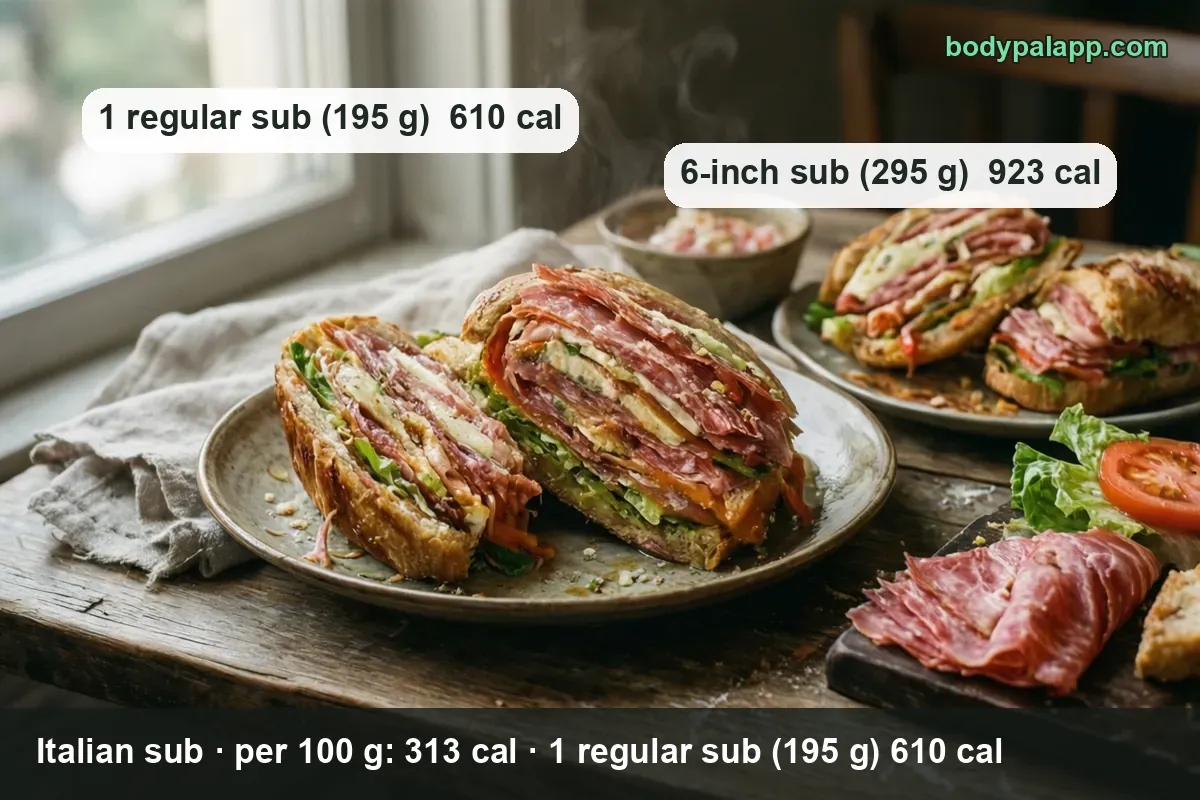
An Italian sub from a deli counter is 610 calories for a regular 195 g sandwich, or 313 calories per 100 g. Each half is 307. Ask for the 6-inch instead and you are holding 295 g and 923 calories — the same sandwich, a heavier noun.
On this page
- Italian sub quick facts
- The word "regular" costs 313 calories
- US servings, from an ounce to a 6-inch
- White, wheat and the store-bought sub
- The sodium is the loudest number
- Saturated fat outruns the carbohydrate
- How does an Italian sub compare?
- Most popular italian sub brands
- FAQ
Italian sub quick facts
Every figure in the table below comes from one record: FNDDS 2707052, "Italian sandwich or sub, restaurant", filed under deli and cured meat sandwiches. That is the sub built at a counter — salami, prosciutto, cheese, lettuce, tomato — and handed to you cut in two. USDA's Foundation and SR Legacy tiers hold no line for an Italian sub at all, so there is no higher source to prefer.
| Nutrient | Per 100 g | Per 1 regular sub (195 g) | % Daily Value |
|---|---|---|---|
| Calories | 313 kcal | 610 kcal | — |
| Total fat | 20.05 g | 39.1 g | 50% |
| Saturated fat | 8.11 g | 15.8 g | 79% |
| Carbohydrate | 16.42 g | 32.0 g | 12% |
| Dietary fiber | 0.7 g | 1.4 g | 5% |
| Total sugars | 2.11 g | 4.1 g | — |
| Protein | 16.23 g | 31.6 g | 63% |
| Sodium | 1053 mg | 2053 mg | 89% |
% Daily Value is based on a 2,000-calorie diet.
Verified nutrition data
Numbers on this page come from USDA FoodData Central, the U.S. Department of Agriculture’s food composition database, and from manufacturer labels where a branded product is named. Last verified September 2026. How we verify our data →
Two rows carry the page. Saturated fat reaches 79% of the day in one sandwich, and sodium reaches 89%. Calories are the reason people search for this food; those two numbers are the reason to keep reading.
Two rows a packaged label would show are missing here, and deliberately so. The 2021–2023 FNDDS release publishes no added sugars and no trans fat for any of its composite dishes, so those cells have no value rather than a value of zero, and printing zeros would be invention. Total sugars carry no Daily Value on a US label either, which is why that percentage is a dash.
Two more figures ride along on the same record and rarely surface on a calorie chart: 57 mg of cholesterol and 251 mg of potassium per 100 g.
The word "regular" costs 313 calories
USDA's household measures for this sandwich contain a contradiction worth knowing before you log anything. One measure is "1 regular sub" at 195 g. Another is "1 regular or 6-inch submarine" at 295 g. Both use the word regular, and they are 100 g apart.
In calories that gap is 313 — a whole extra miniature sandwich hiding inside a single adjective. A regular sub is 610 calories. A 6-inch is 923. Nothing about the recipe changed; only the length of bread did.
This page treats 195 g as the regular sandwich and 295 g as the large or 6-inch, because that is how a deli case reads to an American standing in front of it: a house sub and a footlong-adjacent upgrade. If you are logging from a receipt rather than a scale, the safest move is to record the size you ordered by name and let the weight follow, not the other way around.
Raw against cooked, the split that decides most meat pages, does not apply here. This record describes a finished sandwich, meat already sliced and cured, bread already baked. Every gram on this page is a gram you can hold.
US servings, from an ounce to a 6-inch
| Serving | Weight | Calories |
|---|---|---|
| 1 oz | 28.35 g | 89 |
| 1 miniature or slider | 100 g | 313 |
| Half a regular sub | 98 g | 307 |
| 1 regular sub | 195 g | 610 |
| 1 large or 6-inch submarine | 295 g | 923 |
USDA's household measures on this record are the 195 g, 295 g and 100 g rows; the half and the ounce are our own scaling of the same 313 calories per 100 g.
The half row is the useful one, and not because half of anything is virtuous. A deli sub arrives already cut, which makes it the rare restaurant food with a built-in stopping point. Half is 307 calories with 15.9 g of protein, 32% of the protein Daily Value, and 19.6 g of fat, 25% of the fat Daily Value. Sodium is the row that refuses to halve gracefully: 1,032 mg, still 45% of a day.
The 100 g row deserves a warning label. A miniature sub weighs about 100 g, which means the per-100-gram figure everyone quotes describes a slider, not a sandwich — roughly half the real object. Any chart that ends at 313 calories is describing food you would not consider lunch.
An ounce is 89 calories, which matters if you build subs at home and weigh the finished thing rather than the parts. Seven ounces is the regular sandwich, near enough.
White, wheat and the store-bought sub
| Version | Per 100 g | Serving | Calories |
|---|---|---|---|
| Deli or restaurant sub | 313 | 1 regular (195 g) | 610 |
| Deli or restaurant sub | 313 | 1 large or 6-inch (295 g) | 923 |
| Italian sandwich on white | 309 | 1 regular (165 g) | 510 |
| Italian sandwich on wheat | 308 | 1 regular (165 g) | 508 |
| Italian sandwich on white | 309 | 1 large or 6-inch (250 g) | 773 |
| Italian sandwich on wheat | 308 | 1 large or 6-inch (250 g) | 770 |
| Store-bought packaged sub | 212–283 | 1 sandwich (226–296 g) | 500–781 |
Start with the bread question, because it is the one people ask and the answer is not the one they expect. Italian sandwich on wheat is 308 calories per 100 g and the white version is 309. One calorie. Swapping bread does nothing to the total and never has.
What it does is fiber. Wheat carries 2.0 g per 100 g against 0.8 g on white, and against 0.7 g on the deli sub. That is close to triple, from a change that costs nothing, on a sandwich whose weakest nutritional row is fiber. A regular deli sub delivers 1.4 g, 5% of the Daily Value, which is the sort of number a salad fixes and a bread swap improves.
The homemade lines run lighter than the deli line for one structural reason: the ratio of filling to bread. The restaurant sub packs 20.05 g of fat per 100 g against 18.78 g on white and 18.92 g on wheat, and 1,053 mg of sodium against 1,010 and 1,006. More meat and cheese per inch of roll. That also makes the counter version the biggest protein serving on the page, at 31.6 g against 27.1 g on wheat, which is the trade in plain sight.
Store-bought subs from a grab-and-go case look like the light option and are not. They run 212 to 283 calories per 100 g, comfortably under the deli figure, because they carry more bread and more vegetables per gram of meat. Then they typically arrive as 226 to 296 g objects and land at 500 to 781 calories. Lower density, bigger item, same lunch. It is the oldest illusion in calorie counting: per gram is a property of the recipe, per sandwich is what you eat.
The sodium is the loudest number
One regular Italian sub carries 2,053 mg of sodium, which is 89% of the FDA Daily Value of 2,300 mg. That is a full day's sodium, minus the rounding, from one item eaten with one hand.
The 6-inch does not stop there. At 1,053 mg per 100 g across 295 g, it comes to 3,106 mg, past the whole-day value before dinner exists. Half a sub stays reasonable at 1,032 mg, 45%.
Cured meat is the obvious suspect and only half the story. Bread is the other half, which is why the store-bought versions still run 682 to 928 mg per 100 g while carrying less salami than the deli sub does. The CDC has spent years pointing at packaged and restaurant foods rather than the shaker for exactly this reason, and the Dietary Guidelines for Americans keep sodium on the short list of nutrients Americans overconsume in every edition.
If the sodium row is the one you watch, the lever on this page is size, not ingredients. Half a sub with a side is 1,032 mg. A whole one is 2,053 mg. No bread swap and no lettuce upgrade moves the number the way a knife does.
Saturated fat outruns the carbohydrate
Here is the shape of an Italian sub that surprises people. Per 100 g it holds 20.05 g of fat against 16.42 g of carbohydrate. A sandwich — a food defined by bread — is more fat than starch by weight.
The Daily Value column makes it plainer. A regular sub is 39.1 g of total fat, 50% of the day, and 15.8 g of saturated fat, 79%. The carbohydrate that everyone worries about sits at 32.0 g, 12%. Go up to the 295 g size and saturated fat reaches 23.9 g, 120% of the Daily Value, while carbohydrate is still only 18%. You can blow through a day's saturated fat on this sandwich without coming close to a day's carbohydrate.
That is the useful reframe. If you are cutting bread to make an Italian sub fit your day, you are working on the wrong row.
The protein makes the case for the other side. A regular sub delivers 31.6 g, 63% of the Daily Value, which is more than most sit-down entrées and enough to end hunger for hours. MyPlate counts protein foods in ounce-equivalents, and a sandwich stacked with cured meat and provolone scores well on that column even as it scores badly on two others. Half a sub keeps 15.9 g of that protein for 307 calories, which is the most efficient version of this food anyone sells.
How does an Italian sub compare?
| Item | Per 100 g | Serving | Calories | Protein / Carbs / Fat |
|---|---|---|---|---|
| Italian sub, deli | 313 | 1 regular (195 g) | 610 | 31.6 / 32.0 / 39.1 g |
| Italian sandwich on white | 309 | 1 regular (165 g) | 510 | 25.9 / 31.2 / 31.0 g |
| Italian sandwich on wheat | 308 | 1 regular (165 g) | 508 | 27.1 / 28.9 / 31.2 g |
| Salami sandwich with cheese | 326 | 1 regular (135 g) | 440 | 21.4 / 30.5 / 25.5 g |
| Salami sandwich on white | 321 | 1 regular (115 g) | 369 | 17.3 / 29.7 / 19.7 g |
Every line is a USDA record for a cured-meat sandwich, so this is a fair comparison rather than a lineup of unrelated foods. Per 100 g they sit within 18 calories of each other, from 308 to 326. Per sandwich they span 369 to 610, and the ranking inverts: the densest food on the list, the salami sandwich with cheese at 326 calories per 100 g, is also the second-lightest meal, because it weighs 135 g.
Our take: the plain salami sandwich at 369 calories is the smallest real lunch here and the deli Italian sub at 610 is the biggest, and neither fact has anything to do with how they were made. Size is doing all the work. If you want the protein, the deli sub wins outright at 31.6 g — nothing else on the table breaks 28 g — and if you want a sandwich that leaves room for the rest of the day, order the Italian sub and eat the half you were already handed. The wheat version is the free upgrade: same calories, triple the fiber, marginally less sodium.
Most popular italian sub brands in the United States
Ranked by how widely each product appears among foods sold in the United States, from the BodyPal food database of over 3.3 million products. Calories are the figures printed on each Nutrition Facts label, checked against USDA FoodData Central.
| Product | Calories (per 100 g) |
|---|---|
| Garden Highway Three Meat Italian Sub | 221 cal |
| Boar's Head Authentic Italian Sub | 220 cal |
| Renaissance Food Group Italian Sub | 243 cal |
| Giant Eagle Italian Sub Sandwich | 220 cal |
| Meijer Italian Sub on White Bun | 283 cal |
| Hearthside Italian Sub Large | 233 cal |
Brand popularity: BodyPal food database. Nutrition: manufacturer labels / USDA FoodData Central.
Italian sub FAQs
How many calories are in an Italian sub?
610 calories in one regular 195 g sub, at 313 calories per 100 g. That sandwich carries 31.6 g of protein, 39.1 g of fat, 32.0 g of carbohydrate and 2,053 mg of sodium. A 6-inch version weighs 295 g and reaches 923 calories.
How many calories are in a 6-inch Italian sub?
923 calories for the 295 g size USDA lists as a large or 6-inch submarine. That is 313 calories more than the 195 g regular sub, from the same filling on a longer roll. Saturated fat reaches 23.9 g, or 120% of the Daily Value.
How many calories are in half an Italian sub?
307 calories for one 98 g half, which is how a deli hands the sandwich over. That half brings 15.9 g of protein, 32% of the Daily Value, and 19.6 g of fat, 25%. Sodium is the row that stays high at 1,032 mg, still 45% of a day.
Is an Italian sub high in sodium?
Yes — one regular sub is 2,053 mg, which is 89% of the 2,300 mg Daily Value, and the 6-inch reaches 3,106 mg. Bread shares the blame with the cured meat: packaged supermarket subs still run 682 to 928 mg per 100 g with less salami inside.
How much protein is in an Italian sub?
31.6 g in a regular 195 g sub, which is 63% of the 50 g Daily Value, from 16.23 g per 100 g. Half a sub keeps 15.9 g of it for 307 calories. Very few handheld foods return that much protein without a shake involved.
Italian sub on wheat or white: which has fewer calories?
Effectively neither. Wheat is 308 calories per 100 g and white is 309, so a 165 g sandwich is 508 against 510. The real difference is fiber, at 2.0 g per 100 g on wheat against 0.8 g on white, and sodium is a touch lower too at 1,006 mg against 1,010 mg.
Is an Italian sub a healthy choice?
It is a high-protein, high-sodium lunch: one regular sub gives 31.6 g of protein, 63% of the Daily Value, alongside 15.8 g of saturated fat, 79%, and 2,053 mg of sodium, 89%. At the 295 g size saturated fat passes the day's value at 120%. Half a sub changes the arithmetic completely.
Are store-bought Italian subs lighter than deli ones?
Per gram, yes: 212 to 283 calories per 100 g against 313 for a deli sub, because they hold more bread and vegetables per gram of meat. Per sandwich, no. They typically weigh 226 to 296 g and land at 500 to 781 calories, so the biggest packaged sub beats the deli one.
Similar foods
- Sausage — 210 cal per link
- Coconut Shrimp — 250 cal for 4 shrimp
- Chuck Roast — 257 cal per 3 oz
- Sausage Link — 75 cal per link
- Hush puppies — 521 cal for 8 hush puppies
- Mozzarella — 334 cal per cup, shredded
Count it without the math
Point the camera at the plate and BodyPal logs the sub, the half you actually ate, and the sodium that comes with it.


How long does it take to burn off an Italian sub?
One regular sub (195 g) is 610 kcal. Enter your weight and the amount you ate to see how long it takes you to burn that off:
lb
| Activity | Time to burn 610 kcal |
|---|---|
| Walking, brisk | 2 hr 2 min |
| Cycling, moderate | 1 hr 16 min |
| Swimming, moderate | 1 hr 27 min |
| Jogging | 1 hr 12 min |
| Weight training, moderate | 2 hr 16 min |
Times are for a 155 lb adult at a steady pace; change the weight to see yours. The amount is set to the portion in the text (195 g); change it to what you actually ate. BodyPal works this out from your steps automatically.
Want the bigger picture? Calculate your daily calorie needs — your maintenance figure, a target for losing or gaining, and the date you get there.