
How many calories are in hush puppies?
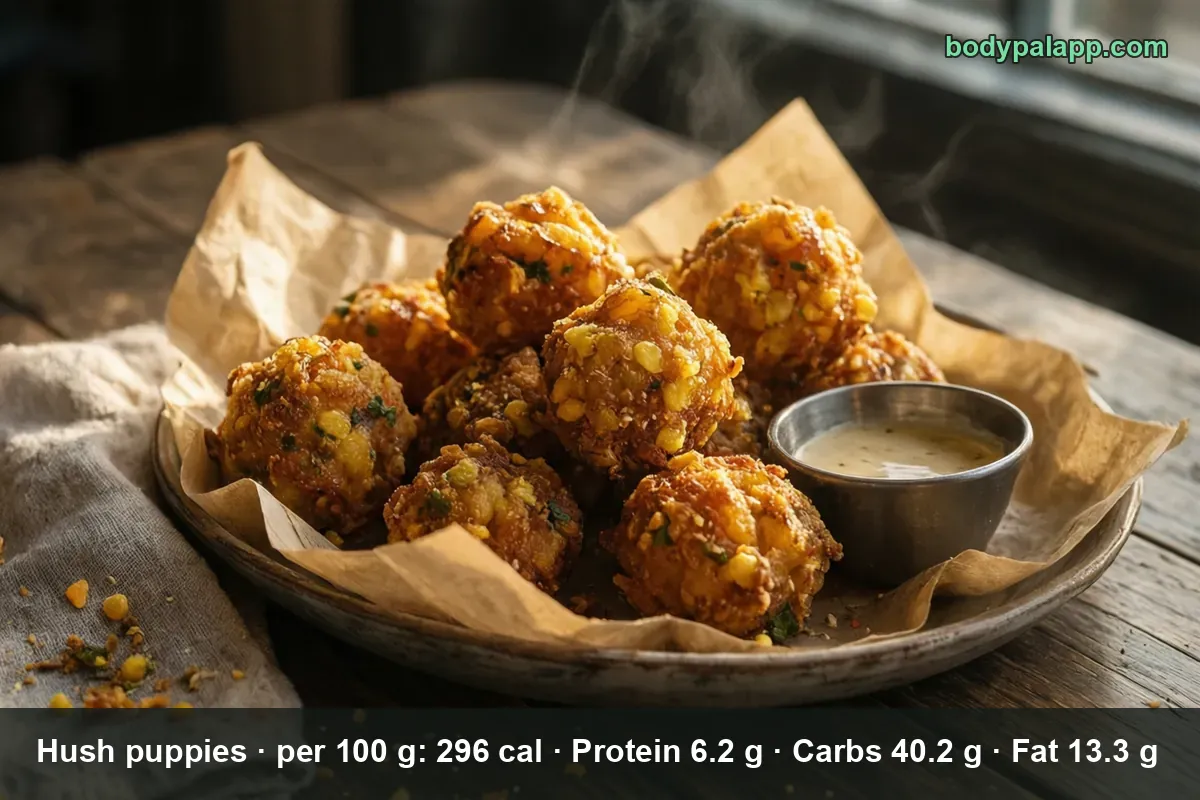
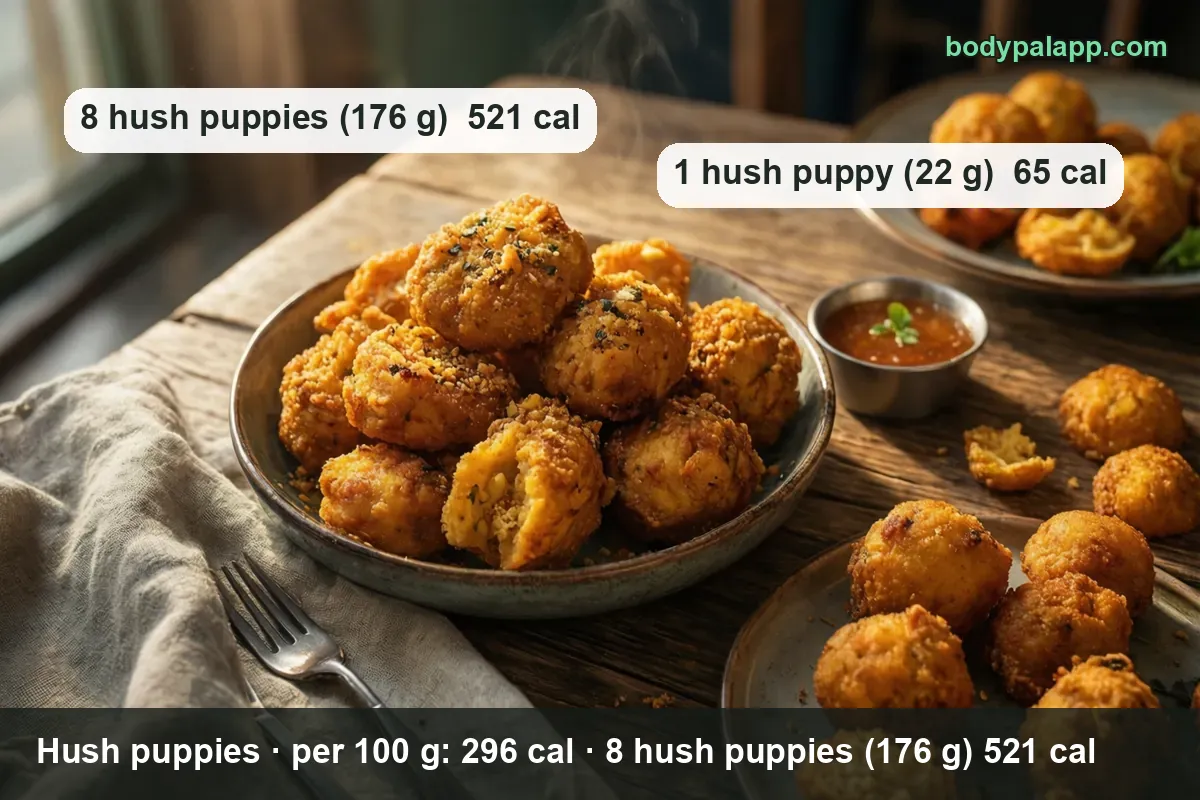
A side of three hush puppies weighs 66 g and comes to 195 calories, or 296 calories per 100 g. One on its own is 65. That is the whole difficulty with the calories in hush puppies: the piece is small enough to feel free, so the figure that decides your day is the count, not the recipe. A restaurant basket of eight is 521.
On this page
- Hush puppy quick facts
- Counting hush puppies, one to eight
- The cup that adds 255 calories
- Homemade hush puppies are the heavier ones
- The frozen bag from the supermarket
- Sodium is the number to watch
- How do hush puppies compare?
- Most popular hush puppies brands
- FAQ
Hush puppy quick facts
Every figure on this page traces back to SR Legacy 170301, "Fast foods, hush puppies" — USDA files it under fast foods rather than baked goods, which is exactly right for the fried cornmeal balls that arrive next to fried catfish or a rack of ribs.
The serving column is three pieces. USDA documents a single hush puppy at 22 g, and the survey database uses 66 g as the typical amount eaten when no quantity is stated, so three is not a convenient invention: it is what the data already calls one helping.
| Nutrient | Per 100 g | Per 3 hush puppies (66 g) | % Daily Value |
|---|---|---|---|
| Calories | 296 cal | 195 cal | — |
| Total fat | 13.3 g | 8.7 g | 11% |
| Saturated fat | 2.6 g | 1.7 g | 9% |
| Carbohydrate | 40.2 g | 26.5 g | 10% |
| Dietary fiber | 2.9 g | 1.9 g | 7% |
| Total sugars | 3.8 g | 2.5 g | — |
| Protein | 6.2 g | 4.1 g | 8% |
| Sodium | 813 mg | 537 mg | 23% |
% Daily Value is based on a 2,000-calorie diet.
Verified nutrition data
Numbers on this page come from USDA FoodData Central, the U.S. Department of Agriculture’s food composition database, and from manufacturer labels where a branded product is named. Last verified September 2026. How we verify our data →
Two rows a packaged label would carry are absent, and for the same reason: USDA publishes no added sugars and no trans fat value for this record. Writing zeros there would turn "not measured" into "none present", so the rows are gone instead. Total sugars carry no Daily Value on a US label either, which is why that cell is blank.
Two figures sit outside the core label but come from the same record. Cholesterol is 0 mg — restaurant hush puppies are fried in vegetable oil and the batter carries no egg, which becomes interesting once the homemade version turns up further down. Potassium is 256 mg per 100 g, 169 mg in a side of three, about 4% of the day.
The fiber row is the small surprise. Cornmeal brings 2.9 g per 100 g, a tenth of the 28 g Daily Value, which is more than most fried sides manage. Scaled to a real portion it shrinks to 1.9 g, or 7%. Cornmeal is also what files them under MyPlate's grain group rather than with the vegetables, whatever the corn on the crust suggests. Good for something out of a fryer, not a reason to order it.
Counting hush puppies, one to eight
| Serving | Weight | Calories |
|---|---|---|
| 1 hush puppy | 22 g | 65 |
| 1 oz | 28 g | 84 |
| 3 hush puppies, typical side | 66 g | 195 |
| 5 hush puppies | 110 g | 326 |
| 6 hush puppies, half a dozen | 132 g | 391 |
| 8 hush puppies, a basket | 176 g | 521 |
| 1 cup | 152 g | 450 |
Read that column from top to bottom and the shape of the problem is obvious. The gap between one hush puppy and eight is 456 calories — more than a whole cheeseburger — and every step of it is made of an object roughly the size of a golf ball.
This is why hush puppies behave differently from the rest of the fried sides. Fries arrive in a defined portion. A biscuit is one biscuit. Hush puppies arrive as a heap that nobody counts, get shared across the table, and are eaten between other things while the conversation goes on. Ask someone afterwards how many they had and the honest answer is usually "a few".
So count them before you start, or count the empty paper afterwards. Three is 195 and holds; five is 326 and is a light lunch on its own; eight is 521, which is a main course sitting next to your main course.
The ounce row is there for the shared basket, and it is the easiest one to carry in your head: an ounce of hush puppy is 84 calories, and an ounce is a little more than one piece.
The cup that adds 255 calories
USDA also documents hush puppies by volume, and this is where food logs go wrong.
One cup weighs 152 g and comes to 450 calories. That cup holds roughly seven pieces. A side of three, the portion most restaurants actually put down, is 66 g and 195 calories.
Tap "1 cup" into a food log after eating a side of three and you have charged yourself 255 calories you never ate. Do it the other way — eat the cup, log the side — and you are 255 short in the direction that matters more.
The cup measure is not wrong; it is just describing a bigger pile than the one in front of most people. Pieces are the honest unit for this food, and USDA gives you the 22 g piece to work with. Use the volume row only when you genuinely have a cup of them, which in practice means a bowl passed around a table.
Homemade hush puppies are the heavier ones
Almost everyone guesses this backwards. Restaurant food is meant to be the indulgent version and the home kitchen the sensible one. The numbers say the opposite.
| Version | Per 100 g | 1 piece (22 g) | 1 oz (28 g) | 1 cup (152 g) | Sodium per 100 g |
|---|---|---|---|---|---|
| Restaurant, fried (this page) | 296 cal | 65 | 84 | 450 | 813 mg |
| Homemade from recipe | 337 cal | 74 | 96 | 512 | 668 mg |
Homemade runs 41 calories heavier per 100 g, about 14% more. On the same cup that is a 62-calorie difference, and per piece it is nine. Our own scaling puts the homemade record on the same piece, ounce and cup weights as the restaurant row, so the two columns line up.
The reason is in the batter, not the fryer. USDA's recipe record carries 45 mg of cholesterol per 100 g against zero for the restaurant version, which is the signature of egg and milk in the mix. Those two ingredients also lift protein from 6.2 g to 7.7 g and carbohydrate from 40.2 g to 46 g per 100 g. Fat barely moves — 13.5 g against 13.25 g — so the extra calories are batter, not oil.
Sodium goes the other way. The home recipe holds 668 mg per 100 g against 813 mg, so cooking them yourself saves salt and costs calories. If salt is the number you are managing, that trade is worth having. If calories are, it is not.
Both records come from the same edition of USDA's legacy database, so this is not two sources disagreeing. It is two genuinely different foods that share a name.
The frozen bag from the supermarket
The bagged kind from the freezer aisle is the third version, and it is the lightest of the three: 273 calories per 100 g. The label serving is four pieces at 55 g, which comes to 150 calories — less than a restaurant side of three, for one more piece.
That is a real difference rather than a rounding artifact. Fat runs 9.09 g per 100 g against 13.25 g for the restaurant version, because the label describes the product as it comes out of the bag, before it spends its time in your own oil. Carbohydrate is 43.64 g and protein 3.64 g.
Then the sting. Sodium on that bag is 1,000 mg per 100 g, higher than the restaurant figure of 813. The label serving of 55 g carries 550 mg, 24% of the Daily Value, from four small fried balls. Freezing food does not make it plain food.
Sodium is the number to watch
Calories are why people search for hush puppies. Sodium is the row that should stop them.
- 3 hush puppies, 66 g: 537 mg, 23% of the day
- 1 cup, 152 g: 1,236 mg, 54%
- 8 hush puppies, 176 g: 1,431 mg, 62%
Set that against the calorie side of the same basket. Eight pieces are 521 calories, about 26% of a 2,000-calorie day, while the sodium in them is 62% — the salt runs more than twice as far ahead as the energy does. The FDA Daily Value for sodium is 2,300 mg, and a teaspoon of table salt holds roughly that much, so a shared basket is a little under two thirds of a teaspoon.
The Dietary Guidelines for Americans keep sodium among the nutrients Americans over-consume, and fried restaurant sides are one of the reliable ways it arrives. Nothing about hush puppies looks salty. They are sweetish, they taste of corn, and they sit on the plate as an afterthought.
There is a practical version of this. If you are having hush puppies with something already cured, brined or sauced — pulled pork, fried fish, a barbecue plate — the side is the part of the meal you can shrink without missing it. Three instead of eight saves 326 calories and 894 mg of sodium in one decision.
How do hush puppies compare?
Every item here is a USDA record from the same corner of the database — small fried or baked things sold by the piece — and each one lists an ounce as its first documented portion, so the ounce column is a fair comparison.
| Item | Per 100 g | Per 1 oz (28 g) | Protein / Carbs / Fat per oz |
|---|---|---|---|
| Hush puppies (this page) | 296 cal | 84 | 1.7 / 11.4 / 3.8 g |
| Biscuit, frozen, baked | 338 cal | 96 | 1.8 / 15.3 / 3.1 g |
| Biscuit from dry mix | 335 cal | 95 | 2.1 / 13.7 / 3.4 g |
| Doughnut, yeast, jelly-filled | 340 cal | 96 | 1.7 / 11.1 / 5.3 g |
| Blueberry toaster muffin, toasted | 333 cal | 94 | 1.4 / 16.1 / 2.9 g |
Our take: per gram the hush puppy is the lightest thing in the table and the only one under 300, so anyone comparing densities will crown it. That is the wrong contest. The other four are single objects you eat one of — a biscuit is a biscuit, a doughnut is a doughnut — and a hush puppy is one of eight. A few percent lighter per gram does not survive being eaten in multiples.
If you want the smallest number on a Southern table, a side of three at 195 calories genuinely is small, and it beats a jelly doughnut with room to spare. If the basket lands in the middle of the table and stays there, the hush puppies are the biggest item you will eat all evening and nobody will remember ordering them.
Most popular hush puppies brands in the United States
Ranked by how widely each product appears among foods sold in the United States, from the BodyPal food database of over 3.3 million products. Calories are the figures printed on each Nutrition Facts label, checked against USDA FoodData Central.
| Product | Calories (per 100 g) |
|---|---|
| Allens Hush Puppies | 273 cal |
Brand popularity: BodyPal food database. Nutrition: manufacturer labels / USDA FoodData Central.
Hush puppy FAQs
How many calories are in hush puppies?
195 calories in a side of three, which is 66 g, at 296 calories per 100 g. That serving carries 8.7 g of fat, 26.5 g of carbohydrate, 4.1 g of protein and 537 mg of sodium. A single hush puppy of 22 g is 65 calories.
How many calories are in one hush puppy?
65 calories for one 22 g piece, USDA's documented single-piece weight. That is small enough to feel like nothing, which is the trap: five are 326 calories and a basket of eight is 521. The difference between one and eight is 456 calories.
How many calories are in 6 hush puppies?
391 calories for half a dozen, or 132 g at 296 calories per 100 g. Five come to 326 and eight to 521. Six pieces also bring 1,073 mg of sodium, close to half the 2,300 mg Daily Value.
How many calories are in a cup of hush puppies?
450 calories for one cup, which USDA weighs at 152 g and works out at roughly seven pieces. That is 255 calories more than the side of three most restaurants serve, so logging a cup when you ate a side overstates the meal badly.
Are homemade hush puppies lower in calories?
No — homemade run 337 calories per 100 g against 296 for the restaurant version, about 14% heavier. One homemade piece is 74 calories against 65. Egg and milk in the batter explain it, and the same record shows 45 mg of cholesterol per 100 g where the restaurant version has none.
How much sodium is in hush puppies?
537 mg in a side of three, 23% of the 2,300 mg Daily Value, from 813 mg per 100 g. A cup reaches 1,236 mg and a basket of eight 1,431 mg, which is 62% of the day. Sodium runs more than twice as far ahead of the calorie figure for the same food.
How many carbs are in hush puppies?
26.5 g in a side of three, 10% of the 275 g Daily Value, from 40.2 g per 100 g. Of that, 2.5 g is sugar and 1.9 g is fiber. Cornmeal is the reason the carbohydrate figure is high and also the reason there is any fiber at all.
Are hush puppies healthy?
A side of three is 195 calories with 1.9 g of fiber and 537 mg of sodium, so the calorie figure is modest and the sodium is not. Cornmeal gives them 2.9 g of fiber per 100 g, a tenth of the Daily Value, which is unusual for a fried side. The count is what decides it: three is a side, eight is 521 calories.
Similar foods
- Ball Park Hot Dog — 302 cal per hot dog on a bun
- Hot Dog — 302 cal per hot dog
- Cheeseburger Slider — 238 cal per slider
- Sausage Egg And Cheese Bagel — 646 cal per bagel
- Corn Nuggets — 250 cal per 5 pieces
- Nathan's Hot Dog — 170 cal per link
Count it without the math
Point the camera at the basket and BodyPal counts the pieces, the oil and the sodium before anyone reaches for a second one.


How long does it take to burn off hush puppies?
A side of three hush puppies (66 g) is 195 kcal. Enter your weight and the amount you ate to see how long it takes you to burn that off:
lb
| Activity | Time to burn 195 kcal |
|---|---|
| Walking, brisk | 39 min |
| Cycling, moderate | 24 min |
| Swimming, moderate | 28 min |
| Jogging | 23 min |
| Weight training, moderate | 43 min |
Times are for a 155 lb adult at a steady pace; change the weight to see yours. The amount is set to the portion in the text (66 g); change it to what you actually ate. BodyPal works this out from your steps automatically.
Want the bigger picture? Calculate your daily calorie needs — your maintenance figure, a target for losing or gaining, and the date you get there.