
How many calories are in a dill pickle?
One large 4-inch dill pickle straight out of the jar weighs 135 g and carries just 16 calories. Per 100 g the figure is 12 calories, which makes it one of the lightest things you can put on a plate. The catch is not the calories. It is the 1,092 mg of sodium riding along.
On this page
- Dill pickle quick facts
- US servings from one slice to a full cup
- Kosher dill and reduced-sodium versions
- Sodium is the row that matters here
- How does a dill pickle compare?
- Most popular dill pickle brands
- FAQ
Dill pickle quick facts
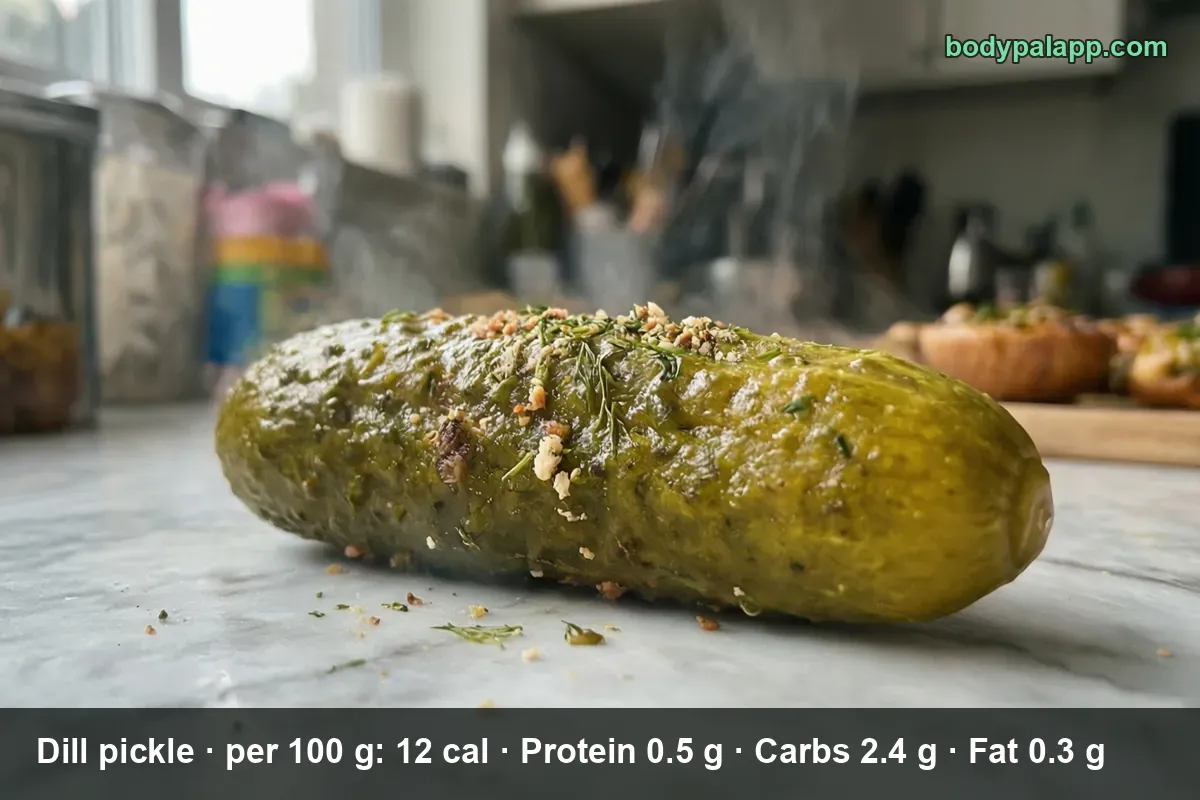
The record behind every number here is SR Legacy 168558, "Pickles, cucumber, dill or kosher dill". It is the whole pickle out of the brine, the kind pictured above, and it is the only USDA entry that carries a complete nutrient set alongside American household measures for a whole pickle, a spear and a cup of slices. Kosher dill and plain dill sit in the same record, because the difference is the seasoning of the brine, not the cucumber.
The serving column below is a 135 g large pickle, roughly 4 inches long, which is the size sold loose at a deli counter and packed whole in a quart jar.
| Nutrient | Per 100 g | Per 1 large pickle (135 g) | % Daily Value |
|---|---|---|---|
| Calories | 12 | 16 | — |
| Total fat | 0.3 g | 0.4 g | 1% |
| Saturated fat | 0.08 g | 0.1 g | 1% |
| Carbohydrate | 2.41 g | 3.3 g | 1% |
| Dietary fiber | 1 g | 1.4 g | 5% |
| Total sugars | 1.07 g | 1.4 g | — |
| Protein | 0.5 g | 0.7 g | 1% |
| Sodium | 809 mg | 1092 mg | 47% |
% Daily Value is based on a 2,000-calorie diet.
Verified nutrition data
Numbers on this page come from USDA FoodData Central, the U.S. Department of Agriculture’s food composition database, and from manufacturer labels where a branded product is named. Last verified September 2026. How we verify our data →
There is no added sugars row because the SR Legacy edition of this food does not publish added sugars, and a dill brine is normally unsweetened anyway, unlike the syrupy bread-and-butter style. Cholesterol is 0 mg. Potassium comes to 158 mg in the large pickle, 3% of the Daily Value, which is the one mineral working in your favor here. Daily Values follow the FDA's Nutrition Facts label reference amounts.
US servings from one slice to a full cup
| Serving | Weight | Calories |
|---|---|---|
| 1 sandwich slice | 7 g | 1 kcal |
| 1 oz | 28 g | 3 kcal |
| 1 spear, small | 35 g | 4 kcal |
| 1 large pickle, 4 inches | 135 g | 16 kcal |
| 1 cup, about 23 slices | 155 g | 19 kcal |
| Per 100 g | 100 g | 12 kcal |
The slice, the spear, the large pickle and the cup are all USDA household measures attached to record 168558, so those weights come from the database rather than from a kitchen scale. The 1 oz line is our own arithmetic from the USDA 100 g figure, not a USDA serving, and it is the one worth memorizing because almost every American pickle jar declares its Nutrition Facts per ounce.
That ounce is where the label and the database quietly disagree. Store brands round to whole numbers on a tiny serving, so Claussen kosher dill sandwich slices and Great Value sliced dills both print 18 calories per 100 g and 5 per ounce, while Safie and Adria whole pickles sit at 17. Several major labels declare 0 calories per serving outright, which is legal rounding on a 3-calorie ounce rather than a different pickle.
Kosher dill and reduced-sodium versions
| Version | Per 100 g | Typical piece | Calories | Sodium |
|---|---|---|---|---|
| Dill or kosher dill, whole | 12 kcal | 1 large, 4 in (135 g) | 16 kcal | 1092 mg |
| Reduced-sodium dill | 12 kcal | 1 large, 4 in (135 g) | 16 kcal | 24 mg |
| Kosher dill, lab entry | 12 kcal | 1 spear (40.4 g) | 5 kcal | 326 mg |
| Dill pickles, survey average | 14 kcal | 1 regular (80 g) | 11 kcal | 646 mg |
| Pickles, NFS | 14 kcal | 1 oz (28 g) | 4 kcal | 226 mg |
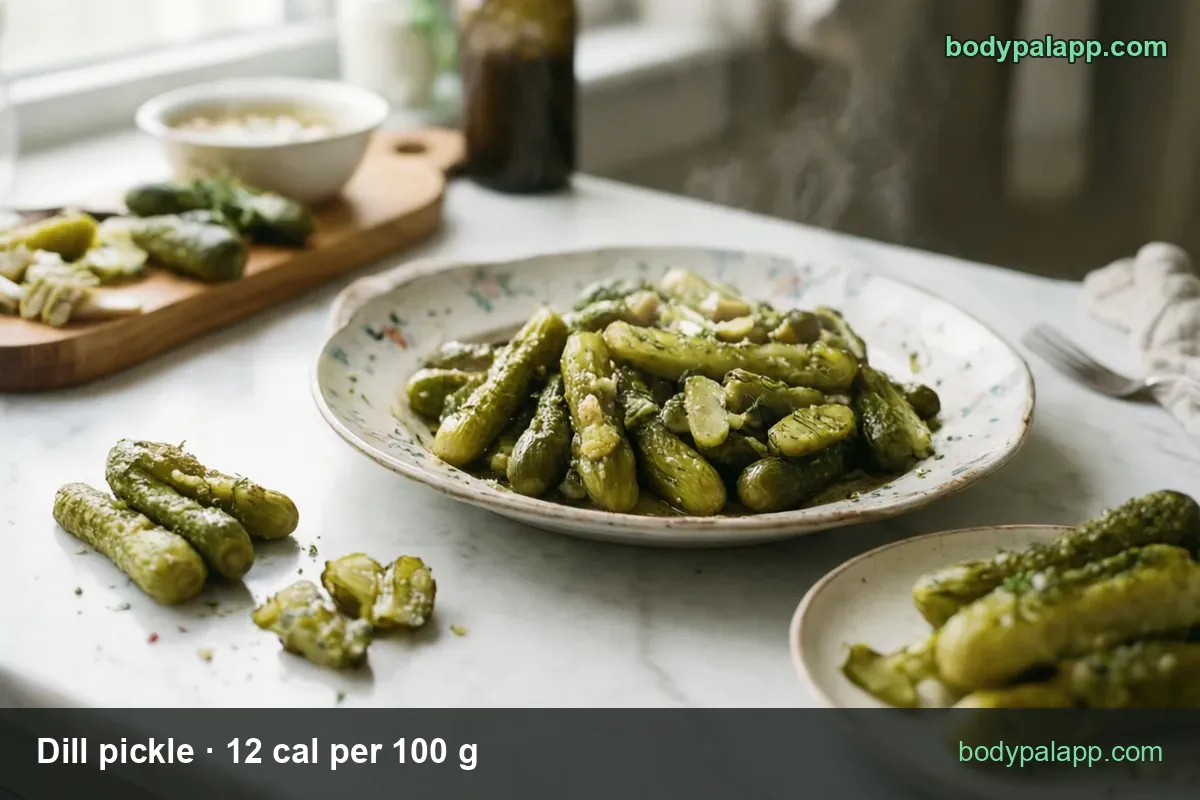
Kosher dill is not a separate calorie count. USDA files it in the same record as plain dill, and the newer Foundation lab entry for it lands on the same 12 calories per 100 g, so a spear is a spear whether or not there is garlic in the jar. The sodium column in the table above is our own scaling of each USDA per-100 g figure to the piece listed, not a USDA serving value.
The reduced-sodium jar is the only variant that changes anything meaningful, and it changes nothing on the calorie line. Same 12 calories per 100 g, same 16 for a whole pickle, 18 mg of sodium per 100 g instead of 809. Over one large pickle that is 1,068 mg less sodium for an identical snack.
The two 14-calorie rows are survey composites: FNDDS averages every dill style Americans report eating, including sweeter brines, which nudges the number up by 2 calories per 100 g. If you are logging a pickle you can see and identify, the 12-calorie record is the closer match.
Sodium is the row that matters here
Almost nothing else on a food page has this shape: under 1% of your day's calories and nearly half your day's sodium in the same object. One large pickle is 1,092 mg, 47% of the 2,300 mg Daily Value. That is about half a teaspoon of table salt.
A cup of slices is the trap. It looks like the small choice at 19 calories, but at 155 g it carries 1,254 mg of sodium, 55% of the Daily Value, more than the whole pickle it was cut from. Volume eating works beautifully on calories and badly on brine.
For scale, the CDC puts average US intake at roughly 3,400 mg a day against a 2,300 mg limit in the Dietary Guidelines for Americans. A burger with a pickle on it is not the problem by itself; a pickle alongside deli meat, chips and a cup of soup is where the day gets away from you. If sodium is something you track, the reduced-sodium jar buys back nearly half of your daily allowance for free.
The upside rows are real too, if small. Fiber is 1.4 g per large pickle, 5% of the Daily Value, which is more than the carbohydrate row would suggest: 3.3 g total carbs minus 1.4 g fiber leaves about 1.9 g net.
How does a dill pickle compare?
| Pickled food | Per 100 g | US serving | Calories |
|---|---|---|---|
| Dill pickle | 12 kcal | 1 oz (28 g) | 3 kcal |
| Kimchi | 15 kcal | 1 oz (28 g) | 4 kcal |
| Hot pickled peppers | 22 kcal | 1 oz (28 g) | 6 kcal |
| Sauerkraut | 40 kcal | 1 oz (28 g) | 11 kcal |
Our take: the dill pickle is the lightest of the four per gram, and by a clear margin over sauerkraut, which runs more than three times its calories per 100 g. For a plate that needs acid and crunch without a calorie cost, the pickle wins outright. All four are preserved in salt, so sodium rather than calories is the line to watch. Pick by flavor, not by calories, and then decide how many of them belong in the same meal.
Most popular dill pickle brands in the United States
Ranked by how widely each product appears among foods sold in the United States, from the BodyPal food database of over 3.3 million products. Calories are the figures printed on each Nutrition Facts label, checked against USDA FoodData Central.
| Product | Calories (per 100 g) |
|---|---|
| Safie Deli Style Dill Pickles | 17 cal |
| Claussen Kosher Dill Sandwich Slices | 18 cal |
| Safie Hot & Spicy Deli Style Dill Pickles | 18 cal |
| Bessinger Baby Dill Pickles | 18 cal |
| Great Value Kosher Sliced Dill Pickles | 18 cal |
| Adria Poland Cucumber Dill Pickles | 17 cal |
Brand popularity: BodyPal food database. Nutrition: manufacturer labels / USDA FoodData Central.
Dill pickle FAQs
How many calories are in one dill pickle?
One large 4-inch pickle, 135 g, is 16 calories. Per 100 g the USDA figure is 12 calories, so even a big deli pickle barely registers. What does register is sodium: 1,092 mg in that single pickle, which is 47% of the 2,300 mg Daily Value.
How many calories in a dill pickle spear?
A small spear of about 35 g is 4 calories, from the USDA figure of 12 calories per 100 g. Deli spears run bigger, and the Foundation lab record lists a 40.4 g spear at 5 calories. Either way the number to watch is sodium: 283 mg in the 35 g spear.
How much sodium is in a dill pickle?
A whole 135 g pickle holds 1,092 mg of sodium, 47% of the 2,300 mg Daily Value, or about half a teaspoon of table salt. One spear is 283 mg, a single sandwich slice about 57 mg, and a full cup of slices climbs to 1,254 mg.
Are dill pickles zero calories?
No, but they are close. A large pickle is 16 calories and one sandwich slice is 1. Labels printing 0 calories are rounding: FDA rules allow a serving under 5 calories to be declared as zero, and a 28 g serving of dill pickle works out to about 3.
How many carbs are in dill pickles?
A large 135 g pickle has 3.3 g of total carbohydrate and 1.4 g of fiber, leaving about 1.9 g net. Per 100 g it is 2.41 g. A full cup of slices, 155 g, comes to 3.7 g of carbs, which keeps pickles easy to fit into low-carb eating.
Are dill pickles good for weight loss?
They cost 12 calories per 100 g, so a whole pickle is 16 calories and adds crunch, acid and salt to a plate for almost nothing. The trade is sodium: that one pickle is 47% of the Daily Value. If you are watching salt, the reduced-sodium jar gives the same calories.
How many calories in a cup of pickle slices?
One cup of slices, about 23 slices at 155 g, is 19 calories. That is close to the cheapest bowl of anything you will ever log. Sodium is the other story: 1,254 mg, or 55% of the Daily Value, which is more than a whole large pickle carries.
Are reduced-sodium pickles healthier?
On calories they are identical: 12 per 100 g, 16 for a large pickle. On sodium the gap is enormous. USDA lists reduced-sodium dill pickles at 18 mg per 100 g against 809 mg, which comes to 24 mg per large pickle instead of 1,092 mg for the standard jar.
Similar foods
- Napa Cabbage — 13 cal per cup
- Pickle — 16 cal per large pickle
- Celery — 6 cal per stalk, medium
- Celery Stick — 6 cal per stick
- Peeled Cucumber — 20 cal per medium cucumber
- Iceberg Lettuce — 10 cal per cup shredded
Count it without the math
Point the camera at the plate and BodyPal counts the pickle for you, spear or slice.


Burning it off is one side of it. The other is knowing your number: work out how many calories you need a day, with macros and a goal date.