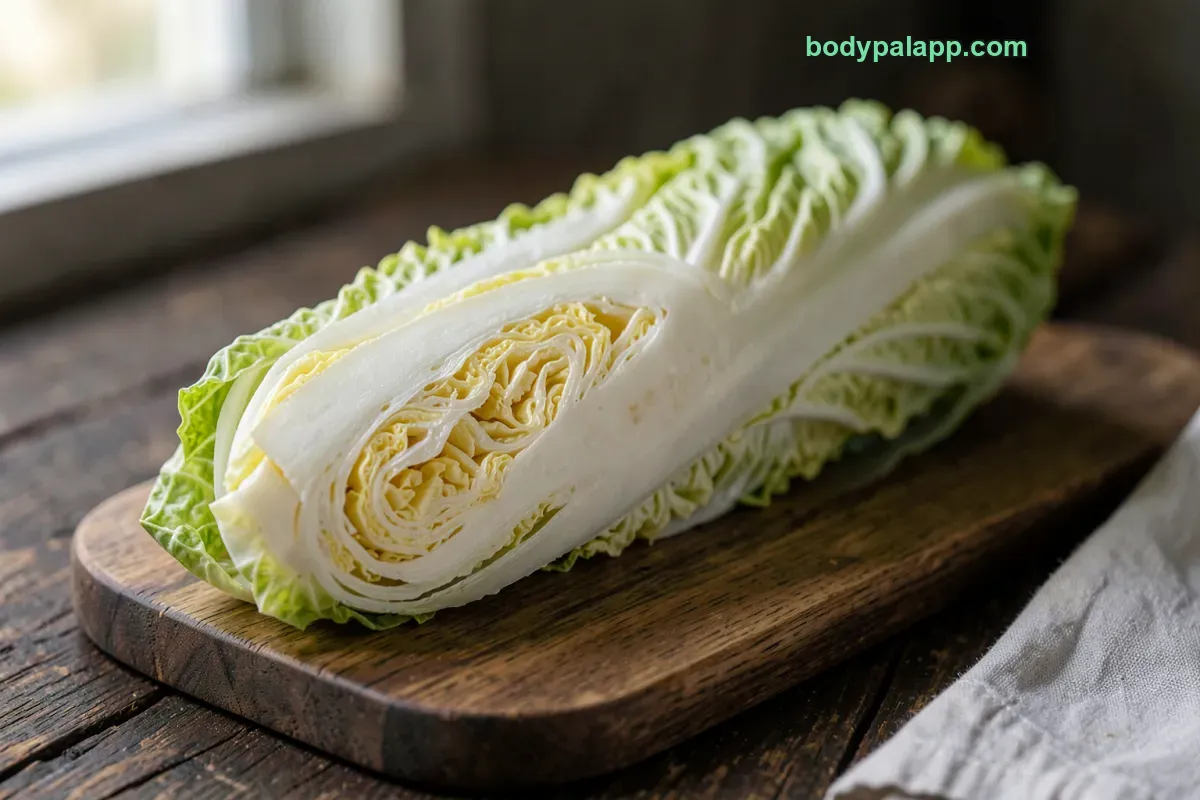
Napa cabbage calories come to 13 for 1 cup (109 g) of cooked leaves and 12 per 100 g. That makes it one of the lightest vegetables you can put on a plate. Watch what goes with it instead: the oil, dressing or sauce, not the cabbage, decides the total.
13kcal
1 cup · 109 g, cooked
30%protein
1.2 gProtein
2 gCarbs
0.2 gFat
How to burn off 13 kcal
—Walking, brisk
—Jogging
—Cycling, moderate
—Swimming
Skip the math. BodyPal counts these calories from your steps and workouts automatically.
Nutrition facts
Cooked · per 109 g
Calories
13 kcal
Protein
1.2 g
Carbohydrate
2.4 g
Fat
0.2 g
Cholesterol
0 mg
Sodium
12 mg
Potassium
95 mg
Iron
0.8 mg
Source: USDA FoodData Central
🛡️
Verified nutrition data
Numbers on this page come from USDA FoodData Central, the U.S. Department of Agriculture’s food composition database, and from manufacturer labels where a branded product is named. Last verified September 2026. How we verify our data →
Napa cabbage: calories, protein and sodium by serving
Percent of daily value uses the FDA reference of 2,000 kcal a day.
Serving
kcal
Protein
Carbs
Fat
Sodium
% DV kcal
1 cup (109 g)
13
1.2 g
2.4 g
0.2 g
12 mg
1%
100 g
12
1.1 g
2.2 g
0.2 g
11 mg
1%
3 × 1 cup (109 g)
39
3.6 g
36 mg
5 × 1 cup (109 g)
65
6 g
60 mg
Five cups of napa cabbage are still only 65 calories
Portion size matters for most foods. With cooked napa cabbage it hardly does. One cup (109 g) gives you 13 calories, 2 cups (218 g) give you 26, and 3 cups (327 g) reach 39. Even a heaping 5 cups (545 g), which is more than most people eat in one sitting, lands at 65 calories.
That is about 1 percent of a 2000-calorie daily value per cup. In practice, you can fill a bowl, a wok or a soup pot with napa and the vegetable itself will not be what moves your number. A big serving buys volume and something to chew on at almost no cost.
The flip side: those same 5 cups give only 6 g of protein and 60 mg of sodium. Napa cabbage fills space on the plate, but it will not carry a meal on its own. Think of it as a base or a bulk ingredient, then build the meal's protein and fat on purpose.
Carbs supply 60 percent of a very small total
Per 100 g, cooked napa cabbage has 2.2 g of carbs, 1.1 g of protein and 0.2 g of fat. Split by calories, carbs supply 60 percent, protein 30 percent and fat 10 percent. Those shares sound meaningful until you remember they are percentages of just 12 calories.
The protein share is high for a vegetable, but the grams are small. A cup has 1.2 g of protein, which is 2 percent of the 50 g daily value. Carbs are equally modest at 2.4 g per cup, so napa fits easily into lower-carb eating without any special counting.
Fat is close to nothing at 0.2 g per cup, and cholesterol is 0. The practical point is that napa adds almost no energy of its own. Whatever fat ends up in the dish, from sesame oil, pork or a creamy dressing, comes from you, not the leaves.
Sodium is a non-issue until you add sauce
Plain cooked napa cabbage has 11 mg of sodium per 100 g and 12 mg per cup. Against a 2300 mg daily value that is about 1 percent per cup, so the vegetable itself is not a sodium concern. Potassium runs higher than sodium at 87 mg per 100 g, measured against a 4700 mg daily value.
The problem shows up in how napa is usually cooked and served. Soy sauce, fish sauce, salted broth and fermented preparations like kimchi can add far more sodium than the cabbage ever brings. The numbers on this page are for plain cooked leaves, the USDA row for cooked napa cabbage, so they do not include any of that.
If you watch sodium, season napa with garlic, ginger, vinegar, citrus or chili first, and add salty sauces last and lightly. You keep the flavor and the low numbers stay low.
Napa works best as a base, not a whole meal
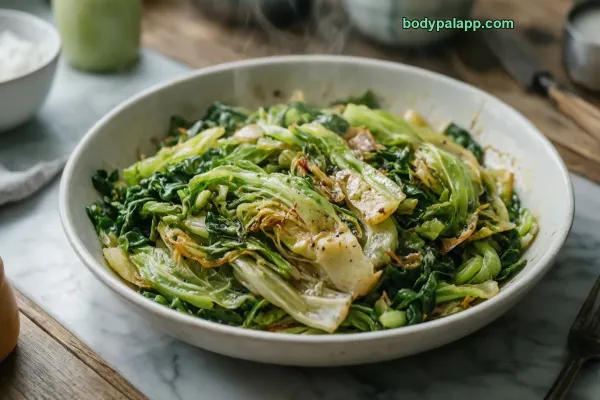
Because a cup costs only 13 calories, napa cabbage is an easy way to add volume to stir-fries, soups, dumpling fillings and slaws. Swapping part of the noodles or rice in a bowl for shredded napa makes the portion look and feel bigger without adding much energy.
Pair it with a real protein source, since napa's 1.2 g per cup will not keep you full for long. Eggs, tofu, chicken, shrimp or lean pork all match its mild, slightly sweet taste. A small amount of oil helps with flavor and texture; just count it, because oil is where a light dish quietly gets heavy.
Raw, napa is crisp and tender enough for salads and wraps. Cooked, it softens fast, so a short stir-fry or a quick simmer keeps some bite. If you log meals, BodyPal can log napa cabbage from a photo, which helps when it is mixed into a larger dish.
How does napa cabbage compare?
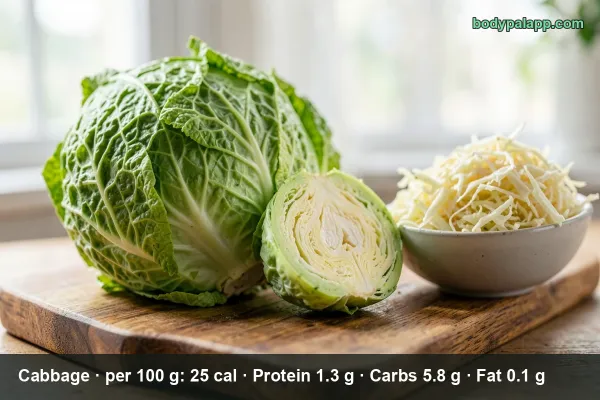
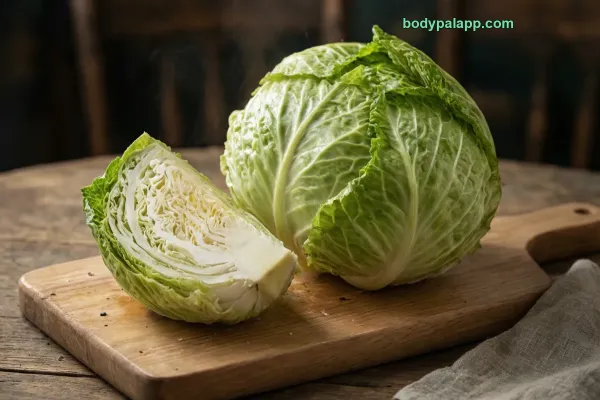
Here is how cooked napa cabbage stacks up against regular, green and cooked cabbage, per 100 g and per usual serving.
Verdict: Napa is the lightest of the group at 12 calories per 100 g, while green cabbage has 31, about 2.6 times as much, and regular cabbage has 25. If your goal is the most volume for the fewest calories, pick napa; if you want a bit more carbs and crunch for a slaw, green cabbage at 28 calories a cup is still a low-cost choice.
Napa cabbage FAQs
How many calories are in a cup of napa cabbage?
About 13 calories in one cup of cooked napa cabbage (109 g), or 12 calories per 100 g.
Is napa cabbage good for weight loss?
Cooked napa cabbage has 12 calories and 0.2 g fat per 100 g, so a full cup adds only 13 calories to a meal.
Napa cabbage vs regular cabbage: which has fewer calories?
Cooked napa cabbage has 12 calories per 100 g, while boiled green cabbage has 23 calories per 100 g.
How many carbs are in napa cabbage?
One cup of cooked napa cabbage has 2.4 g carbs and 1.2 g protein. Per 100 g it has 2.2 g carbs.
How many calories are in 100 g of napa cabbage?
Cooked napa cabbage has 12 calories per 100 g. That weight also brings 1.1 g of protein, 2.2 g of carbs and 0.2 g of fat, so almost any portion stays very light.
How much protein does napa cabbage have?
One cup (109 g) of cooked napa cabbage has 1.2 g of protein, about 2 percent of the 50 g daily value. Protein makes up 30 percent of its calories, but the total grams stay small.
Is napa cabbage high in sodium?
No. Plain cooked napa cabbage has 12 mg of sodium per cup, about 1 percent of the 2300 mg daily value. Sodium climbs only when you add soy sauce, broth or salt.
How many calories are in 5 cups of napa cabbage?
Five cups (545 g) of cooked napa cabbage come to 65 calories, with 6 g of protein and 60 mg of sodium. Even a very large pile of leaves adds little energy to a meal.
Does napa cabbage have fat or cholesterol?
Barely any fat and no cholesterol. A cup of cooked napa cabbage has 0.2 g of fat and 0 mg of cholesterol, and fat supplies only 10 percent of its calories.