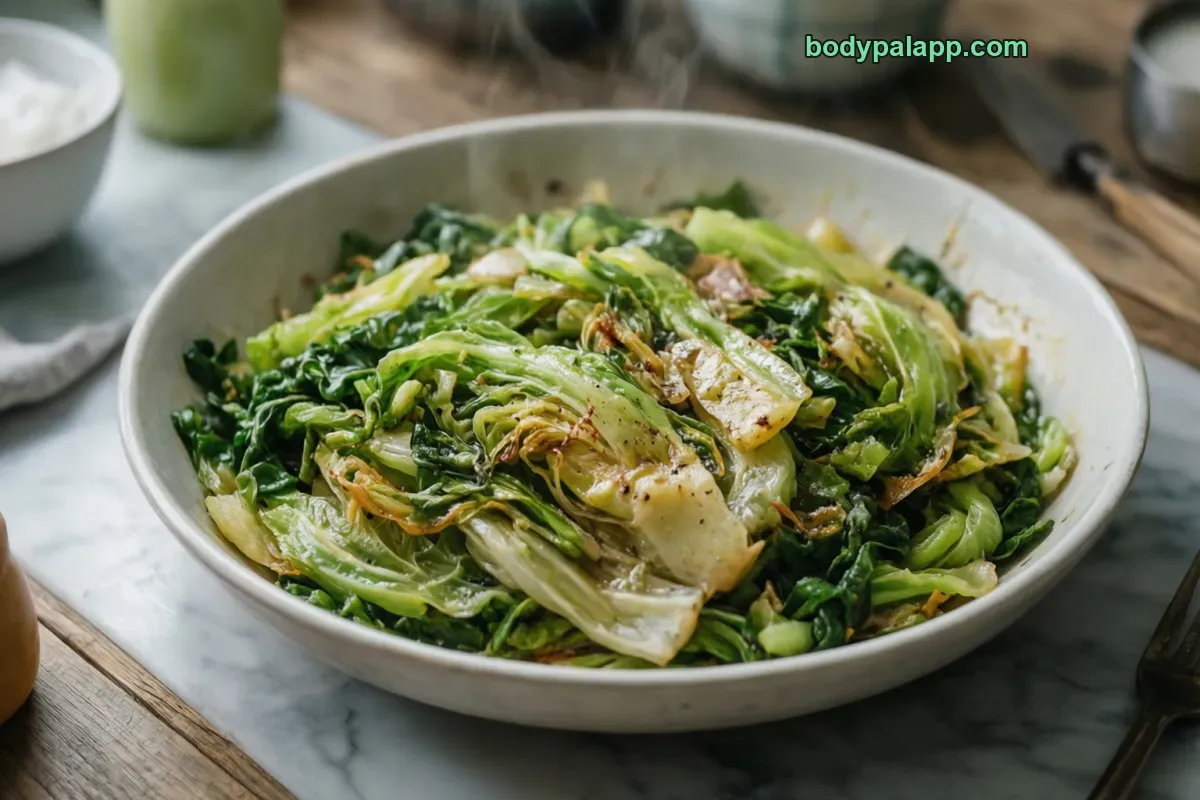
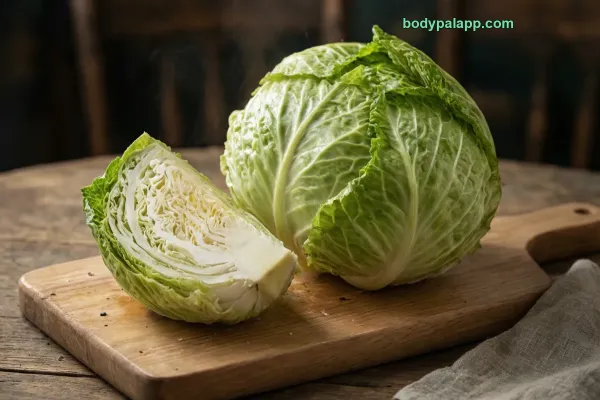
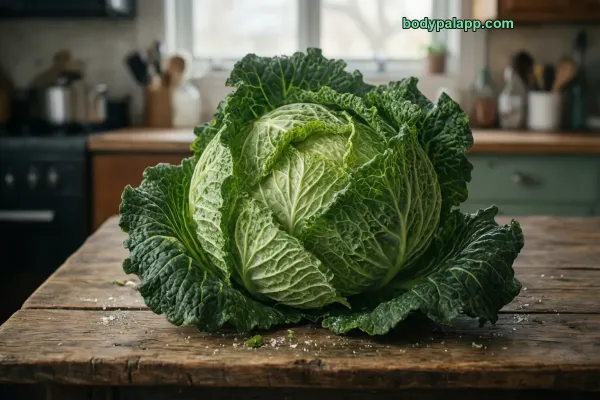
Cooked cabbage calories come to 17 for a half cup shredded (75 g) and 23 per 100 g, boiled and drained with no salt. The thing to notice is how little the total moves: even five half cups (375 g) stop at 86 calories, so whatever goes in the pan with it matters more than the cabbage.
17kcal
1 half cup shredded · 75 g, boiled, drained, no salt
18%protein
1 gProtein
4 gCarbs
0 gFat
How to burn off 17 kcal
—Walking, brisk
—Jogging
—Cycling, moderate
—Swimming
Skip the math. BodyPal counts these calories from your steps and workouts automatically.
Nutrition facts
Boiled, drained, no salt · per 75 g
Calories
17 kcal
Protein
1 g
Carbohydrate
4.1 g
Fat
0 g
Saturated fat
0 g
Cholesterol
0 mg
Sodium
6 mg
Potassium
147 mg
Iron
0.1 mg
Source: USDA FoodData Central
🛡️
Verified nutrition data
Numbers on this page come from USDA FoodData Central, the U.S. Department of Agriculture’s food composition database, and from manufacturer labels where a branded product is named. Last verified September 2026. How we verify our data →
Cooked cabbage: calories, protein and sodium by serving
Percent of daily value uses the FDA reference of 2,000 kcal a day.
Serving
kcal
Protein
Carbs
Fat
Sodium
% DV kcal
Half cup shredded (75 g)
17
1 g
4.1 g
0 g
6 mg
1%
100 g
23
1.3 g
5.5 g
0.1 g
8 mg
1%
Red cabbage (75 g)
22
1.1 g
5.2 g
0.1 g
21 mg
1%
3 oz portion (85 g)
20
1.1 g
4.7 g
0.1 g
7 mg
1%
3 × Half cup shredded (75 g)
52
2.9 g
18 mg
5 × Half cup shredded (75 g)
86
4.8 g
30 mg
Five half cups of cooked cabbage add up to 86 calories
The standard serving is a half cup shredded (75 g), which brings 17 calories. A 3 oz portion (85 g) lands at 20, and a flat 100 g at 23. Each of those is 1 percent of a 2000-calorie daily value, so the serving size you pick barely changes the day's math.
Scale it up and the totals stay small. Two half cups (150 g) give 35 calories, three (225 g) give 52, and five (375 g) still stop at 86. That last amount is a heaping plate of vegetables, yet it barely registers against a daily budget.
This is why cabbage portions are rarely worth weighing to the gram. What is worth tracking is what goes into the pan with it. Butter, oil, bacon drippings or a sweet glaze can easily outweigh the cabbage itself, so log those separately. BodyPal can log the finished dish from a photo if you would rather not measure.
Carbs supply 80 percent of the calories
Per 100 g, cooked cabbage carries 5.5 g of carbs, 1.3 g of protein and 0.1 g of fat. Carbs account for 80 percent of the calories, protein for 18 percent and fat for just 2 percent. In practice, fat is a rounding error unless you add it.
The carbs are not all sugar. Of the 5.5 g, 1.9 g is fiber and 2.8 g is sugars, the kind already present in the leaves, since nothing is added in plain boiling. A half cup gives 1.4 g of fiber and 2.1 g of sugars, measured against a fiber daily value of 28 g.
Protein looks respectable as a share at 18 percent, but the grams are small. A half cup holds 1 g, or 2 percent of the daily value, and even five half cups reach only 4.8 g. Treat cabbage as volume and fiber on the plate, and get your protein from whatever you serve beside it.
Sodium stays near zero until you salt the pot
The USDA row behind this page is cabbage boiled, drained and cooked without salt. On that basis, 100 g carries 8 mg of sodium and a half cup carries 6 mg, which rounds to 0 percent of the 2300 mg daily value. Even five half cups total only 30 mg.
That changes the moment salt goes into the cooking water or onto the plate. These figures do not cover salted cabbage, so treat them as a floor. If you watch sodium, season at the table where you can see how much goes on, or lean on pepper, vinegar or caraway for flavor instead.
Potassium is the mineral cabbage brings more of: 196 mg per 100 g, against a daily value of 4700 mg. That is a modest share per serving. Across a day built around vegetables, though, those small amounts add up.
Red cabbage costs a few more calories per scoop
Cooked red cabbage comes in at 22 calories for 75 g, against 17 for the same weight of the cooked cabbage on this page. It also carries 2 g of fiber, 2.5 g of sugars and 21 mg of sodium per 75 g. Both still sit at 1 percent of daily calories per serving, so the choice comes down to taste and color.
Jarred red cabbage is a different product. Sweet-and-sour styles such as Aunt Nellie's Sweet & Sour Red Cabbage or Hengstenberg Red Cabbage With Apple are prepared with other ingredients, so read the label rather than borrowing the plain figures here. Kimchi from Jongga or Seoul Kimchi is fermented napa cabbage with its own seasoning and deserves its own entry.
For a fuller plate, pair cooked cabbage with chicken, pork, eggs or beans, which covers the protein gap its 1 g per half cup leaves. A splash of vinegar and a little oil turn it into a side that stays light without tasting like diet food.
How does cooked cabbage compare?
Here is cooked cabbage next to raw green cabbage, a whole head of cabbage and cooked carrots, per 100 g and per usual serving.
Verdict: For the lowest count per bite, cooked cabbage wins at 23 calories per 100 g, against 31 for green cabbage and 35 for cooked carrots. If you want sweetness and color on the plate, a half cup of carrots at 27 calories costs only a little more than a half cup of cabbage at 17.
Most popular cooked cabbage brands in the United States
Ranked by popularity in the BodyPal database
# Productkcal / 100 g
1Jongga Kimchi Fermented Napa Cabbage1 oz · 28 g36 kcal
2Jongga Spicy Napa Cabbage Kimchi1 oz · 28 g18 kcal
8Seoul Original Premium Fermented Napa Cabbage Kimchi1 oz · 28 g54 kcal
These jars are fermented kimchi or sweet-and-sour red cabbage with added sugar or brine, so their label numbers run above plain boiled cabbage. Source: manufacturer labels / USDA FoodData Central.
Cooked cabbage FAQs
How many calories are in cooked cabbage?
Half a cup of shredded boiled cabbage is 17 calories, and 100 g is 23 calories.
Is cooked cabbage good for weight loss?
Cooked cabbage has 23 calories per 100 g, with 1.9 g of fiber and 0.06 g of fat, so a half-cup serving adds 17 calories.
Cooked cabbage vs cooked carrots: which has fewer calories?
Cooked cabbage is 23 calories per 100 g and cooked carrots are 35, so cabbage is about a third lower.
How many carbs are in cooked cabbage?
100 g of boiled cabbage has 5.51 g of carbs, of which 2.79 g are sugars and 1.9 g fiber. Half a cup has 4.1 g of carbs.
How many calories are in a cup of cooked cabbage?
Two half-cup scoops of shredded cooked cabbage (150 g) come to 35 calories. That amount also carries 1.9 g of protein and 12 mg of sodium when boiled without salt, so a full cup is still a light side.
How many calories are in half a head of cabbage?
A whole head of cabbage (1262 g) has 290 calories, so half a head comes to roughly half of that. The rate is 23 calories per 100 g, so weighing your piece gives the most exact count.
Is cooked cabbage fattening?
Cooked cabbage has 23 calories and 0.1 g of fat per 100 g, which makes it one of the lightest foods you can fill a plate with. The calories that add up usually come from butter, oil or meat cooked with it, not the cabbage.
How much cooked cabbage is one serving?
One serving is a half cup shredded (75 g), at 17 calories. Another common size is a 3 oz portion (85 g), which comes to 20 calories. Either one is 1 percent of daily calories.
Does boiling cabbage with salt add calories?
No. Salt adds sodium rather than calories, so boiled cabbage stays at 23 calories per 100 g. Our figure is for cabbage boiled without salt, with 8 mg of sodium per 100 g, and salted water pushes that sodium number up.
What are the nutrition facts for cooked cabbage per 100 g?
Per 100 g, cooked cabbage has 23 calories, 1.3 g of protein, 5.5 g of carbs and 0.1 g of fat. It also brings 1.9 g of fiber, 2.8 g of sugars, 8 mg of sodium and 196 mg of potassium.