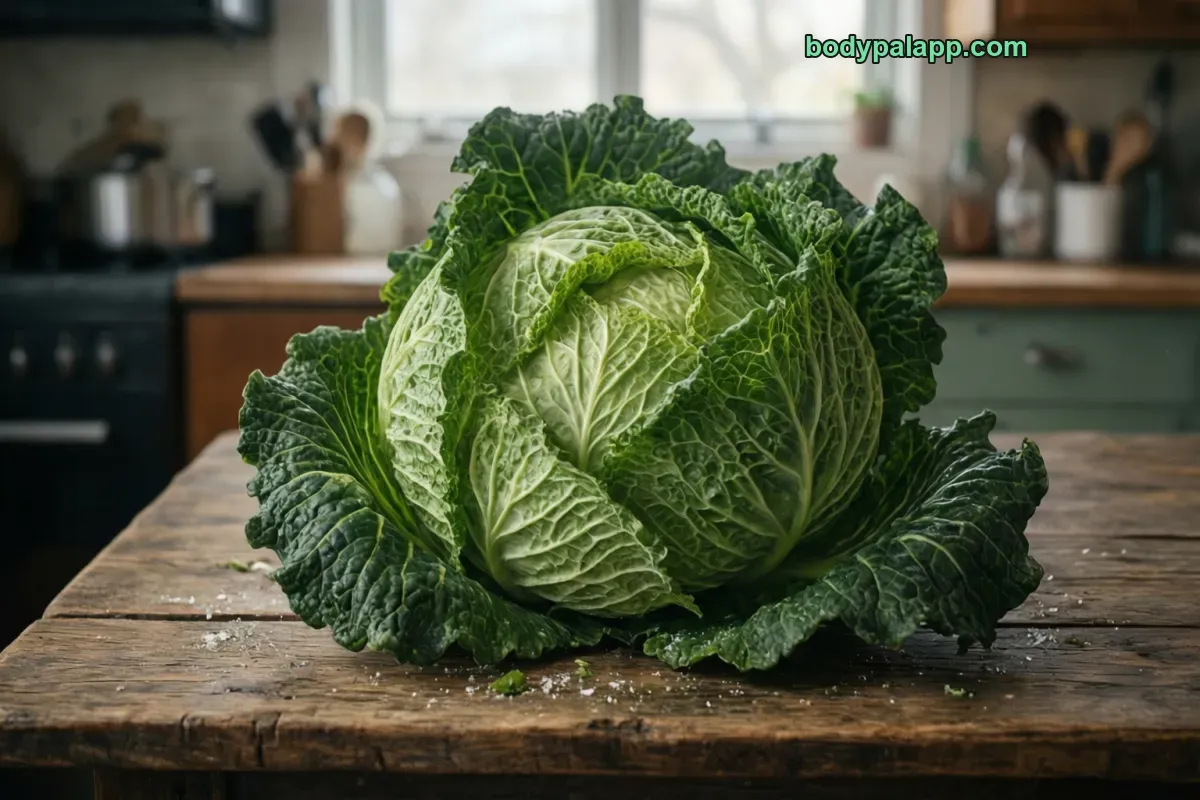
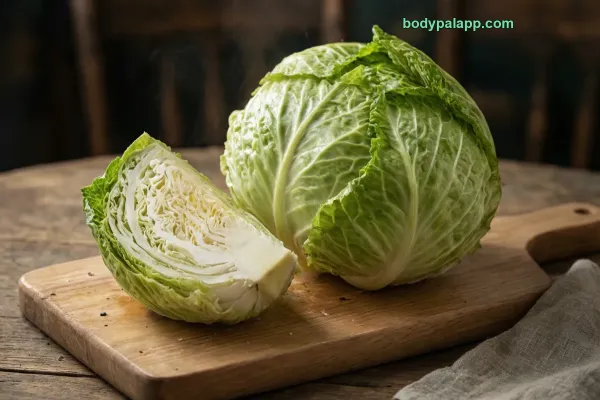
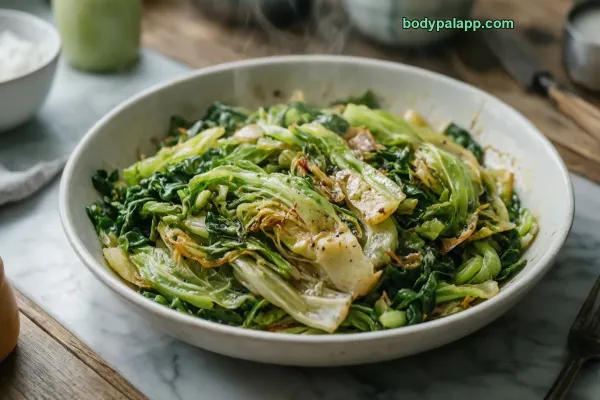
Cabbage head calories come to 290 for one boiled, drained head weighing 1,262 g, and 23 per 100 g. The thing to notice is the weight: a head is a lot of food, so that total also brings 24 g of fiber and 16 g of protein for about 15% of a 2000-calorie day.
290kcal
1 head · 1262 g, boiled, drained, no salt
18%protein
16 gProtein
70 gCarbs
0.8 gFat
How to burn off 290 kcal
—Walking, brisk
—Jogging
—Cycling, moderate
—Swimming
Skip the math. BodyPal counts these calories from your steps and workouts automatically.
Nutrition facts
Boiled, drained, no salt · per 1262 g
Calories
290 kcal
Protein
16 g
Carbohydrate
70 g
Fat
0.8 g
Saturated fat
0 g
Cholesterol
0 mg
Sodium
101 mg
Potassium
2474 mg
Iron
2.1 mg
Source: USDA FoodData Central
🛡️
Verified nutrition data
Numbers on this page come from USDA FoodData Central, the U.S. Department of Agriculture’s food composition database, and from manufacturer labels where a branded product is named. Last verified September 2026. How we verify our data →
Head of cabbage: calories, protein and sodium by serving
Percent of daily value uses the FDA reference of 2,000 kcal a day.
Serving
kcal
Protein
Carbs
Fat
Sodium
% DV kcal
1 head (1262 g)
290
16 g
69.5 g
0.8 g
101 mg
15%
1/2 cup shredded (75 g)
17
1 g
4.1 g
0 g
6 mg
1%
100 g
23
1.3 g
5.5 g
0.1 g
8 mg
1%
3 × 1 head (1262 g)
871
48.1 g
303 mg
5 × 1 head (1262 g)
1,451
80.1 g
505 mg
A whole head is 290 calories you will rarely eat at once
A boiled, drained head of cabbage weighing 1,262 g comes to 290 calories. That sounds like a lot until you look at the weight: it is well over a kilogram of food, and it fills a pot. Most people eat it a scoop at a time, and a 1/2 cup of shredded cabbage at 75 g is just 17 calories.
Per 100 g the figure is 23 calories, which makes weighing easy. If you cook half a head, expect roughly half the 290. Heads vary in size, so a kitchen scale beats guessing from the label on the bin.
Batch cooks see the total move fast. Two heads come to 581 calories across 2,524 g, three heads reach 871, and five heads, the kind of quantity that goes into a big pot of cabbage soup, total 1,451. Even then, those calories are spread across 6,310 g of vegetable, so each bowl stays light until broth, meat or fat join it.
Carbs supply 80% of the calories, and fat almost none
The calorie split is 80% carbs, 18% protein and 2% fat. Per 100 g, boiled cabbage holds 5.5 g of carbs, 1.3 g of protein and 0.1 g of fat, with 0 g of saturated fat and 0 mg of cholesterol.
Across a whole head, those carbs add up to 69.5 g. About half of that is sugar, at 35.2 g, and 24 g is fiber, so those two rows account for most of the carbohydrate. If you track carbs closely, the 1/2 cup serving at 4.1 g is the easier number to work with.
Protein is modest per bite but not trivial at scale. A full head carries 16 g, listed as 32% of the daily value, while a 1/2 cup gives 1 g. Cabbage brings volume and fiber to a meal. The protein has to come from somewhere else.
Fiber is the standout row, and sodium stays low
Fiber is where cabbage earns its place. A whole head delivers 24 g, against a daily value of 28 g used on this page. Per 100 g you get 1.9 g, and a 1/2 cup serving adds 1.4 g, so a couple of scoops make a real difference next to lower-fiber foods on the plate.
Sodium barely registers. These values are for cabbage boiled and drained without salt, which gives 8 mg per 100 g and 101 mg for the full head, 4% of the 2300 mg daily value. The salt shaker, a ham hock or a store-bought dressing will move this row far more than the cabbage does, so if you watch sodium, that is where to look.
Potassium sits at 196 mg per 100 g, measured against a daily value of 4700 mg. It is a steady contribution rather than a headline figure, and like everything else here it grows with the portion.
What you cook it with decides the final count
At 23 calories per 100 g, cabbage is rarely the calorie driver in a dish. Butter, bacon, oil, mayonnaise in coleslaw or sausage in a skillet can easily outweigh the vegetable itself. The cabbage numbers here assume nothing was added, so count the extras on their own line.
Because a 1/2 cup brings only 1 g of protein, cabbage works best as the bulky side next to a protein: eggs, beans, chicken, pork or fish. It also stretches soups and stir-fries, adding volume for few calories. If you are trying to stay full on a calorie budget, filling half the plate with cooked cabbage is a practical move.
Logging it is simple once you know the weight. A kitchen scale and the 23-per-100 g figure cover any portion, and BodyPal can log a plate of cabbage from a photo.
How does head of cabbage compare?
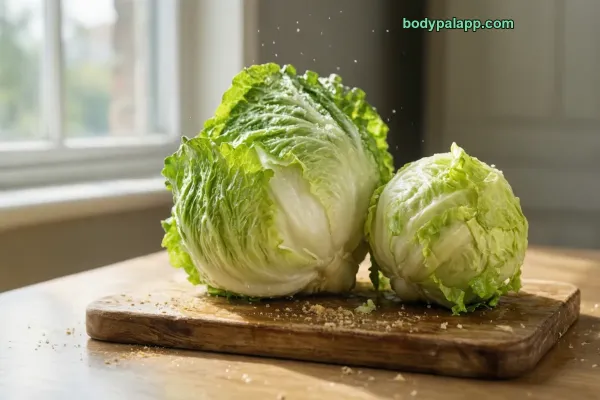
Here is how a boiled head of cabbage stacks up against green cabbage, cooked cabbage and a head of lettuce, per 100 g and per usual serving.
Verdict: Lettuce is the lighter pick at 14 calories per 100 g against 23 here, and a whole 539 g lettuce head totals only 75. Cabbage gives you more substance per bite, and green cabbage at 31 per 100 g, about 1.3 times this boiled head, is still a low-calorie way to add volume.
Head of cabbage FAQs
How many calories are in a head of cabbage?
A whole head weighs about 1,262 g and comes to about 290 calories, which is 23 calories per 100 g.
Is cabbage good for weight loss?
Cabbage is 23 calories per 100 g, so a 1/2 cup shredded serving is 17 calories and even a whole head is only 290 calories with 24 g of fiber.
Is red cabbage higher in calories than green cabbage?
Slightly. Boiled red cabbage is 29 calories per 100 g and savoy is 24, against 23 for common green cabbage.
How many carbs are in a head of cabbage?
A whole head has about 69.5 g of carbs, of which 24 g is fiber and 35 g sugars, plus 16 g of protein and under 1 g of fat.
How much fiber is in a head of cabbage?
A boiled head of cabbage weighing 1,262 g has 24 g of fiber. That is close to the 28 g daily value used on this page. Per 100 g the figure is 1.9 g, and a 1/2 cup shredded serving has 1.4 g.
What is the full nutrition of a head of cabbage?
One boiled head (1,262 g) has 290 calories, 16 g of protein, 69.5 g of carbs, 0.8 g of fat, 24 g of fiber, 35.2 g of sugars and 101 mg of sodium. Saturated fat and cholesterol are both 0.
How many calories are in half a head of cabbage?
Half a head comes to roughly half of the 290 calories in a full 1,262 g boiled head. Heads vary in size, so weighing your portion and using 23 calories per 100 g gives the most accurate count.
How many calories are in a medium head of cabbage?
The head used here weighs 1,262 g and has 290 calories when boiled and drained. A smaller or larger head scales by weight at 23 calories per 100 g, so a kitchen scale settles it quickly.