
How many calories are in cabbage?
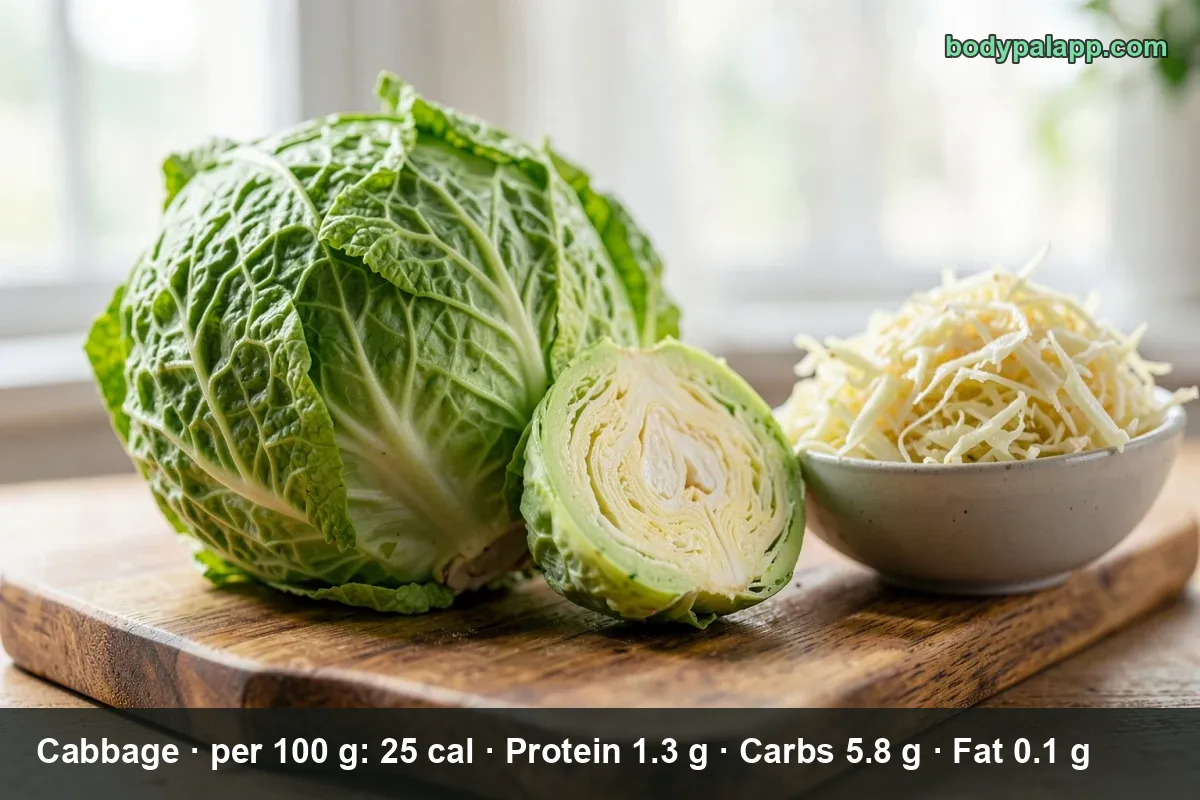
One cup of chopped raw cabbage weighs 89 g and carries 22 calories. Per 100 g, green cabbage runs 25 calories, about as low as a solid vegetable goes. A whole medium head — 908 g of leaves — still comes in at 227. Cabbage is one of the few foods where portion size barely matters.
On this page
- Cabbage quick facts
- US servings, from one ounce to a whole head
- Red, savoy, napa, boiled and buttered
- Fiber and sodium are the rows that move
- How does cabbage compare?
- Most popular cabbage brands
- FAQ
Cabbage quick facts
When an American types "calories in cabbage," the food in question is almost always the pale green head sitting in the produce bin, bought whole or half-wrapped in plastic. That is SR Legacy 169975, "Cabbage, raw" — the one USDA record for cabbage that carries a complete profile and real household measures: a cup chopped, a cup shredded, a large leaf, a medium head. Everything else on this page is a variation on it.
Boiled cabbage, red cabbage and napa each have their own records, and they are all further down as separate sections rather than blended into one average. Cooking changes the number; the source of the number does not.
| Nutrient | Per 100 g | Per 1 cup chopped (89 g) | % Daily Value |
|---|---|---|---|
| Calories | 25 | 22 | — |
| Total fat | 0.1 g | 0.1 g | 0% |
| Saturated fat | 0.03 g | 0.0 g | 0% |
| Carbohydrate | 5.8 g | 5.2 g | 2% |
| Dietary fiber | 2.5 g | 2.2 g | 8% |
| Total sugars | 3.2 g | 2.8 g | — |
| Protein | 1.28 g | 1.1 g | 2% |
| Sodium | 18 mg | 16 mg | 1% |
| Potassium | 170 mg | 151 mg | 3% |
% Daily Value is based on a 2,000-calorie diet.
Verified nutrition data
Numbers on this page come from USDA FoodData Central, the U.S. Department of Agriculture’s food composition database, and from manufacturer labels where a branded product is named. Last verified September 2026. How we verify our data →
There is no added sugars row here, and that is not an omission: the SR Legacy edition does not track added sugars for fresh vegetables, and on a raw head there are none to track. Cholesterol is 0 mg, as it is for every plant food. The 3.2 g of total sugars per 100 g is the cabbage's own, which is why total sugars have no Daily Value to compare against — the FDA limit of 50 g applies to added sugars only.
The Daily Value percentages are worth reading in the other direction here. One cup of a vegetable that costs 22 calories still hands over 8% of a day's fiber. Very little else on the shelf trades that way.
US servings, from one ounce to a whole head
| Serving | Weight | Calories |
|---|---|---|
| 1 oz | 28 g | 7 kcal |
| 1 cup, shredded | 70 g | 18 kcal |
| 1 cup, chopped | 89 g | 22 kcal |
| 1 leaf, large | 33 g | 8 kcal |
| 1 head, medium (about 5-3/4 in across) | 908 g | 227 kcal |
| Per 100 g | 100 g | 25 kcal |
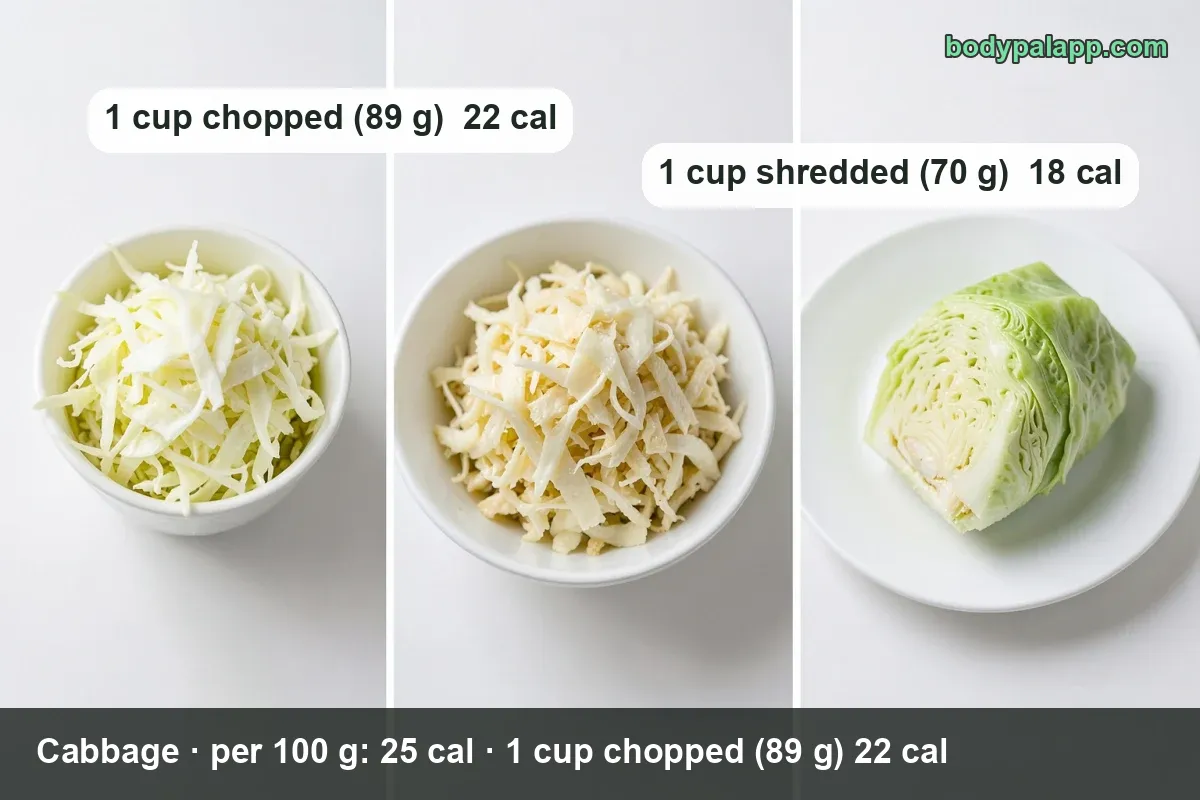
The cup rows are the ones that trip people up, and they are both USDA household measures. A cup of chopped cabbage packs to 89 g. A cup of shredded cabbage — the same knife, a different cut — sits looser and comes to 70 g. That is a 27% gap in weight hiding behind one word, and it is the difference between logging 22 calories and logging 18. Neither is wrong; they are simply different amounts of vegetable.
The ounce row is our own arithmetic from the USDA 100 g figure rather than a USDA serving, and at 7 calories per ounce it mostly proves the point: you would have to eat more than half a pound of raw cabbage to reach the calorie load of a single tablespoon of oil. The leaf row matters if you make wraps — eight large leaves come to roughly 64 calories, again our own scaling.
The head row is the useful one for meal prep. Buy a medium head, shred the whole thing for the week, and you have bought 227 calories of food. By our arithmetic from the same 100 g record, that head also carries 22.7 g of fiber and 11.6 g of protein.
Red, savoy, napa, boiled and buttered
| Version | Per 100 g | Typical serving | Calories |
|---|---|---|---|
| Green cabbage, raw (main record) | 25 kcal | 1 cup chopped, 89 g | 22 kcal |
| Red cabbage, raw | 31 kcal | 1 cup chopped, 89 g | 28 kcal |
| Boiled, drained, no salt | 23 kcal | 1/2 cup shredded, 75 g | 17 kcal |
| Cooked with butter or margarine | 52 kcal | 1 oz, 28 g | 15 kcal |
| Savoy cabbage, raw | 27 kcal | 1 oz, 28 g | 8 kcal |
| Napa (Chinese, pe-tsai) cabbage, raw | 16 kcal | 1 oz, 28 g | 5 kcal |
| Kimchi | 15 kcal | 1 oz, 28 g | 4 kcal |
Red cabbage is the denser one at 31 calories per 100 g, with 7.37 g of carbohydrate and 3.83 g of sugar against green cabbage's 5.8 g and 3.2 g. In a cup chopped that is 28 calories instead of 22 — a real gap in percentage terms and an irrelevant one on a plate. The ounce and half-cup rows in that table are our own scaling from each USDA 100 g record rather than USDA household measures.
Here is a wrinkle worth knowing before you trust any single figure to the decimal. USDA's survey edition carries a separate record for "Cabbage, green, raw" at 31 calories per 100 g — identical to red cabbage, and 6 above the SR Legacy green record used above. Same vegetable, different sampling. That is the real precision of cabbage data: somewhere between 25 and 31 per 100 g, which is to say between 22 and 28 per cup. Chasing more accuracy than that on a leafy vegetable is wasted effort.
Boiling barely touches the calories, 25 down to 23, but it does soften the fiber from 2.5 g to 1.9 g per 100 g and drops sodium from 18 mg to 8 mg as water leaches through the leaves. Butter is the variable that actually counts: cooked with butter or margarine, cabbage more than doubles to 52 calories per 100 g, and the saturated fat row jumps from 0.03 g to 1.02 g. The pan is doing that, not the vegetable.
Savoy, the crinkled one, is the protein and fiber pick at 2 g and 3.1 g per 100 g. Napa is the lightest of the fresh heads at 16 calories per 100 g, which is why it fills a stir-fry without registering. Packaged cabbage runs wider than any fresh head: a fermented napa kimchi such as Jongga's is listed at 36 calories per 100 g, while a jar of Aunt Nellie's sweet-and-sour red cabbage comes to 67 — that is the syrup in the jar, not the cabbage in it.
Fiber and sodium are the rows that move
Two numbers on this page are worth more attention than the calorie count, because the calorie count never really changes.
The first is fiber. One cup of chopped raw cabbage delivers 2.2 g, which is 8% of the FDA's 28 g Daily Value, for 22 calories. Shred a whole medium head into slaw and you are at 22.7 g, 81% of the day, for 227 calories by our own scaling from the 100 g record. That ratio is the entire argument for cabbage, and it lines up with the MyPlate vegetable guidance to build meals around this half of the plate.
The second is sodium, and it is the one people never see coming. Raw cabbage holds 18 mg per 100 g — one percent of the 2,300 mg Daily Value, effectively nothing. Boil it in salted water and the same drained cabbage reads 255 mg per 100 g while the calories stay flat at 23. That is more than thirty times the 8 mg of the unsalted boiled version, bought for zero calories. A pound of it would carry roughly 1,157 mg by our own arithmetic, about half a teaspoon of table salt. Kimchi goes further still at 498 mg per 100 g, 22% of the Daily Value in an amount you could eat in two forkfuls.
If you are watching sodium, unsalted boiled or raw cabbage is the version to reach for, and the seasoning goes on at the table where you can see it. If you are watching calories, honestly, cabbage is not the problem — whatever is in the pan with it is.
How does cabbage compare?
| Vegetable | Per 100 g | US serving | Calories |
|---|---|---|---|
| Cabbage, raw | 25 kcal | 1 oz, 28 g | 7 kcal |
| Cauliflower, raw | 25 kcal | 1 oz, 28 g | 7 kcal |
| Eggplant, raw | 25 kcal | 1 oz, 28 g | 7 kcal |
| Arugula, raw | 25 kcal | 1 oz, 28 g | 7 kcal |
Our take: this is a four-way tie, and that is the finding. All four land on exactly 25 calories per 100 g, so choosing between them on calories alone is a coin flip. Separate them on what else comes with the 25 and the picture changes: arugula leads on protein at 2.58 g per 100 g, cauliflower follows at 1.92 g, cabbage sits at 1.28 g and eggplant trails at 0.98 g. Cabbage wins on the one axis the table cannot show — it holds its structure raw, cooked, fermented or shredded a week ahead, which is why a head of it earns its space in the fridge while a bag of arugula wilts.
Most popular cabbage brands in the United States
Ranked by how widely each product appears among foods sold in the United States, from the BodyPal food database of over 3.3 million products. Calories are the figures printed on each Nutrition Facts label, checked against USDA FoodData Central.
| Product | Calories (per 100 g) |
|---|---|
| Jongga Kimchi Fermented Napa Cabbage | 36 cal |
| Jongga Spicy Napa Cabbage Kimchi | 18 cal |
| Chongga Cut Cabbage Kimchi | 20 cal |
| Aunt Nellie's Sweet & Sour Red Cabbage | 67 cal |
| Hengstenberg Red Cabbage | 62 cal |
| Kuhne Red Cabbage | 54 cal |
Brand popularity: BodyPal food database. Nutrition: manufacturer labels / USDA FoodData Central.
Cabbage FAQs
How many calories are in 1 cup of cabbage?
22 calories for a cup of chopped raw cabbage, which USDA weighs at 89 g. A cup of shredded cabbage is looser and lighter at 70 g, so it comes to 18. Both sit at 25 calories per 100 g; only the packing of the cup changes.
How many calories are in cooked cabbage?
23 calories per 100 g for cabbage boiled and drained without salt, so half a cup of cooked shredded cabbage (75 g) is about 17. Boiling costs almost nothing in calories, since raw is 25 per 100 g, but it does soften the fiber, from 2.5 g to 1.9 g.
Is cabbage good for weight loss?
At 25 calories per 100 g, cabbage is one of the cheapest ways to fill a plate: a full cup of it costs 22 calories and delivers 2.2 g of fiber, 8% of the Daily Value. The catch is what goes on it, since butter alone takes cabbage to 52 per 100 g.
How many carbs are in cabbage?
5.8 g of carbohydrate per 100 g, or 5.2 g in a cup of chopped cabbage. Fiber is 2.2 g of that cup, so the net carbohydrate works out to 3.0 g by our own subtraction. Red cabbage is higher at 7.37 g per 100 g.
Does red cabbage have more calories than green?
Yes, 31 calories per 100 g against 25 for green, a difference of 6 over a whole 100 g. In a cup chopped that is 28 calories versus 22. Red carries more sugar too, 3.83 g per 100 g against 3.2 g, which is why it tastes sweeter raw.
How many calories are in a whole head of cabbage?
227 calories for a medium head, which USDA puts at 908 g, about 5-3/4 inches across. That whole head carries 22.7 g of fiber, 81% of the Daily Value, and 11.6 g of protein by our own arithmetic from the 100 g figures. Few foods scale that gently.
Is kimchi lower in calories than fresh cabbage?
Yes, 15 calories per 100 g for kimchi against 25 for raw cabbage, so an ounce is 4. Fermentation and draining pull the number down, but the sodium goes the other way: 498 mg per 100 g against 18 mg, which is 22% of the Daily Value per 100 g.
Does boiling cabbage add sodium?
Only if you salt the water: cabbage boiled without salt holds 8 mg of sodium per 100 g, down from 18 mg raw; boiled with salt it is 255 mg, more than thirty times as much. Calories are identical at 23 either way, so the salt is the only real difference.
Similar foods
- Arugula — 5 cal per cup
- Broccoli Rabe — 21 cal per cup
- Cabbage Raw — 22 cal per cup
- Cauliflower — 27 cal per cup chopped
- Cauliflower Head — 147 cal per medium head
- Green Bell Pepper — 19 cal per medium pepper
Count it without the math
Point the camera at the bowl and BodyPal counts the cabbage for you, shredded, braised or buttered.


This table assumes you know your daily total. If you do not, the daily calorie calculator works it out from five numbers.