
How many calories are in arugula?
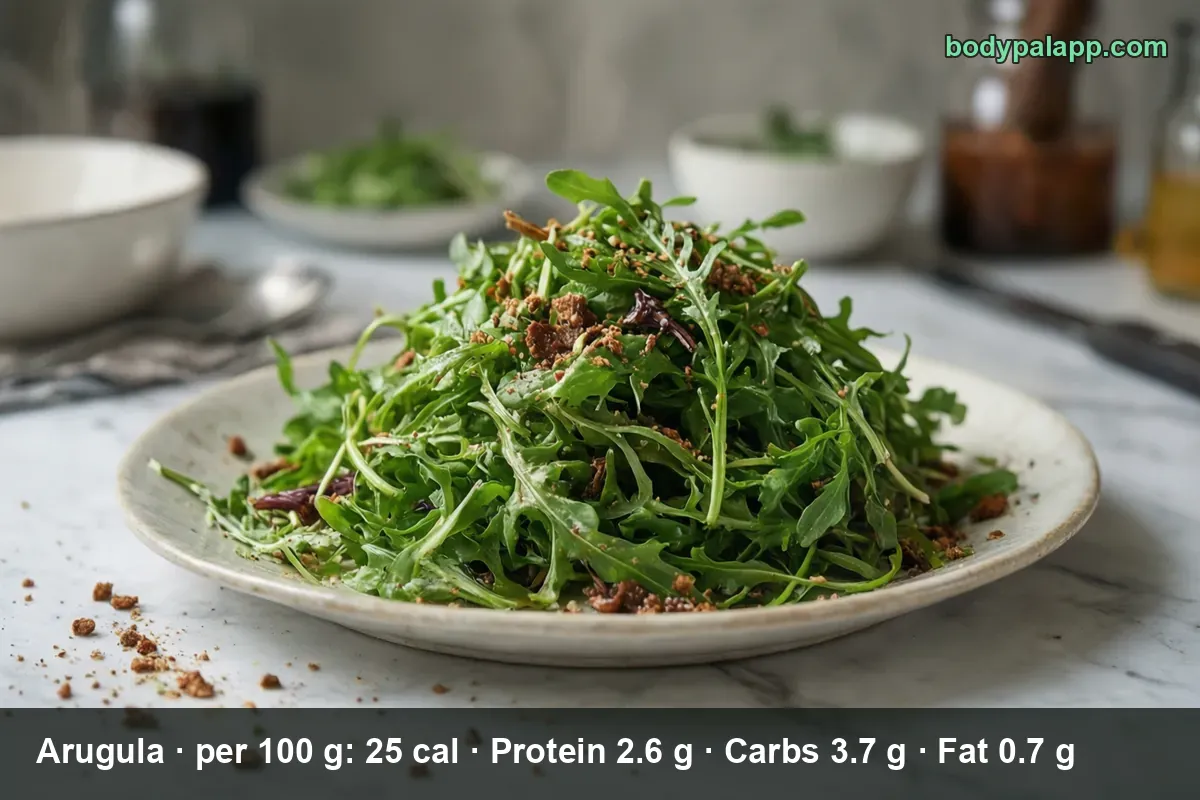
A 1-cup (20 g) handful of raw arugula is 5 calories, and 100 g of leaves comes to 25 calories. That is the whole story for the greens themselves: even a full 3 oz bag lands at 21. Arugula is one of the few foods where the dressing outweighs the food.
On this page
- Arugula quick facts
- US servings, from one cup to a 5 oz clamshell
- Baby arugula, salad arugula and pesto
- The cup-versus-ounce trap
- What arugula actually gives you
- How does arugula compare?
- Most popular arugula brands
- Arugula FAQs
Arugula quick facts
The numbers below come from SR Legacy 169387, "Arugula, raw". That is the mature leaf sold loose in bunches or bagged as salad greens, and it is the only complete profile USDA carries for it. The survey record used in dietary interviews, FNDDS 2709791, repeats the same values line for line, and the Foundation record covers baby leaves only, which get their own section further down.
The % Daily Value column is calculated on the 1-cup serving, because that is what actually lands on a plate.
| Nutrient | Per 100 g | Per 1 cup (20 g) | % Daily Value |
|---|---|---|---|
| Calories | 25 | 5 | — |
| Total fat | 0.66 g | 0.1 g | 0% |
| Saturated fat | 0.09 g | 0.0 g | 0% |
| Carbohydrate | 3.65 g | 0.7 g | 0% |
| Dietary fiber | 1.6 g | 0.3 g | 1% |
| Total sugars | 2.05 g | 0.4 g | — |
| Protein | 2.58 g | 0.5 g | 1% |
| Sodium | 27 mg | 5 mg | 0% |
% Daily Value is based on a 2,000-calorie diet.
Verified nutrition data
Numbers on this page come from USDA FoodData Central, the U.S. Department of Agriculture’s food composition database, and from manufacturer labels where a branded product is named. Last verified September 2026. How we verify our data →
There is no added sugars row here, because the SR Legacy edition does not publish added sugars and raw leaves have none to publish. Cholesterol is 0 mg, as it is in every plant food. Potassium is the one line worth naming: 369 mg per 100 g, or 74 mg in a cup, which is 2% of the 4,700 mg Daily Value.
US servings, from one cup to a 5 oz clamshell
Arugula is bulky and almost weightless, which is why the household measures spread so far apart. A cup is a loose handful. A 5 oz clamshell is a small mountain.
| Serving | Weight | Calories |
|---|---|---|
| 1 cup, loose leaves | 20 g | 5 kcal |
| 2 cups, side-salad portion | 40 g | 10 kcal |
| 1 oz | 28 g | 7 kcal |
| One 3 oz bag | 85 g | 21 kcal |
| One 5 oz clamshell | 142 g | 36 kcal |
| Per 100 g | 100 g | 25 kcal |
USDA's own household measure for this record is half a cup at 10 g. Every other line in the table is our own arithmetic from the USDA 100 g figure, not a USDA serving, scaled at 25 calories per 100 g.
Packaged labels tell the same story with a slightly different rounding. Earthbound Farm, Dole, Taylor Farms and Full Circle all print 24 calories per 100 g and 20 per 85 g serving, one calorie below the USDA record. The outlier is a ShopRite clamshell at 32 calories per 100 g, or 45 for the 142 g container. At this scale the disagreement is a single bite of anything else.
Baby arugula, salad arugula and pesto
| Version | Per 100 g | Typical portion | Calories |
|---|---|---|---|
| Mature arugula, raw | 25 kcal | 1 cup, 20 g | 5 kcal |
| Baby arugula, raw | 31 kcal | 1 cup, 20 g | 6 kcal |
| Arugula in a salad | 25 kcal | 2 cups, 40 g | 10 kcal |
| Arugula pesto | 467 kcal | 1 Tbsp, 15 g | 70 kcal |
Baby arugula is the tender leaf in most clamshells, and USDA measured it separately with modern methods. It comes out at 30.993 calories per 100 g, which rounds to 31, with more fiber (2.28 g), less protein (1.65 g) and far more sodium (86.93 mg) than the mature leaf. At a cup you are choosing between 6 calories and 5.
Arugula in a salad is the same plant through the survey record, which exists so that dietary interviews can price a bowl of greens. Forty grams, the amount a restaurant piles under a piece of salmon, is 10 calories.
Arugula pesto is a different food wearing the same name. Blend the leaves with oil, cheese and nuts and a jarred version runs 467 calories per 100 g. One tablespoon is 70, which is fourteen cups of the raw leaf. If arugula shows up in your log at a three-digit number, this is almost always why.
There is no cooked arugula record in USDA at all, so nothing on this page speaks for wilted or sauteed leaves.
The cup-versus-ounce trap
This is the one thing worth remembering about logging arugula. A cup of leaves weighs 20 g. The "3 oz" on the front of the bag is 85 g. Those two measures sound like neighbors, and the bag is more than four cups of leaves.
The practical consequence: the serving printed on the package is the entire bag, not the garnish. If you tip a bag over a plate and log "one serving," you have logged 21 calories, which is correct. If you drop a handful onto a sandwich and log the label serving, you have overcounted by four times, on a number so small it will never matter. Arugula is a food where precision costs more attention than it returns.
Weigh it once, out of curiosity, and then stop weighing it.
What arugula actually gives you
The calorie line is close to nothing, so the reason to eat this is what rides along with it. A cup delivers 0.3 g of fiber against the 28 g Daily Value, which is 1%. A full 3 oz bag brings that to about 1.4 g. Nobody is meeting a fiber target on arugula.
Where it does count is volume. Arugula belongs to the dark-green vegetables that MyPlate tracks as their own subgroup, and the Dietary Guidelines set a weekly target for that subgroup specifically. Two cups of arugula is 10 calories against that target. There is no other food group where a weekly goal is this cheap to hit.
Sodium is the only row with a twist. Mature arugula is 27 mg per 100 g, essentially nothing. The baby leaf record lists 86.93 mg, more than three times as much, likely a matter of the sample rather than the plant. Both stay under 4% of the 2,300 mg Daily Value, so this is a curiosity rather than a warning, though it does show how much two USDA records for the same vegetable can drift.
How does arugula compare?
| Vegetable | Per 100 g | US serving | Calories |
|---|---|---|---|
| Arugula, raw | 25 kcal | 1 oz, 28 g | 7 kcal |
| Cabbage, raw | 25 kcal | 1 oz, 28 g | 7 kcal |
| Cauliflower, raw | 25 kcal | 1 oz, 28 g | 7 kcal |
| Broccoli raab, cooked | 25 kcal | 1 oz, 28 g | 7 kcal |
Our take: all four sit at exactly 25 calories per 100 g, so calories cannot break the tie and you should pick on something else. For volume on a plate, arugula wins outright, because a cup of it weighs 20 g while a cup of chopped cabbage or cauliflower weighs several times that. For protein, broccoli raab leads at 3.83 g per 100 g with arugula second at 2.58 g. For the lowest carbohydrate load, broccoli raab again (3.12 g) with arugula just behind at 3.65 g, and cabbage last at 5.8 g. If you want the biggest-looking salad for the fewest calories, arugula is the answer; if you want the same calories to carry more protein, cook the raab.
Most popular arugula brands in the United States
Ranked by how widely each product appears among foods sold in the United States, from the BodyPal food database of over 3.3 million products. Calories are the figures printed on each Nutrition Facts label, checked against USDA FoodData Central.
| Product | Calories (per 100 g) |
|---|---|
| Earthbound Farm Organic Baby Arugula | 24 cal |
| Dole Arugula | 24 cal |
| Dole Organic Arugula | 24 cal |
| Taylor Farms Arugula | 24 cal |
| Full Circle Market Arugula | 24 cal |
| ShopRite Arugula | 32 cal |
Brand popularity: BodyPal food database. Nutrition: manufacturer labels / USDA FoodData Central.
Arugula FAQs
How many calories are in a cup of arugula?
5 calories. A US cup of loose arugula leaves weighs about 20 g, and at 25 calories per 100 g that works out to 5. Two cups, the amount most people call a side salad, is 10. USDA lists a half-cup measure, so the cup figure is our own arithmetic.
How many calories in a 5 oz container of arugula?
About 36 calories for the whole 142 g clamshell. That is the entire package eaten in one sitting, which almost nobody does. A 3 oz bag (85 g) is 21. Both figures are scaled from the USDA 100 g value rather than taken from a USDA serving.
How much protein does arugula have?
2.58 g per 100 g, which is 0.5 g in a 1-cup serving, or about 1% of the 50 g Daily Value. Arugula is a leafy green rather than a protein food, but it does beat raw cabbage (1.28 g) and raw cauliflower (1.92 g) gram for gram. A whole 3 oz bag gives roughly 2.2 g.
How many carbs are in arugula?
3.65 g per 100 g, of which 1.6 g is fiber and 2.05 g is naturally occurring sugars. A 1-cup serving carries 0.7 g of carbohydrate, well under 1% of the 275 g Daily Value. Even a full 3 oz bag stays near 3 g, so arugula fits any low-carb plan.
Does arugula have any sodium?
27 mg per 100 g, so 5 mg in a cup, which is a rounding error against the 2,300 mg Daily Value. Baby arugula is the exception: the USDA Foundation record lists 86.93 mg per 100 g, more than three times as much, though even that stays under 4% of the Daily Value.
Is baby arugula different from regular arugula?
Slightly: baby arugula is 31 calories per 100 g against 25 for mature leaves, measured in a separate USDA Foundation analysis. It also tests higher in fiber (2.28 g) and sodium (86.93 mg) and lower in protein (1.65 g). At one cup the gap is 6 calories versus 5, which is not worth tracking.
How many calories in an arugula salad with dressing?
Two cups of leaves is 10 calories, so almost everything else in the bowl comes from what you pour on. USDA publishes no dressing record on this page, so no number is quoted for one. For scale, arugula pesto runs 467 calories per 100 g, or 70 in a single tablespoon.
Does cooking arugula change its calories?
USDA publishes no cooked arugula record, so the only figure here is the raw 25 calories per 100 g. Wilting drives off water, so the same leaves shrink to a couple of forkfuls without gaining any calories. The nearest cooked dark green USDA does list, broccoli raab, also sits at 25 calories per 100 g.
Similar foods
- Broccoli Rabe — 21 cal per cup
- Cabbage — 22 cal per cup chopped
- Cabbage Raw — 22 cal per cup
- Cauliflower — 27 cal per cup chopped
- Cauliflower Head — 147 cal per medium head
- Green Bell Pepper — 19 cal per medium pepper
Count it without the math
Point the camera at the plate and BodyPal counts the greens along with everything you put on them.


Want the bigger picture? Calculate your daily calorie needs — your maintenance figure, a target for losing or gaining, and the date you get there.