
How many calories are in cauliflower?
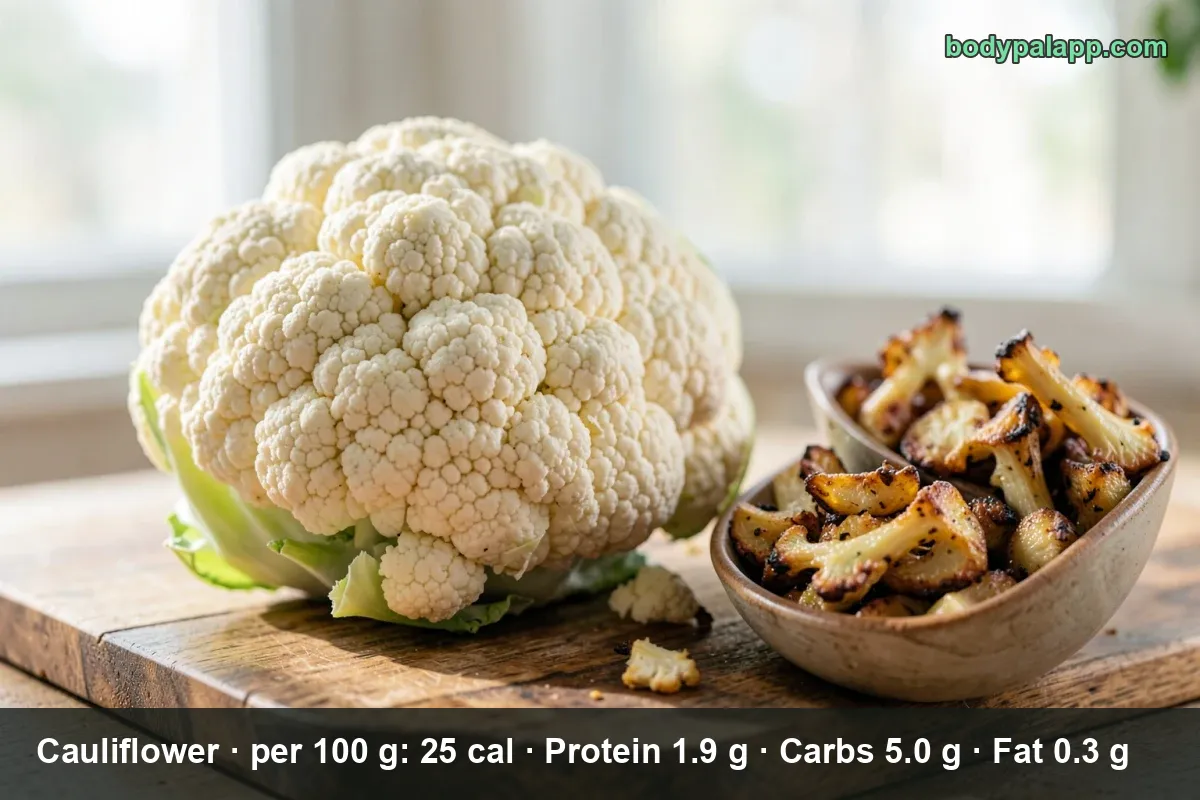
A cup of chopped raw cauliflower weighs 107 g and carries 27 calories — 25 calories per 100 g. A whole medium head, the one that barely fits in the crisper drawer, comes to 147. Cauliflower is mostly water and fiber, so what happens in the pan moves the number far more than the size of the floret.
On this page
- Cauliflower quick facts
- US servings from one floweret to a whole head
- Boiled frozen and green cauliflower
- Cooked with oil and deep fried
- Fiber and sodium are the rows that move
- How does cauliflower compare?
- Most popular cauliflower brands
- Cauliflower FAQs
Cauliflower quick facts
The record behind this page is SR Legacy 169986, "Cauliflower, raw". That is the head you carry home from the produce aisle, and it is the cauliflower entry that arrives with US household measures already attached: a cup chopped, a single floweret, a small head, a medium head. There is also a newer Foundation record that reads 27.6 calories per 100 g, calculated a different way and missing sugars and saturated fat, so the older entry is the fuller nutrition label of the two.
Nothing here is rounded up from a package. Every number in the middle column is the USDA figure exactly as published; the right-hand column is that figure scaled to one cup.
| Nutrient | Per 100 g | Per 1 cup chopped (107 g) | % Daily Value |
|---|---|---|---|
| Calories | 25 | 27 | — |
| Total fat | 0.28 g | 0.3 g | 0% |
| Saturated fat | 0.13 g | 0.1 g | 1% |
| Carbohydrate | 4.97 g | 5.3 g | 2% |
| Dietary fiber | 2 g | 2.1 g | 8% |
| Total sugars | 1.91 g | 2.0 g | — |
| Protein | 1.92 g | 2.1 g | 4% |
| Sodium | 30 mg | 32 mg | 1% |
% Daily Value is based on a 2,000-calorie diet.
Verified nutrition data
Numbers on this page come from USDA FoodData Central, the U.S. Department of Agriculture’s food composition database, and from manufacturer labels where a branded product is named. Last verified September 2026. How we verify our data →
There is no added sugars row above because SR Legacy does not publish added sugars for this record, and a fresh head has none to publish anyway. Cholesterol is zero, as it is in every vegetable. Potassium is the quiet win: 299 mg per 100 g, or 320 mg in a cup, which is 7% of the 4,700 mg Daily Value for a food that costs 27 calories.
US servings from one floweret to a whole head
Cauliflower is one of the few foods where the household measure is genuinely useful, because a floret does not compress. A cup of half-inch pieces really is 107 g, and a bagged head really does land near 588 g.
| Serving | Weight | Calories |
|---|---|---|
| 1 floweret | 13 g | 3 kcal |
| 1 oz raw | 28 g | 7 kcal |
| 1 cup chopped, 1/2-inch pieces | 107 g | 27 kcal |
| 1 small head, 4-inch diameter | 265 g | 66 kcal |
| 1 medium head, 5 to 6-inch diameter | 588 g | 147 kcal |
| Per 100 g | 100 g | 25 kcal |
The floweret, the cup, the small head and the medium head are all USDA household measures published with record 169986. The 1 oz line is our own arithmetic from the USDA 100 g figure, not a USDA serving, and it is there for anyone weighing florets onto a food scale.
Snacking on raw florets is the closest thing there is to eating for free. Ten flowerets is about 130 g and 33 calories, our own arithmetic from the 13 g USDA floweret. The trouble usually starts with the dip, not the vegetable.
Boiled frozen and green cauliflower
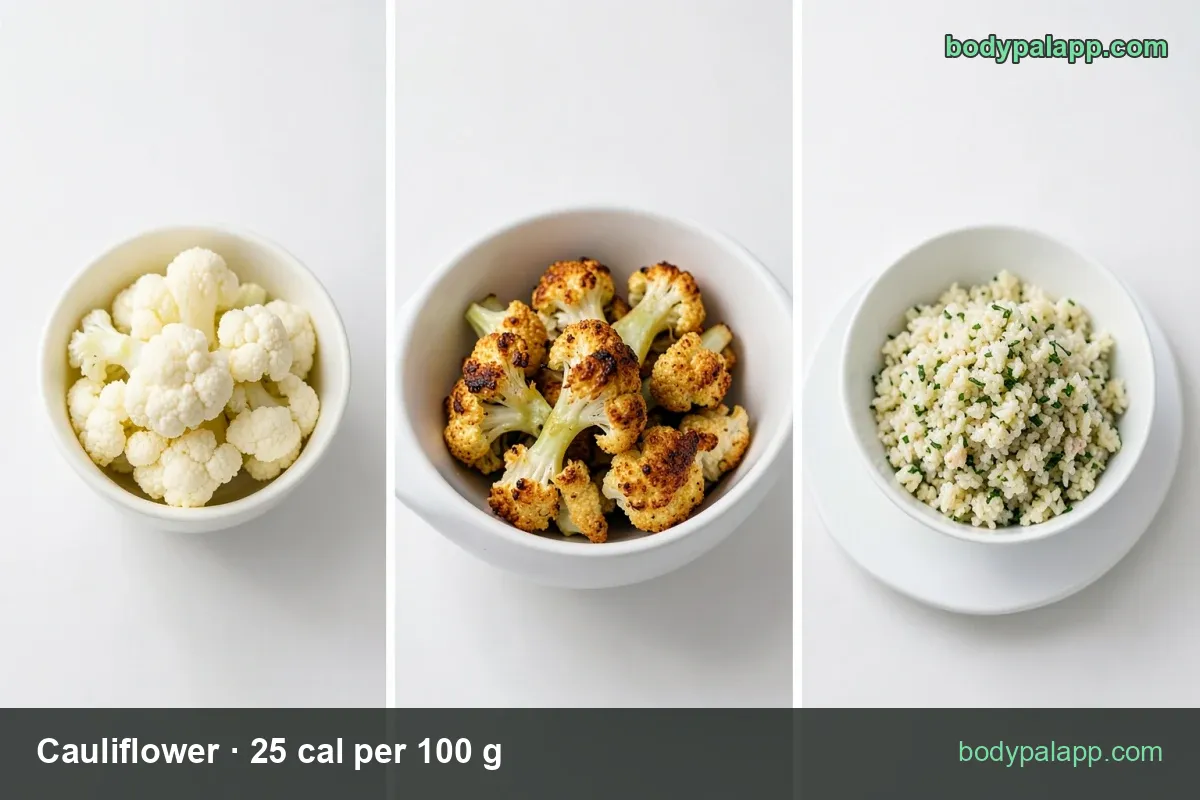
Boiling drains a little carbohydrate into the water, which is why the cooked row reads slightly lower than the raw one. Freezing does almost nothing, since the florets are blanched and then frozen with nothing added.
| Version | Per 100 g | Typical serving | Calories |
|---|---|---|---|
| Boiled, drained, no salt | 23 kcal | 1/2 cup, 1-inch pieces (62 g) | 14 kcal |
| Boiled, drained, with salt | 23 kcal | 1/2 cup, 1-inch pieces (62 g) | 14 kcal |
| Frozen, unprepared | 24 kcal | 1/2 cup, 1-inch pieces (66 g) | 16 kcal |
| Green cauliflower, raw | 31 kcal | 1 cup (64 g) | 20 kcal |
Frozen florets that are then boiled and drained fall further still, to 19 calories per 100 g — the lightest plain cauliflower row on this page. Green cauliflower, sold as broccoflower, is the outlier at 31 calories per 100 g, but it also carries more protein at 2.95 g and more fiber at 3.2 g per 100 g. It is a different cultivar, not a differently cooked white head.
Riced cauliflower belongs in this group rather than with the processed products. USDA Branded lists both VIA EMILIA Organic Riced Cauliflower and Green Giant Cauliflower Riced Veggies at 24 calories per 100 g, which works out to 20 calories in the 85 g three-quarter-cup serving on the bag. Ricing is chopping, so the number does not move.
Cooked with oil and deep fried
Here is where cauliflower stops being a free food. A FNDDS record for fresh cauliflower cooked with oil reads 52 calories per 100 g — double the raw florets — with 3.31 g of fat and 147 mg of sodium. The cauliflower did not change. A tablespoon of oil went into the pan.
| Version | Per 100 g | Fat | Sodium | Calories per 100 g |
|---|---|---|---|---|
| Raw florets | 25 kcal | 0.28 g | 30 mg | 25 kcal |
| Cooked with oil | 52 kcal | 3.31 g | 147 mg | 52 kcal |
| Fried, breaded | 218 kcal | 12.86 g | 326 mg | 218 kcal |
Breaded and fried cauliflower reaches 218 calories per 100 g, nearly nine times the raw florets, and the batter brings 21.9 g of carbohydrate along with it. A shared appetizer plate of fried cauliflower is not a vegetable side in calorie terms; it sits closer to a portion of fries.
The same logic applies to the freezer aisle. Green Giant Cauliflower Veggie Tots run 153 calories per 100 g, or 130 for a six-piece 85 g serving, and Outer Aisle Cauliflower Everything Sandwich Thins are 188 per 100 g, 60 calories for one 32 g piece. Both are useful swaps, but they are baked goods built on cauliflower, not cauliflower.
Fiber and sodium are the rows that move
Two numbers on this page are worth more attention than the calorie count.
The first is fiber. A cup gives 2.1 g, which is 8% of the 28 g Daily Value the FDA sets, for 27 calories. Roast a whole medium head and you are at 11.8 g of fiber, 42% of a day's worth, for 147 calories. Very little else in the produce section moves fiber that far at that price, which is why MyPlate counts cauliflower toward the vegetable group rather than treating it as a filler.
The second is sodium, and it is the salt, not the cooking, that moves it. Half a cup of cauliflower boiled without salt is 9 mg of sodium, 0% of the Daily Value. The identical half cup boiled in salted water is 150 mg, 7% of the Daily Value, for exactly the same 14 calories. That is about a sixteenth of a teaspoon of table salt dissolved into the florets. If you are watching sodium rather than calories, the cooking water is where to make the change; if you are watching calories, it makes no difference at all.
One more habit worth checking: cauliflower carbohydrate is 5.3 g per cup, and 2.1 g of that is fiber, so about 3.2 g is left. That subtraction is our own arithmetic from the USDA figures, not a USDA row, but it is why riced cauliflower keeps turning up in low-carb kitchens.
How does cauliflower compare?
| Vegetable | Per 100 g | US serving | Calories |
|---|---|---|---|
| Cauliflower, raw | 25 kcal | 1 cup chopped, 107 g | 27 kcal |
| Cabbage, raw | 25 kcal | 1 cup chopped, 89 g | 22 kcal |
| Arugula, raw | 25 kcal | 1 cup, 20 g | 5 kcal |
| Broccoli raab, cooked | 25 kcal | 1 NLEA serving, 85 g | 21 kcal |
Our take: all four sit at the same 25 calories per 100 g, so the density argument is a dead heat and the only thing that separates them is how much a cup weighs. Arugula is air — a cup is 20 g and 5 calories, which makes it the cheapest way to fill a salad bowl and a poor way to fill a stomach. Cauliflower is the opposite: 107 g of solid food per cup, 2.1 g of fiber, and it survives roasting, ricing and mashing. For bulk on a dinner plate, cauliflower wins. For volume in a salad, take the arugula and put the cauliflower next to it raw.
Most popular cauliflower brands in the United States
Ranked by how widely each product appears among foods sold in the United States, from the BodyPal food database of over 3.3 million products. Calories are the figures printed on each Nutrition Facts label, checked against USDA FoodData Central.
| Product | Calories (per 100 g) |
|---|---|
| VIA EMILIA Organic Riced Cauliflower | 24 cal |
| Outer Aisle Cauliflower Everything Sandwich Thins | 188 cal |
| Green Giant Cauliflower Veggie Tots | 153 cal |
| Green Giant Cauliflower Riced Veggies | 24 cal |
Brand popularity: BodyPal food database. Nutrition: manufacturer labels / USDA FoodData Central.
Cauliflower FAQs
How many calories are in 1 cup of cauliflower?
One cup of chopped raw cauliflower, 107 g, is 27 calories. That is 25 calories per 100 g. The same cup carries 5.3 g of carbohydrate, 2.1 g of fiber and 2.1 g of protein. Boil it and half a cup, 62 g, drops to 14 calories.
How many calories are in a whole head of cauliflower?
A medium head, 5 to 6 inches across and 588 g, is 147 calories. A small 4-inch head, 265 g, is 66. The medium head also brings 11.8 g of fiber, 42% of the Daily Value, and 29.2 g of carbohydrate, so it is a filling 147 calories.
Does cooking cauliflower change its calories?
Barely: raw is 25 calories per 100 g and boiled, drained cauliflower is 23. What you cook it in changes everything: the same 100 g cooked with oil is 52 calories, and breaded and fried it is 218, nearly nine times the raw florets. Water-based cooking is the cheap route.
How many carbs are in cauliflower?
A cup of chopped raw cauliflower has 5.3 g of carbohydrate, 2 percent of the Daily Value. Subtract the 2.1 g of fiber and 3.2 g are left, our own arithmetic from the USDA figures. Per 100 g it is 4.97 g of carbohydrate, including 1.91 g of natural sugars.
Is cauliflower keto friendly?
On the numbers, yes: a 107 g cup leaves about 3.2 g of carbohydrate once the 2.1 g of fiber is subtracted, and it costs 27 calories. Riced cauliflower keeps the same profile, 24 calories per 100 g and 20 in an 85 g serving. That is our subtraction, not a USDA row.
How much fiber is in cauliflower?
Two grams per 100 g. A cup of chopped raw florets, 107 g, gives 2.1 g, which is 8% of the 28 g Daily Value, for 27 calories. A whole medium head, 588 g, reaches 11.8 g, or 42%. Boiled cauliflower is slightly higher at 2.3 g per 100 g.
How many calories are in riced cauliflower?
About 24 calories per 100 g, or 20 calories in the 85 g three-quarter-cup serving printed on most bags. USDA Branded lists VIA EMILIA Organic Riced Cauliflower and Green Giant Cauliflower Riced Veggies at the same 24 per 100 g. Ricing is just chopping, so nothing is added.
Is frozen cauliflower as low in calories as fresh?
Yes, and slightly lower: frozen unprepared cauliflower is 24 calories per 100 g against 25 for fresh raw, and half a cup, 66 g, is 16 calories. Boil the frozen florets and drain them and it falls to 19 per 100 g, the lightest of the plain cauliflower rows on this page.
Similar foods
- Arugula — 5 cal per cup
- Broccoli Rabe — 21 cal per cup
- Cabbage — 22 cal per cup chopped
- Cabbage Raw — 22 cal per cup
- Cauliflower Head — 147 cal per medium head
- Green Bell Pepper — 19 cal per medium pepper
Count it without the math
Point the camera at the plate and BodyPal counts the florets for you, oil and breading included.


How long does it take to burn off cauliflower?
A 1-cup (107 g) serving is 27 kcal. Enter your weight and the amount you ate to see how long it takes you to burn that off:
lb
| Activity | Time to burn 27 kcal |
|---|---|
| Walking, brisk | 5 min |
| Cycling, moderate | 3 min |
| Swimming, moderate | 4 min |
| Jogging | 3 min |
| Weight training, moderate | 6 min |
Times are for a 155 lb adult at a steady pace; change the weight to see yours. The amount is set to the portion in the text (107 g); change it to what you actually ate. BodyPal works this out from your steps automatically.
One food is easy to picture; a whole day is harder. See how many calories you need a day and what a deficit actually looks like.