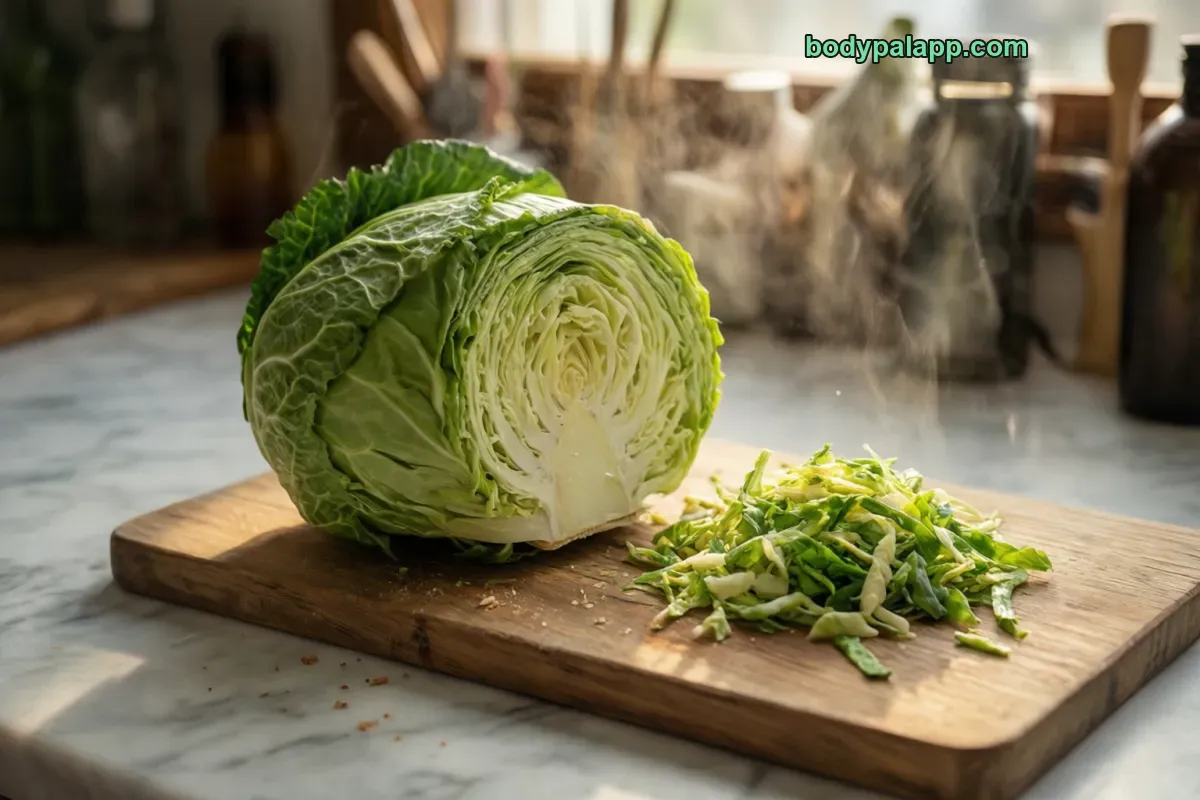
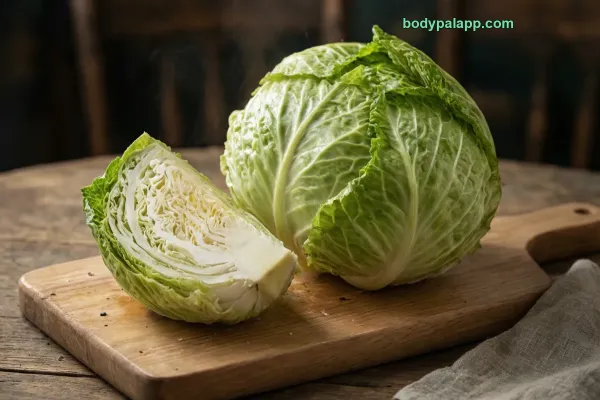
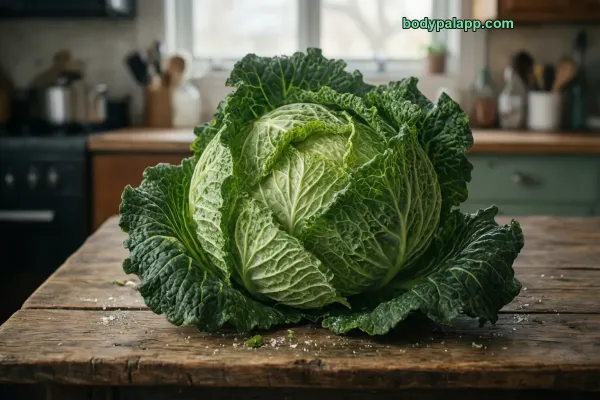
Raw cabbage calories come to 22 for 1 cup chopped (89 g) and 25 per 100 g. What stands out is how much plate you get for so little: that cup also carries 2.2 g of fiber and only 0.1 g of fat, so portion size barely moves your daily total.
22kcal
1 cup chopped · 89 g, raw
18%protein
1.1 gProtein
5 gCarbs
0.1 gFat
How to burn off 22 kcal
—Walking, brisk
—Jogging
—Cycling, moderate
—Swimming
Skip the math. BodyPal counts these calories from your steps and workouts automatically.
Nutrition facts
Raw · per 89 g
Calories
22 kcal
Protein
1.1 g
Carbohydrate
5.2 g
Fat
0.1 g
Saturated fat
0 g
Cholesterol
0 mg
Sodium
16 mg
Potassium
151 mg
Iron
0.4 mg
Source: USDA FoodData Central
🛡️
Verified nutrition data
Numbers on this page come from USDA FoodData Central, the U.S. Department of Agriculture’s food composition database, and from manufacturer labels where a branded product is named. Last verified September 2026. How we verify our data →
Raw cabbage: calories, protein and sodium by serving
Percent of daily value uses the FDA reference of 2,000 kcal a day.
Serving
kcal
Protein
Carbs
Fat
Sodium
% DV kcal
1 cup chopped (89 g)
22
1.1 g
5.2 g
0.1 g
16 mg
1%
1 cup shredded (70 g)
18
0.9 g
4.1 g
0.1 g
13 mg
1%
1 large leaf (33 g)
8
0.4 g
1.9 g
0 g
6 mg
0%
100 g
25
1.3 g
5.8 g
0.1 g
18 mg
1%
3 × 1 cup chopped (89 g)
67
3.4 g
48 mg
5 × 1 cup chopped (89 g)
111
5.7 g
80 mg
Five cups of chopped cabbage stay near 111 calories
One cup chopped (89 g) is 22 calories, or 1% of a daily value. Shredded cabbage packs looser, so a cup of it weighs 70 g and lands at 18 calories. A single large leaf of 33 g, the kind you might use as a wrap, adds just 8.
Scaling up shows how forgiving this vegetable is. Two cups chopped (178 g) come to 45 calories, three cups (267 g) to 67, and a very large bowl of five cups (445 g) still only reaches 111. Few foods let you eat close to half a kilo for that price.
The practical takeaway: you rarely need to weigh raw cabbage to keep a log honest. Measuring by the cup is close enough, and the difference between chopped and shredded matters more than the exact pile. If you track precisely, note which cut you used, because the same cup holds noticeably more chopped cabbage than shredded.
Carbs make up 79% of the calories, and much of that is fiber
Per 100 g, raw cabbage has 5.8 g of carbs, 1.3 g of protein and 0.1 g of fat. In calorie terms that splits into 79% carbs, 18% protein and 3% fat. It is a carb food on paper, but a mild one.
Look inside the carb number. Of the 5.8 g, 2.5 g is fiber and 3.2 g is sugars, the natural kind found in the leaf. A chopped cup gives 2.2 g of fiber and 2.8 g of sugars, so the fiber nearly matches the sugar gram for gram. That is a big part of why cabbage feels filling relative to its calories.
Protein is present but small. A chopped cup holds 1.1 g, about 2% of the daily value, so cabbage will not anchor a meal on its own. Treat it as volume and crunch, and let another food on the plate do the protein work.
The leaf is low in sodium; the add-ons are not
Plain raw cabbage has 18 mg of sodium per 100 g and 16 mg per chopped cup, roughly 1% of the 2300 mg daily value. Even the five-cup bowl only reaches 80 mg. Saturated fat and cholesterol both read 0, and potassium sits at 170 mg per 100 g.
The numbers change once cabbage becomes something else. Fermented and pickled versions, such as Jongga or Seoul kimchi, or jarred sweet and sour red cabbage like Aunt Nellie's, are seasoned products, and their labels should be read on their own terms rather than borrowed from this page. The same goes for coleslaw, where the dressing usually contributes far more calories than the cabbage underneath.
If you watch sodium or calories, keep the raw cabbage as the base and add salt, mayo or sweet dressings by the spoon, logging each one. The vegetable itself is rarely the row that pushes a day over.
Use it to add volume, then pair it with protein
Because a chopped cup costs 22 calories, raw cabbage works well as a way to make a plate look and feel bigger without changing much in the log. Toss shredded cabbage into tacos, grain bowls or stir-fry toppings, or use whole leaves in place of tortillas.
Pair it with something that brings protein and some fat, such as chicken, beans, eggs, fish or a modest drizzle of oil, so the meal holds you longer than the cabbage alone could. A squeeze of lime or a splash of vinegar adds flavor at almost no calorie cost.
If you want to log a slaw or a mixed bowl quickly, BodyPal can identify the food from a photo, and you can then adjust the cabbage portion to chopped or shredded cups.
How does raw cabbage compare?
Here is how raw cabbage stacks up against green, boiled and whole-head cabbage, per 100 g and per usual serving.
Verdict: For the lowest count per bite, boiled cabbage at 23 calories per 100 g edges out raw at 25, while green cabbage logged at 31 per 100 g runs about 1.2 times higher. For crunch and the most fiber-backed volume in a salad, raw cabbage at 22 calories per chopped cup is the pick.
Most popular raw cabbage brands in the United States
Ranked by popularity in the BodyPal database
# Productkcal / 100 g
1Jongga Kimchi Fermented Napa Cabbage1 oz · 28 g36 kcal
2Jongga Spicy Napa Cabbage Kimchi1 oz · 28 g18 kcal
7Seoul Original Premium Fermented Napa Cabbage Kimchi1 oz · 28 g54 kcal
Packaged cabbage is sold fermented as kimchi or cooked in a sweet and sour sauce, so the label numbers sit above plain raw cabbage. Source: manufacturer labels / USDA FoodData Central.
Raw cabbage FAQs
How many calories are in raw cabbage?
A cup of chopped raw cabbage (89 g) has 22 calories and a shredded cup (70 g) has 18. Per 100 g raw cabbage has 25 calories.
Is raw cabbage low in calories?
Yes, at 25 calories per 100 g even a large 200 g bowl comes to 50 calories, with 5 g of fiber.
Raw cabbage vs green cabbage: what is the difference?
The plain raw cabbage row is 25 calories per 100 g, while the separate green cabbage row is 31. Red cabbage raw is 31 calories per 100 g.
How many carbs are in raw cabbage?
100 g of raw cabbage has 5.8 g of carbs, of which 2.5 g is fiber and 3.2 g sugars. A chopped cup (89 g) has 5.2 g of carbs.
How many calories are in a cup of shredded raw cabbage?
A cup of shredded raw cabbage (70 g) has 18 calories. It weighs less than a chopped cup, which comes to 22 calories for 89 g, because shredded leaves pack more loosely.
How many calories are in one cabbage leaf?
One large raw cabbage leaf of 33 g has about 8 calories, with 1.9 g of carbs and 0.8 g of fiber. That makes leaves a very light swap for wraps or tortillas.
How much fiber is in raw cabbage?
Raw cabbage has 2.5 g of fiber per 100 g and 2.2 g per chopped cup. Against a 28 g daily value, one cup is a modest but useful contribution for just 22 calories.
How much sugar does raw cabbage contain?
Raw cabbage has 3.2 g of sugars per 100 g and 2.8 g per chopped cup. These are the natural sugars of the leaf, and the cup carries almost as much fiber, at 2.2 g.
Is raw cabbage high in sodium?
No. Raw cabbage has 16 mg of sodium per chopped cup and 18 mg per 100 g, about 1% of the daily value. Kimchi, slaw dressings and added salt are where sodium climbs.