
How many calories in a dosa?
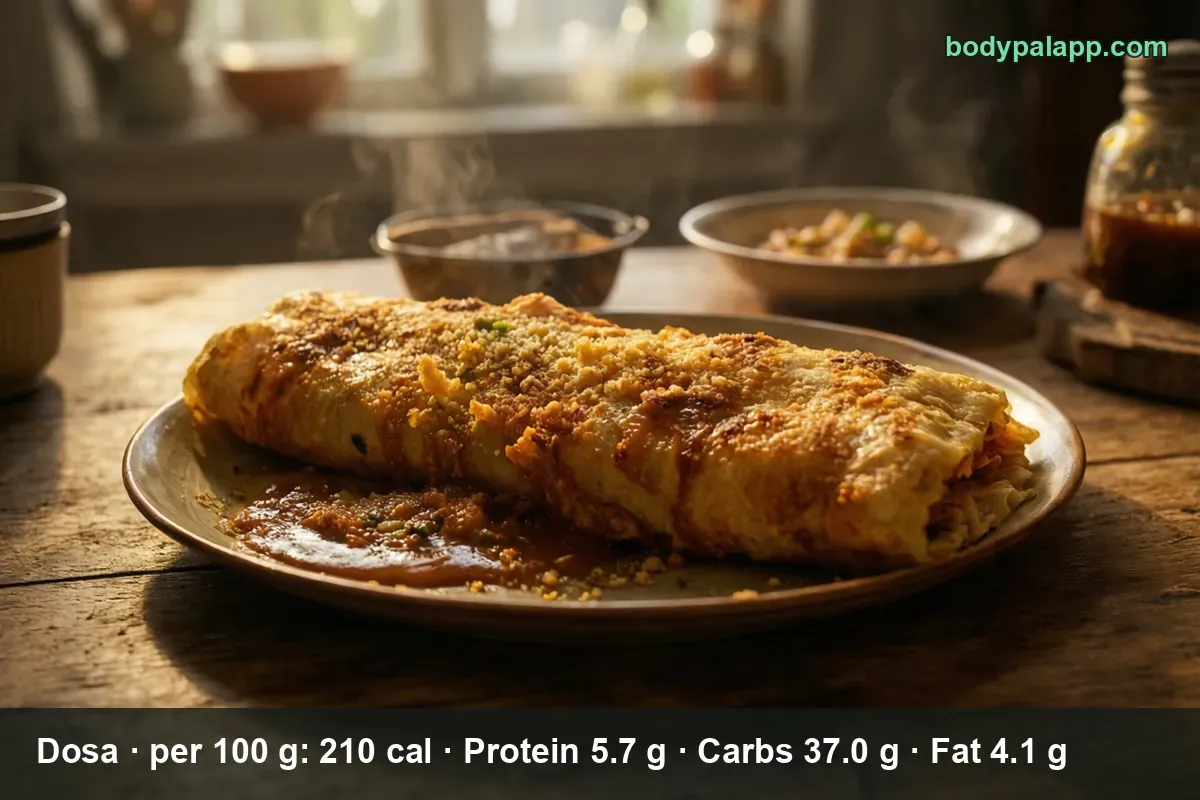
One medium dosa weighs 80 g and carries 168 calories, from a batter that runs 210 calories per 100 g. The large one a restaurant slides across the table is 326. Fold spiced potato into it and a medium masala dosa lands at 491, from the same rice-and-lentil batter.
On this page
- Dosa quick facts
- Small, medium, large: one batter, five numbers
- Masala dosa is lighter per gram and triple the plate
- The sodium arrives before the sambar
- Frozen dosa and dosa batter from the store
- How does a dosa compare?
- Most popular dosa brands
- FAQ
Dosa quick facts
Every figure on this page comes from FNDDS 2708347, "Dosa, plain", the USDA survey record filed under pancakes, waffles and French toast. USDA has no Foundation or SR Legacy line for dosa at all, which is normal for a cooked restaurant dish; the survey database is where prepared foods live.
The serving column is one medium dosa at 80 g, which is also USDA's own default weight when a survey respondent says "a dosa" without giving a size.
| Nutrient | Per 100 g | Per 1 medium dosa (80 g) | % Daily Value |
|---|---|---|---|
| Calories | 210 kcal | 168 kcal | — |
| Total fat | 4.05 g | 3.2 g | 4% |
| Saturated fat | 0.58 g | 0.46 g | 2% |
| Carbohydrate | 37.04 g | 29.6 g | 11% |
| Dietary fiber | 1.8 g | 1.4 g | 5% |
| Total sugars | 0.3 g | 0.2 g | — |
| Protein | 5.7 g | 4.6 g | 9% |
| Sodium | 309 mg | 247 mg | 11% |
% Daily Value is based on a 2,000-calorie diet.
Verified nutrition data
Numbers on this page come from USDA FoodData Central, the U.S. Department of Agriculture’s food composition database, and from manufacturer labels where a branded product is named. Last verified September 2026. How we verify our data →
Two rows a packaged label would carry are absent, and for the same reason: the 2021–2023 FNDDS release publishes no added sugars and no trans fat value for either dosa record. Writing zero would be inventing a measurement nobody took, so the rows are gone instead. Total sugars carry no Daily Value on a US label, which is why that cell is blank.
Two more numbers sit in the same record without appearing on the label grid. Cholesterol is 0 mg, because a plain dosa is rice, lentils and oil with nothing animal in it. Potassium is 104 mg per 100 g, or 83 mg in a medium dosa, roughly 2% of the day.
The shape of this record is the whole story. Read down the fat column and a dosa looks like health food at 3.2 g a piece. Read down the carbohydrate column and it is 29.6 g, nine times the fat by weight. A dosa is a starch, not a fried snack.
Small, medium, large: one batter, five numbers
| Serving | Weight | Calories |
|---|---|---|
| 1 oz | 28 g | 59 |
| 1 small dosa | 35 g | 74 |
| 1 medium dosa | 80 g | 168 |
| 1 large dosa | 155 g | 326 |
| 100 g of dosa | 100 g | 210 |
The three piece weights are USDA's own, taken from the portion file for this record, and the spread between them is the single most useful thing on this page. A small dosa is 74 calories. A large one is 326. That is 4.4 times the same food, cooked from the same ladle of batter on the same griddle.
No other number moves anything like that much. The recipe barely varies between a home kitchen and a restaurant kitchen; the diameter of the pan does. A South Indian restaurant serving a dosa that hangs off both sides of the plate is not using a richer batter, it is using twice as much of it. So "calories in dosa" answered without a size is not a useful answer, and any chart that gives you one figure is quietly assuming a medium.
The ounce row is there for the shared dosa and the torn-off piece: 59 calories an ounce, which makes the arithmetic easy at a table where one large dosa is being pulled apart by three people.
Raw against cooked, the split that matters so much for meat and rice, does not apply here in the usual way. A dosa only exists after the griddle. The uncooked stage is batter, sold as a separate product with its own label, and it gets its own section further down.
Masala dosa is lighter per gram and triple the plate
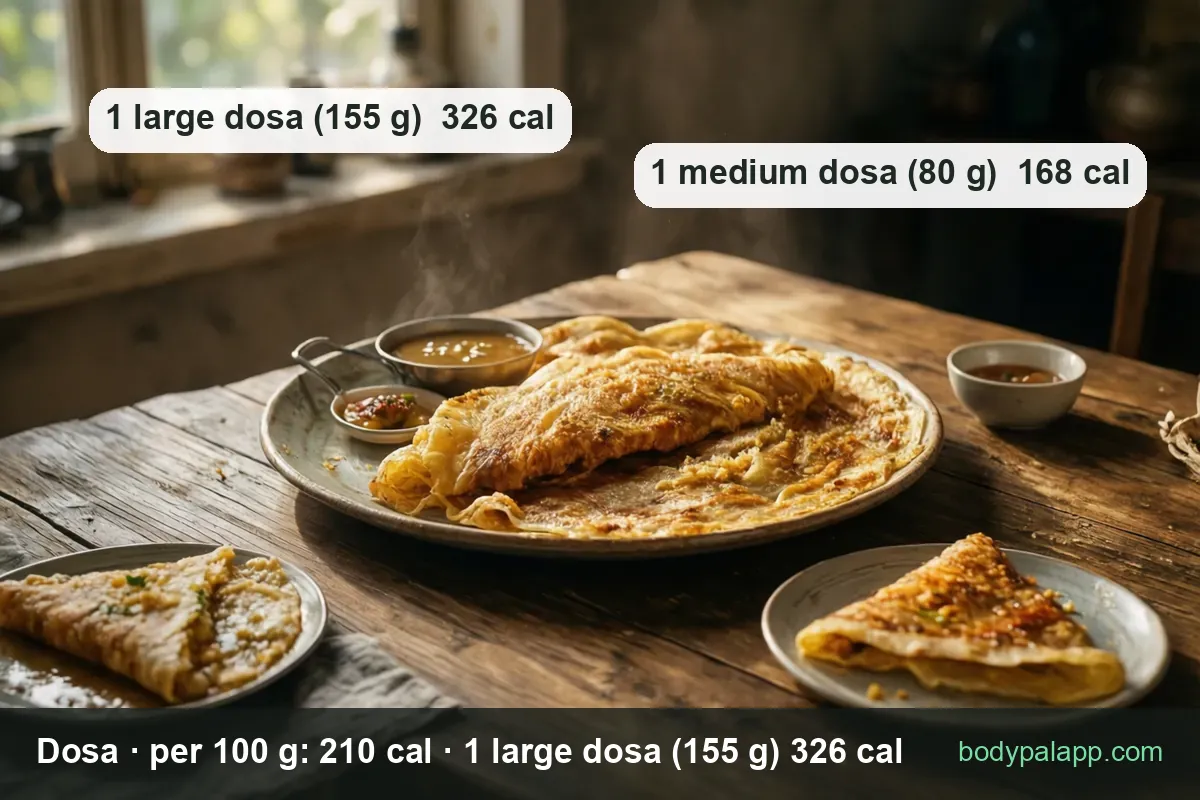
USDA keeps a second record, FNDDS 2709129, "Dosa, with filling", which is what most American menus call masala dosa: the same crepe wrapped around spiced potato and onion.
| Version | Per 100 g | Serving | Calories |
|---|---|---|---|
| Plain dosa, medium | 210 | 1 medium (80 g) | 168 |
| Plain dosa, large | 210 | 1 large (155 g) | 326 |
| Dosa with filling, small | 184 | 1 small (113 g) | 208 |
| Dosa with filling, medium | 184 | 1 medium (267 g) | 491 |
| Dosa with filling, large | 184 | 1 large (523 g) | 962 |
| Frozen retail masala dosa | 273 | 1 dosa with 1 tsp chutney (99 g) | 270 |
Look at the density column first and the filled dosa looks like the better order: 184 calories per 100 g against 210 for the plain one. Potato cooked with onion is mostly water, and water has no calories, so the average per gram falls.
Now look at the weight column. A medium plain dosa is 80 g. A medium filled dosa is 267 g. The filling does not replace batter, it arrives on top of it, and it brings its own volume with it. The finished plate is 491 calories against 168 — nearly three times the meal from the food that reads lighter per gram.
This is the reason per-100 g comparisons mislead people so reliably. Adding a wet ingredient always lowers density and almost always raises the total. If you log by density, masala dosa scores well. If you log what you ate, it is one of the larger single items on an Indian menu, and the large version at 523 g and 962 calories is a full day's lunch and dinner in one object.
The filling does pay you back in one column. Fiber goes from 1.8 g per 100 g to 2.2 g, and because the piece is so much heavier, a medium masala dosa delivers about 5.9 g of fiber, 21% of the 28 g Daily Value, against 1.4 g and 5% for the plain medium. Protein moves the same way, roughly 14.6 g against 4.6 g. Those two per-piece figures are our own scaling of USDA's per-100 g values to the 267 g portion weight. Potato is not the villain here; portion size is.
The sodium arrives before the sambar
Fermented rice-and-lentil batter is salted before it ever meets the pan, and the number that comes out of that is larger than the food tastes.
- 1 medium plain dosa, 80 g: 247 mg, 11% of the day
- 1 large plain dosa, 155 g: 479 mg, 21%
- 1 medium dosa with filling, 267 g: 881 mg, 38%
The FDA Daily Value for sodium is 2,300 mg. A medium masala dosa uses well over a third of it, and that figure describes the pancake and its potato only. USDA publishes no line for restaurant sambar or coconut chutney inside these records, so the lentil stew and the two chutneys that arrive alongside are not counted anywhere above. Whatever they contain is added to 881 mg, not included in it.
That ordering is worth remembering, because most people assume the sauces are where the salt hides. On a dosa plate the pancake gets there first.
Calories break down the other way round. In a medium dosa, carbohydrate supplies roughly 118 of the 168 calories, fat about 29 and protein about 18. One large dosa is 57.4 g of carbohydrate, 21% of the 275 g Daily Value, while its fat is 6.3 g, only 8%. MyPlate counts rice-based foods in the grains group, and a dosa behaves like one: it is bread in pancake form, with a little oil.
Frozen dosa and dosa batter from the store
The freezer aisle changes the numbers, and not in the direction most shoppers expect. Deep Indian Kitchen's frozen masala dosa declares 273 calories per 100 g, against 184 for the restaurant-style filled dosa in USDA's survey record. That is close to 50% denser per gram. The pack is small enough that the piece itself stays moderate — 99 g including a teaspoon of chutney, for 270 calories — but it carries about 11 g of fat and 450 mg of sodium in that small piece, 20% of the day's sodium in something the size of a burrito half.
Refrigerated batter is a different product again, and it is the one people misread most often. Shastha Foods sells its oats batter at 175 calories per 100 g and its brown rice batter at 170, with the label serving set at 57 g, or 2.01 oz: 100 calories and 97 calories respectively. Those figures describe raw batter as sold. They do not include the oil or ghee that goes on the griddle, and they are not comparable to the 210 of a finished dosa, which has lost water to the heat and gained fat from the pan. Logging a dosa at its batter weight is the most common way to undercount one.
USDA's branded database holds 46 rows matching "dosa" for the US market, and only three of them are actually dosa. Ten belong to a brand literally named DOSA that sells wraps, samosas, curries and salad, and one quinoa batter row carries a label figure so low it cannot describe rice and lentils. Brand names are not ingredients, which is why a search result count is a bad way to price a food.
How does a dosa compare?
| Item | Per 100 g | US serving | Calories | Protein / carbs / fat per 100 g |
|---|---|---|---|---|
| Dosa, plain (this page) | 210 | 1 medium (80 g) | 168 | 5.7 / 37.04 / 4.05 g |
| Dosa with filling | 184 | 1 medium (267 g) | 491 | 5.46 / 30.8 / 4.27 g |
| Chinese pancake | 207 | 1 pancake (28 g) | 58 | 4.05 / 45.38 / 0.38 g |
| Pancakes, gluten free | 215 | 1 medium pancake (50 g) | 108 | 3.31 / 40.32 / 4.55 g |
| Crepe, plain | 224 | 1 crepe, any size (65 g) | 146 | 8.85 / 22.02 / 11.29 g |
| Crepe, fruit filled | 188 | 1 crepe with filling (80 g) | 150 | 4.57 / 26.55 / 7.12 g |
All six are USDA survey records from the same pancake family, so this is a fair fight. Per 100 g they run 184 to 224, a spread of just over 20%, which means density tells you almost nothing about which of them is the bigger meal. Per serving they run 58 to 491, a spread of more than eight to one. Size decides, every time.
Our take: for the largest plate that still stays under 350 calories, the large plain dosa at 326 beats everything here, and it does it with 4.05 g of fat per 100 g, the second-lowest in the table. For the fewest calories per gram of protein, the plain crepe wins on paper with 8.85 g per 100 g, though it pays for that with 11.29 g of fat, nearly three times a dosa's. And if you are choosing between a plain dosa and a masala dosa for the same hunger, order the plain one with an extra bowl of sambar rather than the filled one: the potato inside a masala dosa costs 323 calories over the medium plain version before anything is dipped.
Most popular dosa brands in the United States
Ranked by how widely each product appears among foods sold in the United States, from the BodyPal food database of over 3.3 million products. Calories are the figures printed on each Nutrition Facts label, checked against USDA FoodData Central.
| Product | Calories (per 100 g) |
|---|---|
| Deep Indian Kitchen Masala Dosa | 273 cal |
| Shastha Foods Oats Dosa | 175 cal |
| Shastha Foods Brown Rice Dosa | 170 cal |
Brand popularity: BodyPal food database. Nutrition: manufacturer labels / USDA FoodData Central.
Dosa FAQs
How many calories are in a dosa?
168 calories in a medium dosa of 80 g, which is 210 calories per 100 g. A small dosa of 35 g is 74 calories and a large one of 155 g is 326. That medium serving carries 4.6 g of protein, 29.6 g of carbohydrate, 3.2 g of fat and 247 mg of sodium.
How many calories are in a small dosa?
74 calories for a 35 g small dosa, using USDA's figure of 210 per 100 g. An ounce of dosa, useful when a large one is being shared, is 59 calories. The small size is the one most home kitchens produce, because a domestic pan cannot hold a restaurant dosa.
How many calories are in a masala dosa?
491 calories for a medium filled dosa of 267 g, at 184 calories per 100 g. A small one of 113 g is 208 and a large one of 523 g reaches 962. The filled version is lighter per gram than a plain dosa but three times heavier as an object, so the total is far higher.
How many calories are in a large dosa?
326 calories for a plain large dosa of 155 g. If that large dosa is filled with spiced potato, USDA's weight for it is 523 g and the figure becomes 962 calories. The gap between those two answers is why a size has to be attached to any dosa calorie number.
Is a dosa healthy?
A medium dosa is 168 calories with 3.2 g of fat, 4% of the Daily Value, and 29.6 g of carbohydrate, 11%. It behaves like a grain food rather than a fried one: nine times more carbohydrate than fat by weight, no cholesterol, and 1.4 g of fiber. The number to watch is sodium at 247 mg a piece.
How much protein is in a dosa?
4.6 g in a medium dosa of 80 g, 9% of the 50 g Daily Value, from 5.7 g per 100 g. A large dosa gives about 8.8 g. A medium masala dosa reaches roughly 14.6 g, mostly because it weighs 267 g rather than because potato is protein-rich.
How many calories in a dosa with sambar and chutney?
USDA's dosa records cover the pancake and its filling only, so the 168 for a medium and 491 for a masala dosa exclude the sides entirely. The one figure that includes any is the frozen retail masala dosa, 270 calories for a 99 g piece packed with a teaspoon of chutney. Log restaurant sambar and chutney as separate items.
How many calories are in dosa batter?
Around 170 to 175 calories per 100 g of refrigerated batter as sold, which is 97 to 100 calories in the 57 g label serving. That is the raw product before the griddle, without the oil or ghee used to cook it, so it is not interchangeable with the 210 per 100 g of a finished dosa.
Similar foods
- Pretzel Bread — 80 cal per slice
- Fish Cake — 180 cal per cake or patty
- Spanakopita — 254 cal per large piece
- Crab Cake — 182 cal per crab cake
- Bagel Bite — 190 cal for 4 pieces
- Chicken Pot Pie — 428 cal per slice
Count it without the math
A dosa is the food a scale never sees, so point the camera at the plate and BodyPal sorts the 168 from the 326 for you.


How long does it take to burn off dosa?
One medium dosa (80 g) is 168 kcal. Enter your weight and the amount you ate to see how long it takes you to burn that off:
lb
| Activity | Time to burn 168 kcal |
|---|---|
| Walking, brisk | 34 min |
| Cycling, moderate | 21 min |
| Swimming, moderate | 24 min |
| Jogging | 20 min |
| Weight training, moderate | 37 min |
Times are for a 155 lb adult at a steady pace; change the weight to see yours. The amount is set to the portion in the text (80 g); change it to what you actually ate. BodyPal works this out from your steps automatically.
Want the bigger picture? Calculate your daily calorie needs — your maintenance figure, a target for losing or gaining, and the date you get there.