
How many calories are in a chicken drumstick?
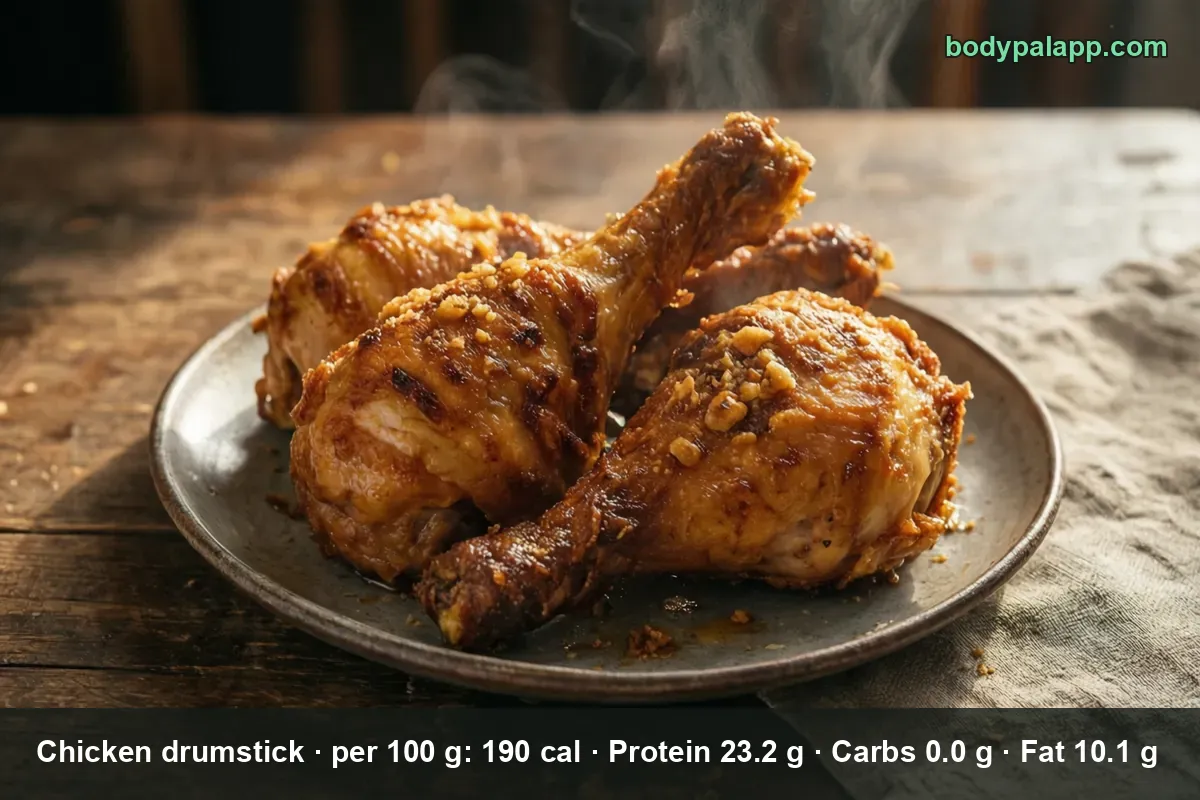
One medium chicken drumstick, roasted with the skin eaten, is 114 calories at 60 g. Per 100 g of meat and skin that is 190 calories with 23.21 g of protein; one medium piece carries 13.9 g of protein and no carbohydrate. Size moves it more than anything else: a small piece is 86, a large one 152.
On this page
- Chicken drumstick quick facts
- US drumstick servings from one ounce to a cup
- Fried breaded grilled and stewed
- Skin on versus skin off
- Raw on the package cooked on the plate
- Protein is the reason to eat the drumstick
- How does a chicken drumstick compare?
- Most popular chicken drumstick brands
- FAQ
Chicken drumstick quick facts
The row on this page is FNDDS 2706002, Chicken drumstick, baked, broiled, or roasted, skin eaten, from raw. It is the drumstick people actually pick up: cooked from raw, seasoned the way a home kitchen or a deli counter seasons it, skin left on. It also comes with household measures for a small, medium and large piece, which is the part most calorie pages skip.
The older SR Legacy record 173612 describes the same cut at 191 calories per 100 g, close enough to be the same food, but it is unseasoned lab meat with no per-drumstick weight. The difference between the two is salt, not chicken.
| Nutrient | Per 100 g | Per 1 medium drumstick (60 g) | % Daily Value |
|---|---|---|---|
| Calories | 190 | 114 | — |
| Total fat | 10.09 g | 6.1 g | 8% |
| Saturated fat | 2.72 g | 1.6 g | 8% |
| Carbohydrate | 0 g | 0 g | 0% |
| Dietary fiber | 0 g | 0 g | 0% |
| Total sugars | 0 g | 0 g | — |
| Protein | 23.21 g | 13.9 g | 28% |
| Sodium | 353 mg | 212 mg | 9% |
% Daily Value is based on a 2,000-calorie diet.
Verified nutrition data
Numbers on this page come from USDA FoodData Central, the U.S. Department of Agriculture’s food composition database, and from manufacturer labels where a branded product is named. Last verified September 2026. How we verify our data →
Two rows you would expect on a package label are missing here on purpose. FNDDS does not publish added sugars or trans fat for meat records, so neither belongs in the table, and a plain roasted drumstick has no added sugars to report anyway. Cholesterol and potassium do exist in the record: 129 mg and 246 mg per 100 g, which works out to 77 mg of cholesterol on one medium drumstick (26% of the Daily Value) and 148 mg of potassium (3%). The 212 mg of sodium is less than a tenth of a teaspoon of table salt.
US drumstick servings from one ounce to a cup
| Serving | Weight | Calories |
|---|---|---|
| 1 oz, cooked | 28 g | 54 kcal |
| 1 small drumstick | 45 g | 86 kcal |
| 1 medium drumstick | 60 g | 114 kcal |
| 1 large drumstick | 80 g | 152 kcal |
| 1 cup, cooked and diced | 135 g | 257 kcal |
| Per 100 g | 100 g | 190 kcal |
Every weight in that table is a USDA household measure for this record, including the cup of diced meat, so none of it is estimated. The gap between the sizes is where budgets break. Log "three drumsticks" as medium and you have written down 342 calories; if the pack was large birds, the plate was 456. That is a 114-calorie error, an entire extra drumstick, from a word instead of a number.
The ounce line is worth keeping in your head for leftovers. Pulled off the bone and tossed into a salad, a drumstick's meat and skin is 54 calories per ounce, so a generous two-ounce handful is roughly one whole medium piece.
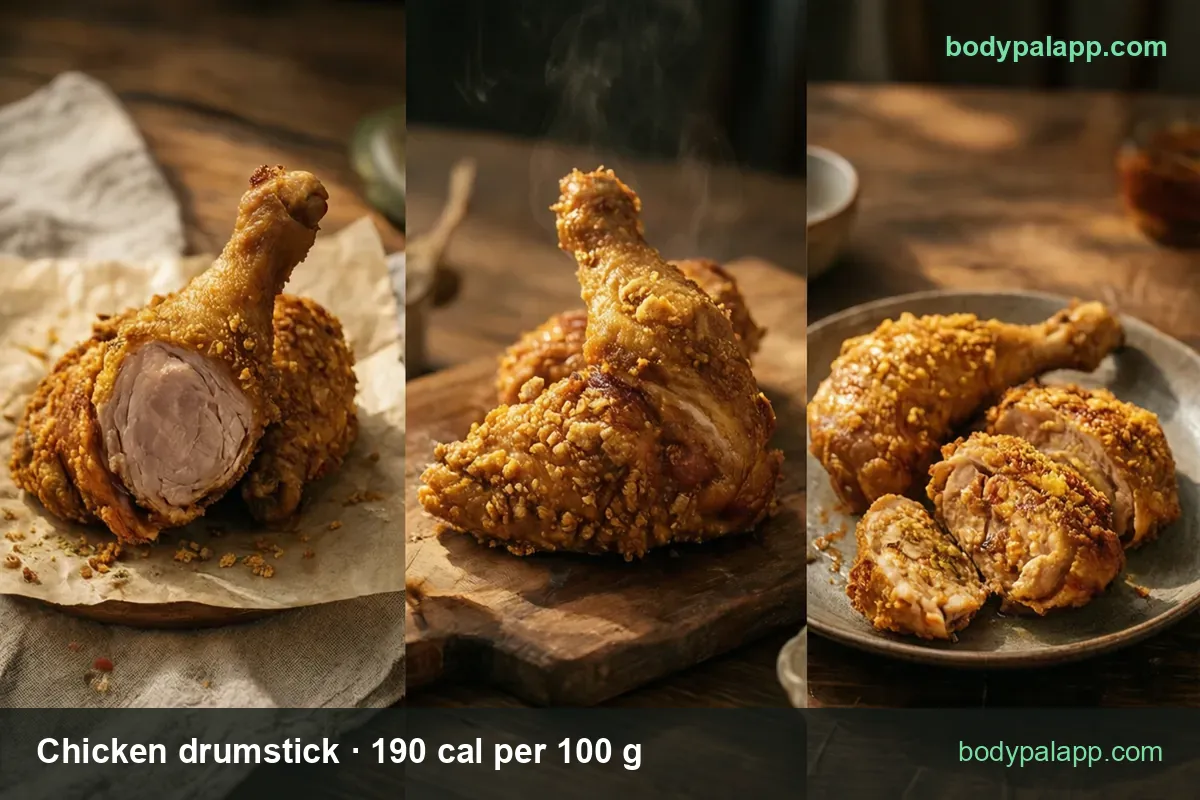
Fried breaded grilled and stewed
| Version | Per 100 g | Typical piece | Calories |
|---|---|---|---|
| Baked or roasted, skin eaten | 190 kcal | 1 medium, 60 g | 114 kcal |
| Grilled, no sauce, skin eaten | 204 kcal | 1 medium, 60 g | 122 kcal |
| Stewed, skin eaten | 186 kcal | 1 medium, 65 g | 121 kcal |
| Breaded and baked, coating eaten | 205 kcal | 1 medium, 85 g | 174 kcal |
| Fried, coated, coating eaten | 241 kcal | 85 g coated piece | 205 kcal |
The fried line needs a footnote: USDA publishes 241 calories per 100 g for the coated fried drumstick but no piece weight, so the 205 is our own arithmetic from the 100 g figure, borrowed from the 85 g weight USDA gives the breaded baked piece. Treat it as a good estimate, not a USDA serving.
Frying costs 51 calories per 100 g against baking, and it does something the other methods never do: it puts carbohydrate on a piece of chicken. The coated record carries 5.98 g of carbohydrate per 100 g, about 5.1 g on that 85 g piece, plus 0.2 g of fiber. Baked, grilled and stewed drumsticks are all flat zeros there.
Grilling looks harsher than it is. At 204 calories per 100 g it sits above baking on paper, because grilled pieces lose more water and the calories concentrate into fewer grams. USDA still weighs both pieces at 60 g, so per piece grilled is 122 and baked is 114 — an eight-calorie argument, and only if there is no sauce on it.
Skin on versus skin off
Removing the skin is the single cleanest cut available on this food. FNDDS 2706003, the same drumstick with the skin left on the plate, is 154 calories per 100 g against 190 with the skin eaten. That is 36 calories per 100 g, or 22 calories on one medium drumstick, which lands it at about 92 calories (our own arithmetic from the 154 figure, not a USDA serving weight).
What those 22 calories buy is mostly fat. The skin accounts for 4.42 g of fat per 100 g, roughly 2.7 g of the 6.1 g on a medium piece — close to half the fat for about a fifth of the calories. Protein barely moves: 23.21 g per 100 g with skin, 24.1 g without, because you are subtracting fat and leaving the meat alone.
A rotisserie drumstick from the supermarket counter is the other direction. USDA record 171521 rates it at 215 calories per 100 g, the densest drumstick in this file that is not wearing a coating, because the bird spends an hour losing water under heat. The piece weight is small, though — 53 g — so one rotisserie leg is 114 calories, exactly what a medium home-roasted one costs. Same number, denser meat, smaller portion.
Raw on the package cooked on the plate
This is where drumsticks trip up more logs than any cooking method. The Nutrition Facts panel on a tray of drumsticks is written for raw, bone-in meat: Tyson lists 134 calories per 100 g and 150 for a 4 oz (112 g) serving, Food Lion 136, Perdue 161, Market Pantry 138 with a per-piece serving of 116 g. Every one of those numbers is lower than the 190 you eat, and none of them is wrong.
Two things happen between the tray and the plate. Water leaves, which concentrates everything per gram — USDA's raw drumstick record is 161 calories per 100 g against 190 roasted. And the package weight includes bone, which you do not eat. The old rule of thumb for meat still works here: roughly 4 oz raw is about 3 oz cooked.
So a 4 oz raw label serving at 150 calories and a 3 oz cooked portion at 162 calories are the same chicken, counted at two different moments. If you weigh drumsticks before they go in the oven, use the package number. If you weigh what comes off the bone, use 190 per 100 g. Mixing the two is how a plate of chicken quietly loses calories: 100 g of cooked meat logged at a package's 136 is 54 calories short of the 190 you actually ate.
Protein is the reason to eat the drumstick
One medium drumstick delivers 13.9 g of protein for 114 calories — 28% of the Daily Value in a piece of food that fits in one hand. The FDA sets the Daily Value for protein at 50 g, and MyPlate counts a cooked ounce of poultry as one ounce-equivalent, so two drumsticks cover about four of the five to six ounce-equivalents an adult is pointed toward each day.
Saturated fat is the row that keeps drumsticks honest rather than the row that condemns them: 1.6 g per medium piece, 8% of the Daily Value, so three of them is under a quarter of the day's allowance. Cholesterol is the higher number at 77 mg, 26% of the Daily Value on one piece, which is worth knowing if you are already eating eggs at breakfast.
Sodium is not about the chicken. Unseasoned roasted drumstick in the SR Legacy record carries 123 mg per 100 g; the same cut seasoned the way people actually cook it is 353 mg, close to three times as much, and rotisserie runs 411 mg. If you are watching sodium, the fix is the salt shaker and the deli counter, not the cut of chicken.
How does a chicken drumstick compare?
| Cut | Per 100 g | US serving | Calories |
|---|---|---|---|
| Drumstick, baked with skin, as eaten | 190 kcal | 1 medium, 60 g | 114 kcal |
| Drumstick, meat and skin, roasted, unseasoned | 191 kcal | 3 oz, 85 g | 162 kcal |
| Drumstick, meat only, roasted | 155 kcal | 1 drumstick without skin, 96 g | 149 kcal |
| Drumstick, rotisserie, meat and skin | 215 kcal | 1 drumstick, 53 g | 114 kcal |
Our take: the skinless row is the only one under 160 calories per 100 g, and it gets there without losing protein, so if you are cutting calories the skin goes first and the cooking method second. If you are eating for fullness, keep the skin and keep the piece small — 114 calories for 13.9 g of protein and zero carbohydrate is a ratio very little else on a dinner plate can match. Watch the serving column rather than the density column: the roasted and the rotisserie rows differ by 25 calories per 100 g but land on the same 114 once you weigh a real piece. A turkey drumstick, for the record, sits at 197 calories per 100 g with 28.21 g of protein — denser food, much bigger leg.
Most popular chicken drumstick brands in the United States
Ranked by how widely each product appears among foods sold in the United States, from the BodyPal food database of over 3.3 million products. Calories are the figures printed on each Nutrition Facts label, checked against USDA FoodData Central.
| Product | Calories (per 100 g) |
|---|---|
| Tyson Chicken Drumsticks | 134 cal |
| Tyson Uncooked Chicken Drumsticks | 136 cal |
| Tyson IF Unbreaded Chicken Drumsticks | 135 cal |
| Food Lion Bone-In Fresh Chicken Drumsticks | 136 cal |
| Perdue Chicken Drumsticks | 161 cal |
| Market Pantry Chicken Drumsticks | 138 cal |
Brand popularity: BodyPal food database. Nutrition: manufacturer labels / USDA FoodData Central.
Chicken drumstick FAQs
How many calories are in one chicken drumstick?
One medium drumstick, baked with the skin eaten, is 114 calories at 60 g. USDA lists small at 45 g and large at 80 g, so the same plate can run 86 or 152 calories per piece. Per 100 g of meat and skin the figure is 190 calories.
How many calories in a drumstick without the skin?
About 92 calories for a medium 60 g drumstick with the skin left on the plate, our own arithmetic from the USDA figure of 154 calories per 100 g. Pulling the skin saves 22 calories and 2.7 g of fat, and it costs you nothing in protein.
How much protein is in a chicken drumstick?
13.9 g of protein in one medium 60 g drumstick, which is 28% of the Daily Value. Two drumsticks put you at 27.8 g. Per 100 g the meat and skin carry 23.21 g of protein, and skinless meat is slightly higher at 24.1 g.
How many calories in a fried chicken drumstick?
241 calories per 100 g for a drumstick fried in coating, against 190 for the same piece baked with the skin. On an 85 g coated drumstick, our own arithmetic, that is about 205 calories, and roughly 5.1 g of it is carbohydrate from the breading.
Are baked drumsticks healthier than fried ones?
On the numbers, yes: 190 calories per 100 g baked with the skin against 241 fried and coated. Frying costs more than the skin does, 51 calories per 100 g versus 36, and it adds about 6 g of carbohydrate per 100 g to a food that otherwise has none.
How much does one chicken drumstick weigh?
A medium drumstick is 60 g of edible meat and skin in USDA's household measures, with small at 45 g and large at 80 g. Raw bone-in packages are labeled differently: a 4 oz (112 g) serving includes the bone, and one store-brand piece is listed at 116 g.
How many calories in a rotisserie chicken drumstick?
114 calories for one rotisserie drumstick, because USDA weighs that piece at 53 g and rates it 215 calories per 100 g. It is the densest uncoated drumstick in the file, and the saltiest: 411 mg of sodium per 100 g, roughly 218 mg on that small piece.
Are chicken drumsticks good for weight loss?
13.9 g of protein for 114 calories makes one medium drumstick a strong ratio, and carbohydrate is 0 g. Skinless is leaner still, about 92 calories. The trap is the count rather than the cut: three large drumsticks are 456 calories, not the 342 people assume.
Similar foods
- Ground Chicken — 214 cal per 4 oz cooked
- Turkey — 161 cal for 3 oz sliced
- Chicken Thigh Without Skin — 134 cal per medium thigh
- Pork Pot Sticker — 48 cal per pot sticker
- Beef Cubes — 252 cal per cup
- Beef Cube Steak — 299 cal per steak
Count it without the math
Point the camera at the plate and BodyPal counts the drumsticks for you, skin and all.


How long does it take to burn off 114 kcal of chicken Drumstick?
One medium drumstick (60 g) is 114 kcal. Enter your weight and the amount you ate to see how long it takes you to burn that off:
lb
| Activity | Time to burn 114 kcal |
|---|---|
| Walking, brisk | 23 min |
| Cycling, moderate | 14 min |
| Swimming, moderate | 16 min |
| Jogging | 13 min |
| Weight training, moderate | 25 min |
Times are for a 155 lb adult at a steady pace; change the weight to see yours. The amount is set to the portion in the text (60 g); change it to what you actually ate. BodyPal works this out from your steps automatically.
One food is easy to picture; a whole day is harder. See how many calories you need a day and what a deficit actually looks like.