
How many calories are in turkey?
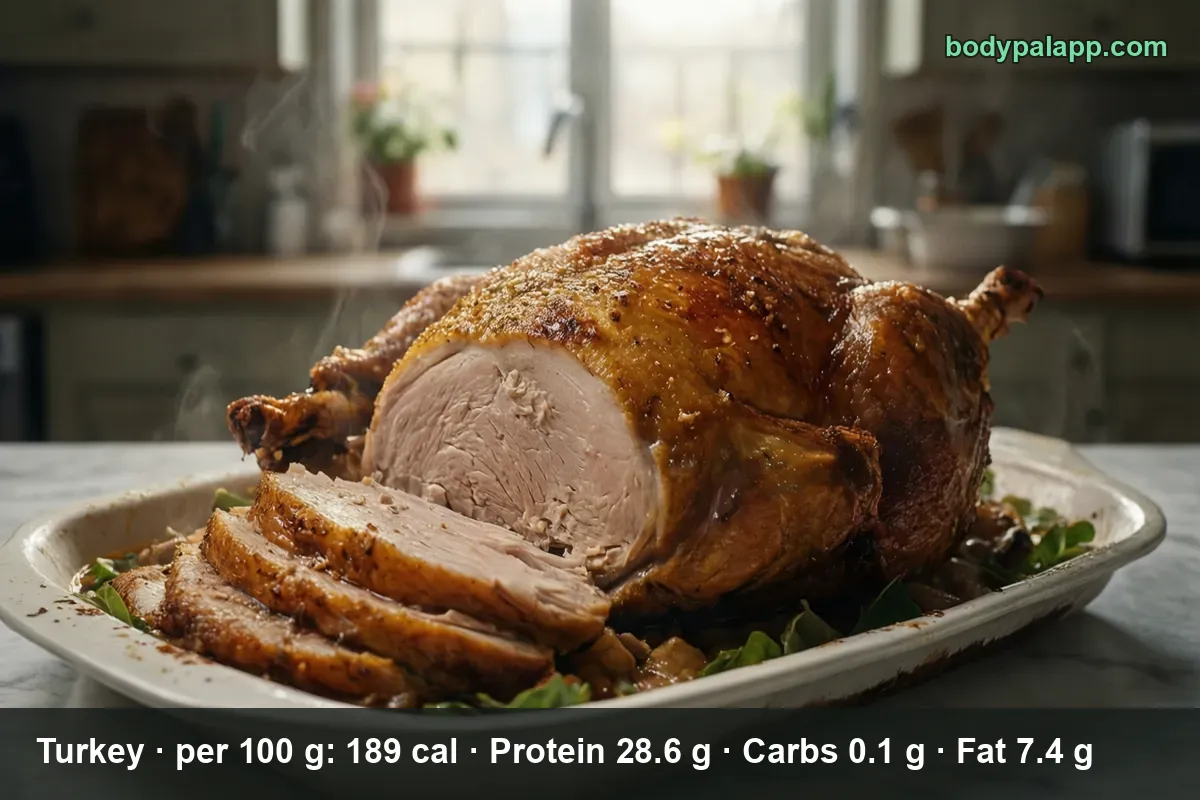
A 3 oz serving of roast turkey with the skin on, about four carved slices, is 161 calories. Per 100 g the bird runs 189 calories. Nearly all of that is protein and fat: 24.3 g of protein, 6.3 g of fat, and essentially no carbohydrate at all.
On this page
- Turkey quick facts
- US servings, from one ounce to the whole bird
- Breast, dark meat, ground and deli turkey
- Protein is the headline, sodium is the trap
- How does turkey compare?
- Most popular turkey brands
- FAQ
Turkey quick facts
The record behind this page is USDA SR Legacy 171479, "Turkey, whole, meat and skin, cooked, roasted". That is the whole bird as it comes out of the oven, skin included, breast and thigh together. It is the version most people are actually holding when they search: a plate carved off the roasting pan, not a package of ground turkey and not a stack of deli slices.
The standard American portion is 3 oz, which USDA counts as 85 g. That is roughly four thin slices off the breast, or one thigh's worth of pulled meat.
| Nutrient | Per 100 g | Per 3 oz (85 g) | % Daily Value |
|---|---|---|---|
| Calories | 189 | 161 | — |
| Total fat | 7.39 g | 6.3 g | 8% |
| Saturated fat | 2.15 g | 1.8 g | 9% |
| Carbohydrate | 0.06 g | 0.1 g | 0% |
| Dietary fiber | 0 g | 0 g | 0% |
| Total sugars | 0 g | 0 g | — |
| Protein | 28.55 g | 24.3 g | 49% |
| Sodium | 103 mg | 88 mg | 4% |
| Cholesterol | 109 mg | 93 mg | 31% |
| Potassium | 239 mg | 203 mg | 4% |
% Daily Value is based on a 2,000-calorie diet.
Verified nutrition data
Numbers on this page come from USDA FoodData Central, the U.S. Department of Agriculture’s food composition database, and from manufacturer labels where a branded product is named. Last verified September 2026. How we verify our data →
Two rows you would see on a supermarket label are missing here on purpose. USDA does not publish added sugars or trans fat for this SR Legacy record, and plain roasted turkey has nothing added to it anyway, so there is nothing to report rather than a zero we invented. Total sugars have no Daily Value on the US label, which is why that cell is blank.
Cholesterol is the row that surprises people: 93 mg in a single 3 oz serving, 31% of the 300 mg Daily Value the FDA sets for the Nutrition Facts label. Potassium comes in at 203 mg, a modest 4%.
US servings, from one ounce to the whole bird
| Serving | Weight | Calories |
|---|---|---|
| 1 oz, one slice | 28 g | 53 kcal |
| 3 oz sliced, the standard portion | 85 g | 161 kcal |
| 4 oz | 113 g | 214 kcal |
| 6 oz, a hungry holiday plate | 170 g | 321 kcal |
| Per 100 g | 100 g | 189 kcal |
| One whole roasted bird | 3812 g | 7205 kcal |
The 3 oz line and the whole-bird line come straight from USDA. The 1 oz, 4 oz and 6 oz rows are our own arithmetic from the USDA 100 g figure, not USDA servings, because those are the amounts that actually land on a plate at a carving station.
One trap worth naming before Thanksgiving: raw weight is not cooked weight. Turkey loses roughly a quarter of its mass to water in the oven, so 4 oz of raw meat lands close to 3 oz cooked. All the numbers on this page are cooked weights. If you weigh a raw breast before it goes in the pan, log it as raw or you will overcount by about a third.
The whole-bird figure is worth keeping in view for a different reason. At 7,205 calories for 3,812 g of meat and skin, one roasted turkey is around 45 servings of 3 oz. A single bird feeds a table twice over; the calories that get people are the gravy and the second plate, not the meat.
Breast, dark meat, ground and deli turkey
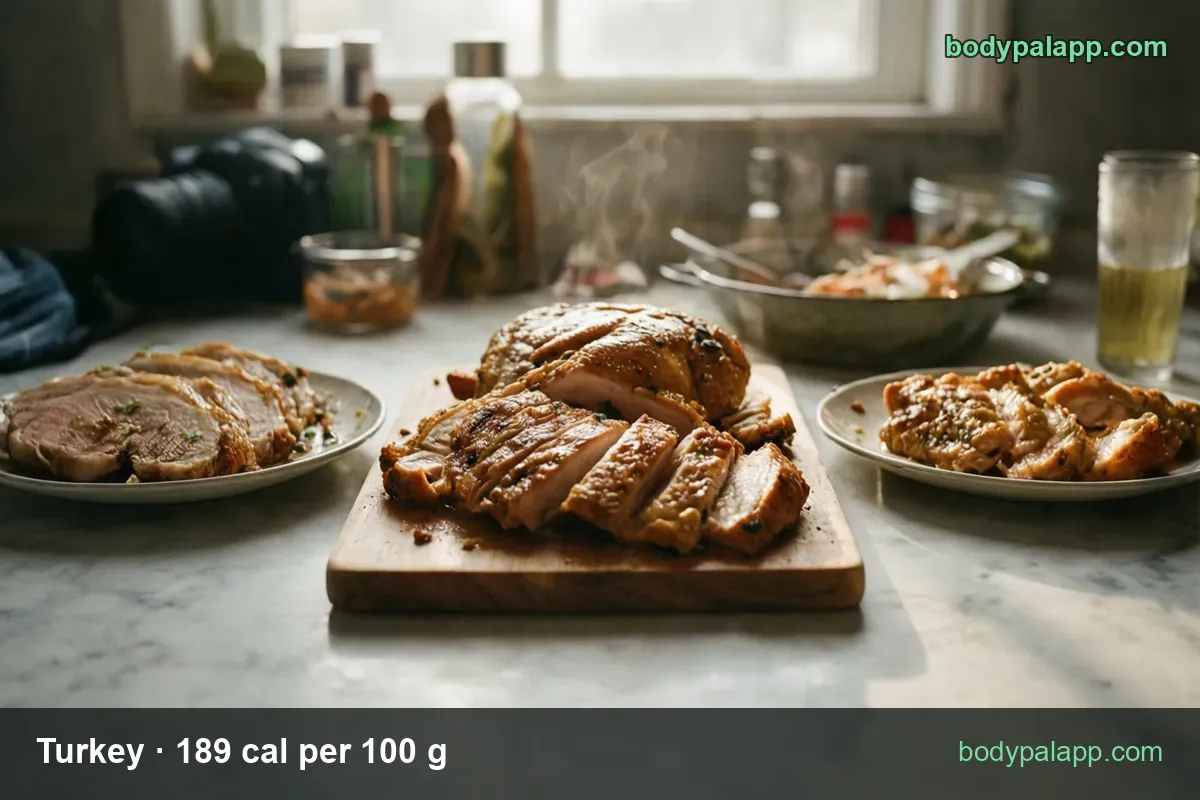
Turkey is not one number. Which part you take, and whether you eat the skin, moves the count more than anything a recipe does to it.
| Version | Per 100 g | Typical serving | Calories |
|---|---|---|---|
| Whole turkey, meat and skin | 189 kcal | 3 oz (85 g) | 161 kcal |
| Breast, meat and skin | 189 kcal | 3 oz (85 g) | 161 kcal |
| Meat only, skin removed | 159 kcal | 3 oz (85 g) | 135 kcal |
| Breast, no skin | 147 kcal | 3 oz (85 g) | 125 kcal |
| Dark meat with skin | 206 kcal | 3 oz (85 g) | 175 kcal |
| Ground turkey, cooked | 203 kcal | 3 oz (85 g) | 173 kcal |
| Breaded turkey, baked or fried | 173 kcal | 3 oz (85 g) | 147 kcal |
| Deli turkey slices | 106 kcal | 2 oz (56 g) | 59 kcal |
| Turkey bacon, cooked | 368 kcal | 1 slice (14 g) | 52 kcal |
The skin costs 30 calories per 100 g. Whole turkey with skin is 189, meat only is 159. Over a 3 oz serving that is 161 against 135, a 26-calorie difference for something most people eat without thinking about it. Two servings and you have paid for a slice of bread.
Breast with skin and the whole bird land on the same number. Both read 189 calories per 100 g, which looks like a copy-and-paste error and is not: the skin on the breast is fatty enough to close the gap that leaner white meat opens. Strip the skin and they separate immediately, 147 for breast against 159 for mixed meat.
Dark meat is the quiet upgrade. Thigh and drumstick with skin run 206 calories per 100 g, or 175 per 3 oz. That is 14 calories over breast with skin and 50 over skinless breast, for meat that tastes considerably better. If somebody is choosing between white and dark at the table, the calorie argument is thinner than the reputation suggests.
Ground turkey is not automatically lean. Cooked ground turkey is 203 calories per 100 g and 10.4 g of fat, close to dark meat and well above breast. It gets its healthy reputation from standing next to ground beef, not from being low in fat. The package ratio matters; read it.
Breaded turkey, baked or fried with the skin left uneaten, comes in at 173 calories per 100 g and is the only version here with meaningful carbohydrate, 6.46 g per 100 g from the coating. The 3 oz calorie figures for dark meat, ground turkey and breaded turkey, along with the 2 oz deli and single-slice bacon figures, are our own arithmetic from the USDA 100 g values rather than published USDA servings.
Turkey bacon is a separate animal in practice. At 368 calories per 100 g it is the most calorie-dense turkey product on this page by a wide margin, though the slices are small enough that one strip is only 52 calories. Retail slices vary: Butterball's original and lower-sodium strips are 179 calories per 100 g on a 14 g slice, about 25 per strip, while Oscar Mayer's runs 222 per 100 g. Oscar Mayer's oven-roasted turkey breast, the deli tub, is 89 calories per 100 g, or 50 for the 2 oz label serving.
Protein is the headline, sodium is the trap
A 3 oz serving delivers 24.3 g of protein, 49% of the 50 g Daily Value, for 161 calories. That works out to roughly 15 g of protein per 100 calories, which is why turkey sits in the Protein Foods group on MyPlate alongside chicken, fish and beans. Skinless breast is denser still, 30.13 g per 100 g, the highest protein figure of any whole-bird cut on this page.
For anyone counting calories, that ratio is the useful part. A 3 oz portion of turkey plus a large salad is a lunch under 300 calories that still hits nearly half a day's protein target on the label. The Dietary Guidelines for Americans put lean poultry in the same recommended slot as seafood and legumes for exactly this reason.
Sodium is where home cooking and the deli case part ways. Roasted turkey off the bird is 103 mg per 100 g, so a 3 oz serving is 88 mg, 4% of the 2,300 mg Daily Value. Prepackaged deli turkey is 810 mg per 100 g, nearly eight times as much. Two ounces of deli slices, one sandwich's worth, carries 454 mg, about 20% of the day's sodium in a portion of only 59 calories. That is roughly a fifth of a teaspoon of table salt. If sodium is the number you are watching rather than calories, carving your own bird on Sunday and slicing it for the week is the better move.
Saturated fat stays modest throughout: 1.8 g in a 3 oz serving with skin, 9% of the Daily Value. Even dark meat with skin, the fattiest whole-bird cut here, is 2.93 g per 100 g.
How does turkey compare?
| Meat | Per 100 g | US serving | Calories |
|---|---|---|---|
| Turkey, whole, meat and skin | 189 kcal | 3 oz (85 g) | 161 kcal |
| Turkey wing, meat only | 170 kcal | 3 oz (85 g) | 145 kcal |
| Chicken drumstick, meat only, stewed | 169 kcal | 3 oz (85 g) | 144 kcal |
| Chicken, roasting, meat only, roasted | 167 kcal | 3 oz (85 g) | 142 kcal |
Our take: the comparison is closer than the "turkey is the lean one" story implies, and the skin is doing most of the work. Roast turkey with skin is the highest of these four per 100 g, at 189 against 167 for skinless roasted chicken. Take the skin off the turkey and it falls to 159, below every row in the table. Turkey's real edge is protein, not calories: 28.55 g per 100 g with skin and 30.17 g for wing meat, against 25.01 g for chicken. For weight loss, skinless turkey breast at 125 calories per 3 oz is the sharpest pick on this page. For a meal that keeps you full through the afternoon, dark meat at 175 buys 14 extra calories' worth of flavor and is worth it.
Most popular turkey brands in the United States
Ranked by how widely each product appears among foods sold in the United States, from the BodyPal food database of over 3.3 million products. Calories are the figures printed on each Nutrition Facts label, checked against USDA FoodData Central.
| Product | Calories (per 100 g) |
|---|---|
| Butterball Original Turkey Bacon | 179 cal |
| Butterball Lower Sodium Turkey Bacon | 179 cal |
| Butterball Uncured Turkey Bacon | 161 cal |
| Oscar Mayer Turkey Bacon | 222 cal |
| Oscar Mayer Oven Roasted Turkey Breast | 89 cal |
| Oscar Mayer Carving Board Oven Roasted Turkey Breast | 107 cal |
Brand popularity: BodyPal food database. Nutrition: manufacturer labels / USDA FoodData Central.
Turkey FAQs
How many calories are in 3 oz of turkey?
161 calories for 3 oz (85 g) of whole roast turkey with the skin on, the USDA figure that matches about four carved slices off the breast. Take the skin off and the same 3 oz drops to 135 calories. That portion also brings 24.3 g of protein.
How many calories in turkey breast without skin?
125 calories in 3 oz (85 g) of roast turkey breast with the skin removed, or 147 per 100 g. That is the leanest cut on the bird and the lowest-calorie choice here apart from deli slices, and it still carries 25.6 g of protein per serving.
Does turkey skin add many calories?
About 30 calories per 100 g. Whole turkey with skin is 189 calories per 100 g against 159 for meat only, so a 3 oz serving moves from 135 to 161. Fat is what changes: 7.39 g with the skin, 3.84 g without, per 100 g.
How much protein is in a serving of turkey?
24.3 g of protein in a 3 oz (85 g) serving with the skin on, which is 49% of the FDA Daily Value of 50 g. Skinless breast is denser still at 30.13 g per 100 g. Two servings in a day cover almost the whole label target.
Is turkey healthier than chicken?
On calories they are close: 189 per 100 g for roast turkey with skin against 167 for roasted chicken meat only, and turkey meat only is 159. Skinless turkey breast is the leanest of the white meats at 147 per 100 g, but over 3 oz the gap is only 17 calories.
How many calories in deli turkey slices?
59 calories in 2 oz (56 g) of prepackaged deli turkey, or 106 per 100 g, lighter than roast turkey off the bird. Sodium is the catch: 810 mg per 100 g, so those 2 oz carry 454 mg, roughly 20% of the 2,300 mg Daily Value.
How many calories in dark meat turkey?
175 calories in 3 oz (85 g) of dark meat with the skin, at 206 calories per 100 g. That is 14 calories more than the same 3 oz of breast with skin at 161, and 50 more than skinless breast. Dark meat carries 9.95 g of fat per 100 g.
How many calories in a whole roast turkey?
7,205 calories for a whole roasted bird of 3,812 g, meat and skin, which is the USDA reference weight for one turkey. Carved onto plates that is roughly 45 servings of 3 oz. Nobody eats a bird alone, but it is the number behind the platter.
Similar foods
- Ground Chicken — 214 cal per 4 oz cooked
- Chicken Drumstick — 114 cal per medium drumstick
- Beef Cubes — 252 cal per cup
- Beef Cube Steak — 299 cal per steak
- Cube Steak — 449 cal per thick steak
- Chicken Thigh Without Skin — 134 cal per medium thigh
Count it without the math
Point the camera at the plate and BodyPal counts the turkey for you, skin and all.


How long does it take to burn off turkey?
A 3 oz (85 g) serving is 161 kcal. Enter your weight and the amount you ate to see how long it takes you to burn that off:
lb
| Activity | Time to burn 161 kcal |
|---|---|
| Walking, brisk | 32 min |
| Cycling, moderate | 20 min |
| Swimming, moderate | 23 min |
| Jogging | 19 min |
| Weight training, moderate | 36 min |
Times are for a 155 lb adult at a steady pace; change the weight to see yours. The amount is set to the portion in the text (85 g); change it to what you actually ate. BodyPal works this out from your steps automatically.
Want the bigger picture? Calculate your daily calorie needs — your maintenance figure, a target for losing or gaining, and the date you get there.