English muffin calories come to 129 for one 57 g muffin and 227 per 100 g. Carbs supply 78% of those calories and fat only 7%, so the muffin itself is a lean bread. Your toppings decide the final total. Sodium, at 242 mg per muffin, is the number worth a second look.
129kcal
1 muffin · 57 g, plain, enriched
16%protein
5.1 gProtein
25 gCarbs
1 gFat
How to burn off 129 kcal
—Walking, brisk
—Jogging
—Cycling, moderate
—Swimming
Skip the math. BodyPal counts these calories from your steps and workouts automatically.
Nutrition facts
Plain, enriched · per 57 g
Calories
129 kcal
Protein
5.1 g
Carbohydrate
25 g
Fat
1 g
Saturated fat
0.4 g
Cholesterol
0 mg
Sodium
242 mg
Potassium
62 mg
Iron
2.3 mg
Source: USDA FoodData Central
🛡️
Verified nutrition data
Numbers on this page come from USDA FoodData Central, the U.S. Department of Agriculture’s food composition database, and from manufacturer labels where a branded product is named. Last verified September 2026. How we verify our data →
English muffin: calories, protein and sodium by serving
Percent of daily value uses the FDA reference of 2,000 kcal a day.
Serving
kcal
Protein
Carbs
Fat
Sodium
% DV kcal
1 muffin (57 g)
129
5.1 g
25.2 g
1 g
242 mg
6%
Whole wheat (66 g)
134
5.8 g
26.7 g
1.4 g
240 mg
7%
Cinnamon raisin (57 g)
137
4.5 g
27.4 g
1 g
170 mg
7%
100 g
227
8.9 g
44.2 g
1.7 g
425 mg
11%
3 × 1 muffin (57 g)
388
15.2 g
727 mg
5 × 1 muffin (57 g)
647
25.3 g
1,211 mg
Two muffins make a 259-calorie breakfast
One plain muffin weighs 57 g and carries 129 calories, about 6% of the daily value for energy. That is a modest base. The catch is that English muffins are easy to stack: a breakfast sandwich uses both halves of one, and many people toast two without thinking about it.
Two muffins come to 259 calories, 485 mg of sodium and 10.1 g of protein. Three reach 388 calories and 727 mg of sodium. If you keep a pack on the counter and work through five over a day or two of snacking, that is 647 calories and 1,211 mg of sodium from bread alone, before butter, jam, egg or cheese.
The practical move is to count the muffin as a fixed unit and spend your attention on what goes inside. A muffin is a predictable 129 calories. A pat of butter, a slice of cheese or a spoon of jam is where the total swings, and those additions are not part of the numbers on this page.
Carbs are 78% of every muffin
Per 100 g, an English muffin holds 44.2 g of carbohydrate, 8.9 g of protein and just 1.7 g of fat. Translated into calories, carbs supply 78%, protein 16% and fat 7%. This is a starch food first, with a respectable protein side.
That protein deserves credit. One muffin gives 5.1 g, which is 10% of the daily value, more than many people expect from a piece of bread. Saturated fat is low at 0.7 g per 100 g, and cholesterol sits at 0, since the plain enriched dough has no egg or butter worked into it.
Fiber and sugar are both small. A plain muffin carries 2 g of each, so it is neither a sweet item nor a high-fiber one. If you want the muffin to keep you full longer, the protein and fat you add on top will do more work than the bread itself. An egg or a slice of lean meat turns a carb-heavy base into a more balanced plate.
Sodium is the row to watch
A single muffin brings 242 mg of sodium, 11% of the 2300 mg daily value. Per 100 g that rises to 425 mg, or 18%. For a food that tastes plain and barely salty, that is a meaningful share, and it is the line on the label most people skip.
The issue is less one muffin than what usually comes with it. Breakfast sandwiches pair the bread with cheese, bacon or ham, all salty foods. Two muffins already account for 485 mg before any filling goes in. If you watch sodium, treat the muffin as the first salty item of the meal, not a neutral one.
Variety helps here. The cinnamon raisin version drops to 170 mg per muffin, 7% of the daily value, and whole wheat sits at 240 mg. Neither is a low-sodium food, but the sweeter option trades salt for sugar, which matters depending on which row you are tracking.
A whole wheat muffin is heavier at 66 g and comes to 134 calories, only a little more than plain. What you gain is fiber: 4.4 g against 2 g, more than double. Protein edges up to 5.8 g, or 12% of the daily value. Sugar also climbs to 5.3 g, so it is not a strictly better swap on every row.
Cinnamon raisin is the sweet one. At 57 g it carries 137 calories and 8.4 g of sugar, roughly four times the plain version. Fiber falls to 1.5 g and protein to 4.5 g. It works as a treat with a thin spread, less well as the base for an egg sandwich.
Brands such as Thomas' English Muffins sell plain, multigrain, corn and cinnamon raisin lines, and labels vary between them, so check the package for the exact figures. If you would rather skip reading labels, BodyPal can log an English muffin from a photo of your plate.
How does English muffin compare?
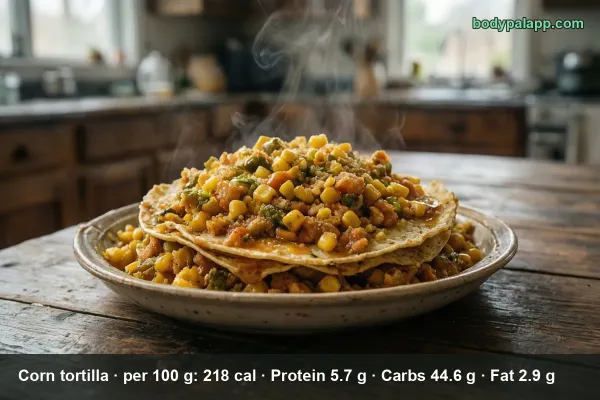
Here is how a plain English muffin stacks up against a burger bun, a biscuit and a corn tortilla, per 100 g and per usual serving.
Verdict: For the leanest bread base pick the English muffin: 129 calories per muffin against 165 for a biscuit, which carries 11.2 g of fat per 100 g versus 1.7. If sodium is your main concern, the corn tortilla wins easily at 45 mg per 100 g compared with 425 for the muffin and 1,002 for the biscuit.
Most popular English muffin brands in the United States
Ranked by popularity in the BodyPal database
# Productkcal / 100 g
1Thomas' Cinnamon Raisin English Muffins1 muffin · 61 g246 kcal
3Thomas' The Original Light Multi Grain English Muffins1 muffin · 57 g175 kcal
4Thomas' English Muffins1 muffin · 57 g175 kcal
5Thomas' Corn English Muffins1 muffin · 61 g246 kcal
Light and multi grain versions are made lighter than the plain muffin above, so their per 100 g numbers read lower. Source: manufacturer labels / USDA FoodData Central.
English muffin FAQs
How many calories are in one English muffin?
A plain English muffin weighs about 57 g and has 129 calories. Per 100 g that is 227 calories.
Are English muffins good for weight loss?
One plain 57 g muffin is 129 calories with 5.1 g protein and 2.0 g fiber. A light multi grain muffin from Thomas' is 175 calories per 100 g, about 100 calories for a 57 g muffin.
English muffin or corn tortilla: which has fewer calories?
Per 100 g they are close: 227 calories for an English muffin and 218 for a corn tortilla. One whole 57 g muffin comes to 129 calories.
How much protein is in an English muffin?
About 5.1 g per 57 g muffin, or 8.9 g per 100 g. The same muffin has 25.2 g carbs and 1.0 g fat.
How many calories are in a whole wheat English muffin?
A whole wheat English muffin of 66 g has 134 calories. It also brings 4.4 g of fiber and 5.8 g of protein, so for only a few extra calories you get more than double the fiber of plain.
How many calories are in two English muffins?
Two plain English muffins total 259 calories, with 10.1 g of protein and 485 mg of sodium. That is the bread for a typical double breakfast sandwich, before any butter, egg or cheese.
How much sodium is in an English muffin?
One plain English muffin contains 242 mg of sodium, which is 11% of the daily value. Per 100 g the figure is 425 mg. The cinnamon raisin version is lower at 170 mg per muffin.
How many calories are in a cinnamon raisin English muffin?
A cinnamon raisin English muffin of 57 g has 137 calories, close to plain. The bigger difference is sugar: 8.4 g per muffin compared with 2 g in the plain version.
Is there fiber in an English muffin?
A plain English muffin has 2 g of fiber, a small amount. Whole wheat raises that to 4.4 g per muffin, while cinnamon raisin drops to 1.5 g.