Espresso shot calories come to 3 for a single 30 g shot and 9 per 100 g, with a 60 g double at just 5. Those figures cover plain brewed espresso with nothing added. The thing to notice is how little the shot count matters: milk, cream and sugar move the total far more than another pull ever will.
3kcal
1 single shot · 30 g, brewed, unsweetened
5%protein
0 gProtein
1 gCarbs
0.1 gFat
How to burn off 3 kcal
—Walking, brisk
—Jogging
—Cycling, moderate
—Swimming
Skip the math. BodyPal counts these calories from your steps and workouts automatically.
Nutrition facts
Brewed, unsweetened · per 30 g
Calories
3 kcal
Protein
0 g
Carbohydrate
0.5 g
Fat
0.1 g
Saturated fat
0 g
Cholesterol
0 mg
Sodium
4 mg
Potassium
35 mg
Iron
0 mg
Source: USDA FoodData Central
🛡️
Verified nutrition data
Numbers on this page come from USDA FoodData Central, the U.S. Department of Agriculture’s food composition database, and from manufacturer labels where a branded product is named. Last verified September 2026. How we verify our data →
Espresso shot: calories, protein and sodium by serving
Percent of daily value uses the FDA reference of 2,000 kcal a day.
Serving
kcal
Protein
Carbs
Fat
Sodium
% DV kcal
Single shot (30 g)
3
0 g
0.5 g
0.1 g
4 mg
0%
Double shot (60 g)
5
0.1 g
1 g
0.1 g
8 mg
0%
100 g
9
0.1 g
1.7 g
0.2 g
14 mg
0%
3 × Single shot (30 g)
8
0.1 g
13 mg
5 × Single shot (30 g)
14
0.2 g
21 mg
A double shot is still a 5-calorie drink
A single shot weighs 30 g and holds 3 calories, 0.5 g of carbohydrate and 0.1 g of fat. A double shot doubles the liquid to 60 g but lands at only 5 calories, with 1 g of carbs and 8 mg of sodium. The math looks uneven because each figure is rounded, and at this scale rounding is most of the story.
On the % daily value scale, both sizes read 0 for calories, protein and sodium. Even a full 100 g of espresso, more than three singles, registers just 1% of the daily sodium value and 0% of daily calories. That is about as close to nothing as a drink with real flavor gets.
Stacking shots only moves the total in small steps. Three singles, or 90 g, come to 8 calories. Five singles, 150 g in all, reach 14 calories and 21 mg of sodium. If you drink espresso several times a day, logging it takes seconds and barely dents your budget.
Carbs make up most of a tiny total
Per 100 g, brewed espresso carries 1.7 g of carbohydrate, 0.2 g of fat and 0.1 g of protein. Split by calories, carbs account for 76%, fat for 18% and protein for 5%. Those shares look lopsided, but they are shares of only 9 calories.
None of that carbohydrate is listed as sugar. The sugars row reads 0 for a single shot, a double shot and 100 g alike, and fiber is 0 too. If you avoid added sugar, a straight shot fits without any adjustment; the moment a sugar packet or a pump of syrup goes in, that changes.
Fat is just as minor, with 0.1 g of saturated fat and 0 cholesterol per 100 g. Protein rounds to 0 g in a single shot and 0.1 g in a double, so espresso is not a protein source and not a stand-in for food. Think of it as flavor with almost no nutritional weight.
Sodium stays under the radar
A single shot carries 4 mg of sodium and a double 8 mg. Per 100 g the figure is 14 mg, which works out to 1% of the 2300 mg daily value. Even five singles, at 21 mg, stay small next to that benchmark. For anyone counting milligrams, espresso is a rounding error on the day's total.
Potassium is the larger mineral here at 115 mg per 100 g, against a daily value of 4700 mg. It is a modest amount, not a reason to drink espresso, but it shows the cup is not entirely empty.
These values come from the USDA entry for restaurant-prepared brewed espresso, unsweetened. A shot pulled at home or at a different café, with its own grind, dose and extraction, may vary slightly, though not enough to change the calorie picture. If you watch sodium, plain espresso is one of the easiest rows in your day.
What you add decides the real total
Every number on this page describes plain espresso. Once milk, cream, sugar or flavored syrup join the cup, the drink becomes a different entry, and the shot itself turns into the smallest part of it. A latte or a sweetened iced drink should be logged by its ingredients, not as espresso.
That makes espresso a handy base if you are trimming calories from a coffee habit. Ordering the shot straight, or adding a splash rather than a pour, keeps the drink close to its 3 or 5 calories. The food next to the cup is where a coffee break tends to add up, so a pastry or a sandwich deserves more attention than the espresso.
If you log meals, BodyPal can log an espresso from a photo, along with whatever you ate beside it. For a straight shot, a quick entry is enough: it is too small to skew a day either way.
How does espresso shot compare?
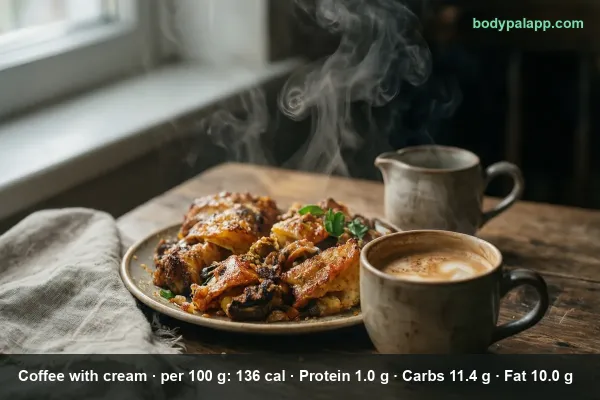
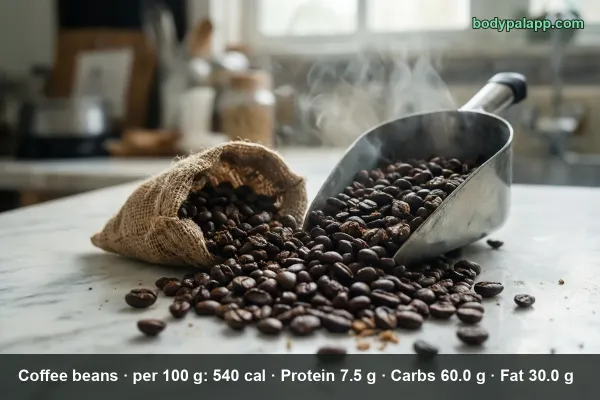
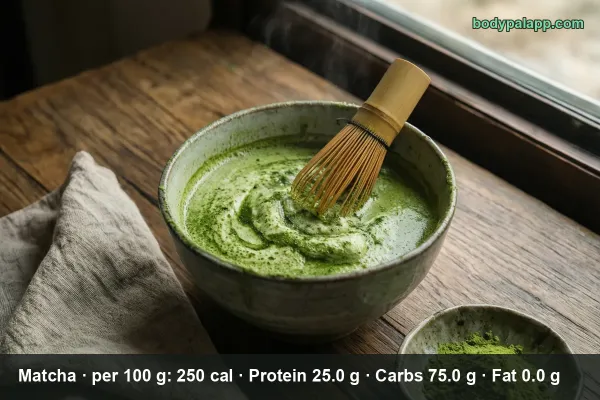
Here is how espresso stacks up against coffee with cream, whole coffee beans and matcha, per 100 g and per usual serving.
Verdict: If you want the lightest coffee drink, espresso wins easily at 9 calories per 100 g against 136 for coffee with cream, which is 15.1 times as much. Matcha at 250 and coffee beans at 540 per 100 g are dense dry foods, so judge them by the small amount you actually use, not by the 100 g row.
Espresso shot FAQs
How many calories are in one espresso shot?
A single 30 g shot of brewed espresso has 3 calories. A double shot of 60 g has 5 calories.
Is espresso good for weight loss?
Plain espresso is 9 calories per 100 g, so a single shot adds 3 calories to the day. Milk, syrup and sugar are what move the number up.
Espresso shot vs coffee with cream: which is lighter?
Espresso is 9 calories per 100 g against 136 for coffee with cream, so a 30 g shot stays at 3 calories.
How many carbs are in an espresso shot?
Espresso has 1.67 g carbs per 100 g, which is 0.5 g in a 30 g shot, with 0 g sugar.
How many calories are in a double shot of espresso?
A double shot of espresso, 60 g, has 5 calories. It also carries 1 g of carbohydrate, 0.1 g of fat, 0.1 g of protein and 8 mg of sodium, with 0 g of sugar, so it is still a near-zero drink.
Are two single shots of espresso the same as a double?
Yes, by the numbers. Two singles of 30 g each make 60 g and 5 calories, exactly what a double shot lists. The total is not simply twice the single figure because each value is rounded on its own.
What are the nutrition facts for a single espresso shot?
A single 30 g shot has 3 calories, 0.5 g of carbohydrate, 0.1 g of fat, 0 g of protein, 0 g of sugar and 4 mg of sodium. Calories, protein and sodium each read 0% of the daily value.
How many kcal does espresso have per 100 g?
Espresso has 9 kcal per 100 g, with 1.7 g of carbohydrate, 0.2 g of fat, 0.1 g of protein and 14 mg of sodium. That is 1% of the daily sodium value and 0% of daily calories.
Is an "expresso" shot different from espresso?
No. "Expresso" is a common misspelling, and the drink is the same: 3 calories for a single 30 g shot and 5 for a 60 g double. These figures cover plain, unsweetened espresso.