
How many calories are in matcha?
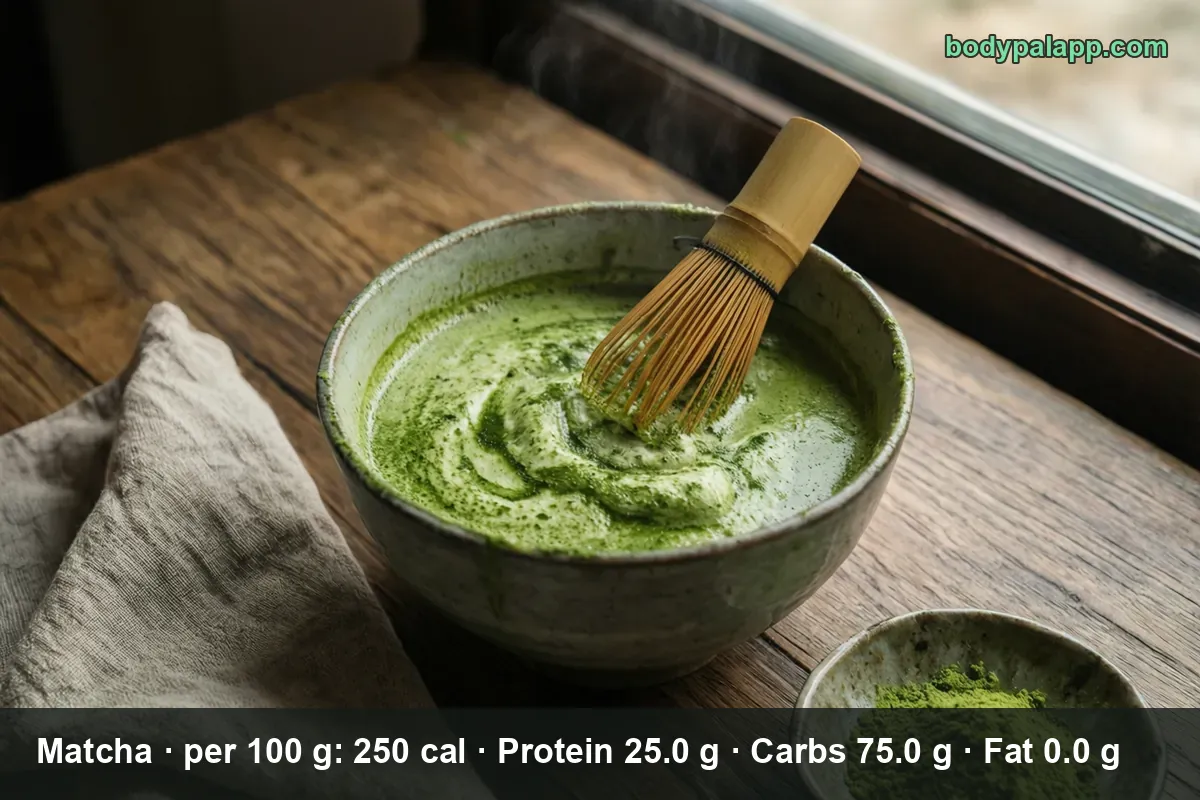
One single-serve matcha stick weighs 4 g and carries 10 calories. The powder itself runs 250 calories per 100 g, but nobody drinks 100 g of it. A level teaspoon is about 2 g. Whisk that into hot water and the cup in your hand is 5 calories. The sweetened latte versions are a different food entirely.
On this page
- Matcha quick facts
- US servings from a teaspoon to a full cup
- Matcha powder vs latte mixes vs bottled matcha
- Protein and carbs in a powder you drink whole
- How does matcha compare?
- Most popular matcha brands
- FAQ
Matcha quick facts
Matcha is a stubborn food to look up, because USDA has no matcha entry in Foundation Foods, SR Legacy or FNDDS. Every matcha record in FoodData Central sits in the Branded database, and most of them are latte mixes, bars or bottled drinks with sugar and milk powder already in them. The row used here is Branded 2210244, "Matcha To Go Sticks, Matcha" (Aiya, GTIN 846670000885), the one entry that is plain ground green tea leaf and nothing else. That is what somebody scooping powder into a cup is actually holding.
| Nutrient | Per 100 g | Per 1 stick (4 g) | % Daily Value |
|---|---|---|---|
| Calories | 250 | 10 | — |
| Total fat | 0 g | 0 g | 0% |
| Carbohydrate | 75 g | 3.0 g | 1% |
| Protein | 25 g | 1.0 g | 2% |
| Sodium | 0 mg | 0 mg | 0% |
% Daily Value is based on a 2,000-calorie diet.
Verified nutrition data
Numbers on this page come from USDA FoodData Central, the U.S. Department of Agriculture’s food composition database, and from manufacturer labels where a branded product is named. Last verified September 2026. How we verify our data →
Four rows that usually appear on this page are missing: saturated fat, dietary fiber, total sugars and added sugars. A Nutrition Facts panel built on a 4 g serving declares them all as zero or omits them, so USDA has no value to publish and the rows are dropped rather than filled with a guess.
One honest wrinkle. Multiply the declared grams by 4 calories each and 100 g of this powder would come out near 400 calories, not 250. Branded records are label data as the manufacturer printed it, rounded on a serving small enough that the rounding swamps the arithmetic. The calorie figure is the one to trust here, and it is the one used throughout this page.
US servings from a teaspoon to a full cup
| Serving | Weight | Calories |
|---|---|---|
| 1 tsp | 2 g | 5 kcal |
| 1 stick | 4 g | 10 kcal |
| 1 tbsp | 6 g | 15 kcal |
| 1 cup prepared, 2 g whisked into water | 247 g | 5 kcal |
| 1 oz | 28 g | 71 kcal |
| Per 100 g | 100 g | 250 kcal |
Only the 4 g stick is a USDA serving. The teaspoon, the tablespoon, the ounce and the prepared cup are our own arithmetic from the USDA 100 g figure of 250 calories, not USDA servings. The prepared cup is the interesting line: the water adds 245 g of weight and no calories at all, so a full 8 oz cup of whisked matcha weighs 247 g and costs 5 calories.
The ounce row is there for scale rather than for logging. Nobody drinks an ounce of matcha; 28 g is roughly two weeks of daily cups, and it would be a bitter, undrinkable amount in one sitting.
Matcha powder vs latte mixes vs bottled matcha
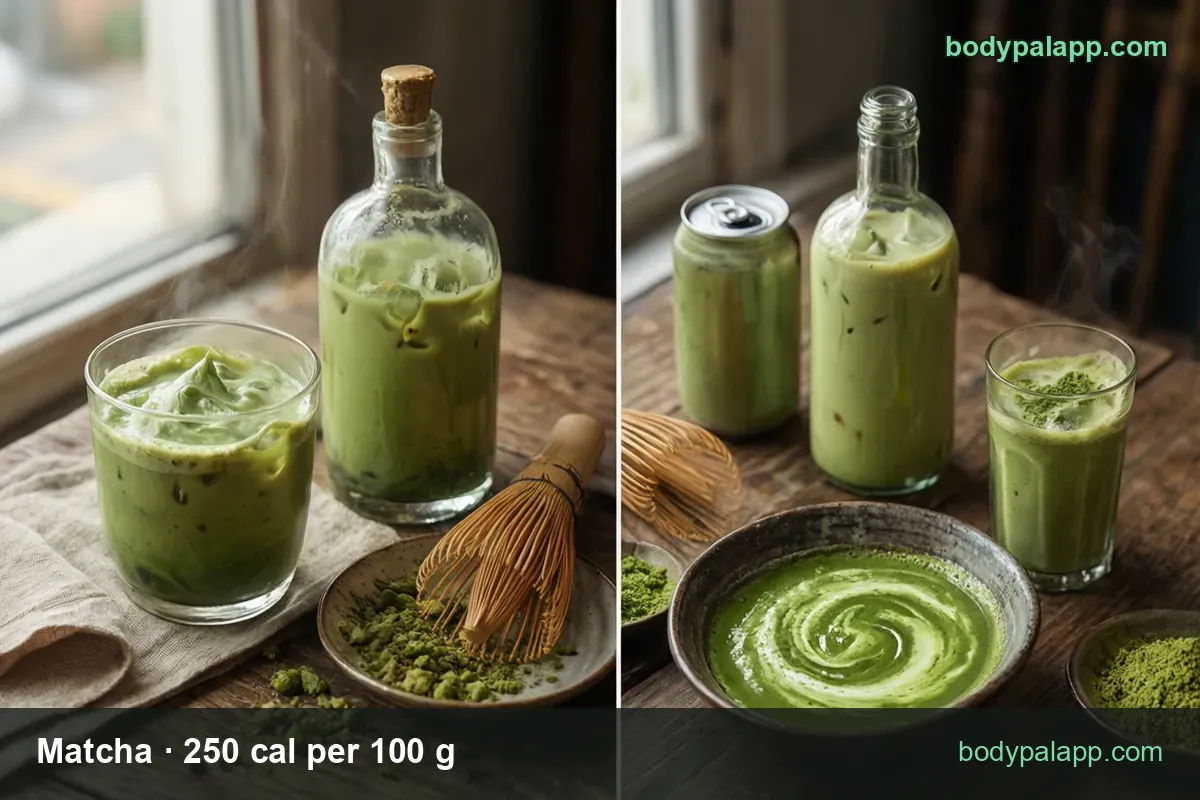
The word "latte" is what moves this number, not the tea. Plain powder and latte mixes are sold on the same shelf in the same size pouches, and they are between 2 and 30 times apart per serving.
| Version | Per 100 g | Typical serving | Calories |
|---|---|---|---|
| Matcha powder, plain | 250 kcal | 1 tsp (2 g) | 5 kcal |
| Matcha latte mix, packet | 352 kcal | 1 packet (7.1 g) | 25 kcal |
| Instant matcha latte mix | 536 kcal | 1/4 cup (28 g) | 150 kcal |
| Sugar-free matcha latte mix | 77 kcal | 1 tbsp (13 g) | 10 kcal |
| Ready-to-drink matcha | 48 kcal | 12 fl oz (355 mL) | 170 kcal |
| Brewed green tea | 1 kcal | 1 cup (245 g) | 2 kcal |
A quarter cup of instant latte mix at 150 calories is the same as fifteen plain matcha sticks. The heaviest mixes get there with coconut milk powder and coconut oil rather than sugar, which is why one of them reaches 536 calories per 100 g while a monk-fruit sweetened mix sits at 77. Matcha also turns up in solid food: a 45 g matcha chai bar is 180 calories, closer to a granola bar than to a drink.
Bottled matcha is the trap for anyone reading per-100 g numbers. At 48 calories per 100 g it is the lightest matcha in the table per gram, beaten only by brewed green tea at 1. But the bottle is 355 mL, so the drink you carry out of the store is 170 calories, the highest of any drink on this page.
Protein and carbs in a powder you drink whole
Matcha's per-100 g profile reads like a supplement: 25 g of protein and 75 g of carbohydrate. Scaled to what you actually drink, it collapses. One stick delivers 1 g of protein, 2% of the FDA Daily Value of 50 g, and 3 g of carbohydrate, 1% of the 275 g DV. Matcha is not a protein source, whatever the 100 g column implies.
Sodium is where the versions separate. Plain matcha is 0 mg. A matcha latte mix with probiotics is 864 mg per 100 g, so an 11 g scoop is 95 mg, or 4% of the 2,300 mg DV, before you add anything else to the cup. One sugar-free mix runs 846 mg per 100 g for the same reason: potassium salts and mineral flavor carriers in the base, not the tea.
Matcha is also the rare drink where you swallow the plant. Brewed tea leaves its solids in the strainer, which is why USDA's brewed green tea record is 1 calorie per 100 g. The NIH Office of Dietary Supplements green tea fact sheet covers what that difference means for catechin and caffeine intake. On calories, the difference is small in absolute terms and total in relative ones. If you are watching added sugars against the 50 g daily limit in the Dietary Guidelines for Americans, the powder is the version that keeps you clear of them.
How does matcha compare?
| Drink | Per 100 g | US serving | Calories |
|---|---|---|---|
| Matcha powder | 250 kcal | 1 tsp (2 g) in a cup | 5 kcal |
| Brewed green tea | 1 kcal | 1 cup (245 g) | 2 kcal |
| Sweetened bottled green tea | 27 kcal | 1 cup (270 g) | 73 kcal |
| Matcha latte mix | 352 kcal | 1 packet (7.1 g) | 25 kcal |
Our take: for weight loss, plain matcha whisked into water is effectively free, and the 3-calorie gap over brewed green tea is not worth a decision. The comparison that matters is against the sweetened bottle at 73 calories a cup, or a latte packet at 25 plus whatever milk you pour in. If you want matcha to stay a 5-calorie habit, buy the powder and not the mix; if you want the creamy version, log the milk separately and treat the matcha itself as a rounding error. For satiety, none of these do anything, and no tea is going to keep you full.
Most popular matcha brands in the United States
Ranked by how widely each product appears among foods sold in the United States, from the BodyPal food database of over 3.3 million products. Calories are the figures printed on each Nutrition Facts label, checked against USDA FoodData Central.
| Product | Calories (per 100 g) |
|---|---|
| Jade Leaf Matcha Premium Matcha Latte Infusions | 352 cal |
| IQBar Matcha Chai Bar | 400 cal |
| Remedy Organics Matcha Oxidants Drink | 48 cal |
| Organic Traditions Matcha Latte with Probiotics | 455 cal |
| Aiya Matcha To Go Sticks | 250 cal |
| Laird Superfood Matcha Instant Latte | 536 cal |
Brand popularity: BodyPal food database. Nutrition: manufacturer labels / USDA FoodData Central.
Matcha FAQs
How many calories are in matcha?
10 calories for a 4 g stick of pure matcha powder, and 250 calories per 100 g. Most people use less than a stick: a level teaspoon is about 2 g, or 5 calories, so a cup whisked with water lands closer to 5 than 10.
How many calories in a matcha latte?
25 calories for a 7.1 g latte packet, 150 for a quarter cup (28 g) of instant latte mix, and 170 for a 12 fl oz bottled matcha drink. Coffee-shop lattes add milk and syrup on top of that, so the mix is only the starting point.
How many calories in a teaspoon of matcha powder?
5 calories for a level teaspoon, about 2 g of powder. That is our own arithmetic from the USDA 100 g figure of 250 calories, not a USDA serving. A heaping teaspoon closer to 3 g would be about 8. Either way it rounds to nothing in a day's total.
Is matcha zero calories?
No, but it is close: 10 calories per 4 g stick and 5 per level teaspoon. Matcha is not zero because you swallow the ground leaf instead of steeping and discarding it. It is close enough that plain matcha in water barely moves a daily total, unlike a 150-calorie instant latte mix.
Does matcha have carbs?
3 g of carbohydrate in a 4 g stick, which is 1% of the Daily Value, from 75 g per 100 g of powder. USDA does not publish a fiber or sugar breakdown for this record, so how much of that 3 g is fiber is not something the label answers.
Matcha vs green tea: which has more calories?
Matcha, at 10 calories per 4 g stick against 2 calories for a full 245 g cup of brewed green tea. Brewed tea leaves the leaf behind in the strainer at 1 calorie per 100 g, while matcha is the leaf itself, ground and swallowed at 250 per 100 g.
Does matcha powder have protein?
1 g of protein in a 4 g stick, 2% of the Daily Value, scaled from 25 g per 100 g of powder. That reads impressive in the 100 g column, but nobody drinks powder by the cup, so matcha is not a practical protein source. Latte mixes dilute it further.
How much matcha powder per cup?
2 g per cup is the usual measure, one level teaspoon whisked into about 8 oz of water, giving a 247 g cup at 5 calories. Some recipes go to a full 4 g stick and 10 calories. Doubling the powder doubles a number that already starts near zero.
Similar foods
- Pina Colada — 340 cal per drink
- Milkshake — 599 cal per small
- Coffee With Cream — 41 cal per fl oz
- Chocolate Malt — 350 cal per malt
- Chocolate Shake — 357 cal per shake
- Banana Milkshake — 540 cal per shake
Count it without the math
Point the camera at the cup and BodyPal counts it for you, mix and milk included.


One food is easy to picture; a whole day is harder. See how many calories you need a day and what a deficit actually looks like.