
How many calories are in coffee beans?
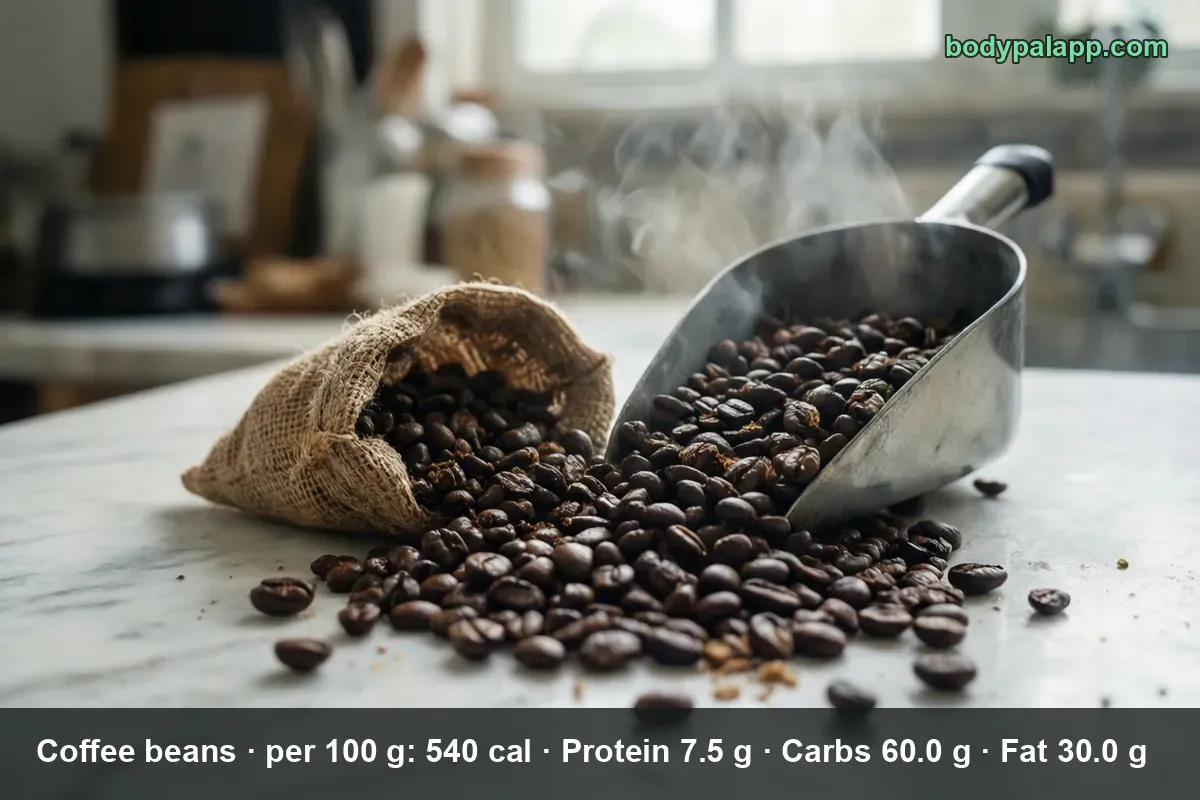
A 28-piece serving of chocolate covered coffee beans weighs 40 g and carries 216 calories, or 540 calories per 100 g. That number belongs to the chocolate, not the coffee: USDA has no record for plain roasted or green beans, and the beans people actually snack on come coated.
On this page
- Coffee bean quick facts
- US servings, from one bean to a quarter cup
- Dark chocolate, milk chocolate and one bare bean
- Saturated fat is the row to watch, not calories
- How do chocolate covered coffee beans compare?
- Most popular coffee beans brands
- FAQ
Coffee bean quick facts
The record used here is SR Legacy 169634, "Candies, dark chocolate coated coffee beans". It sits in the candy section of FoodData Central, and that is the honest place for it. Search the database for a coffee bean and you get two hits, both chocolate coated; there is no entry for a plain roasted bean, a green bean, or a bean you chew straight from the bag. So this page prices the thing sold in a jar by the register, which is also what most US labels say on the front: eight of the fifteen branded entries are titled some version of "dark chocolate coffee beans."
The household measure on the record is generous by snack standards — 28 pieces, 40 g, a level quarter cup.
| Nutrient | Per 100 g | Per 28 pieces (40 g) | % Daily Value |
|---|---|---|---|
| Calories | 540 | 216 | — |
| Total fat | 30 g | 12.0 g | 15% |
| Saturated fat | 15 g | 6.0 g | 30% |
| Carbohydrate | 59.95 g | 24.0 g | 9% |
| Dietary fiber | 7.5 g | 3.0 g | 11% |
| Total sugars | 42.5 g | 17.0 g | — |
| Protein | 7.5 g | 3.0 g | 6% |
| Sodium | 25 mg | 10 mg | 0% |
% Daily Value is based on a 2,000-calorie diet.
Verified nutrition data
Numbers on this page come from USDA FoodData Central, the U.S. Department of Agriculture’s food composition database, and from manufacturer labels where a branded product is named. Last verified September 2026. How we verify our data →
Two label rows are missing on purpose. USDA does not publish added sugars or trans fat for this SR Legacy record — the older SR editions never measured them — so guessing a split between natural and added sugar would be inventing data. Cholesterol runs 13 mg per 100 g, 5 mg in a serving, and potassium 342 mg per 100 g, 137 mg in a serving, about 3% of the Daily Value. Sodium is a non-issue at 10 mg a serving, well under half a percent of the FDA Daily Value of 2,300 mg.
US servings, from one bean to a quarter cup
| Serving | Weight | Calories |
|---|---|---|
| 1 piece | 1.4 g | 8 kcal |
| 10 pieces, a small handful | 14.3 g | 77 kcal |
| 1 oz | 28.35 g | 153 kcal |
| 28 pieces, 1/4 cup | 40 g | 216 kcal |
| Per 100 g | 100 g | 540 kcal |
Only the 40 g row is a USDA household measure. The single piece, the ten-bean handful and the ounce are our own arithmetic from the USDA 100 g figure, not USDA servings — a bean averages 1.4 g because 28 of them make the 40 g portion.
Here is the trap. One bean at 8 calories feels free, and it is. The problem is that nobody eats one. A quarter cup is a normal pour into a bowl, and at 216 calories it costs about what a candy bar costs. Ten beans, an actual handful, land at 77 — that is the version of this snack that behaves. The gap between 77 and 216 is the whole story of the food, and it is decided by the container you eat from, not by the beans.
Dark chocolate, milk chocolate and one bare bean
| Version | Per 100 g | Typical piece | Calories |
|---|---|---|---|
| Dark chocolate covered | 540 kcal | 28 pieces, 40 g | 216 kcal |
| Milk chocolate covered | 549 kcal | 1 oz, 28.35 g | 156 kcal |
| One covered espresso bean | 540 kcal | 1 piece, 1.4 g | 8 kcal |
| Small handful, dark | 540 kcal | 10 pieces, 14.3 g | 77 kcal |
| Half cup, dark | 540 kcal | 1/2 cup, 80 g | 432 kcal |
Dark and milk are nine calories apart per 100 g, which is nothing. What changes is the composition of those calories: the milk chocolate record carries 50.75 g of sugars against 42.5 g, and 18.14 g of saturated fat against 15 g. It also drops to 5.7 g of fiber per 100 g from 7.5 g, because there is less cocoa solid in the coating and more sugar and milk. Pick dark for the sugar and the fiber, not because it saves you calories. It does not.
"Espresso bean" on a jar is marketing rather than a different food. Espresso is a brewing method, not a bean type, and USDA has no separate record for one — so a chocolate covered espresso bean is priced here at the same 8 calories as a chocolate covered coffee bean of the same size.
Store labels cluster tightly around the USDA figure without matching it. Raley's lists 525 calories per 100 g and 210 for a quarter cup; Weis and Aurora Natural both sit at 475 with 190 for a 29-piece, 40 g serving; Whole Foods Market's version comes in lowest at 450 per 100 g, 180 a serving. Meijer's tri-colored beans use a smaller 23-piece, 30 g serving at 150. If you are logging a specific jar, use the jar. If you are logging a bowl at somebody's office, 540 per 100 g is the safe middle.
Saturated fat is the row to watch, not calories
Look at the two fat rows in the quick facts table together. Total fat in a 40 g serving is 12.0 g — 15% of the Daily Value, unremarkable. Saturated fat is 6.0 g, which is 30% of the Daily Value, double the total-fat percentage. That inversion is what a chocolate coating does: exactly half the fat in the product is saturated, because cocoa butter is.
The Dietary Guidelines for Americans recommend keeping saturated fat under 10% of daily calories, which is about 22 g on a 2,000-calorie day. A quarter cup of these uses more than a quarter of that before dinner. Sugars work the same way: 17.0 g in a serving, in a food that reads as a coffee product.
The fiber is real, though — 3.0 g a serving, 11% of the Daily Value, more than most candy delivers. That is cocoa and coffee bean together, and it is a genuine point in this snack's favor. MyPlate treats foods like this as discretionary calories: fine in the small handful, expensive by the bowl.
One thing the record cannot tell you is the caffeine. SR Legacy does not measure it, so no caffeine number appears on this page. The beans are whole and roasted under the chocolate, so a quarter cup is not a caffeine-free snack — but any milligram figure you see quoted elsewhere is not coming from USDA.
How do chocolate covered coffee beans compare?
| Candy | Per 100 g | US serving | Calories |
|---|---|---|---|
| Dark chocolate coffee beans | 540 kcal | 1 oz, 28.35 g | 153 kcal |
| Carob, unsweetened | 540 kcal | 1 oz, 28.35 g | 153 kcal |
| White chocolate | 539 kcal | 1 oz, 28.35 g | 153 kcal |
| MR. GOODBAR chocolate bar | 538 kcal | 1 oz, 28.35 g | 153 kcal |
Our take: at an ounce apiece, all four are the same food. Two calories per 100 g separate the heaviest from the lightest, and every one of them rounds to 153 calories an ounce — chocolate is chocolate, whatever is buried in it. So choose on the other rows. Coffee beans are the leanest of the four at 30 g of fat per 100 g, against 31.36 g for carob, 32.09 g for white chocolate and 33.21 g for MR. GOODBAR. Where they win clearly is fiber and portion discipline: 7.5 g of fiber per 100 g, and a shape that lets you take ten pieces for 77 calories instead of breaking a bar in half.
Most popular coffee beans brands in the United States
Ranked by how widely each product appears among foods sold in the United States, from the BodyPal food database of over 3.3 million products. Calories are the figures printed on each Nutrition Facts label, checked against USDA FoodData Central.
| Product | Calories (per 100 g) |
|---|---|
| Raley's Dark Chocolate Coffee Beans | 525 cal |
| Whole Foods Market Dark Chocolate Coffee Beans | 450 cal |
| Meijer Tri-Colored Coffee Beans | 500 cal |
| Weis Dark Chocolate Coffee Beans | 475 cal |
| Aurora Natural Dark Chocolate Coffee Beans | 475 cal |
| Regal Dark Chocolate Coffee Beans | 467 cal |
Brand popularity: BodyPal food database. Nutrition: manufacturer labels / USDA FoodData Central.
Coffee bean FAQs
How many calories are in one chocolate covered coffee bean?
One dark chocolate covered coffee bean is about 8 calories. A piece averages 1.4 g, and at 540 calories per 100 g that comes to 8 — our own arithmetic from the USDA 100 g figure, not a USDA serving. Ten of them, an actual handful, add up to 77 calories.
How many calories in a quarter cup of chocolate covered coffee beans?
A quarter cup weighs 40 g and carries 216 calories, the same as the 28-piece serving on the USDA record. That brings 12.0 g of fat, 6.0 g of it saturated, 17.0 g of sugars and 3.0 g of fiber. It eats like a candy portion, because that is what it is.
Do plain roasted coffee beans have calories?
The 540 calories per 100 g on this page belong to the chocolate, not the coffee. USDA FoodData Central publishes no record for plain roasted or green coffee beans, so we put no number on them here. Brewed coffee is a separate record and a separate question entirely.
Are dark chocolate coffee beans healthier than milk chocolate ones?
Dark runs 540 calories per 100 g and milk 549, a nine-calorie gap that decides nothing. The split is sugar and saturated fat: 42.5 g versus 50.75 g of sugars, 15 g versus 18.14 g saturated per 100 g. If you are watching either one, dark is the better pick.
How many coffee beans are in a 40 g serving?
Twenty-eight pieces make the 40 g USDA serving, so a coated bean averages about 1.4 g. Counts vary with bean size and coating thickness — one store label lists 29 pieces per 40 g, another 23 pieces per 30 g. Weighing beats counting when the beans look unusually large.
How many calories in an ounce of chocolate covered coffee beans?
One ounce, 28.35 g, is 153 calories — our own arithmetic from the USDA 100 g figure of 540, not a USDA serving. That is roughly 20 beans, 8.5 g of fat and 12.0 g of sugars. Milk chocolate covered beans at the same weight come to 156 calories.
Do chocolate covered coffee beans have fiber?
Yes, 7.5 g per 100 g, which is 3.0 g in the 40 g serving, or 11% of the Daily Value. The fiber comes from the cocoa solids and the bean itself. Milk chocolate versions carry less, 5.7 g per 100 g, because the coating holds less cocoa and more sugar.
How much sugar is in chocolate covered coffee beans?
42.5 g of sugars per 100 g, which is 17.0 g in a 40 g serving. USDA does not publish added sugars for this SR Legacy record, so the page cannot split natural from added — though in a chocolate coating most of it is added. Milk chocolate versions reach 50.75 g.
Similar foods
- Salt Water Taffy — 111 cal for 4 pieces
- Matcha — 5 cal per tsp
- Pina Colada — 340 cal per drink
- Milkshake — 599 cal per small
- Coffee With Cream — 41 cal per fl oz
- Chocolate Malt — 350 cal per malt
Count it without the math
Point the camera at the bowl and BodyPal counts the beans for you, coating and all.


How long does it take to burn off coffee beans?
One 28-piece serving (40 g) is 216 kcal. Enter your weight and the amount you ate to see how long it takes you to burn that off:
lb
| Activity | Time to burn 216 kcal |
|---|---|
| Walking, brisk | 43 min |
| Cycling, moderate | 27 min |
| Swimming, moderate | 31 min |
| Jogging | 25 min |
| Weight training, moderate | 48 min |
Times are for a 155 lb adult at a steady pace; change the weight to see yours. The amount is set to the portion in the text (40 g); change it to what you actually ate. BodyPal works this out from your steps automatically.
This table assumes you know your daily total. If you do not, the daily calorie calculator works it out from five numbers.