
How Many Calories in a Falafel Ball?
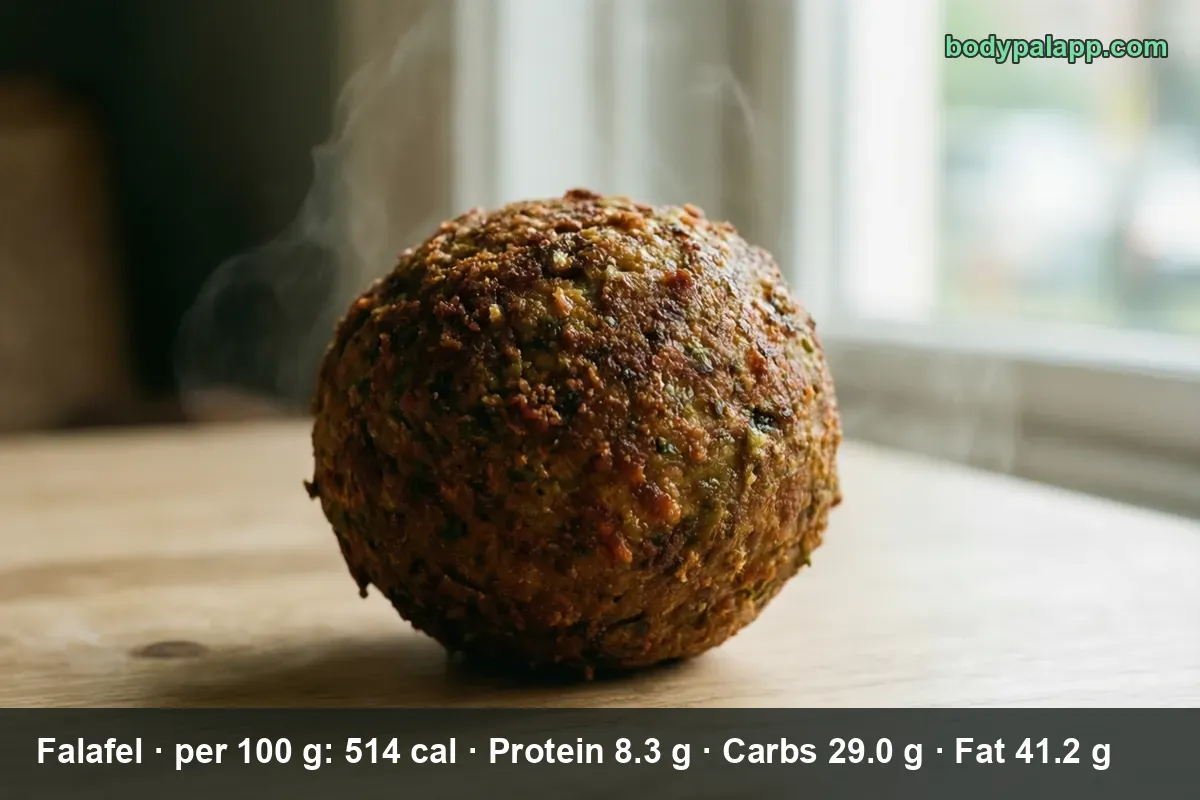
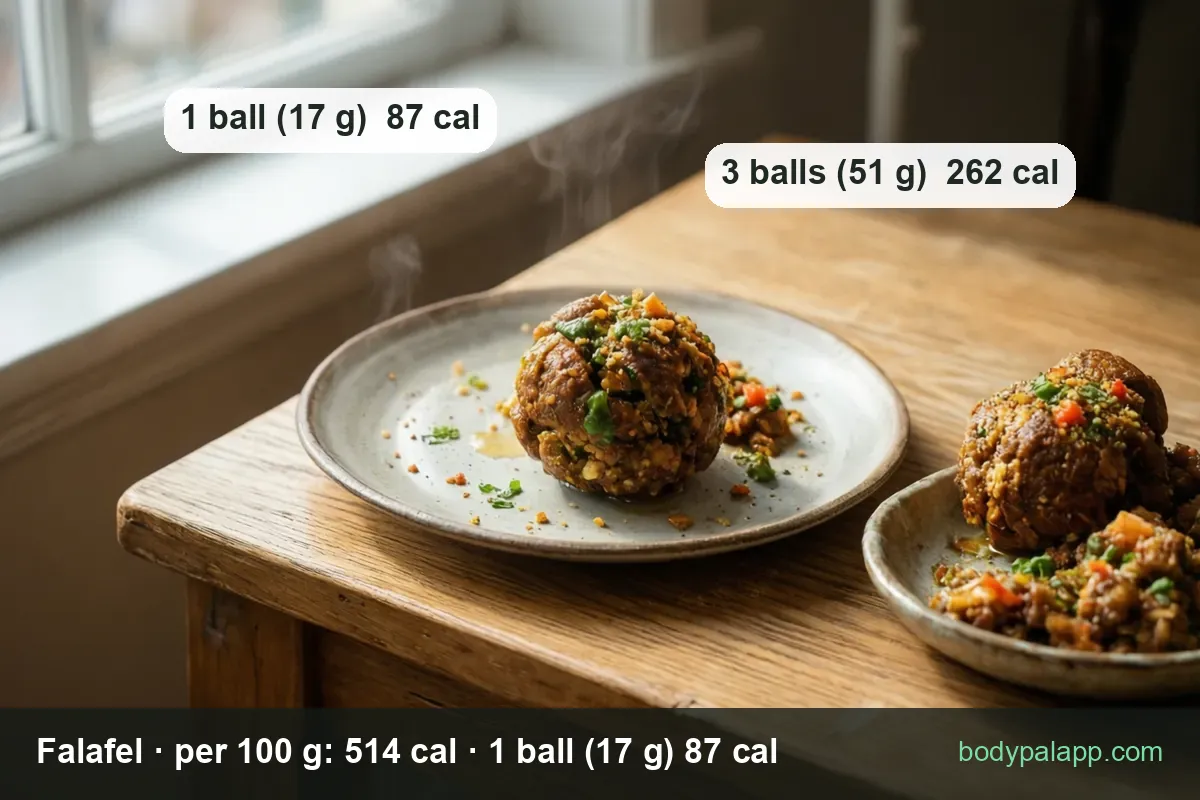
One deep-fried falafel ball weighs 17 g and carries 87 calories. Three of them, the smallest thing most people call a serving, come to 262 calories, and falafel runs 514 calories per 100 g. Very little of that comes from the chickpeas. The fryer wrote most of the number.
On this page
- Falafel quick facts
- The fryer sets the number
- Portions, ball by ball
- Homemade, baked and frozen
- The sandwich looks lighter than it is
- Falafel is not a protein food
- Sodium comes from the bag, not the pan
- How does falafel compare?
- Most popular falafel ball brands
- FAQ
Falafel quick facts
The reference row on this page is USDA 2707408, "Falafel," from the FNDDS survey release covering 2021 to 2023. That record describes falafel as Americans actually eat it: chickpea batter shaped into balls, dropped into hot oil, served hot from a cart, a counter or a home skillet. The oil the batter drinks while it fries is already inside every figure below.
| Nutrient | Per 100 g | Per 3 balls (51 g) | % Daily Value |
|---|---|---|---|
| Calories | 514 | 262 | — |
| Total fat | 41.19 g | 21.0 g | 27% |
| Saturated fat | 5.43 g | 2.8 g | 14% |
| Carbohydrate | 28.96 g | 14.8 g | 5% |
| Dietary fiber | 4.8 g | 2.4 g | 9% |
| Total sugars | 4.52 g | 2.3 g | — |
| Protein | 8.28 g | 4.2 g | 8% |
| Sodium | 499 mg | 254 mg | 11% |
% Daily Value is based on a 2,000-calorie diet.
Verified nutrition data
Numbers on this page come from USDA FoodData Central, the U.S. Department of Agriculture’s food composition database, and from manufacturer labels where a branded product is named. Last verified September 2026. How we verify our data →
One row runs the whole page. Fat is 41.19 g per 100 g, which means fat supplies roughly three quarters of the calories in a food people file mentally under "beans." Three balls hand you 27% of a day's fat against 5% of a day's carbohydrate, a ratio nobody expects from ground chickpeas and parsley.
Two lines you would expect on a Nutrition Facts panel are not here. Added sugars and trans fat are missing because this FNDDS release does not carry either value for falafel — they are absent, not zero, and printing a 0 would claim a measurement nobody took. What the record does carry is worth a line of its own: cholesterol is 0 mg, since nothing in the bowl came from an animal, and potassium is 259 mg per 100 g, 6% of the FDA Daily Value.
The fryer sets the number
Search for falafel calories and you will meet two figures that disagree by more than half. Both are USDA, both are correct, and the gap has nothing to do with which database is better.
Deep-fried falafel is 514 calories per 100 g. USDA 172455, "Falafel, home-prepared," is 333. That is a difference of 181 calories in the same 100 g of what looks like the same food.
Now put the two macro columns side by side. Carbohydrate barely moves: 28.96 g fried against 31.84 g homemade. Protein actually goes up in the homemade record, 13.31 g against 8.28 g. Only one number swings, and it swings hard — fat, 41.19 g fried against 17.8 g home-prepared.
The chickpeas did not change. The oil did. A patty shaped by hand and cooked in a shallow pan absorbs a fraction of what a ball tumbling in a deep fryer takes on, and that absorbed oil then dilutes everything else per gram, which is why the fried version reads lower in protein while carrying far more energy.
The practical rule: log the cooking method, not the recipe. Whatever spices went into the batter changes the calorie count by almost nothing. How the ball met the oil changes it by more than half.
Portions, ball by ball
| Portion | Weight | Calories |
|---|---|---|
| 1 ball | 17 g | 87 |
| 3 balls | 51 g | 262 |
| 1 oz | 28 g | 144 |
| 6 balls, a mezze plate | 102 g | 524 |
| Per 100 g | 100 g | 514 |
The 17 g ball comes straight from USDA's own portion entry for this record, listed as "1 patty." It is the small ball: the size that comes seven to a serving out of the freezer case, or six on a paper plate next to the hummus. Restaurant falafel is often built larger, so weigh one the first time if you can.
Here is why the small ball matters. Individually, 87 calories is a genuinely light thing to eat. Nobody eats one. Three is a garnish on a salad and already 262 calories, and six on a shared appetizer plate is 524, which is a full meal's worth of energy eaten standing up with a toothpick.
One more trap sits in the frozen aisle. The numbers above describe falafel that has already been fried and is ready to eat. A bag of raw, uncooked frozen balls prints a much lower figure on its label because the oil has not happened yet — that label is describing the disk before it goes in the pan, not the ball that lands on your plate.
Homemade, baked and frozen
| Version | Per 100 g | Portion | Calories |
|---|---|---|---|
| Deep-fried falafel ball | 514 | 3 balls (51 g) | 262 |
| Homemade falafel patty | 333 | 1 patty (17 g) | 57 |
| Baked frozen falafel balls | 271 | 3 pieces (85 g) | 230 |
| Frozen uncooked falafel balls | 141 | 3 pieces (85 g) | 120 |
| Falafel sandwich in pita | 265 | 1 sandwich (215 g) | 570 |
The baked frozen row is the one worth pinning to the refrigerator door. Three baked balls weigh 85 g and cost 230 calories. Three deep-fried balls weigh 51 g and cost 262. That is two thirds more food for thirty-two fewer calories, and it is the single largest saving available to anyone who likes falafel and eats it often.
The homemade patty at 57 calories is the same 17 g object as the 87-calorie fried ball, which makes the comparison unusually clean. Same weight, same shape, same chickpeas. Thirty calories of difference, all of it oil.
The frozen uncooked line at 141 calories per 100 g is not a low-calorie falafel — it is falafel before cooking. Fry those balls and they climb toward the deep-fried record; bake them and they land nearer the 271 figure. The label tells you what is in the bag, not what will be on the plate.
The sandwich looks lighter than it is
USDA 2707483, "Falafel sandwich," reads 265 calories per 100 g. Set that against 514 for the balls and the sandwich looks like the sensible order. Pita, salad, sauce, and roughly half the calorie density of the thing inside it.
Density is not what you eat. One falafel sandwich weighs 215 g, and the whole thing is 570 calories — more than the six-ball mezze plate at 524, and more than double a 3-ball serving.
What happened is arithmetic, not nutrition. Bread, tomato and tahini are all less energy-dense than a fried ball, so adding them pulls the per-100-g figure down while pushing the plate weight up. The sandwich also brings 58.1 g of carbohydrate and 13.4 g of protein, so it functions as a meal rather than a snack. Just log it as one.
Falafel is not a protein food
This is the assumption that costs people the most, and the numbers are blunt about it. Three falafel balls deliver 4.2 g of protein, 8% of the Daily Value, alongside 21.0 g of fat, 27% of the Daily Value. The fat share is more than three times the protein share.
Chickpeas are listed under protein foods by MyPlate, and plain ones earn it. Take the same 51 g of boiled chickpeas from USDA 173757: 4.5 g of protein and 1.3 g of fat. Fry that quantity into falafel and the protein stays flat while the fat multiplies roughly sixteen times.
Fiber survives the fryer better. Three balls carry 2.4 g, 9% of the Daily Value, which is respectable for a 51 g portion and one of the few things falafel does that a meat appetizer cannot. The Dietary Guidelines for Americans put beans, peas and lentils in both the vegetable and the protein groups precisely because of that combination.
Eat falafel because it tastes like falafel. If protein per calorie is what you are shopping for, three balls at 262 calories is an expensive way to buy 4.2 g of it.
Sodium comes from the bag, not the pan
Three balls carry 254 mg of sodium, 11% of the 2,300 mg Daily Value. That is a moderate number, and if you are eating falafel someone fried from a USDA-typical batter, sodium is not your problem.
Store-bought is a different question. Across clean packaged falafel products, sodium per 100 g runs from about 188 mg at the low end to 683 mg at the high end — a 3.6-fold spread between two bags sitting in the same freezer case. A 60 g serving off the salty end is 410 mg of sodium, which is more than one and a half USDA servings' worth from less food.
Calories vary between those bags too, but far less dramatically: packaged falafel clusters between roughly 129 and 271 calories per 100 g, all of it well under the deep-fried figure because most of these products are sold to be baked. Sodium is where the labels genuinely disagree. Turn the bag over and read that line first — it is the only number on packaged falafel that can quietly triple.
How does falafel compare?
| Food | Per 100 g | US serving | Calories | Protein | Carbs | Fat |
|---|---|---|---|---|---|---|
| Falafel, deep-fried | 514 | 3 balls (51 g) | 262 | 4.2 g | 14.8 g | 21.0 g |
| Falafel, home-prepared | 333 | 1 patty (17 g) | 57 | 2.3 g | 5.4 g | 3.0 g |
| Hummus, plain | 243 | 1 oz (28 g) | 68 | 2.1 g | 4.2 g | 4.8 g |
| Chickpeas, boiled | 164 | 1 oz (28 g) | 46 | 2.5 g | 7.7 g | 0.7 g |
| Falafel sandwich | 265 | 1 sandwich (215 g) | 570 | 13.4 g | 58.1 g | 31.7 g |
Our take: for the same chickpeas at a third of the energy, boiled chickpeas win outright at 164 calories per 100 g, and they carry more protein per 100 g than falafel does. If you want the mezze plate experience without the fryer, hummus is the smarter scoop — 68 calories an ounce against 144 for the same ounce of falafel, with a similar mouthfeel and the same dip-and-pita ritual.
Falafel earns its place when it is the meal rather than the appetizer. Three balls and a salad is a defined 262 calories with 2.4 g of fiber, and that is a reasonable plate. The order to watch is the sandwich: at 570 calories it outweighs every other row here, including six loose balls, and it is the one people order thinking they chose the lighter option.
Most popular falafel ball brands in the United States
Ranked by how widely each product appears among foods sold in the United States, from the BodyPal food database of over 3.3 million products. Calories are the figures printed on each Nutrition Facts label, checked against USDA FoodData Central.
| Product | Calories (per 100 g) |
|---|---|
| Olive Valley Falafel Patties | 176 cal |
| Yves Veggie Cuisine Falafel Balls | 250 cal |
| Ta'amti Falafel Balls | 219 cal |
| Franklin Farms Baked Falafel Balls | 271 cal |
| Dagim Mediterranean Style Mini Falafel Balls | 220 cal |
| Falafelim Original Frozen Uncooked Falafel Balls | 141 cal |
Brand popularity: BodyPal food database. Nutrition: manufacturer labels / USDA FoodData Central.
Falafel FAQs
How many calories in a falafel ball?
87 calories in one deep-fried falafel ball weighing 17 g, from USDA record 2707408 at 514 calories per 100 g. Three balls come to 262 calories and six to 524. A homemade patty of the same 17 g weight is 57 calories, because it absorbs far less oil.
How many calories in 3 falafel balls?
262 calories for three deep-fried balls, 51 g in total. That serving brings 21.0 g of fat (27% of the Daily Value), 14.8 g of carbohydrate, 4.2 g of protein and 2.4 g of fiber. Three baked frozen balls weigh more, 85 g, and come to 230 calories.
Is falafel healthy?
It is a chickpea food with the calorie profile of a fried food: 514 calories per 100 g, three quarters of them from fat. Three balls give 2.4 g of fiber (9% DV), 254 mg of sodium (11% DV) and no cholesterol. Baked versions cut the calories per gram by roughly half.
Baked or fried falafel: how big is the calorie difference?
The gap is large: deep-fried falafel is 514 calories per 100 g against 271 for baked frozen balls and 333 for home-prepared patties. In portion terms, three baked balls at 85 g are 230 calories while three fried balls at 51 g are 262 — two thirds more food for slightly less energy.
How many calories in a falafel sandwich?
570 calories for one 215 g falafel sandwich in pita, from USDA record 2707483 at 265 calories per 100 g. It reads lighter than the balls per 100 g because bread and salad are less energy-dense, but the finished sandwich outweighs a six-ball plate at 524 calories.
How much protein is in falafel?
4.2 g in three balls (51 g), which is 8% of the Daily Value, and 8.28 g per 100 g. That is low for a legume dish because absorbed frying oil dilutes everything per gram. The same 51 g of boiled chickpeas gives 4.5 g of protein with 1.3 g of fat instead of 21.0 g.
How much sodium is in falafel?
254 mg in three balls, 11% of the 2,300 mg Daily Value, and 499 mg per 100 g. Packaged falafel varies far more: sodium runs from about 188 mg to 683 mg per 100 g across clean products, so a 60 g serving off the salty end reaches 410 mg on its own.
Do frozen falafel balls have fewer calories?
Baked ones do, at 271 calories per 100 g against 514 for deep-fried. Raw frozen balls print about 141 calories per 100 g, but that figure describes the uncooked disk — frying it adds the oil the label never counted. Read the package for whether the product is pre-cooked.
Similar foods
- Cheez-its — 303 cal per cup, bite size
- Croutons — 186 cal per cup
- Pistachios — 332 cal per cup in shell
- Baklava — 352 cal per piece
- Ramen Noodles — 374 cal per package
- Sleeve Of Saltines — 481 cal per sleeve
Count it without the math
Point the camera at the plate and BodyPal counts the balls, the pita and the tahini in one shot.


How long does it take to burn off a falafel ball?
One deep-fried ball (17 g) is 87 kcal. Enter your weight and the amount you ate to see how long it takes you to burn that off:
lb
| Activity | Time to burn 87 kcal |
|---|---|
| Walking, brisk | 17 min |
| Cycling, moderate | 11 min |
| Swimming, moderate | 12 min |
| Jogging | 10 min |
| Weight training, moderate | 19 min |
Times are for a 155 lb adult at a steady pace; change the weight to see yours. The amount is set to the portion in the text (17 g); change it to what you actually ate. BodyPal works this out from your steps automatically.
This table assumes you know your daily total. If you do not, the daily calorie calculator works it out from five numbers.