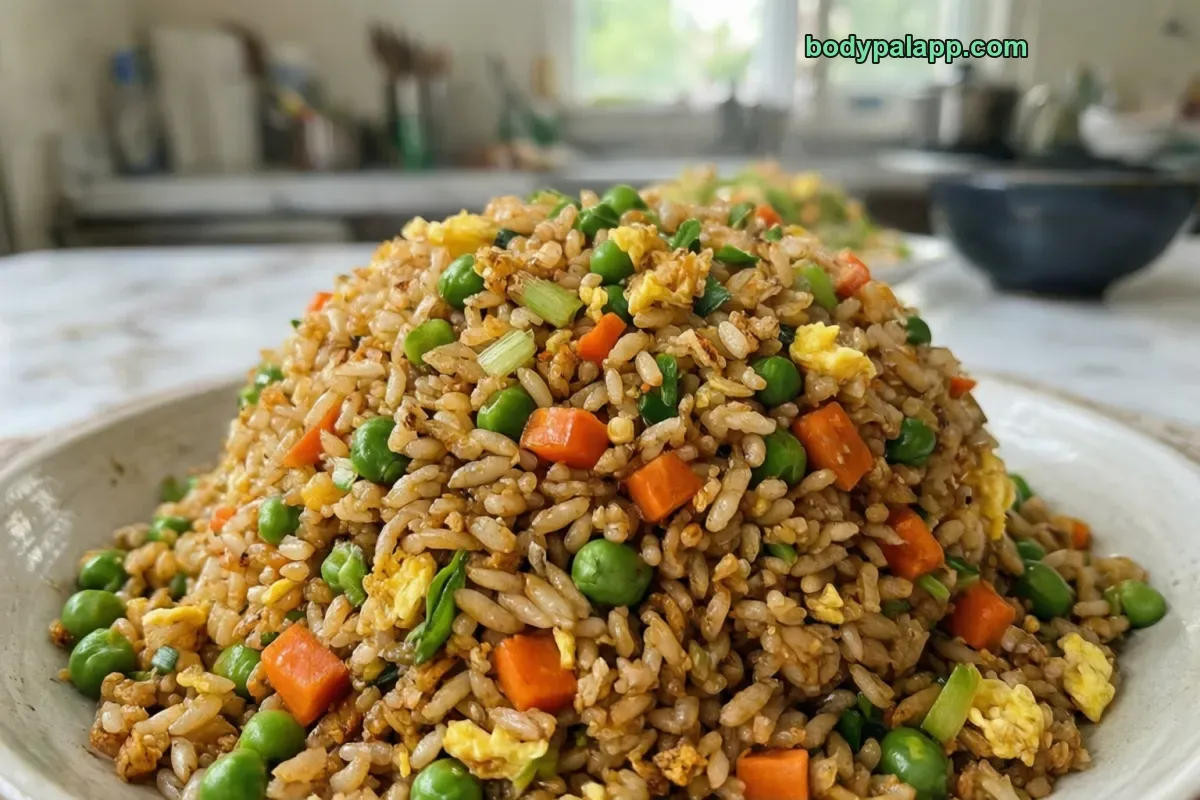
Fried rice calories come to 238 for 1 cup (137 g) of restaurant-style fried rice without meat, or 174 per 100 g. The portion matters more than anything else here. Fried rice is easy to eat by the plateful, and calories and sodium climb fast with every cup: one cup alone already holds 530 mg of sodium.
238kcal
1 cup · 137 g, restaurant style, without meat
9%protein
5.5 gProtein
45 gCarbs
4.1 gFat
How to burn off 238 kcal
—Walking, brisk
—Jogging
—Cycling, moderate
—Swimming
Skip the math. BodyPal counts these calories from your steps and workouts automatically.
Nutrition facts
Restaurant style, without meat · per 137 g
Calories
238 kcal
Protein
5.5 g
Carbohydrate
45 g
Fat
4.1 g
Saturated fat
0.7 g
Cholesterol
25 mg
Sodium
530 mg
Potassium
104 mg
Iron
0.9 mg
Source: USDA FoodData Central
🛡️
Verified nutrition data
Numbers on this page come from USDA FoodData Central, the U.S. Department of Agriculture’s food composition database, and from manufacturer labels where a branded product is named. Last verified October 2026. How we verify our data →
Fried rice: calories, protein and sodium by serving
Percent of daily value uses the FDA reference of 2,000 kcal a day.
Serving
kcal
Protein
Carbs
Fat
Sodium
% DV kcal
1 cup (137 g)
238
5.5 g
44.9 g
4.1 g
530 mg
12%
With chicken, 1 cup (198 g)
343
14.4 g
54.7 g
7.2 g
711 mg
17%
With shrimp, 1 cup (198 g)
329
13.2 g
55.1 g
5.9 g
642 mg
16%
100 g
174
4.1 g
32.8 g
3 g
387 mg
9%
3 × 1 cup (137 g)
715
16.6 g
1,591 mg
5 × 1 cup (137 g)
1,192
27.7 g
2,651 mg
One cup is 238 calories, but few plates stop at one cup
A level cup of restaurant fried rice without meat weighs 137 g and carries 238 calories, about 12% of the daily value. As a side dish, that number is modest. The trouble is that fried rice rarely gets measured by the cup, and a heaped plate or a takeout box can hold a lot more than you think.
Scale it up and the total moves fast. Two cups (274 g) come to 477 calories, three cups (411 g) to 715, and five cups (685 g) reach 1,192 calories. Protein barely keeps up: those five cups still deliver only 27.7 g. The extra rice adds plenty of calories and not much else.
If you track, weigh your usual portion once at home or spoon it into a measuring cup. A scoop that looks like one cup on a wide plate can easily be closer to two, and that is the difference between 238 and 477 calories. BodyPal can also log fried rice from a photo, which helps when the plate comes from a restaurant.
Three quarters of the calories come from carbs
The calorie split is 75% carbs, 15% fat and 9% protein. Per 100 g that works out to 32.8 g of carbohydrate, 3 g of fat and 4.1 g of protein. This is a rice dish first. The oil from the wok shapes the flavor more than it shapes the totals.
Fat is lower than many people expect, and saturated fat sits at just 0.5 g per 100 g. Sugar is almost absent at 0.6 g. Fiber is light too, at 1.1 g per 100 g and 1.5 g per cup, so the dish brings little bulk beyond the starch itself.
Protein is the weak spot. One cup supplies 5.5 g, only 11% of the daily value, while the same cup carries 44.9 g of carbs. That imbalance is why plain fried rice works better as the base of a meal than as the whole meal. Treat it like you would any other rice side and build the plate around it.
Sodium is the row to watch
Fried rice carries 387 mg of sodium per 100 g, and a single cup holds 530 mg, 23% of the daily value. Calories in that same cup sit at 12% of the daily value, so sodium runs nearly twice as high. That gap is the real story of this dish: the seasoning adds salt without adding much energy.
Portions multiply it. Two cups reach 1,060 mg, three cups 1,591 mg, and five cups 2,651 mg, which is more than a full day's daily value in one sitting. Meat versions run higher still, with 711 mg (31%) in a cup with chicken and 642 mg (28%) in a cup with shrimp.
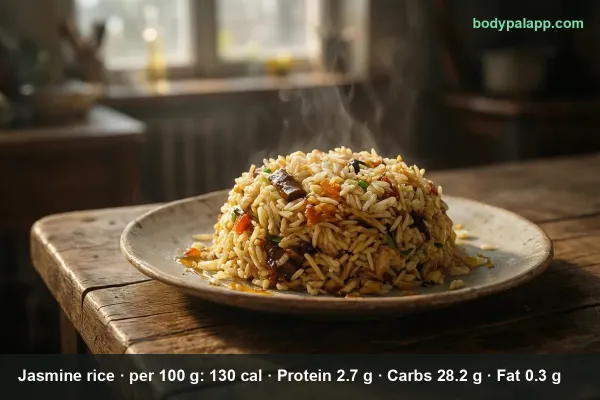
If you watch sodium, the fix is simple. Keep the portion to about a cup, skip extra soy sauce at the table, and balance the rest of the day with lower-sodium foods. Plain jasmine rice, with 1 mg per 100 g, shows how much of the salt comes from the frying and seasoning rather than the grain.
Chicken or shrimp turns a side into a meal
A cup of fried rice with chicken weighs 198 g and comes to 343 calories with 14.4 g of protein, 29% of the daily value. The shrimp version, in the same 198 g cup, has 329 calories and 13.2 g of protein, 26% of the daily value. Both cups are heavier than the plain 137 g cup, so part of the jump is simply more food on the plate.
Per cup, chicken more than doubles the protein of plain fried rice while calories rise from 238 to 343. Shrimp is the slightly leaner pick, with 5.9 g of fat against 7.2 g for chicken and less sodium. Chicken wins narrowly on protein. Either way, the meat fixes the dish's biggest gap.
For a plate that keeps you going, pair a cup of plain fried rice with a lean protein and a generous serving of vegetables rather than adding a second cup of rice. You keep the flavor, add the protein the rice lacks, and hold sodium near the one-cup level instead of doubling it.
How does fried rice compare?
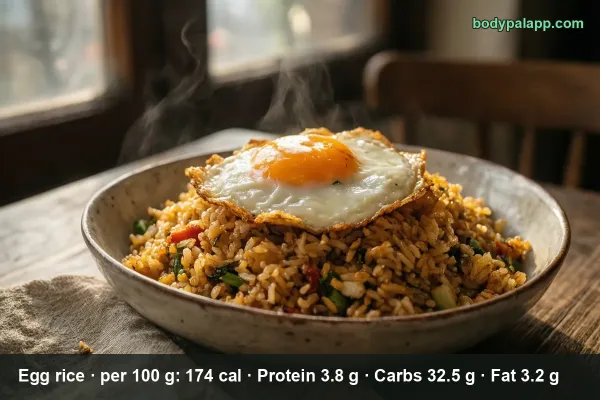
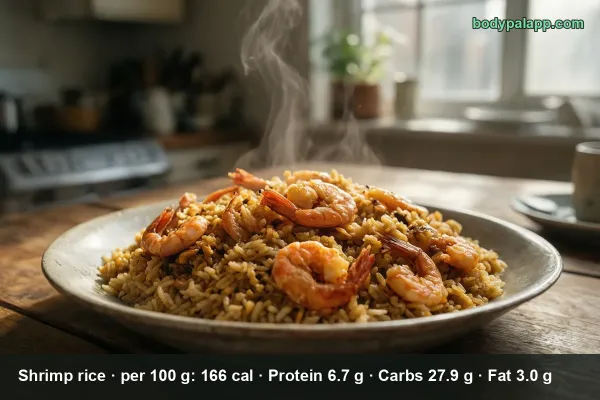
Here is how restaurant fried rice stacks up against egg rice, shrimp rice and plain jasmine rice, per 100 g and per usual serving.
Verdict: For the fewest calories pick jasmine rice: 130 per 100 g against 174 for fried rice, with 1 mg of sodium instead of 387 mg. If you want fried flavor with more protein, shrimp rice at 166 calories and 6.7 g of protein per 100 g beats both fried rice and egg rice.
Most popular fried rice brands in the United States
Ranked by popularity in the BodyPal database
# Productkcal / 100 g
1Bibigo Korean Style Fried Rice Chicken with Korean BBQ Flavor1 bag · 255 g157 kcal
Packaged frozen fried rice follows each brand's own recipe and mix of rice, meat and vegetables, so label numbers per 100 g differ from the restaurant-style number above. Source: manufacturer labels / USDA FoodData Central.
Fried rice FAQs
How many calories are in a cup of fried rice?
About 238 calories in a cup (137 g) of restaurant-style fried rice without meat, and 343 in a cup of chicken fried rice (198 g).
Is fried rice good for weight loss?
A cup (137 g) has 238 calories and 4.1 g of fat. Per 100 g it has 174 calories, 44 more than cooked jasmine rice at 130.
Fried rice vs jasmine rice: which has fewer calories?
Jasmine rice has fewer, with 130 calories per 100 g against 174 for fried rice.
How many carbs and how much protein are in fried rice?
A cup (137 g) has 44.9 g of carbs and 5.5 g of protein. A cup of chicken fried rice (198 g) has 14.4 g of protein.
How many calories and how much protein are in chicken fried rice?
One cup of fried rice with chicken (198 g) has 343 calories and 14.4 g of protein, 29% of the daily value. The same cup also carries 54.7 g of carbs, 7.2 g of fat and 711 mg of sodium.
How many calories are in shrimp fried rice?
One cup of shrimp fried rice (198 g) has 329 calories, with 13.2 g of protein, 55.1 g of carbs and 5.9 g of fat. Sodium reaches 642 mg, which is 28% of the daily value.
How many calories are in egg fried rice?
Egg rice comes to 174 calories per 100 g, the same as restaurant fried rice without meat. It has 3.8 g of protein, 32.5 g of carbs, 3.2 g of fat and 361 mg of sodium per 100 g.
How many calories are in 100 g of fried rice?
100 g of restaurant fried rice without meat has 174 calories, with 4.1 g of protein, 32.8 g of carbs and 3 g of fat. That is 9% of the daily value for calories and 17% for sodium.