
How many calories are in egg rice?
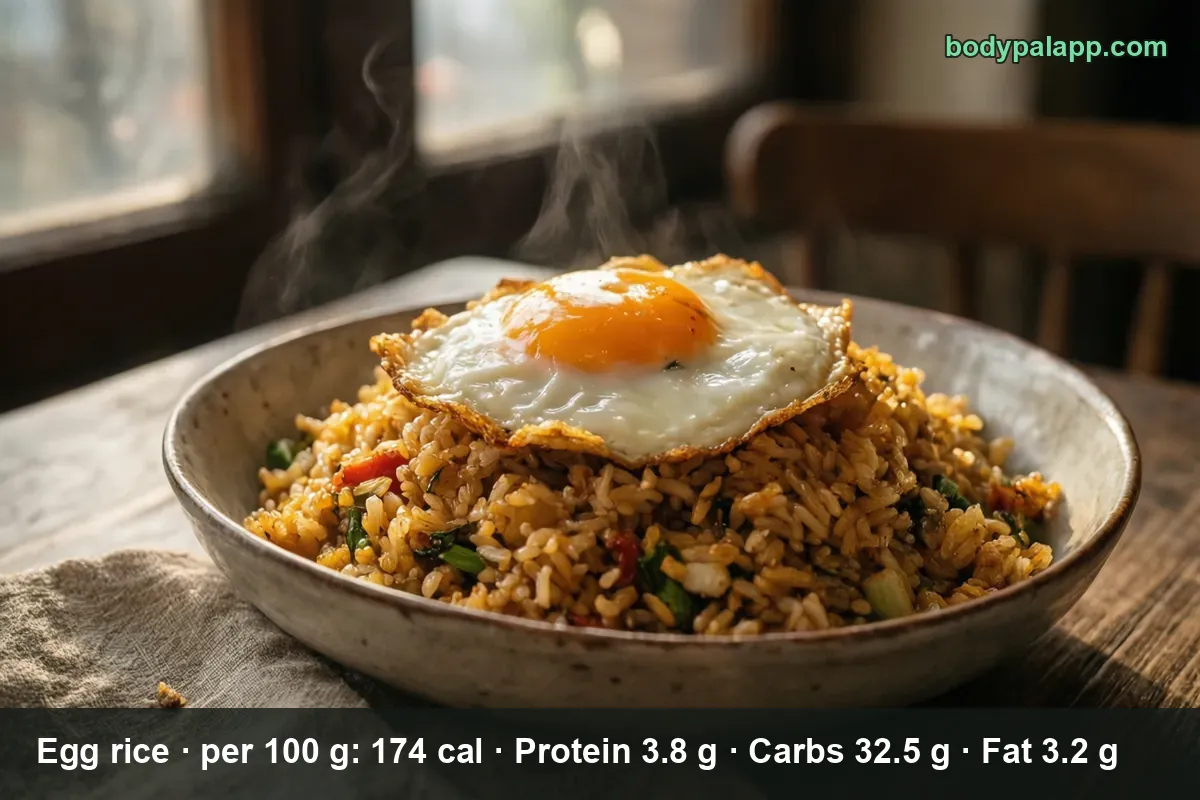
A 1-cup serving of egg rice weighs 166 g and comes to 289 calories. Per 100 g it runs 174 calories, which puts it in the same band as most cooked grain dishes with oil in the pan. The egg shows up in the cholesterol line, not the calorie line.
On this page
- Egg rice quick facts
- US servings, from one ounce to a takeout pint
- Takeout, chicken, shrimp and the meatless baseline
- Sodium is the row that moves fastest
- How does egg rice compare?
- Most popular egg rice brands
- Egg rice FAQs
Egg rice quick facts
The record behind every number on this page is USDA FNDDS 2708951, "Rice, fried, meatless", food code 58150110 from the 2021-2023 survey cycle. That record is the closest match to what Americans call egg rice: fried rice with no meat in it, whose 18 mg of cholesterol per 100 g can only have come from egg. It also carries its own household measure, one cup at 166 g, so the serving column below is a USDA weight rather than a guess.
USDA does not publish added sugars or trans fat for mixed dishes in FNDDS, so those two label rows are absent here rather than estimated.
| Nutrient | Per 100 g | Per 1 cup (166 g) | % Daily Value |
|---|---|---|---|
| Calories | 174 | 289 | — |
| Total fat | 3.19 g | 5.3 g | 7% |
| Saturated fat | 0.493 g | 0.8 g | 4% |
| Carbohydrate | 32.5 g | 54.0 g | 20% |
| Dietary fiber | 1.1 g | 1.8 g | 7% |
| Total sugars | 0.62 g | 1.0 g | — |
| Protein | 3.84 g | 6.4 g | 13% |
| Sodium | 361 mg | 599 mg | 26% |
% Daily Value is based on a 2,000-calorie diet.
Verified nutrition data
Numbers on this page come from USDA FoodData Central, the U.S. Department of Agriculture’s food composition database, and from manufacturer labels where a branded product is named. Last verified September 2026. How we verify our data →
Two rows worth pulling out of the small print: cholesterol is 18 mg per 100 g, or 30 mg a cup, which is 10% of the Daily Value and the clearest fingerprint of the egg. Potassium is 69 mg per 100 g, 115 mg a cup, a thin 2%. The Daily Values used here are the FDA reference amounts for a 2,000-calorie diet.
US servings, from one ounce to a takeout pint
| Serving | Weight | Calories |
|---|---|---|
| 1 oz | 28.4 g | 49 kcal |
| 1/2 cup, side portion | 83 g | 144 kcal |
| 1 cup | 166 g | 289 kcal |
| 1 1/2 cups | 249 g | 433 kcal |
| 2 cups, a takeout pint | 332 g | 578 kcal |
| Per 100 g | 100 g | 174 kcal |
Only the 1-cup row and the 100 g row are USDA figures. The ounce, the half cup, the cup and a half and the pint are our own arithmetic from the USDA 100 g value, not USDA servings, which is why the half cup lands on a clean 144 rather than a labeled number.
The pint is the row most people actually eat. A standard white takeout carton holds close to two cups, and at 578 calories it is a meal on its own before the entree it came with. If you are eating egg rice as a side, the half cup at 144 calories is the portion that behaves like a side.
Takeout, chicken, shrimp and the meatless baseline
| Version | Per 100 g | Typical serving | Calories |
|---|---|---|---|
| Egg rice, meatless (main record) | 174 kcal | 1 cup (166 g) | 289 kcal |
| Fried rice, NFS - takeout style | 174 kcal | 1 cup (198 g) | 345 kcal |
| Chicken fried rice | 173 kcal | 1 cup (198 g) | 343 kcal |
| Shrimp fried rice | 166 kcal | 1 cup (198 g) | 329 kcal |
| Beef fried rice | 178 kcal | 100 g | 178 kcal |
| Pork fried rice | 179 kcal | 100 g | 179 kcal |
| White rice with soy sauce, not fried | 117 kcal | 100 g | 117 kcal |
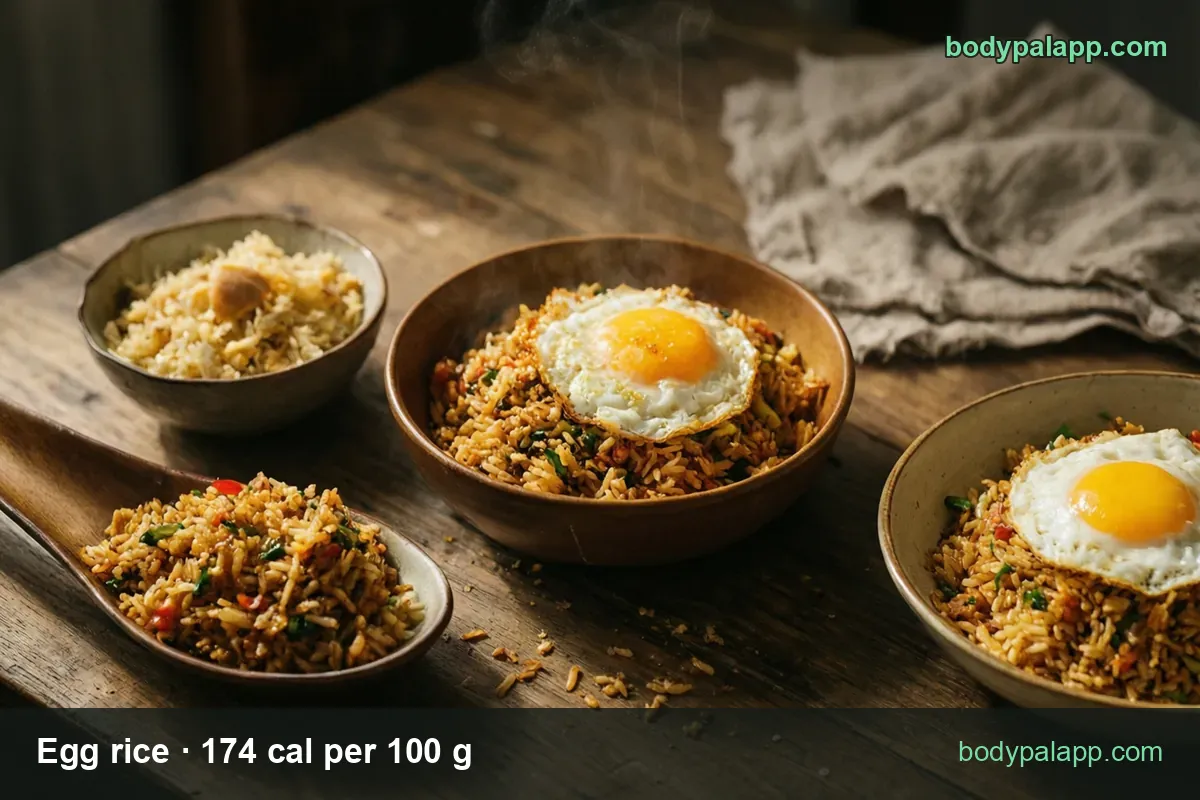
Here is the thing almost nobody flags. The meatless record and the not-further-specified record are identical per 100 g at 174 calories, yet USDA measures a cup of the first at 166 g and a cup of the second at 198 g. Same food, same density, and the cup jumps from 289 to 345 calories purely on how densely the scoop packs. Thirty-two grams of rice is the entire difference, and it is a measuring artifact, not a recipe change.
The second surprise is how little the meat matters to calories. Across all six fried rice records the spread is 166 to 179 calories per 100 g - thirteen calories from the leanest shrimp version to the fattiest pork one. What the meat changes is protein: 3.84 g per 100 g without it, 7.28 g with chicken, 6.68 g with shrimp. If you want the rice to hold you until dinner, adding protein costs almost nothing in calories.
Skipping the pan entirely is the only move that changes the math. Plain white rice tossed with soy sauce is 117 calories per 100 g, 57 fewer than fried, because the oil never enters the picture.
Frozen supermarket versions sit on both sides of the USDA figure. InnovAsian Cuisine Fried Rice is 183 calories per 100 g, or 220 for its 1-cup 120 g label serving, while Wegmans Vegetable Fried Rice is 138 and Tai Pei Combination Fried Rice runs 157 per 100 g, which works out to 490 for the whole 312 g package.
Sodium is the row that moves fastest
One cup of egg rice delivers 599 mg of sodium, 26% of the FDA Daily Value of 2,300 mg, against 6.4 g of protein, which is 13%. Sodium climbs at exactly twice the rate protein does. Eat the takeout pint and you are at roughly 1,200 mg from a side dish - more than half a day's allowance before the entree lands.
That 599 mg is about a quarter teaspoon of table salt, and it comes from the soy sauce rather than the rice. The older restaurant sample in USDA's SR Legacy set, fried rice without meat, is saltier still at 387 mg per 100 g.
Fiber is the other weak row: 1.1 g per 100 g, 1.8 g a cup, 7% of the Daily Value. That is what white rice does. MyPlate's guidance on grains is to make at least half of them whole grains, and fried white rice is not one of them. If you are watching sodium, the half-cup side at 300 mg is the version that keeps the day's budget intact; if you are watching fiber, the vegetables you stir in do more than the rice ever will. The general framework for both sits in the Dietary Guidelines for Americans.
How does egg rice compare?
| Dish | Per 100 g | US serving | Calories |
|---|---|---|---|
| Egg rice, meatless | 174 kcal | 1 cup (166 g) | 289 kcal |
| Chicken fried rice | 173 kcal | 1 cup (198 g) | 343 kcal |
| Shrimp fried rice | 166 kcal | 1 cup (198 g) | 329 kcal |
| Restaurant fried rice, no meat | 174 kcal | 1 cup (137 g) | 238 kcal |
Our take: on a per-gram basis these four are almost the same food, spanning 166 to 174 calories per 100 g. Every gap in the calorie column is a gap in serving weight - 137 g, 166 g, 198 g - which means the scoop decides your number, not the menu description. For weight loss, order any of them and weigh out a cup at home. For staying full, shrimp fried rice is the pick: it is the lightest per gram at 166 calories and still carries 6.68 g of protein per 100 g, nearly double the meatless version.
Most popular egg rice brands in the United States
Ranked by how widely each product appears among foods sold in the United States, from the BodyPal food database of over 3.3 million products. Calories are the figures printed on each Nutrition Facts label, checked against USDA FoodData Central.
| Product | Calories (per 100 g) |
|---|---|
| InnovAsian Cuisine Fried Rice | 183 cal |
| InnovAsian Cuisine Vegetable Fried Rice | 122 cal |
| InnovAsian Fried Rice (family) | 141 cal |
| Tai Pei Combination Fried Rice | 157 cal |
| Kahiki Chicken Fried Rice | 127 cal |
| Wegmans Vegetable Fried Rice | 138 cal |
Brand popularity: BodyPal food database. Nutrition: manufacturer labels / USDA FoodData Central.
Egg rice FAQs
How many calories are in egg fried rice?
A 1-cup serving weighs 166 g and carries 289 calories, or 174 calories per 100 g. That is the USDA figure for meatless fried rice, the record whose 18 mg of cholesterol per 100 g comes from the egg. Restaurant portions are usually larger than one measured cup.
How much protein is in egg fried rice?
One cup gives 6.4 g of protein, 13% of the Daily Value, from 3.84 g per 100 g. Egg rice is a carbohydrate dish first: the same cup carries 54.0 g of carbohydrate. Chicken fried rice nearly doubles the protein, at 7.28 g per 100 g.
How many carbs are in egg fried rice?
A 1-cup serving holds 54.0 g of carbohydrate, 20% of the Daily Value, with 1.8 g of that as fiber and only 1.0 g as sugars. Per 100 g the figure is 32.5 g. Half a cup, 83 g, brings the carbohydrate down to 27.0 g.
How much sodium is in egg fried rice?
One cup carries 599 mg of sodium, 26% of the 2,300 mg Daily Value and roughly a quarter teaspoon of table salt. A takeout pint of two cups, 332 g, reaches about 1,200 mg. The soy sauce does that, not the rice, which is nearly sodium-free on its own.
Is egg fried rice healthy?
It sits in the middle: at 174 calories per 100 g it is moderate, but 361 mg of sodium per 100 g is high for a side dish and fiber is thin at 1.1 g. MyPlate asks for half your grains to be whole grains, which fried white rice is not. Portion size decides it.
Is egg fried rice good for weight loss?
A half-cup side is 144 calories and fits most days easily. The problem is volume, not density: a takeout pint of 332 g is 578 calories. Plain white rice with soy sauce is 117 calories per 100 g, so swapping the fried version out saves 57 calories per 100 g.
Egg fried rice vs chicken fried rice - which has fewer calories?
Chicken fried rice is 173 calories per 100 g against 174 for the meatless egg version, one calorie apart. Per cup, USDA measures the chicken version at 198 g and 343 calories. The real difference is protein: 7.28 g per 100 g versus 3.84 g. Chicken wins on fullness, not calories.
How many calories in a takeout container of egg fried rice?
A pint carton holding two cups, 332 g, is 578 calories by our own arithmetic from the USDA 100 g figure. USDA measures a cup of fried rice NFS at 198 g instead of 166 g, so a densely packed restaurant pint can run closer to 690 calories.
Similar foods
- Omelet — 305 cal for 3-egg omelet
- Egg — 72 cal per large egg
- Crepe — 179 cal per crepe
- Pancake — 423 cal for 3 medium pancakes
- Toast with butter — 100 cal per slice with butter
- Shrimp Tempura Roll — 432 cal per roll, 8 pieces
Count it without the math
Point the camera at the carton and BodyPal counts the rice for you, egg and all.


How long does it take to burn off egg rice?
A 1-cup (166 g) serving is 289 kcal. Enter your weight and the amount you ate to see how long it takes you to burn that off:
lb
| Activity | Time to burn 289 kcal |
|---|---|
| Walking, brisk | 58 min |
| Cycling, moderate | 36 min |
| Swimming, moderate | 41 min |
| Jogging | 34 min |
| Weight training, moderate | 1 hr 4 min |
Times are for a 155 lb adult at a steady pace; change the weight to see yours. The amount is set to the portion in the text (166 g); change it to what you actually ate. BodyPal works this out from your steps automatically.
Want the bigger picture? Calculate your daily calorie needs — your maintenance figure, a target for losing or gaining, and the date you get there.