
How Many Calories in an Omelet?
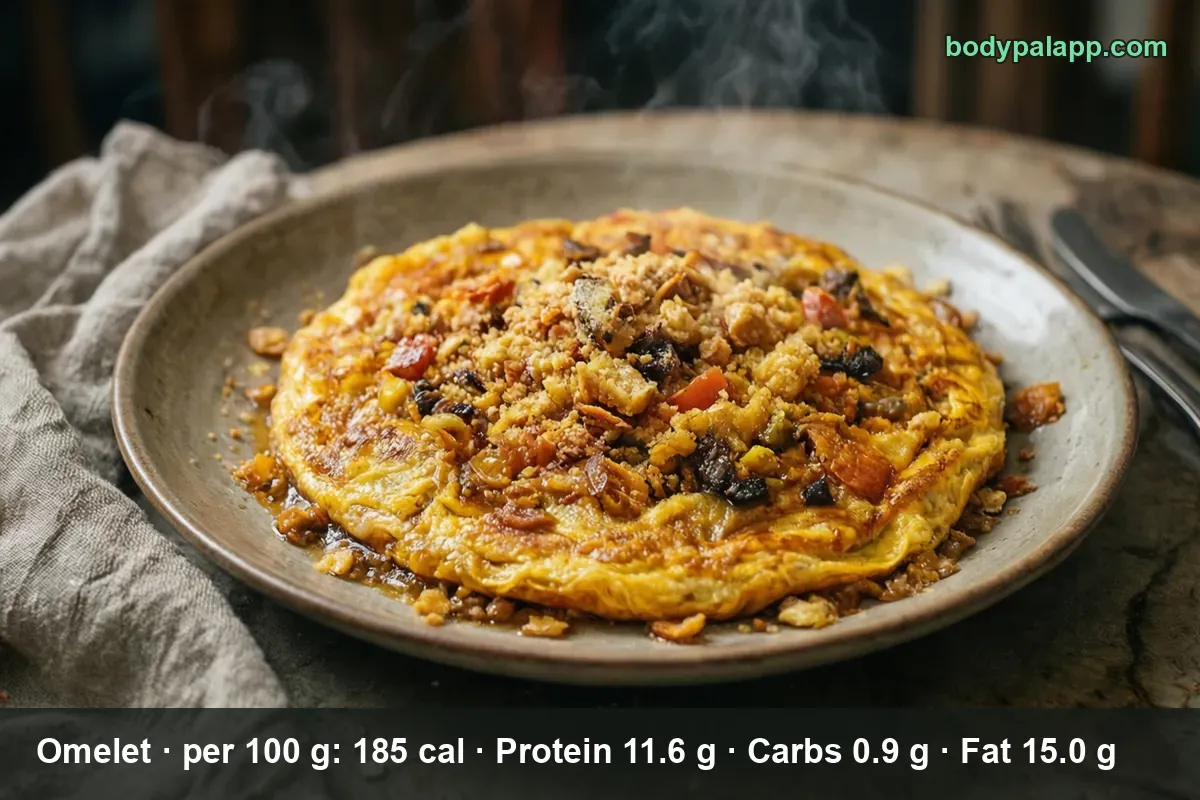
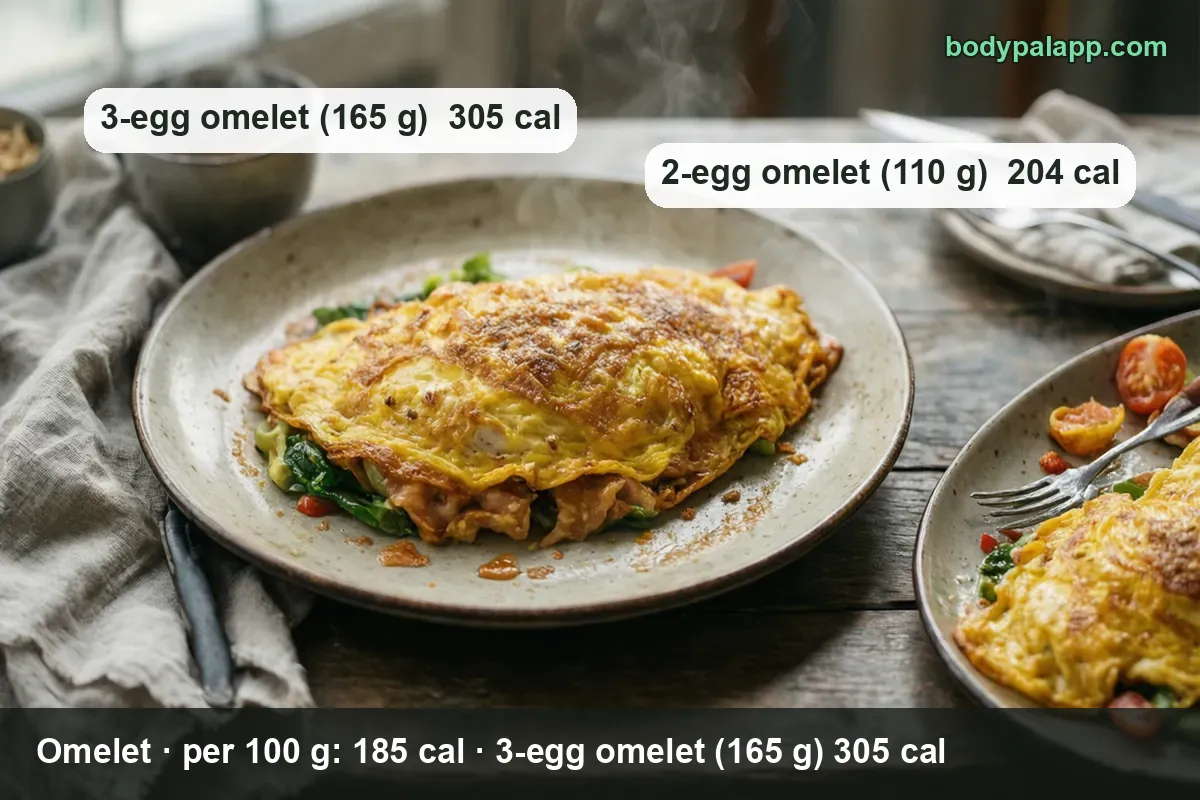
A 3-egg omelet is 305 calories, and a 2-egg omelet is 204. Both come off the same rate: 185 calories per 100 g of finished omelet. The eggs set the floor. What moves the number is how much fat hits the pan, and that choice is worth about a hundred calories on a 3-egg breakfast.
On this page
- Omelet quick facts
- The fat in the pan, not the eggs
- Serving sizes, egg by egg
- What the filling adds
- The egg white omelet trap
- Cholesterol is the number that moves
- How an omelet compares
- Omelet brands
- FAQ
Omelet quick facts
The reference below is the plain omelet most people actually cook: whole eggs, a pan, whatever fat was already on the counter. USDA files it as Egg omelet or scrambled egg, NS as to fat, where NS means the fat was never specified. The serving column is a 3-egg omelet at 165 g, built from the USDA weight of 55 g per finished egg.
| Nutrient | Per 100 g | Per 3-egg omelet (165 g) | % Daily Value |
|---|---|---|---|
| Calories | 185 cal | 305 cal | — |
| Total fat | 15.0 g | 24.8 g | 32% |
| Saturated fat | 4.5 g | 7.4 g | 37% |
| Carbohydrate | 0.9 g | 1.5 g | <1% |
| Dietary fiber | 0 g | 0 g | 0% |
| Total sugars | 0.2 g | 0.3 g | — |
| Protein | 11.6 g | 19.1 g | 38% |
| Sodium | 248 mg | 409 mg | 18% |
% Daily Value is based on a 2,000-calorie diet.
Verified nutrition data
Numbers on this page come from USDA FoodData Central, the U.S. Department of Agriculture’s food composition database, and from manufacturer labels where a branded product is named. Last verified September 2026. How we verify our data →
Two rows are missing on purpose. Added sugars and trans fat are not published for omelet entries in the current USDA survey release, so writing a zero would be inventing a measurement nobody took. Fiber is a real zero: eggs have none, and the plain version has no vegetables in it.
You may see 154 calories per 100 g quoted elsewhere. That is the older 2018 laboratory record for a cooked omelet, a leaner recipe with 155 mg of sodium instead of 248. It describes a different pan, not a better source, and the two numbers should never be blended into an average.
The fat in the pan, not the eggs
Three eggs are three eggs. The cooking fat is where the calories separate.
| How it is cooked | Per 100 g | 3-egg portion | Calories |
|---|---|---|---|
| No added fat | 143 cal | 150 g | 215 cal |
| Cooking spray | 149 cal | not published | — |
| Butter | 182 cal | 165 g | 300 cal |
| Fat not specified (the default) | 185 cal | 165 g | 305 cal |
| Oil, and restaurant omelets | 192 cal | 165 g | 317 cal |
The spread from top to bottom is 102 calories on the same three eggs, which is more than the fat difference alone explains. The second half of the gap is weight: USDA records a no-added-fat omelet at 50 g per egg rather than 55 g, because nothing was poured in to be absorbed. Less fat means a lighter omelet as well as a leaner one, and the two effects stack.
Cooking spray sits almost on top of the no-fat row at 149 calories per 100 g. It has no household serving weight in the USDA files, so there is no honest 3-egg figure to print for it, only the rate.
The restaurant line is not an estimate either. In the survey data, an omelet from a restaurant or fast-food counter is coded identically to a home omelet made with oil: 192 calories per 100 g, 317 for three eggs. Diner omelets are usually bigger than home ones, but per gram they are simply oil omelets.
Serving sizes, egg by egg
| Serving | Weight | Calories |
|---|---|---|
| Omelet from 1 large egg | 55 g | 102 cal |
| 2-egg omelet | 110 g | 204 cal |
| 1 cup, chopped | 135 g | 250 cal |
| 3-egg omelet | 165 g | 305 cal |
| 1 oz | 28 g | 52 cal |
The 55 g, 110 g and 135 g weights come straight from the USDA portion file for this entry, so the 165 g in the quick facts table is that measured 55 g egg tripled rather than guessed at. The 1 oz row is our own conversion of the same rate.
The cup row is the one worth a second look. A cup of chopped omelet weighs 135 g and lands at 250 calories, which is more than an entire 2-egg omelet at 110 g and 204 calories. A cup measures packed food, not eggs, and a folded omelet chopped into a measuring cup packs tighter than most people expect. If a tracking app hands you "1 cup" as the default, check it against the number of eggs you actually cracked.
Raw versus cooked does not apply to an omelet the way it does to a steak or to rice. Nobody eats it raw, and the USDA weights are already for the finished item on the plate.
What the filling adds
| Omelet | Per 100 g | Serving | Calories |
|---|---|---|---|
| Plain, fat not specified | 185 cal | 2 eggs, 110 g | 204 cal |
| Tomato, fat added | 165 cal | 100 g | 165 cal |
| Veggie, no added fat | 129 cal | 2 eggs, 140 g | 181 cal |
| Spinach, fat added | 166 cal | 2 eggs, 150 g | 249 cal |
| Spinach, tomato and cheese | 186 cal | 100 g | 186 cal |
| Cheese, no added fat | 171 cal | 100 g | 171 cal |
| Cheese, made with oil | 212 cal | 2 eggs, 130 g | 276 cal |
| Western, cheese and meat | 209 cal | 2 eggs, 170 g | 355 cal |
Read that table by column and it looks harmless. A western omelet is 209 calories per 100 g against 185 for a plain one: 24 calories of difference, nothing to think about.
Read it by serving and the picture changes completely. The filling adds grams before it adds density. USDA weighs a finished egg at 55 g in a plain omelet, 65 g in a cheese omelet and 85 g in a cheese-and-meat omelet, because the ham and the cheddar are inside the fold and go on the scale with it. A 3-egg western omelet therefore weighs 255 g and comes to 533 calories — 1.7 times a plain 3-egg omelet, off a per-100-g figure that barely moved.
Vegetables run the same mechanism in reverse. A 2-egg spinach omelet weighs 150 g against 110 g plain, so 249 calories against 204, but you are eating 40 g more food for 45 more calories. Skip the added fat with the vegetables and a 140 g veggie omelet is 181 calories, below the plain 110 g one. Vegetables are the only filling in the table that buys volume at a discount, which is roughly what the MyPlate protein guidance has in mind when it pairs eggs with produce rather than with more meat.
Sodium follows the filling too, not the eggs. Plain sits at 248 mg per 100 g; cheese and meat pushes it to 399 mg, which is 678 mg in a 170 g western omelet. The eggs were never the salty part.
The egg white omelet trap
An egg white omelet is 100 calories per 100 g against 185 for the whole-egg version, and 52 calories per 100 g if nothing is added to the pan. With cheese it comes back up to 132. That is a genuine saving, and it is the reason the item exists on every brunch menu in the country.
The catch is the serving, and almost nobody quotes it. The USDA serving for an egg white omelet is 72 g, against 110 g for a plain 2-egg omelet, because whites without yolks make a thinner, lighter fold. So the honest comparison is 72 calories against 204 — and 7.2 g of protein against 12.7 g.
Per 100 g, protein hardly moves at all: 10.0 g in whites, 11.6 g in whole eggs. The protein you lose is not lost to the yolk, it is lost to the smaller omelet. Order the same weight of egg white omelet, in other words, and the protein comes back.
One number goes the wrong way. Egg whites carry 282 mg of sodium per 100 g, more than the 248 mg in a whole-egg omelet, because commercial whites are usually salted or seasoned before they hit the pan. Lower calories, higher sodium rate.
Cholesterol is the number that moves
Fat is 32% of a Daily Value in a 3-egg omelet. Sodium is 18%. Cholesterol is 640 mg, or 213% — the only nutrient on this page that clears the full day twice over in a single breakfast.
The FDA Daily Value for cholesterol is 300 mg, and a plain omelet carries 388 mg per 100 g. Nothing about the fat you cook in changes it much: butter, oil, spray and no fat at all sit between 383 and 410 mg per 100 g, since the cholesterol is in the yolks and the pan has nothing to do with it.
The one thing that does change it is dropping the yolks. An egg white omelet is 5 mg per 100 g, and the no-added-fat white omelet is zero. That is the entire nutritional argument for egg whites in one line, and it has nothing to do with calories.
How an omelet compares
Each row below uses the USDA serving for that specific omelet, which is what makes the comparison fair: a filled omelet is a heavier object than a plain one.
| Omelet type | Per 100 g | Serving | Calories | Protein |
|---|---|---|---|---|
| Egg white, fat not specified | 100 cal | 72 g | 72 cal | 7.2 g |
| Plain, fat not specified | 185 cal | 110 g | 204 cal | 12.7 g |
| Spinach, fat added | 166 cal | 150 g | 249 cal | 15.8 g |
| Cheese, made with oil | 212 cal | 130 g | 276 cal | 16.4 g |
| Western, cheese and meat | 209 cal | 170 g | 355 cal | 22.6 g |
Our take: among the whole-egg rows, protein per calorie is almost identical — 15.8 g for 249 calories in the spinach omelet, 22.6 g for 355 in the western — and the spinach omelet is the only one of them that adds food rather than fat. For a breakfast that holds until lunch without a mid-morning stop, the western omelet earns its 355 calories with 22.6 g of protein, as long as you know the sodium comes with it.
The egg white row is the one to be careful with. At 72 calories it looks like a free breakfast, and it is, but 7.2 g of protein is closer to a snack than a meal, and most people end up eating something else an hour later. Two whole eggs beat the 72 g egg white serving on both counts if satiety is the point, which is the balance the Dietary Guidelines for Americans describes when it treats eggs as a whole protein food rather than a calorie to be minimized.
Most popular omelet brands in the United States
Ranked by how widely each product appears among foods sold in the United States, from the BodyPal food database of over 3.3 million products. Calories are the figures printed on each Nutrition Facts label, checked against USDA FoodData Central.
| Product | Calories (per 100 g) |
|---|---|
| Unearthed Traditional Egg & Potato Omelet | 164 cal |
| Eggland's Best Ham & Cheese Omelets | 171 cal |
| Eggland's Best Sausage & Cheese Omelets | 207 cal |
| Bob Evans Omelet Rolls | 158 cal |
| Atkins Ham & Cheese Omelet | 172 cal |
| Just Crack An Egg Garden Omelet Rounds | 123 cal |
Brand popularity: BodyPal food database. Nutrition: manufacturer labels / USDA FoodData Central.
Omelet FAQs
How many calories are in a 3-egg omelet?
305 calories for a 165 g 3-egg omelet, at 185 calories per 100 g. That comes with 19.1 g of protein, 24.8 g of fat and 409 mg of sodium. Cooked with no added fat the same three eggs are 215 calories; cooked in oil, 317.
How many calories are in a 2-egg omelet?
204 calories for a 110 g 2-egg omelet, with 12.7 g of protein and 16.5 g of fat. That is the USDA default serving for a plain omelet. A cup of chopped omelet weighs more at 135 g and comes to 250 calories, so the cup is the larger portion.
How many calories are in a cheese omelet?
276 calories for a 2-egg cheese omelet made with oil, which weighs 130 g and runs 212 calories per 100 g. Made with no added fat it drops to 171 calories per 100 g. The cheese adds weight as well as density: USDA counts 65 g per finished egg instead of 55 g.
How many calories are in an egg white omelet?
72 calories for the USDA serving of 72 g, at 100 calories per 100 g. With no added fat the rate falls to 52 calories per 100 g, and with cheese it rises to 132. Protein in that serving is 7.2 g, against 12.7 g in a 2-egg whole-egg omelet.
How many calories are in a veggie omelet?
181 calories for a 140 g veggie omelet cooked with no added fat, at 129 calories per 100 g. A spinach omelet with fat added is 166 per 100 g, or 249 calories for a 150 g serving. A tomato omelet with fat added sits at 165 calories per 100 g.
How many calories are in a western omelet?
355 calories for a 2-egg western omelet with cheese and meat, weighing 170 g at 209 calories per 100 g. It carries 22.6 g of protein, 28.5 g of fat and 678 mg of sodium. A 3-egg version weighs 255 g and reaches 533 calories.
Does cooking an omelet without oil save calories?
About 90 calories on a 3-egg omelet: 215 with no added fat against 305 for the unspecified default and 317 cooked in oil. Cooking spray lands at 149 calories per 100 g, near the no-fat figure. Butter gives 300 calories for three eggs.
Is an omelet good for weight loss?
A 3-egg omelet is 305 calories with 19.1 g of protein, which is 38% of a Daily Value for protein in one breakfast. Cooking it without added fat brings it to 215 calories for the same eggs. Fillings decide the rest: spinach adds 45 calories, cheese and meat add 151.
Similar foods
- Duck Egg — 130 cal per egg
- Egg And Toast — 248 cal per fried egg + 2 slices toast
- Egg Omelet — 204 cal per omelet, 2 eggs
- Scrambled Eggs — 102 cal per egg
- Egg Dosa — 208 cal per small dosa
- Egg Fried In Butter — 100 cal per fried egg
Count it without the math
Point the camera at the pan and BodyPal logs the eggs, the cheese and the oil as one meal.


How long does it take to burn off an omelet?
A 3-egg omelet (165 g) is 305 kcal. Enter your weight and the amount you ate to see how long it takes you to burn that off:
lb
| Activity | Time to burn 305 kcal |
|---|---|
| Walking, brisk | 1 hr 1 min |
| Cycling, moderate | 38 min |
| Swimming, moderate | 44 min |
| Jogging | 36 min |
| Weight training, moderate | 1 hr 8 min |
Times are for a 155 lb adult at a steady pace; change the weight to see yours. The amount is set to the portion in the text (165 g); change it to what you actually ate. BodyPal works this out from your steps automatically.
One food is easy to picture; a whole day is harder. See how many calories you need a day and what a deficit actually looks like.