
How many calories are in an egg omelet?
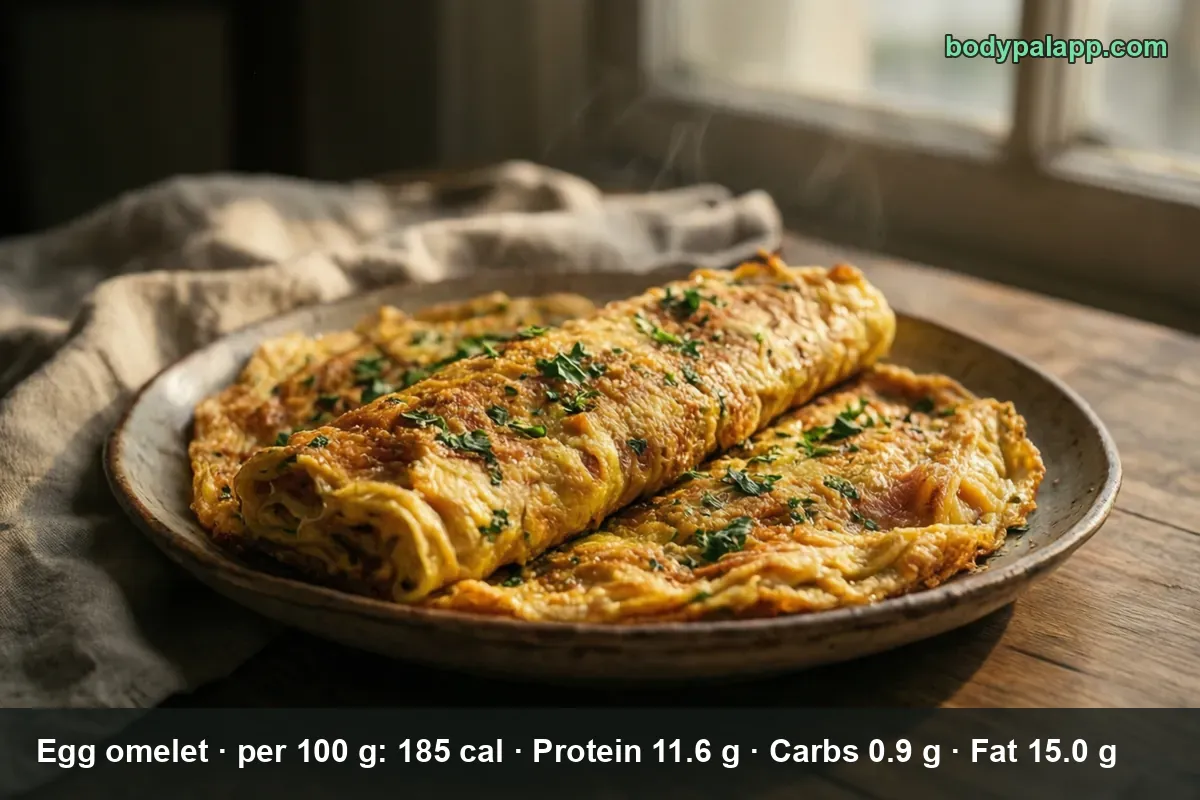
A two-egg omelet weighs about 110 g and carries 204 calories. Per 100 g the same omelet runs 185 calories, which puts it in the same range as fried eggs. Almost all of that is fat and protein — carbohydrate is under a gram — and the pan decides the rest.
On this page
- Egg omelet quick facts
- US servings from one egg to a full cup
- Butter or oil or nothing in the pan
- Cheese and ham omelets add more than you think
- Cholesterol is the row that jumps
- How does an egg omelet compare?
- Most popular egg omelet brands
- FAQ
Egg omelet quick facts
The record that matches what most people actually eat is FNDDS 2707198, "Egg omelet or scrambled egg, NS as to fat". "NS as to fat" means the fat in the pan was not specified — an average of how American home cooks make it, some butter, some oil, some spray, some nothing. If you cannot remember what your skillet had in it that morning, this is your row.
USDA's own quantity-not-specified portion for that record is 110 g, which is a standard two-egg omelet. Every headline number on this page runs off that.
| Nutrient | Per 100 g | Per 1 omelet, 2 eggs (110 g) | % Daily Value |
|---|---|---|---|
| Calories | 185 | 204 | — |
| Total fat | 15 g | 16.5 g | 21% |
| Saturated fat | 4.48 g | 4.9 g | 25% |
| Carbohydrate | 0.91 g | 1.0 g | 0% |
| Dietary fiber | 0 g | 0.0 g | 0% |
| Total sugars | 0.2 g | 0.2 g | — |
| Protein | 11.58 g | 12.7 g | 25% |
| Sodium | 248 mg | 273 mg | 12% |
| Cholesterol | 388 mg | 427 mg | 142% |
| Potassium | 124 mg | 136 mg | 3% |
% Daily Value is based on a 2,000-calorie diet.
Verified nutrition data
Numbers on this page come from USDA FoodData Central, the U.S. Department of Agriculture’s food composition database, and from manufacturer labels where a branded product is named. Last verified September 2026. How we verify our data →
There is no added-sugars row and no trans-fat row here, because this edition of FNDDS does not publish either for this food. That is no real loss on a plain omelet: total sugars are 0.2 g per 100 g, and none of it is added. The percentages come from the FDA's Daily Values for the Nutrition Facts label.
One spelling note, since it changes what you type into a search box and nothing else: American menus and the USDA both write omelet, while the British spelling omelette turns up the same food and the same numbers.
US servings from one egg to a full cup
| Serving | Weight | Calories |
|---|---|---|
| 1 oz | 28.4 g | 52 kcal |
| One egg's worth | 55 g | 102 kcal |
| One omelet, 2 eggs | 110 g | 204 kcal |
| One cup, chopped | 135 g | 250 kcal |
| One omelet, 3 eggs | 165 g | 305 kcal |
| Per 100 g | 100 g | 185 kcal |
The 110 g two-egg omelet and the 135 g cup are USDA portions. The ounce and the three-egg line are our own arithmetic from the USDA 100 g figure, not USDA servings — a third egg simply adds another 55 g.
Watch the cup. A measuring cup of chopped omelet is 135 g, so it holds nearly two and a half eggs' worth and lands at 250 calories, well past the 204 most people picture when they say "an omelet." If you log by cup and cook by egg, you will overshoot yourself by roughly a fifth every time. Logging by egg count is the more honest habit here.
The third egg is the other quiet cost. Going from two to three moves you from 204 to 305 — a jump of 101 calories, which is more than the difference between the leanest and the greasiest way of cooking a two-egg omelet.
Butter or oil or nothing in the pan
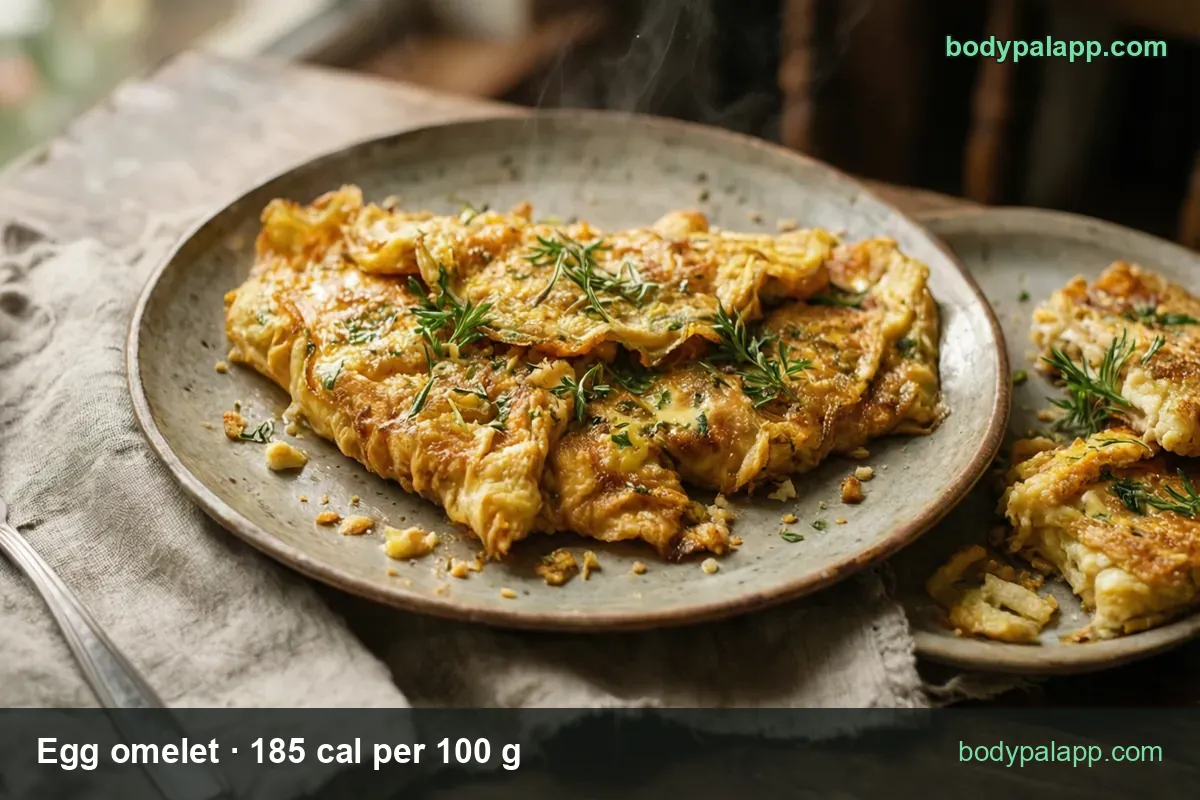
This is the part almost nobody counts. The eggs are fixed; the fat is not. USDA keeps a separate record for each way of greasing the skillet, and the spread across them is wide.
| Version | Per 100 g | Two-egg omelet (110 g) | Saturated fat per 100 g |
|---|---|---|---|
| No added fat | 143 kcal | 157 kcal | 3.19 g |
| Cooking spray | 149 kcal | 164 kcal | 3.21 g |
| Made with margarine | 171 kcal | 188 kcal | 3.82 g |
| Made with butter | 182 kcal | 200 kcal | 5.96 g |
| Fat not specified (main record) | 185 kcal | 204 kcal | 4.48 g |
| Made with oil | 192 kcal | 211 kcal | 3.85 g |
Every two-egg figure in that table except the 204 of the main record is our own arithmetic from the USDA 100 g numbers, scaled to 110 g.
The bottom line: 54 calories separate the dry omelet from the oil omelet at the same two-egg size, 157 against 211. That is more than half an egg's worth, bought or saved entirely in the pan. If you are trimming, a nonstick skillet and a two-second spray costs you only 7 calories over cooking dry and behaves much better.
Butter versus oil surprises people twice. Oil is the higher-calorie choice — 192 per 100 g against 182 — because a pat of butter is part water while oil is pure fat. But butter carries far more saturated fat, 5.96 g per 100 g against 3.85 g, so the two swap places depending on which line you are watching.
Cheese and ham omelets add more than you think
Fillings move calories less than you would guess and sodium more.
| Filling | Per 100 g | Two-egg omelet (110 g) | Sodium per 100 g |
|---|---|---|---|
| Plain, fat not specified | 185 kcal | 204 kcal | 248 mg |
| Dark-green vegetables | 166 kcal | 183 kcal | — |
| Ham or other meat | 190 kcal | 209 kcal | 353 mg |
| Cheese | 203 kcal | 223 kcal | 344 mg |
All three filled two-egg figures are our arithmetic from the matching USDA 100 g records, scaled to 110 g. The sodium column uses the closest no-added-fat cheese record and the meat record; the dark-green vegetable row has no published sodium figure at the same preparation, so it is left out rather than guessed.
A cheese omelet costs 19 calories more than plain at the same weight, and a ham omelet 5. Those are rounding errors next to the 101 calories a third egg adds. What the fillings really change is salt: cheese pushes sodium to 344 mg per 100 g and meat to 353 mg, both roughly 40% above the plain omelet's 248 mg. A two-egg meat omelet lands near 388 mg of sodium, about 17% of the 2,300 mg Daily Value, from breakfast alone.
Vegetables run the other way. A dark-green vegetable omelet is 166 per 100 g, or 183 for two eggs, because the vegetables displace egg with water and bulk. It is the only filling on this list that makes the plate bigger and the count smaller.
Cholesterol is the row that jumps
Read the % Daily Value column again and one number stands out by a mile. A two-egg omelet delivers 427 mg of cholesterol, 142% of the 300 mg Daily Value. Nothing else on the label comes close: saturated fat is 25%, protein 25%, total fat 21%, sodium just 12%.
That percentage is a labeling reference, not a ceiling anyone has to hit. The Dietary Guidelines for Americans dropped the old numeric cap and now advise keeping dietary cholesterol as low as possible within an eating pattern that still works, which is why eggs sit comfortably in the protein foods group on MyPlate. If your doctor has you tracking cholesterol, this is a number worth knowing before breakfast rather than after.
The upside on the same plate is protein. Two eggs give 12.7 g, a quarter of the Daily Value, for 204 calories — about 16 calories per gram of protein. Cooked dry, that improves to 12.4 g of protein per 100 g at 143 calories, one of the better protein-per-calorie trades available at 7 a.m. without opening a tub of anything.
How does an egg omelet compare?
| Egg dish | Per 100 g | US serving | Calories |
|---|---|---|---|
| Egg omelet, fat not specified | 185 kcal | one omelet, 2 eggs, 110 g | 204 kcal |
| Egg, whole, fried | 185 kcal | 100 g | 185 kcal |
| Egg, whole, baked with fat | 185 kcal | 100 g | 185 kcal |
| Omelet with cheese and tomatoes | 186 kcal | 100 g | 186 kcal |
Our take: at the gram level these four are the same food. All of them sit at 185 or 186 calories per 100 g — a spread of a single calorie — so choosing between frying, baking and folding is a texture decision, not a calorie one. The number on your log is set by two things only: how many eggs go in, and how much fat goes in the pan. Two eggs cooked dry is 157; three eggs cooked in oil is 317, both our own scaling from the USDA 100 g rows. That is the real range, and both ends are called "an omelet."
Most popular egg omelet brands in the United States
Ranked by how widely each product appears among foods sold in the United States, from the BodyPal food database of over 3.3 million products. Calories are the figures printed on each Nutrition Facts label, checked against USDA FoodData Central.
| Product | Calories (per 100 g) |
|---|---|
| Unearthed Traditional Egg & Potato Omelet | 164 cal |
| Eggland's Best Ham & Cheese Omelets | 171 cal |
| Atkins Ham & Cheese Omelet | 172 cal |
| Bob Evans Omelet Rolls | 158 cal |
| Jimmy Dean Cheddar Cheese Omelet | 155 cal |
| Crepini Omelets To-Go Cheddar Cheese | 318 cal |
Brand popularity: BodyPal food database. Nutrition: manufacturer labels / USDA FoodData Central.
Egg omelet FAQs
How many calories are in a 2 egg omelet?
204 calories for a 110 g omelet made with two eggs, from the USDA's unspecified-fat record at 185 calories per 100 g. That figure assumes some fat in the pan. Cook the same two eggs dry and you land near 157; finish them in oil and it climbs to 211.
How many calories are in a 3 egg omelet?
About 305 calories. That is our own arithmetic from the USDA 100 g figure of 185, scaled to 165 g, because USDA publishes only the two-egg portion. Add cheese and you are closer to 335; cook the three eggs in oil and they run near 317 instead.
How many calories in an omelet with no added fat?
143 calories per 100 g, or about 157 for a two-egg omelet of 110 g. That is 47 calories less than the standard 204, purely because nothing went into the pan. A nonstick skillet with cooking spray sits between them, at 149 per 100 g or 164 for two eggs.
Does butter or oil add more calories to an omelet?
Oil adds more. USDA puts a butter omelet at 182 calories per 100 g and an oil omelet at 192, so a two-egg version is 200 with butter and 211 with oil. Butter is the lighter of the two but carries more saturated fat, 5.96 g per 100 g against 3.85 g.
How much protein is in an egg omelet?
12.7 g in a two-egg omelet of 110 g, which is 25% of the Daily Value, and 11.58 g per 100 g. A cup of chopped omelet, 135 g, brings 15.6 g. Skipping the fat in the pan nudges protein up per 100 g, to 12.36 g, because there is less fat diluting it.
How much cholesterol is in a 2 egg omelet?
427 mg, which is 142% of the 300 mg Daily Value, scaled from 388 mg per 100 g. It is by far the highest percentage on this food's label; sodium, by comparison, reaches only 273 mg, or 12%. The eggs themselves supply nearly all of it, not the cooking fat.
How many calories in a cheese omelet?
223 calories for a two-egg cheese omelet of 110 g, at 203 per 100 g. That is only 19 more than the plain version. Cheese moves sodium far more than calories: the cheese record carries 344 mg per 100 g against 248 mg for a plain omelet.
Is an omelet better than scrambled eggs for calories?
They are identical. USDA files omelets and scrambled eggs under one record, 185 calories per 100 g, because the pan treatment is the same. What changes the number is the fat: 143 per 100 g cooked dry, 182 with butter, 192 with oil. The shape of the eggs does not.
Similar foods
- Duck Egg — 130 cal per egg
- Egg And Toast — 248 cal per fried egg + 2 slices toast
- Omelet — 305 cal for 3-egg omelet
- Scrambled Eggs — 102 cal per egg
- Egg Dosa — 208 cal per small dosa
- Egg Fried In Butter — 100 cal per fried egg
Count it without the math
Point the camera at the plate and BodyPal counts the omelet for you, fillings and all.


How long does it take to burn off an egg omelet?
One omelet made with two eggs (110 g) is 204 kcal. Enter your weight and the amount you ate to see how long it takes you to burn that off:
lb
| Activity | Time to burn 204 kcal |
|---|---|
| Walking, brisk | 41 min |
| Cycling, moderate | 26 min |
| Swimming, moderate | 29 min |
| Jogging | 24 min |
| Weight training, moderate | 45 min |
Times are for a 155 lb adult at a steady pace; change the weight to see yours. The amount is set to the portion in the text (110 g); change it to what you actually ate. BodyPal works this out from your steps automatically.
Burning it off is one side of it. The other is knowing your number: work out how many calories you need a day, with macros and a goal date.