
How many calories are in an egg dosa?
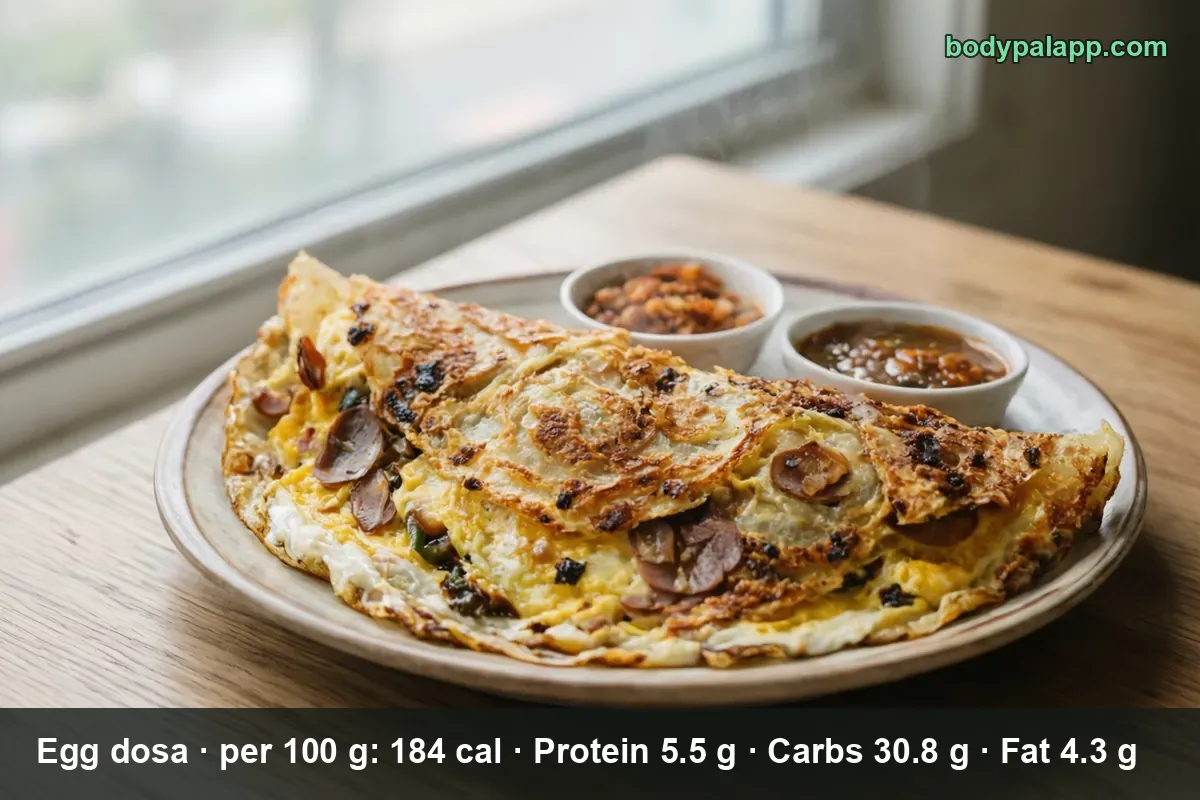
A small egg dosa weighing 113 g carries 208 calories, and per 100 g a filled dosa runs 184 calories. That is a modest number for a plate that looks substantial: the batter is thin, the fat is low, and most of the weight is savory filling rather than oil or cheese.
On this page
- Egg dosa quick facts
- US servings, from one ounce to a large dosa
- Plain, frozen, oats and brown rice dosas
- Sodium is the row to watch
- How does an egg dosa compare?
- Most popular egg dosa brands
- FAQ
Egg dosa quick facts
USDA has no record called "egg dosa." The closest match to what you are actually holding is the FoodData Central entry Dosa, with filling (FNDDS 2709129), the only dosa record that includes a filling and that comes with portion weights for a whole stuffed dosa: 113 g small, 267 g medium, 523 g large. That is the record used for every number on this page.
One caveat worth stating up front: the filling in that USDA record is potato, not egg. At the same weight, an egg filling pushes protein up and carbohydrate slightly down. USDA does not publish a separate figure for the egg version, so the protein line below is the conservative floor rather than the ceiling.
| Nutrient | Per 100 g | Per 1 small dosa (113 g) | % Daily Value |
|---|---|---|---|
| Calories | 184 | 208 | — |
| Total fat | 4.27 g | 4.8 g | 6% |
| Saturated fat | 0.58 g | 0.7 g | 3% |
| Carbohydrate | 30.8 g | 34.8 g | 13% |
| Dietary fiber | 2.2 g | 2.5 g | 9% |
| Total sugars | 1.1 g | 1.2 g | — |
| Protein | 5.46 g | 6.2 g | 12% |
| Sodium | 330 mg | 373 mg | 16% |
% Daily Value is based on a 2,000-calorie diet.
Verified nutrition data
Numbers on this page come from USDA FoodData Central, the U.S. Department of Agriculture’s food composition database, and from manufacturer labels where a branded product is named. Last verified September 2026. How we verify our data →
Added sugars and trans fat are not in the table because USDA does not publish those two values for Survey (FNDDS) mixed dishes. Cholesterol reads 0 mg on this record, again because the filling is potato; a dosa built around a real egg will not be at zero, and there is no USDA record for that version to quote. Potassium is 137 mg per 100 g, or 155 mg in the small dosa, which is 3% of the FDA Daily Value.
US servings, from one ounce to a large dosa
| Serving | Weight | Calories |
|---|---|---|
| 1 oz | 28 g | 52 kcal |
| 1 small dosa | 113 g | 208 kcal |
| 1 medium dosa | 267 g | 491 kcal |
| 1 large dosa | 523 g | 962 kcal |
| Per 100 g | 100 g | 184 kcal |
Small, medium and large are USDA's own household portions for this record, so those three calorie figures are not estimates. The 1 oz row is our own arithmetic from the USDA 100 g figure, not a USDA serving; it is there because packaged and frozen dosas are sold by weight, not by size name.
The spread between those three sizes is the whole story. A small dosa and a large dosa are the same food, but the large weighs more than four and a half times as much, and 962 calories is not a snack. Restaurant menus rarely tell you which size is on the plate, and a folded dosa hides its own length. If you are logging by eye, weigh it once, then remember what that size looked like.
Chutney and sambar are not in any of these numbers. The USDA record covers the dosa and its filling only, so the two small bowls that arrive alongside sit on top of everything in the table.
Plain, frozen, oats and brown rice dosas
| Version | Per 100 g | Typical piece | Calories |
|---|---|---|---|
| Filled dosa (the main record) | 184 kcal | 1 small, 113 g | 208 kcal |
| Plain dosa, no filling | 210 kcal | 1 medium, 80 g | 168 kcal |
| Frozen masala dosa, retail | 273 kcal | 1 dosa + chutney, 99 g | 270 kcal |
| Oats dosa, retail | 175 kcal | 57 g | 100 kcal |
| Brown rice dosa, retail | 170 kcal | 57 g | 97 kcal |
| Crepe, plain | 224 kcal | 80 g | 179 kcal |
| Chinese pancake | 207 kcal | 80 g | 166 kcal |
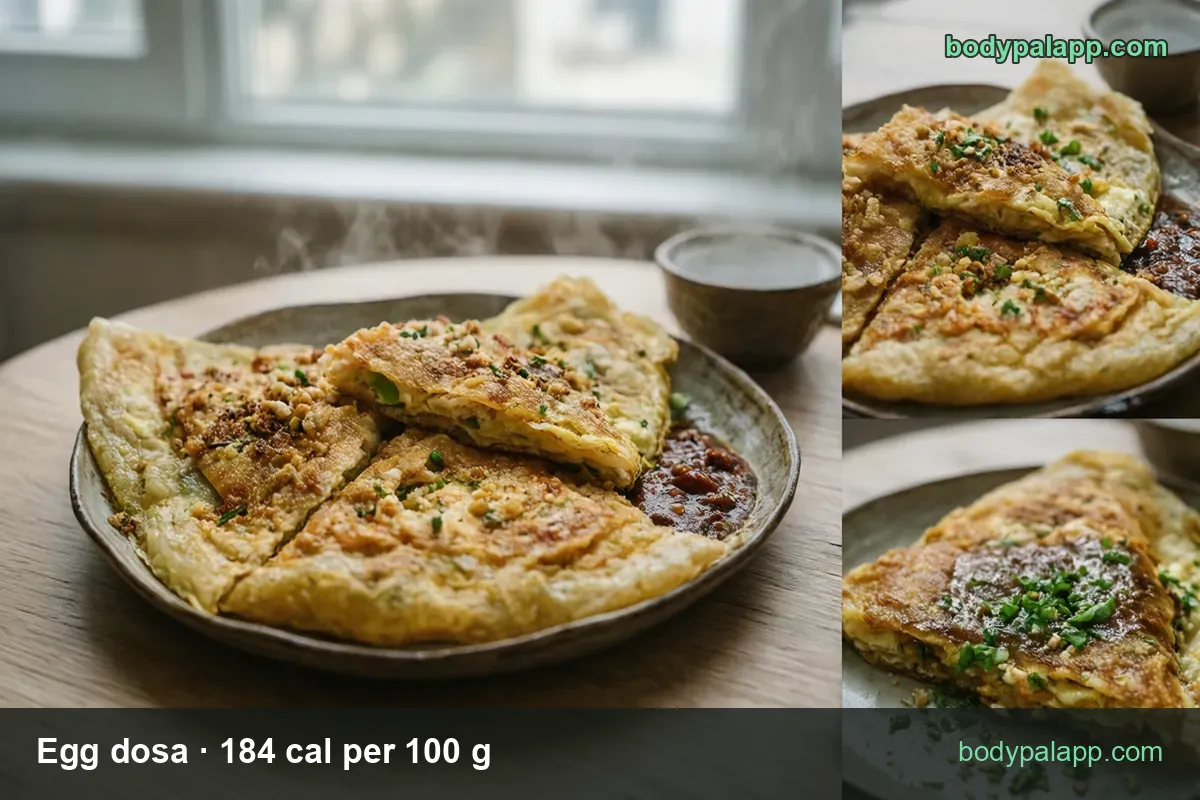
Here is the counterintuitive part. A plain dosa is denser than a filled one, 210 calories per 100 g against 184, because nothing wet has been added to the batter. Fill it and the per-gram number drops. But the plate goes up, not down: a medium filled dosa is 267 g and 491 calories, while a plain one at 80 g is 168. The filling dilutes the density and multiplies the weight at the same time, and weight wins.
Retail dosas behave differently again. A frozen masala dosa with its chutney packet is 273 calories per 100 g, the densest item in the table, and the whole 99 g tray is 270 calories. The two dry-mix retail dosas, oats at 175 and brown rice at 170 per 100 g, are the lightest per gram, and their 57 g labeled servings land at 100 and 97 calories. Those are label servings from the manufacturer, not USDA household portions.
Two crepe-family records sit here for reference. A plain crepe is 224 calories per 100 g with 11.29 g of fat, more than double the 4.27 g in a filled dosa, because crepe batter is built on egg, milk and butter rather than fermented rice and lentils. A Chinese pancake is 207 calories with only 0.38 g of fat but 45.38 g of carbohydrate per 100 g. Same shape, three different builds.
Sodium is the row to watch
Calories are not the interesting column on this food. Sodium is. A small dosa carries 373 mg, 16% of the Daily Value, which is about a sixth of a teaspoon of table salt. That is fine. Order the medium and it becomes 881 mg, or 38% of the Daily Value, before a spoonful of chutney or a bowl of sambar touches the plate. The large is 1,726 mg, 75% of the day's allowance in one dish. The Dietary Guidelines for Americans set the ceiling at 2,300 mg per day for adults, and most people are already over it.
Fiber runs the other way, and it is the quiet advantage of a fermented rice-and-lentil batter. The small dosa gives 2.5 g, 9% of the Daily Value. The large gives 11.5 g, or 41% of a day's fiber in one sitting, which is more than most restaurant breakfasts manage. MyPlate's grains guidance puts fiber-carrying grains at the center of the plate, and dosa batter qualifies without trying.
Saturated fat is close to a non-issue: 0.7 g in a small dosa, 3% of the Daily Value. If you are choosing a breakfast on saturated fat alone, a dosa beats almost anything fried in butter. If you are choosing on sodium, order small.
How does an egg dosa compare?
| Food | Per 100 g | US serving | Calories |
|---|---|---|---|
| Egg dosa (filled dosa) | 184 kcal | 1 small, 113 g | 208 kcal |
| Dosa, plain | 210 kcal | 1 medium, 80 g | 168 kcal |
| Crepe, plain | 224 kcal | 80 g | 179 kcal |
| Chinese pancake | 207 kcal | 80 g | 166 kcal |
The 80 g weights for the crepe and the Chinese pancake are our own arithmetic from the USDA 100 g figures, not USDA servings, so those two rows are matched to the plain dosa's portion for a fair per-piece read.
Our take: the filled dosa is the lightest of these four per 100 g at 184 calories, and it is still the biggest number on the plate at 208, because it is the only one that arrives as a full stuffed piece. That is the trap worth naming. If you are cutting calories, the plain dosa at 168 is the smaller order and the crepe at 179 is the fattiest per gram. If you want to stay full until lunch, the filled dosa is the better buy at 208 calories with 2.5 g of fiber and 6.2 g of protein, and an egg filling only improves that ratio. Skip the large, whatever the filling is.
Most popular egg dosa brands in the United States
Ranked by how widely each product appears among foods sold in the United States, from the BodyPal food database of over 3.3 million products. Calories are the figures printed on each Nutrition Facts label, checked against USDA FoodData Central.
| Product | Calories (per 100 g) |
|---|---|
| Deep Indian Kitchen Masala Dosa | 273 cal |
| Shastha Oats Dosa | 175 cal |
| Shastha Brown Rice Dosa | 170 cal |
Brand popularity: BodyPal food database. Nutrition: manufacturer labels / USDA FoodData Central.
Egg dosa FAQs
How many calories are in an egg dosa?
208 calories for a small dosa weighing 113 g, based on USDA's filled-dosa record at 184 calories per 100 g. A medium dosa of 267 g is 491 calories and a large of 523 g is 962. Size drives the number far more than the filling does.
Egg dosa vs plain dosa: which has more calories?
Per 100 g the plain dosa is higher, 210 calories against 184, because no moist filling has been added to dilute the batter. Per piece the filled dosa wins easily: a small filled dosa is 208 calories at 113 g, while a medium plain dosa is 168 calories at 80 g.
How much protein does an egg dosa have?
6.2 g in a small 113 g dosa, which is 12% of the Daily Value, from 5.46 g per 100 g. That figure comes from USDA's potato-filled record, so an egg filling at the same weight will read higher. USDA does not publish a separate record for the egg version.
How many calories in 2 egg dosas?
416 calories for two small dosas, 226 g in total, doubled from the 208-calorie USDA portion. Two also means 746 mg of sodium, or 32% of the Daily Value, plus whatever the chutney and sambar add. Two medium dosas would be 982 calories, closer to a day's half.
How many carbs are in an egg dosa?
34.8 g in a small 113 g dosa, 13% of the Daily Value, from 30.8 g per 100 g. Of that, only 1.2 g is total sugars, and 2.5 g is fiber. A plain dosa is more carbohydrate-dense per gram at 37.04 g, since the batter is not diluted by filling.
How much sodium is in an egg dosa with chutney?
373 mg in a small dosa alone, 16% of the Daily Value, and 881 mg in a medium, which is 38%. Chutney and sambar sit on top of those figures, because the USDA record covers the dosa and its filling only. The sides are not counted anywhere on this page.
Is egg dosa good for weight loss?
A small dosa at 208 calories works well, with 2.5 g of fiber and 6.2 g of protein and only 0.7 g of saturated fat. The large is the problem: 962 calories and 1,726 mg of sodium in one dish. If you are watching calories, order small and treat the chutney as extra.
Egg dosa vs masala dosa calories?
A retail frozen masala dosa is 273 calories per 100 g, well above the 184 of USDA's filled-dosa record, and its 99 g tray with chutney lands at 270 calories. A small fresh dosa is 208 at 113 g. The frozen version is denser per gram but arrives in a smaller piece.
Similar foods
- Duck Egg — 130 cal per egg
- Egg And Toast — 248 cal per fried egg + 2 slices toast
- Egg Omelet — 204 cal per omelet, 2 eggs
- Omelet — 305 cal for 3-egg omelet
- Scrambled Eggs — 102 cal per egg
- Egg Fried In Butter — 100 cal per fried egg
Count it without the math
Point the camera at the plate and BodyPal counts the dosa, filling and all.


How long does it take to burn off egg dosa?
One small dosa (113 g) is 208 kcal. Enter your weight and the amount you ate to see how long it takes you to burn that off:
lb
| Activity | Time to burn 208 kcal |
|---|---|
| Walking, brisk | 42 min |
| Cycling, moderate | 26 min |
| Swimming, moderate | 30 min |
| Jogging | 24 min |
| Weight training, moderate | 46 min |
Times are for a 155 lb adult at a steady pace; change the weight to see yours. The amount is set to the portion in the text (113 g); change it to what you actually ate. BodyPal works this out from your steps automatically.
One food is easy to picture; a whole day is harder. See how many calories you need a day and what a deficit actually looks like.