
How many calories are in an egg fried in butter?
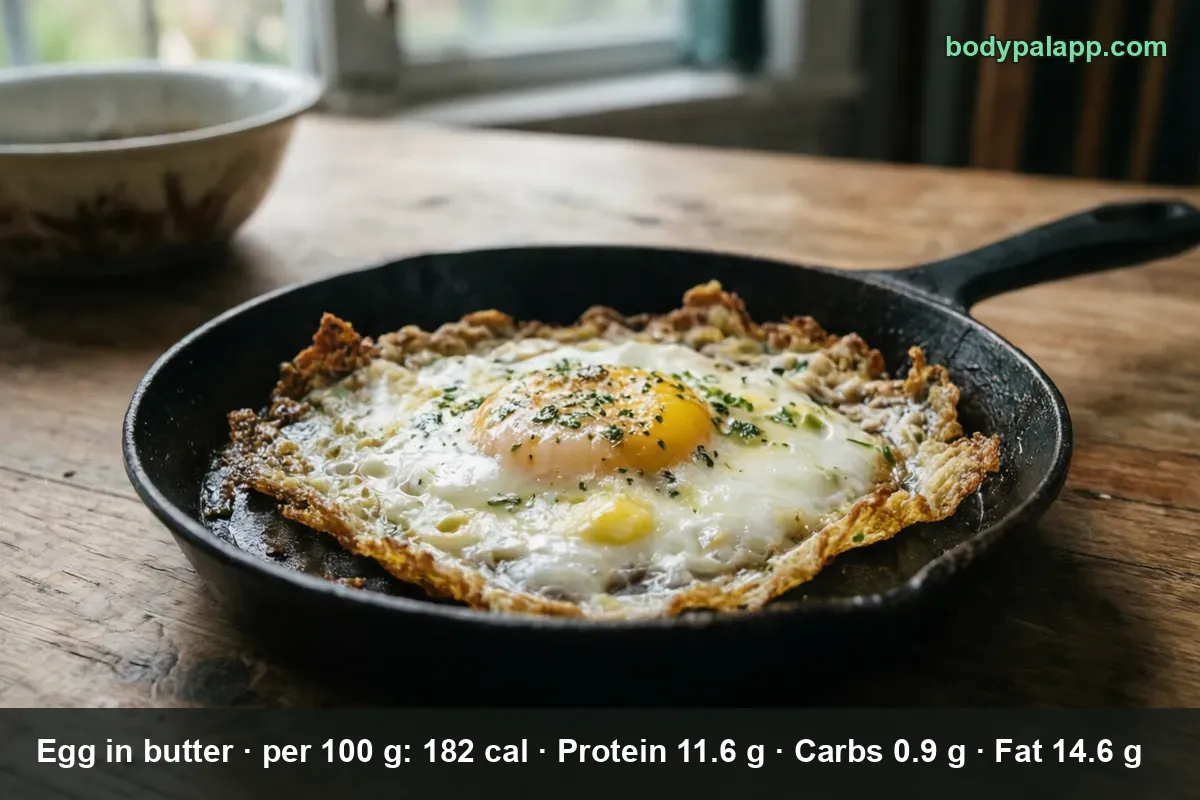
One egg fried in butter weighs 55 g and lands at 100 calories. Per 100 g the same egg runs 182 calories, which puts a two-egg breakfast at 200. Fat does most of the work here: 14.64 g per 100 g against 11.61 g of protein. And the cholesterol column moves faster than the calorie one.
On this page
- Egg in butter quick facts
- US servings, from one ounce to a chopped cup
- Scrambled eggs, omelets and egg whites in butter
- Cholesterol is the row to watch
- How does an egg in butter compare?
- Most popular egg in butter brands
- Egg in butter FAQs
Egg in butter quick facts
The record that matches what is on your fork is FNDDS 2707159, "Egg, whole, fried with butter", from the USDA 2021-2023 survey files. It is a whole egg cooked in butter, yolk included, with the butter already counted in the numbers. That matters, because the plain "fried egg" entries in the same database leave the cooking fat unspecified and land a few calories higher per 100 g.
The omelet, scrambled and egg-white records are different preparations, not different sources, so they stay in the variant table further down rather than getting averaged into this one.
| Nutrient | Per 100 g | Per 1 fried egg (55 g) | % Daily Value |
|---|---|---|---|
| Calories | 182 | 100 | — |
| Total fat | 14.64 g | 8.1 g | 10% |
| Saturated fat | 5.96 g | 3.3 g | 16% |
| Carbohydrate | 0.9 g | 0.5 g | 0% |
| Dietary fiber | 0 g | 0 g | 0% |
| Total sugars | 0.22 g | 0.1 g | — |
| Protein | 11.61 g | 6.4 g | 13% |
| Sodium | 263 mg | 145 mg | 6% |
| Cholesterol | 398 mg | 219 mg | 73% |
| Potassium | 125 mg | 69 mg | 1% |
% Daily Value is based on a 2,000-calorie diet.
Verified nutrition data
Numbers on this page come from USDA FoodData Central, the U.S. Department of Agriculture’s food composition database, and from manufacturer labels where a branded product is named. Last verified September 2026. How we verify our data →
Two rows you would see on a package are missing here on purpose. USDA does not publish added sugars or trans fat for the egg entries in this FNDDS release, so quoting either would mean inventing a number. The sodium, meanwhile, is mostly salted butter and seasoning rather than the egg itself: 145 mg is about a sixteenth of a teaspoon of table salt.
US servings, from one ounce to a chopped cup
| Serving | Weight | Calories |
|---|---|---|
| 1 oz | 28 g | 51 kcal |
| One fried egg | 55 g | 100 kcal |
| Two fried eggs | 110 g | 200 kcal |
| 1 cup, chopped | 135 g | 246 kcal |
| Per 100 g | 100 g | 182 kcal |
Two of these are USDA household measures: the single egg at 55 g and the chopped cup at 135 g. The two-egg line and the ounce are our own arithmetic from the USDA 100 g figure, not USDA servings, which is why they scale so cleanly.
The chopped cup is where people get burned. A cup sounds like breakfast for one, but at 135 g it is roughly two and a half fried eggs, and 246 calories. If you log a fried egg by volume after chopping it into a bowl or a salad, you are almost certainly logging more than you cooked. Weighing the eggs before they hit the pan is the faster fix: a large egg out of the shell is close enough to the 55 g USDA piece that the math holds.
Scrambled eggs, omelets and egg whites in butter
| Version | Per 100 g | Typical serving | Calories |
|---|---|---|---|
| Fried in butter | 182 kcal | 1 egg, 55 g | 100 kcal |
| Scrambled with butter | 182 kcal | 1 egg, 55 g | 100 kcal |
| Egg white, fried or scrambled in butter | 97 kcal | 1 white, 36 g | 35 kcal |
| Omelet with cheese, made with butter | 203 kcal | 1 egg, 65 g | 132 kcal |
| Omelet with meat, made with butter | 190 kcal | 1 egg, 75 g | 143 kcal |
| Omelet with cheese and meat, made with butter | 207 kcal | 1 egg, 85 g | 176 kcal |
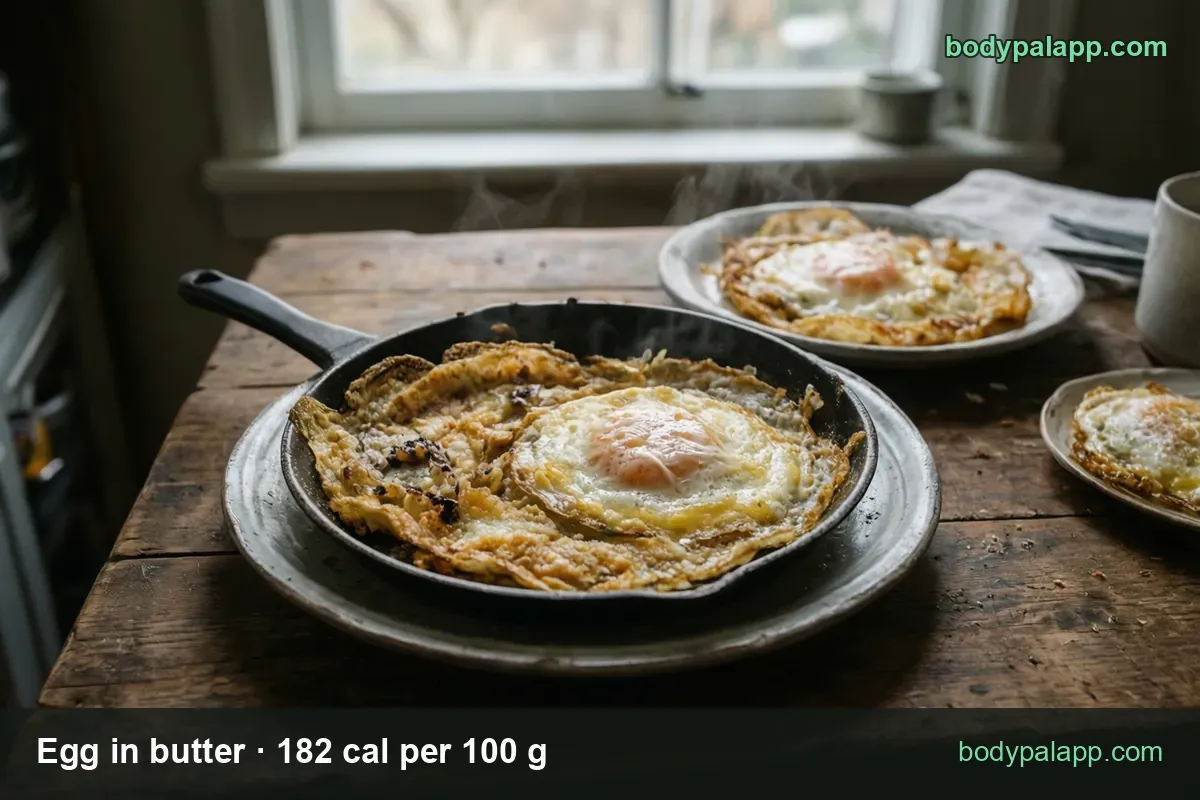
Scrambling is free. USDA gives the scrambled-in-butter record the same 182 calories per 100 g as the fried one, with identical fat, protein and sodium, because stirring changes texture and nothing else. What you fold into it is the whole story: cheese pushes the per-100-g figure to 203, meat to 190, and both together to 207, while the serving weight climbs at the same time. A cheese-and-meat omelet built on one egg's worth of filling weighs 85 g and costs 176 calories, 76 percent more than the plain fried egg.
Egg whites go the other direction. At 97 calories per 100 g, a 36 g white cooked in butter is 35 calories, and fat drops from 14.64 g to 5.36 g per 100 g. The trade is sodium: the white record carries 297 mg per 100 g against 263 mg for the whole egg, since there is less egg and proportionally more salted butter in the pan.
Supermarket versions sit in the same range once you account for the filling. A Jimmy Dean Cheddar Cheese Omelet is 155 calories per 100 g, or 110 for one omelet, while Simple Truth Three Cheese Fluffy Egg Bites run 280 per 100 g and 230 for five pieces. There is no packaged product that is simply an egg fried in butter, which is why the homemade record is the one to log.
Cholesterol is the row to watch
Calories are not the interesting constraint on this plate. One fried egg is 100 calories, five percent of a 2,000-calorie day, but its 219 mg of cholesterol is 73 percent of the FDA Daily Value of 300 mg. Two eggs come to 438 mg, or 146 percent. The chopped cup reaches 537 mg, 179 percent, on 246 calories.
Saturated fat behaves the same way. One egg brings 3.3 g, 16 percent of the 20 g Daily Value; two bring 6.6 g, 33 percent. The Dietary Guidelines for Americans suggest keeping saturated fat under 10 percent of daily calories, which is about 22 g at 2,000 calories, so a two-egg breakfast in butter uses roughly a third of that before anything else is on the plate.
The upside is real too. At 6.4 g of protein per egg, 13 percent of the Daily Value, this is a solid entry in the MyPlate protein group, though not the leanest one per calorie. If you are watching saturated fat or cholesterol, the egg-white record does the protein job at 10.03 g per 100 g for 97 calories and no cholesterol at all. If you are watching sodium, cook in unsalted butter and season at the table.
How does an egg in butter compare?
Comparing egg records at a common weight makes the point better than comparing servings, so every line here is priced at one ounce.
| Cooked egg record | Per 100 g | US serving | Calories |
|---|---|---|---|
| Egg, whole, fried with butter | 182 kcal | 1 oz, 28 g | 51 kcal |
| Egg, whole, fried, NS as to fat | 185 kcal | 1 oz, 28 g | 52 kcal |
| Omelet with cheese and meat, cooking spray | 182 kcal | 1 oz, 28 g | 51 kcal |
| Omelet with meat, made with margarine | 181 kcal | 1 oz, 28 g | 51 kcal |
Our take: the fat you cook in barely registers. Four calories per 100 g separate the highest of these records from the lowest, and at an ounce they are within a single calorie of each other. Swapping butter for margarine or cooking spray is not a calorie decision, it is a saturated-fat one, and the spray version also pushes protein to 13.89 g per 100 g because it is carrying cheese and meat. For weight loss, the lever is the count of eggs and the fillings, not the pan. For staying full, keep the yolks: 6.4 g of protein and 8.1 g of fat per egg hold better than the same calories in white-only scramble.
Most popular egg in butter brands in the United States
Ranked by how widely each product appears among foods sold in the United States, from the BodyPal food database of over 3.3 million products. Calories are the figures printed on each Nutrition Facts label, checked against USDA FoodData Central.
| Product | Calories (per 100 g) |
|---|---|
| Jimmy Dean Cheddar Cheese Omelet | 155 cal |
| Just Crack An Egg Garden Omelet Rounds | 123 cal |
| Three Little Pigs Sous Vide Sausage & Cheddar Egg Bites | 200 cal |
| Hormel Eggs, Bacon & 3 Cheeses Egg Bites | 218 cal |
| Jimmy Dean Gouda & Bacon Omelet Minis | 244 cal |
| Simple Truth Three Cheese Fluffy Egg Bites | 280 cal |
Brand popularity: BodyPal food database. Nutrition: manufacturer labels / USDA FoodData Central.
Egg in butter FAQs
How many calories are in an egg fried in butter?
100 calories for one 55 g egg fried in butter, or 182 calories per 100 g. That is the USDA FNDDS record for a whole egg cooked in butter, not a dry pan. Two eggs come to 200 calories, and a chopped cup of them, 135 g, reaches 246.
How many calories in 2 eggs fried in butter?
200 calories for two 55 g eggs fried in butter, doubled from the USDA 100 g figure rather than taken from a USDA serving. They bring 12.8 g of protein, 16.1 g of fat and 438 mg of cholesterol, which is 146 percent of the Daily Value in one plate.
Is a fried egg in butter healthy?
One egg delivers 6.4 g of protein for 100 calories, 13 percent of the protein Daily Value for 5 percent of a 2,000-calorie day. The catch is 219 mg of cholesterol and 3.3 g of saturated fat, 73 and 16 percent of their Daily Values. If you are watching saturated fat, cook fewer eggs in less butter.
How much cholesterol is in an egg cooked in butter?
219 mg in one 55 g fried egg, 73 percent of the 300 mg Daily Value. Per 100 g the record shows 398 mg. A chopped cup, 135 g, carries 537 mg, or 179 percent, so the cholesterol column runs out long before the calorie column does.
How much protein is in an egg fried in butter?
6.4 g in one 55 g egg, 13 percent of the 50 g Daily Value, and 11.61 g per 100 g. Two eggs bring 12.8 g. The egg white version is the denser option per calorie: 10.03 g of protein per 100 g for only 97 calories.
Do scrambled eggs made with butter have more calories than fried?
No, both sit at 182 calories per 100 g, so a 55 g egg is 100 calories either way. USDA files scrambled eggs and omelets made with butter under a separate record with identical fat, protein and sodium. Stirring changes texture, not composition. Fillings are what move the number.
Are egg whites fried in butter lower in calories?
Yes, 97 calories per 100 g against 182, and a single 36 g white cooked in butter is 35 calories. Fat drops from 14.64 g to 5.36 g per 100 g and the cholesterol disappears. Sodium goes the other way, 297 mg per 100 g against 263 mg.
Are eggs in butter keto friendly?
Carbohydrate is 0.9 g per 100 g, so one 55 g fried egg carries 0.5 g, well inside any low-carb count. Fat supplies 14.64 g per 100 g and protein 11.61 g. The cheese omelet version stays low too, at 1.41 g of carbohydrate per 100 g.
Similar foods
- Omelet — 305 cal for 3-egg omelet
- Egg — 72 cal per large egg
- Crepe — 179 cal per crepe
- Pancake — 423 cal for 3 medium pancakes
- Toast with butter — 100 cal per slice with butter
- Shrimp Tempura Roll — 432 cal per roll, 8 pieces
Count it without the math
Point the camera at the skillet and BodyPal counts the eggs and the butter together.


How long does it take to burn off 100 kcal of egg in butter?
One fried egg (55 g) is 100 kcal. Enter your weight and the amount you ate to see how long it takes you to burn that off:
lb
| Activity | Time to burn 100 kcal |
|---|---|
| Walking, brisk | 20 min |
| Cycling, moderate | 12 min |
| Swimming, moderate | 14 min |
| Jogging | 12 min |
| Weight training, moderate | 22 min |
Times are for a 155 lb adult at a steady pace; change the weight to see yours. The amount is set to the portion in the text (55 g); change it to what you actually ate. BodyPal works this out from your steps automatically.
Burning it off is one side of it. The other is knowing your number: work out how many calories you need a day, with macros and a goal date.