
How Many Calories in a Crepe?
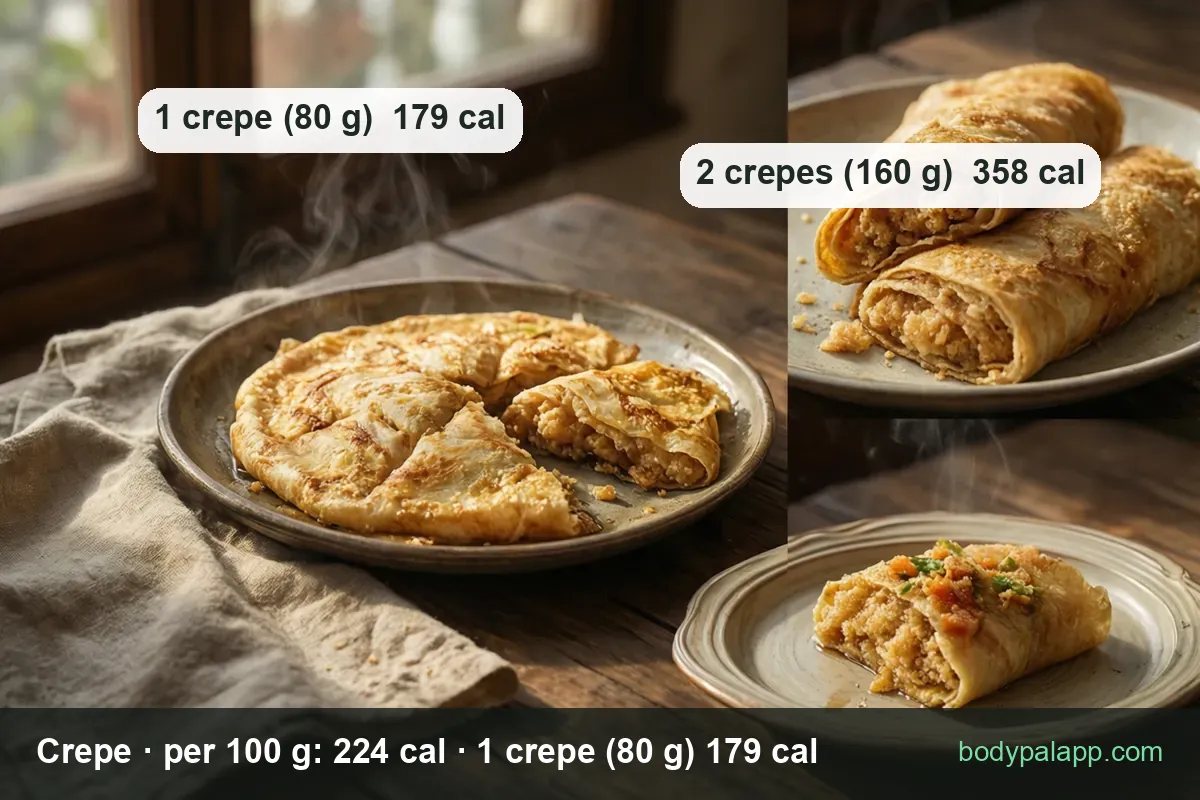
One crepe is 179 calories. That is USDA's standard piece — 80 g of thin batter off a flat pan — running 224 calories per 100 g. Two crepes make 358. The fillings then move the number in a direction most people guess wrong: chocolate and fruit pull the calories per gram down, and the savory one folded around meat is the heaviest thing on this page at 268.
On this page
- Crepe quick facts
- How many crepes are on the plate
- Sweet fillings lower the calories per gram
- The savory crepe is the heavy one
- Cholesterol is the number to read
- Crepe vs pancake: the piece, not the batter
- Packaged crepes read much higher
- Most popular crepe brands
- FAQ
Crepe quick facts
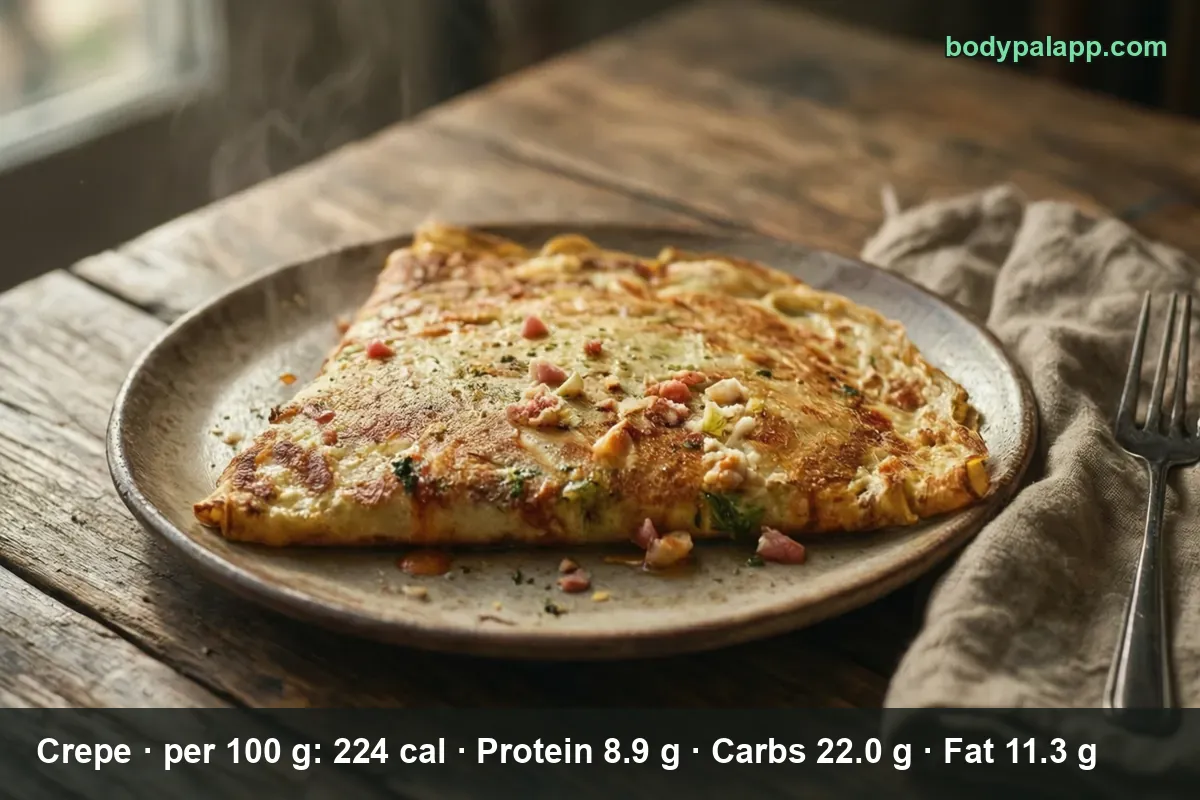
The reference here is a crepe with nothing decided about it yet: egg, milk and flour cooked thin, no filling, no sugar dusted over the top. USDA files it as record 2708341, "Crepe, NFS" — not further specified, which is the database's way of describing the crepe an American is actually handed. It weighs one at 80 g.
| Nutrient | Per 100 g | Per 1 crepe (80 g) | % Daily Value |
|---|---|---|---|
| Calories | 224 | 179 | — |
| Total fat | 11.29 g | 9.0 g | 12% |
| Saturated fat | 3.44 g | 2.8 g | 14% |
| Carbohydrate | 22.02 g | 17.6 g | 6% |
| Dietary fiber | 0.6 g | 0.5 g | 2% |
| Total sugars | 4.48 g | 3.6 g | — |
| Protein | 8.85 g | 7.1 g | 14% |
| Sodium | 278 mg | 222 mg | 10% |
| Cholesterol | 153 mg | 122 mg | 41% |
| Potassium | 169 mg | 135 mg | 3% |
% Daily Value is based on a 2,000-calorie diet.
Verified nutrition data
Numbers on this page come from USDA FoodData Central, the U.S. Department of Agriculture’s food composition database, and from manufacturer labels where a branded product is named. Last verified September 2026. How we verify our data →
Two lines you would see on a package are absent here, and that is deliberate. This edition of USDA's survey database carries no added-sugars value and no trans fat value for any crepe record at all, so neither row is filled in from a lookalike food. Total sugars run without a percentage because the FDA assigns a Daily Value to added sugars only.
Now read down the right-hand column, because the calories are the least interesting thing in it. One crepe is about 9% of a 2,000-calorie day and 12% of the fat. Cholesterol is 41% of the Daily Value in a single 80 g crepe — a consequence of a batter that is largely eggs and milk. No crepe recipe on the internet leads with that figure. It is the one that separates a crepe from every other flat breakfast starch.
How many crepes are on the plate
Nobody eats 100 g of crepe. They eat one, or two, and the second one is the decision that matters.
| Serving | Weight | Calories |
|---|---|---|
| 1 crepe, any size | 80 g | 179 |
| 2 crepes | 160 g | 358 |
| 1 oz | 28 g | 63 |
| 100 g | 100 g | 224 |
The 80 g figure is USDA's own portion for this record, not our estimate, and it covers a crepe "of any size" — the database does not sort them by pan width. Two of them, the standard plate at a creperie counter, come to 358 calories with 14.2 g of protein and 444 mg of sodium. The 2-crepe and 1 oz rows are our own arithmetic on that same per-100 g number, not separate USDA portions.
USDA also lists a portion called "1 surface inch" at 1.6 g, which works out to about 3.6 calories. It exists for logging a wedge cut off a larger crepe, and it is close to useless for anyone eating a crepe the normal way. If you cut one into quarters, log a quarter of the crepe.
There is no raw-versus-cooked split on this page either, and that is worth one sentence: a crepe has no raw form anyone eats. The number describes finished batter off the pan, so unlike rice or a steak, the weight in your hand is the weight in the table.
Sweet fillings lower the calories per gram
This is the section where intuition fails.
| Crepe | Per 100 g | One crepe | Total sugars per 100 g |
|---|---|---|---|
| Plain, the reference | 224 | 179 (80 g) | 4.48 g |
| Plain, USDA's thinner piece | 224 | 146 (65 g) | 4.48 g |
| Fruit filled | 188 | 150 (80 g) | 15.98 g |
| Chocolate filled | 170 | 136 (80 g) | 12.25 g |
A chocolate-filled crepe is 170 calories per 100 g against 224 for the plain one. Fruit filled is 188. Both sit below the crepe with nothing in it, and the reason is unglamorous: filling is wetter than batter, so it dilutes the density. Water weighs and carries nothing.
What the filling does change is sugar, and it changes it hard. Plain batter holds 4.48 g of total sugars per 100 g. Chocolate filled holds 12.25 g, fruit filled 15.98 g — nearly three times as much for the chocolate and three and a half times for the fruit. Protein moves the other way, from 8.85 g down to 4.87 g and 4.57 g, because the fruit and the chocolate replace some of the egg-and-milk mixture rather than adding to it.
The second row deserves a note. USDA carries a separate record for a plain crepe whose per-100 g numbers are identical to the reference, down to the decimal. The only thing that differs is the piece: 65 g instead of 80 g, and so 146 calories instead of 179. That is a thinner crepe, not a different recipe. When two USDA rows read the same per 100 g and different per piece, the disagreement is about the pan, not the food.
The savory crepe is the heavy one
Fold a crepe around ham, cheese and herbs and you get the row that breaks the pattern in both directions at once.
USDA's crepe with meat is 173 calories per 100 g — well under the plain crepe's 224, and only the chocolate-filled one at 170 reads lower. And it is 268 calories per crepe, the highest figure anywhere on this page. One savory crepe weighs 155 g. One plain crepe weighs 80 g. The object nearly doubles while the density falls.
That single contrast is the whole argument for logging crepes by the piece. Anyone reading the per-100 g column and concluding that the savory one is the light choice has it backwards by 89 calories.
The rest of its profile is a different food entirely:
- Protein: 19.9 g, or 40% of the Daily Value, against 7.1 g in a plain crepe
- Saturated fat: 6.2 g, 31% of the day, against 2.8 g
- Sodium: 595 mg, 26% of the day, against 222 mg — roughly a quarter teaspoon of table salt
- Cholesterol: 116 mg, 39% of the Daily Value
So a ham-and-cheese crepe is not a heavier version of a sweet one. It is a 268-calorie protein dish that happens to be wrapped in the same batter, and sodium is the number it asks you to watch. Two of them clear half the day's sodium before anything else on the table.
Cholesterol is the number to read
Back to the row that stood out in Quick Facts. One plain crepe carries 122 mg of cholesterol, 41% of the 300 mg Daily Value, from 153 mg per 100 g. Two crepes reach 244 mg and 81% of the day.
That is high for a breakfast starch, and it comes from the defining feature of the batter. A pancake is flour with a little egg. A crepe is closer to a thin omelet with flour in it, which is also why its protein figure — 8.85 g per 100 g — beats every pancake in the table below.
The fillings dilute it along with everything else. Fruit filled is 74 mg per 100 g and 59 mg a crepe; chocolate filled is 63 mg and 50 mg. The savory crepe lands at 116 mg per piece, close to the plain one.
Fiber is the weak spot, and there is no way to dress it up: 0.5 g in a crepe, 2% of the Daily Value. MyPlate counts crepes toward the grains group and asks for at least half of those grains to be whole, which a white-flour crepe is not. The Dietary Guidelines for Americans make the same point about refined grains generally. A crepe brings protein to breakfast; it does not bring fiber, and pairing it with fruit is the cheapest fix available.
Crepe vs pancake: the piece, not the batter
The most common question about crepes is how they stack up against the American default. Per 100 g, they barely differ.
| Food | Per 100 g | Typical piece | Protein | Carbohydrate | Fat |
|---|---|---|---|---|---|
| Crepe, plain | 224 | 179 (80 g) | 7.1 g | 17.6 g | 9.0 g |
| Pancakes, plain, frozen | 233 | 93 (40 g) | 2.1 g | 15.1 g | 2.7 g |
| Pancakes, gluten free | 215 | 108 (50 g) | 1.7 g | 20.2 g | 2.3 g |
| Chinese pancake | 207 | 58 (28 g) | 1.1 g | 12.7 g | 0.1 g |
| Dosa, plain | 210 | 168 (80 g) | 4.6 g | 29.6 g | 3.2 g |
Nine calories per 100 g separate a crepe from a frozen pancake. Per piece, the gap is 86 calories, because a crepe is twice the pancake's weight. Everything people believe about crepes being "lighter" is an artifact of that comparison being made per gram, on a food nobody weighs.
Our take: for protein per calorie the crepe wins this table outright, and it is not close — 7.1 g in one piece against 2.1 g in a frozen pancake, which is a third as much for half the calories. That is the crepe's real advantage, and it is an egg advantage, not a batter one. For the smallest number on the plate, the Chinese pancake at 58 calories a piece is the answer, though at 1.1 g of protein it will not hold anyone until lunch. Dosa is the closest thing here to a like-for-like swap: same 80 g piece, 168 calories against 179, more carbohydrate, less fat.
Packaged crepes read much higher
The chilled and frozen aisles are a separate calculation, and the spread is wide. USDA's branded records for ready-made crepes run from 199 to 469 calories per 100 g, against 224 for the crepe in the table above.
Two things drive it. The packaged ones are sold filled, so the label describes crepe plus filling as one number. And the batter itself is richer — a plain frozen crepe in those files reads 381 calories per 100 g, which is 240 calories for a single 63 g piece against 179 for the 80 g USDA crepe. Same name, denser food.
The pieces are also smaller than you would make at home. A strawberry-filled crepe from the chilled aisle is 375 calories per 100 g but weighs 32 g, so it is 120 calories each. A chocolate-hazelnut one at 469 per 100 g works out to 150. A gluten free crepe at 200 per 100 g and 40 g a piece is 80 calories.
The rule that falls out of this: for anything from a package, log the label, not the category. The per-piece numbers there have almost nothing to do with the per-100 g numbers, and a 469-calorie-per-100 g crepe can still come in under the 179-calorie crepe in the table above.
Most popular crepe brands in the United States
Ranked by how widely each product appears among foods sold in the United States, from the BodyPal food database of over 3.3 million products. Calories are the figures printed on each Nutrition Facts label, checked against USDA FoodData Central.
| Product | Calories (per 100 g) |
|---|---|
| Bakerly Strawberry Filled Crepes | 375 cal |
| St. Pierre Crepes, Strawberry | 375 cal |
| St. Pierre Crepes, Chocolate & Hazelnut | 469 cal |
| Absolutely Gluten Free Crepes | 200 cal |
| D'Orazio Crepe Manicotti | 199 cal |
| Allie & Sara's Kitchen Plain Crepes | 381 cal |
Brand popularity: BodyPal food database. Nutrition: manufacturer labels / USDA FoodData Central.
Crepe FAQs
How many calories in a crepe?
179 calories for one plain 80 g crepe, at 224 calories per 100 g. It carries 7.1 g of protein, 17.6 g of carbohydrate and 9.0 g of fat. Two crepes come to 358 calories, and a thinner 65 g crepe is 146.
How many calories in a plain crepe?
146 calories for USDA's thinner 65 g plain crepe, or 179 for the standard 80 g piece. Both records read 224 calories per 100 g with identical macros, so the only thing separating them is how thin the crepe was spread on the pan.
Crepe vs pancake - which has fewer calories?
Per 100 g they are almost the same: 224 for a crepe against 233 for a plain frozen pancake. Per piece the pancake wins easily at 93 calories against 179, because it weighs 40 g and a crepe weighs 80 g. The crepe carries more than three times the protein.
How many calories in a Nutella crepe?
About 136 calories for an 80 g chocolate-filled crepe, from USDA's chocolate crepe record at 170 calories per 100 g. That is lower per gram than a plain crepe, since the filling is wetter than the batter. Sugars nearly triple, from 4.48 g to 12.25 g per 100 g.
How many calories in a savory crepe with ham and cheese?
268 calories for one 155 g crepe with meat filling, at 173 calories per 100 g. It is lighter per gram than a plain crepe and the heaviest crepe per piece. It also brings 19.9 g of protein, 40% of the Daily Value, and 595 mg of sodium, which is 26% of the day.
How many calories in two crepes?
358 calories for two plain 80 g crepes, a total of 160 g. That plate gives 14.2 g of protein, 444 mg of sodium and 244 mg of cholesterol, which is 81% of the Daily Value. Fillings change it: two chocolate-filled crepes are 272 calories.
Are crepes healthy?
They are strong on protein and weak on fiber. One 80 g crepe gives 7.1 g of protein, 14% of the Daily Value, but only 0.5 g of fiber, which is 2%. Cholesterol is high for a breakfast starch at 122 mg, or 41% of the day, because the batter is mostly eggs and milk.
How much protein is in a crepe?
7.1 g in one 80 g crepe, which is 14% of the Daily Value, from 8.85 g per 100 g. That beats every pancake in the comparison on this page, including the frozen plain one at 5.23 g per 100 g. A savory crepe with meat reaches 19.9 g per 155 g piece.
Similar foods
- Omelet — 305 cal for 3-egg omelet
- Pancake — 423 cal for 3 medium pancakes
- Egg — 72 cal per large egg
- Toast with butter — 100 cal per slice with butter
- Fish Cake — 180 cal per cake or patty
- Bagel — 277 cal per bagel
Count it without the math
Point the camera at the plate and BodyPal counts the crepes, the filling and the second one you went back for.


How long does it take to burn off a crepe?
One crepe (80 g) is 179 kcal. Enter your weight and the amount you ate to see how long it takes you to burn that off:
lb
| Activity | Time to burn 179 kcal |
|---|---|
| Walking, brisk | 36 min |
| Cycling, moderate | 22 min |
| Swimming, moderate | 26 min |
| Jogging | 21 min |
| Weight training, moderate | 40 min |
Times are for a 155 lb adult at a steady pace; change the weight to see yours. The amount is set to the portion in the text (80 g); change it to what you actually ate. BodyPal works this out from your steps automatically.
Want the bigger picture? Calculate your daily calorie needs — your maintenance figure, a target for losing or gaining, and the date you get there.