
How many calories in toast with butter?
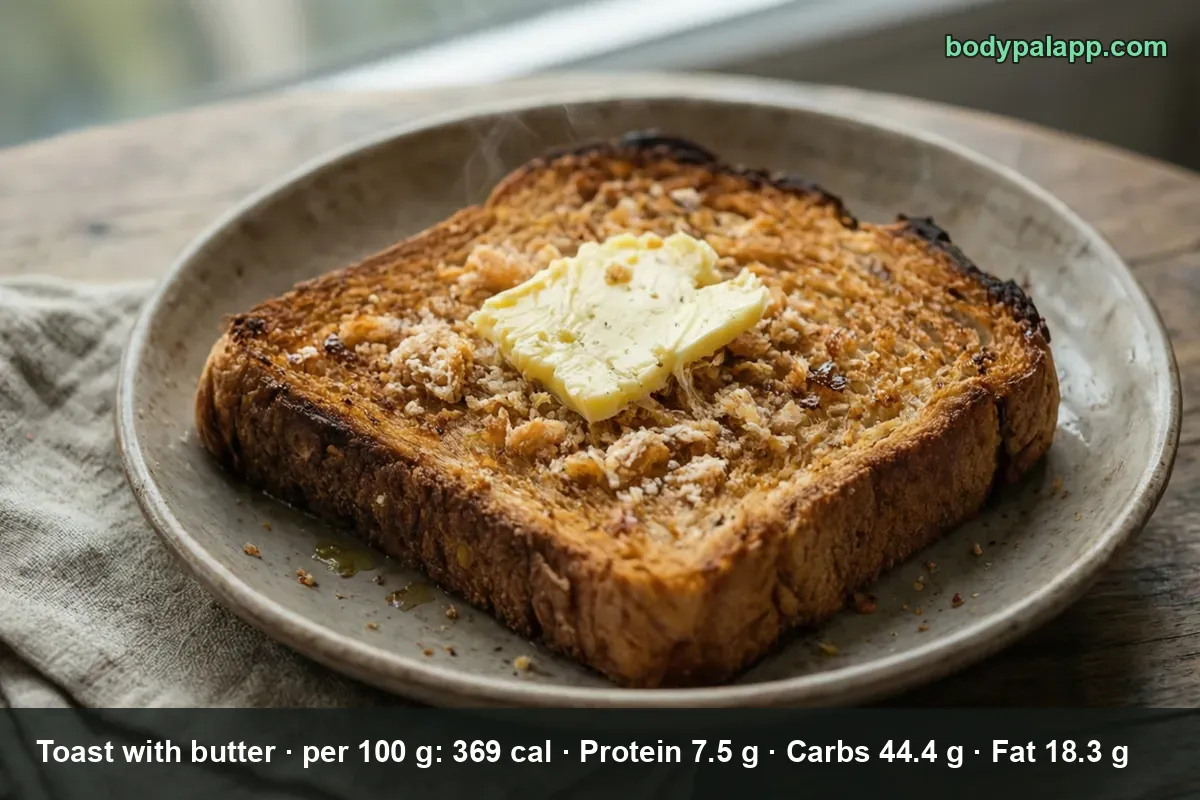
One slice of white toast with a pat of butter is 100 calories. Sixty-four of those come from the bread and 36 from the 5 g pat. Per 100 g the two together run 369. Two slices, the ordinary American breakfast, land at 199. Butter it heavily and a single slice reaches 166.
On this page
- Toast with butter quick facts
- US servings, from a thin slice to a Texas cut
- Butter is a fifth of the weight and a third of the calories
- Does toasting bread add calories?
- White or wheat, butter or margarine
- Saturated fat, not calories, is the row that moves
- Four fifths of the sodium comes from the bread
- How does toast with butter compare?
- FAQ
Toast with butter quick facts
There is no single USDA record for toast with butter, and there is a good reason for that: nobody sells it. It gets made in kitchens, one slice at a time, so no label exists to be filed. The number on this page is therefore built from two records rather than lifted from one, both of them SR Legacy so that the method behind them matches: 174925, "Bread, white, commercially prepared, toasted" for the slice, and 173410, "Butter, salted" for what goes on it.
The serving is USDA's own household measure on both sides. One regular slice is 22 g in the portion file for that bread record, and one pat of butter, the 1-inch square a third of an inch thick, is 5 g. Together that is 27 g on the plate, which is what the table below describes.
| Nutrient | Per 100 g | Per 1 slice with butter (27 g) | % Daily Value |
|---|---|---|---|
| Calories | 369 | 100 | — |
| Total fat | 18.3 g | 4.9 g | 6% |
| Saturated fat | 10.1 g | 2.7 g | 14% |
| Carbohydrate | 44.4 g | 12.0 g | 4% |
| Dietary fiber | 2.4 g | 0.6 g | 2% |
| Total sugars | 5.1 g | 1.4 g | — |
| Protein | 7.5 g | 2.0 g | 4% |
| Sodium | 557 mg | 150 mg | 7% |
% Daily Value is based on a 2,000-calorie diet.
Verified nutrition data
Numbers on this page come from USDA FoodData Central, the U.S. Department of Agriculture’s food composition database, and from manufacturer labels where a branded product is named. Last verified September 2026. How we verify our data →
Two rows a packaged label would print are missing here, and neither is an oversight. The SR Legacy edition holds no added sugars figure for either record, which is the honest answer anyway: nothing is added to buttered toast, and the 1.4 g of sugars in a slice belongs to the bread's own recipe. Trans fat is absent for a different reason. Butter carries a figure, white bread does not, and combining a known number with a blank produces a number that describes neither food. Total sugars carry no Daily Value on a US label at all, which is why that cell stays empty.
Two figures sit outside the label block but come from the same two records. Cholesterol is 41 mg per 100 g, so 11 mg in a slice with butter, about 4% of the day, and almost all of it is the butter's. Potassium is 111 mg per 100 g, or 30 mg in the slice, roughly 1%.
A cross-check is worth a line, because a composite number invites suspicion. USDA's survey files hold their own toasted white bread at 293 calories per 100 g and their own butter at 743. Run the same 22 g and 5 g through those and you get 372 per 100 g against the 369 above, a gap of under 1%. Two independent USDA tiers describe the same breakfast within three calories per 100 g.
US servings, from a thin slice to a Texas cut
| Serving | Weight | Calories |
|---|---|---|
| 1 thin slice with butter | 21 g | 78 |
| 1 regular slice with butter | 27 g | 100 |
| 1 oz | 28 g | 105 |
| 1 large or Texas-cut slice with butter | 33 g | 122 |
| 2 regular slices with butter | 54 g | 199 |
| 100 g of buttered toast | 100 g | 369 |
Every slice weight in that table is a USDA portion entry for record 174925: thin at 17 g, regular at 22 g, large at 27 g. The butter scales with the bread, because a bigger slice takes a bigger pat, so a large slice gets 6 g rather than 5 g and a thin slice gets 4 g. Those pairings, and the 1 oz row, are our own scaling of the two records rather than a USDA serving.
The spread is the point. From the thinnest sandwich bread to a Texas cut is 44 calories on one slice, which is a 56% swing on the same food with the same spread. Log "toast with butter" as a generic item and you have picked one of those numbers at random.
That last row deserves a warning rather than a use. One hundred grams of buttered toast is 3.7 slices, so any chart that hands you 369 as the answer has quietly served you almost four of them. The unit that matches the plate is the slice, and the slice is 100.
Butter is a fifth of the weight and a third of the calories
Split the slice and the arithmetic gets interesting. Bare toast, 22 g of it, is 64 calories. One pat of butter, 5 g, is 36. So butter contributes 18.5% of what is sitting on the plate and 36% of what gets logged, because it runs 717 calories per 100 g against the bread's 290.
That ratio is why the spread, not the bread, is the variable worth watching. Nobody eyeballs a slice of bread wrong by much. Butter is eyeballed wrong constantly.
| Amount of butter | Total weight | Calories | Saturated fat | %DV saturated |
|---|---|---|---|---|
| None, plain toast | 22 g | 64 | 0.2 g | 1% |
| 1 pat (5 g) | 27 g | 100 | 2.7 g | 14% |
| 1 tablespoon (14.2 g) | 36 g | 166 | 7.5 g | 37% |
A full tablespoon is not an unusual amount on hot toast, where butter vanishes into the crumb and stops looking like anything. At 14.2 g it is 102 calories of butter on 64 calories of bread: the spread has become the larger half of the food. The slice arrives at 166 calories and 458 per 100 g, and the saturated fat goes from 14% of the day to 37%.
That is the useful thing to know about buttered toast. The bread is a fixed cost of about 64 calories; everything variable sits on top of it, measured in grams you never see.
Does toasting bread add calories?
No. It only moves them around, and the numbers look like it does.
Untoasted white bread is 266 calories per 100 g and toasted white bread is 290, which reads as a 9% penalty for owning a toaster. Read the other column, though. A slice of that bread weighs 25 g before it goes in and 22 g when it comes out, because toasting drives off water and nothing else. The slice is 67 calories untoasted and 64 toasted.
No calories were destroyed and none were created. Bread lost about 3 g of water, so the calories that stayed behind are packed into less mass, and the per-100-g figure rose to say so. It is the same trick that makes dried fruit look calorific next to fresh.
The practical takeaway is short. If you log by the slice, toasting changes nothing worth recording. If you log by weight, weigh the slice after it toasts and use the toasted figure, or weigh it before and use the untoasted one. Mixing the two, weighing raw bread and applying 290, is how a breakfast quietly gains 9%.
White or wheat, butter or margarine
| Version | Per 100 g | Serving | Calories |
|---|---|---|---|
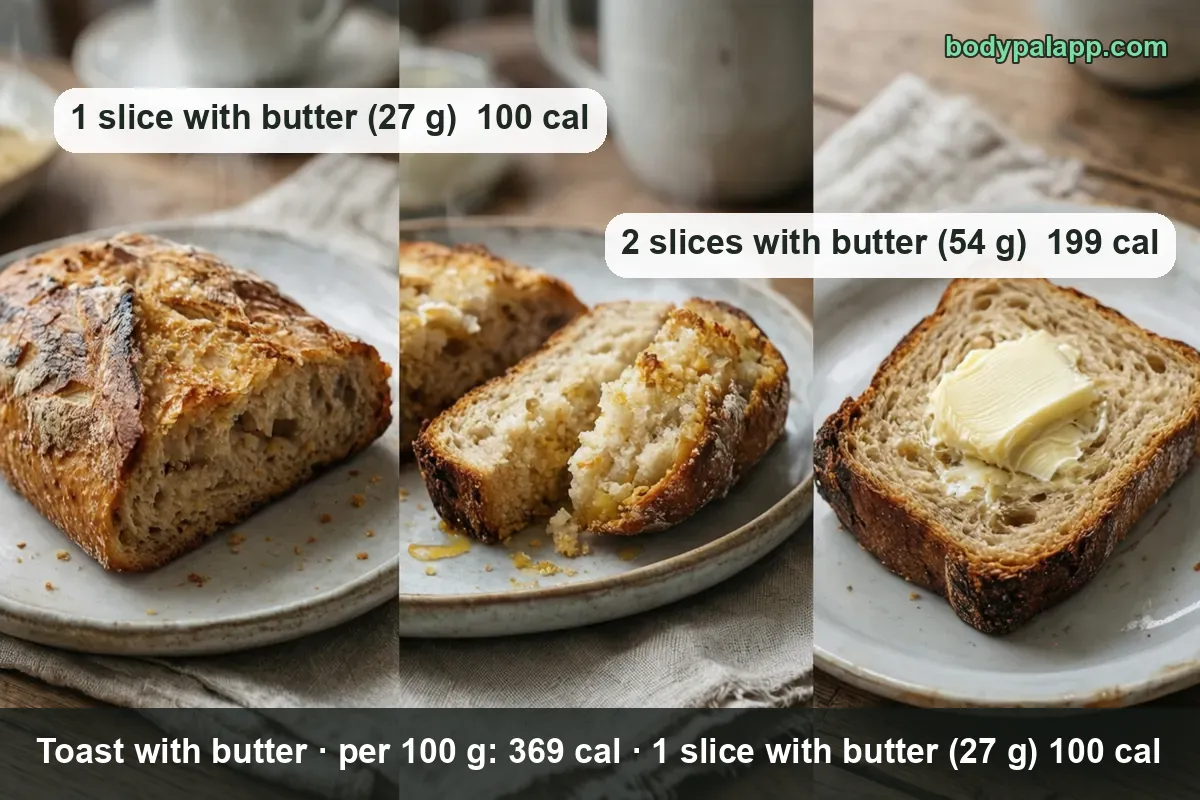
| White toast with butter (this page) | 369 | 1 slice with butter (27 g) | 100 |
| Whole-wheat toast with butter | 375 | 1 slice with butter (30 g) | 112 |
| White toast with margarine | 369 | 1 slice with margarine (27 g) | 100 |
| White toast, heavily buttered | 458 | 1 slice + 1 tbsp (36 g) | 166 |
| Two slices with butter | 369 | 2 slices with butter (54 g) | 199 |
Whole wheat costs twelve calories and buys a great deal. Built on 172689, "Bread, whole-wheat, commercially prepared, toasted", the buttered slice is 112 calories with 1.9 g of fiber against 0.6 g in the white version, which is 7% of the Daily Value instead of 2%. Protein doubles too, 4.1 g against 2.0 g, and sodium comes out slightly higher at 174 mg. MyPlate asks for half the day's grains to be whole grains, and breakfast toast is the easiest of those to switch, since it is the one grain most people eat on autopilot.
Margarine is the more interesting swap, because on calories it is not a swap at all. Stick margarine runs 717 calories per 100 g, exactly matching butter, so the slice stays at 100. What changes is the kind of fat: 0.9 g of saturated fat against 2.7 g, nearly a tenth of the Daily Value's worth of difference, and 0.2 mg of cholesterol against 11 mg.
One caveat on that record, and it matters. The USDA line for stick margarine dates from before the 2018 US ban on partially hydrogenated oils and carries 14.9 g of trans fat per 100 g. That figure describes the margarine of twenty years ago, not the tub in a 2026 refrigerator, which is reformulated to zero. Use the saturated fat comparison; ignore the trans fat row on that old record.
Saturated fat, not calories, is the row that moves
Calories are why people search for buttered toast. Saturated fat is the row that should make them look twice.
One slice with a pat of butter is 100 calories, which is 5% of a 2,000-calorie day. The same slice carries 2.7 g of saturated fat, 14% of the 20 g FDA Daily Value. The second percentage is nearly three times the first, and that ratio is unusual. Most breakfast foods track much closer to one to one.
Two slices, which is what most people actually make, come to 199 calories and 5.5 g of saturated fat, 27% of the day. That is a quarter of the ceiling spent on the least conspicuous item on the table, before eggs, bacon or coffee creamer arrive. The Dietary Guidelines for Americans put saturated fat under 10% of daily calories, about 22 g on a 2,000-calorie day, and buttered toast alone takes a quarter of it.
Where it comes from is no mystery. Of the 2.7 g in a slice, 2.6 g is butter, which is 51 g of saturated fat per 100 g. The bread contributes under 0.2 g. Halve the butter and you halve the row; switch to margarine and you cut it by two thirds while the calorie count sits still.
Four fifths of the sodium comes from the bread
A slice with butter holds 150 mg of sodium, 7% of the 2,300 mg Daily Value. Two slices reach 301 mg, or 13%.
The split is the surprise. Butter is the salty-tasting half of this food, so the sodium looks like the butter's fault. It is not. 118 mg comes from the toast and 32 mg from the pat, because bread is salted at about 537 mg per 100 g and even a salted butter at 643 mg per 100 g arrives in a 5 g piece. Weight decides the outcome, and the bread outweighs the butter four to one.
That has a practical consequence people usually get backwards. Buying unsalted butter to bring a breakfast's sodium down does almost nothing, because it targets the smaller fifth. Changing the bread targets the larger four fifths. USDA lists a low-sodium white loaf at 298 mg per 100 g against the standard 537 mg, and swapping to it removes more sodium from the slice than the entire pat of butter contributes.
The 150 mg in a slice is roughly the sodium in a sixteenth of a teaspoon of table salt, which is nothing on its own. It matters only because toast is eaten daily, in twos, by people who would never guess the bread was the source.
How does toast with butter compare?
| Item | Per 100 g | Serving | Calories | Protein / Carbs / Fat |
|---|---|---|---|---|
| Toast with butter (this page) | 369 | 1 slice with butter (27 g) | 100 | 2.0 / 12.0 / 4.9 g |
| Plain white toast, no butter | 290 | 1 slice (22 g) | 64 | 2.0 / 12.0 / 0.9 g |
| Whole-wheat toast with butter | 375 | 1 slice with butter (30 g) | 112 | 4.1 / 12.8 / 5.1 g |
| Butter alone | 717 | 1 pat (5 g) | 36 | 0.0 / 0.0 / 4.1 g |
| White bread, untoasted | 266 | 1 slice (25 g) | 67 | 2.2 / 12.4 / 0.8 g |
Read the density column and butter tops the ranking, with untoasted white bread at the bottom. Read the serving column and it inverts: the densest food in the table, at 717 per 100 g, is also the smallest number on the plate at 36 calories, because a pat of butter is five grams and nobody eats a hundred of them.
Our take: the useful comparison is the second row against the first. Skipping the butter saves 36 calories and takes the saturated fat from 2.7 g down to 0.2 g, and it is the only change on this page that moves that row meaningfully. If you want the butter, take it on whole-wheat, where 12 extra calories buy triple the fiber and double the protein. If sodium is the number you track, the bread choice beats the butter choice by a factor of nearly four. And if you are counting anything at all, count the spread rather than the slice: bread is a stable 64 calories, while butter swings from 36 to 102 depending on how enthusiastic the knife was.
Toast with butter FAQs
How many calories are in toast with butter?
100 calories in one regular slice of white toast with a 5 g pat of butter, which is 27 g on the plate and 369 calories per 100 g. Two slices come to 199. A thin slice is 78 and a Texas-cut slice is 122, so the size of the bread moves the answer by about 44 calories.
How many calories in 1 slice of toast with butter?
100 calories, split 64 from the bread and 36 from the butter. The slice is 22 g of toasted white bread and the pat is 5 g. That serving carries 4.9 g of fat, 12.0 g of carbohydrate, 2.0 g of protein, 0.6 g of fiber and 150 mg of sodium.
How many calories in 2 slices of toast with butter?
199 calories for two regular slices with a pat of butter each, 54 g in total. That breakfast brings 9.9 g of fat, 5.5 g of saturated fat, 24.0 g of carbohydrate, 4.0 g of protein and 301 mg of sodium. The saturated fat is the figure to note: 27% of the Daily Value.
Does toasting bread add calories?
No: a slice is 67 calories untoasted and 64 toasted, because toasting removes water rather than calories. White bread goes from 266 to 290 calories per 100 g in the toaster, but the slice drops from 25 g to 22 g at the same time. The per-100-g figure rises only because the same calories now sit in less mass.
How much butter is on a slice of toast?
One pat, USDA's household measure, is 5 g and 36 calories. A full tablespoon is 14.2 g and 102 calories, which takes the slice from 100 calories to 166 and the saturated fat from 14% to 37% of the Daily Value. On hot toast the difference is invisible, since butter melts into the crumb either way.
Is white or wheat toast with butter better?
Whole wheat, by 12 calories. A buttered whole-wheat slice is 112 calories against 100 for white, and it carries 1.9 g of fiber against 0.6 g and 4.1 g of protein against 2.0 g. Sodium is a little higher at 174 mg against 150 mg. For 12 calories it is the better trade on every other row.
Is butter or margarine on toast healthier?
On calories they are identical: both run 717 per 100 g, so the slice is 100 calories either way. Stick margarine carries 0.9 g of saturated fat against butter's 2.7 g, and 0.2 mg of cholesterol against 11 mg. The USDA margarine record predates the 2018 ban on partially hydrogenated oils, so its trans fat figure no longer describes what is sold today.
How much saturated fat is in buttered toast?
2.7 g in one slice with a pat of butter, which is 14% of the 20 g Daily Value while the slice is only 5% of a 2,000-calorie day. Two slices reach 5.5 g, or 27%. Butter supplies 2.6 g of that and the bread under 0.2 g, so the spread is the whole story on this row.
Similar foods
- Cotija Cheese — 102 cal per ounce
- Pepper Jack Cheese — 104 cal per slice
- Babybel Cheese — 100 cal per oz
- Gouda cheese — 75 cal per slice
- Provolone Cheese — 98 cal per slice
- Cheese Curds — 110 cal per oz
Count it without the math
Point the camera at the plate and BodyPal reads the bread and the butter as one number, before the pat has finished melting.


How long does it take to burn off toast with butter?
One slice with butter (27 g) is 100 kcal. Enter your weight and the amount you ate to see how long it takes you to burn that off:
lb
| Activity | Time to burn 100 kcal |
|---|---|
| Walking, brisk | 20 min |
| Cycling, moderate | 12 min |
| Swimming, moderate | 14 min |
| Jogging | 12 min |
| Weight training, moderate | 22 min |
Times are for a 155 lb adult at a steady pace; change the weight to see yours. The amount is set to the portion in the text (27 g); change it to what you actually ate. BodyPal works this out from your steps automatically.
One food is easy to picture; a whole day is harder. See how many calories you need a day and what a deficit actually looks like.