
How Many Calories in Gouda Cheese?
An ounce of gouda — 28.35 g — is 101 calories, at 356 calories per 100 g. A deli slice of 21 g is 75, a snack cube of 17 g is 61, and a cup of diced gouda is 470. The calories in gouda cheese are unremarkable for a hard cheese. The saturated fat sitting behind them is not.
On this page
- Gouda quick facts
- The calories are not the number that runs out first
- Gouda servings, from cracker slice to cup
- Sliced, cubed, shredded, smoked and aged
- The sodium arrives quietly
- Almost no carbs, and no fiber either
- How does gouda compare?
- Most popular gouda cheese brands
- FAQ
Gouda quick facts
Every figure on this page traces to one line: SR Legacy 171241, "Cheese, gouda", the plain wheel cheese with a wax rind that an American store sells by the wedge. USDA files its serving as one ounce, 28.35 g.
| Nutrient | Per 100 g | Per 1 oz (28.35 g) | % Daily Value |
|---|---|---|---|
| Calories | 356 | 101 | — |
| Total fat | 27.44 g | 7.8 g | 10% |
| Saturated fat | 17.61 g | 5.0 g | 25% |
| Carbohydrate | 2.22 g | 0.6 g | 0% |
| Dietary fiber | 0 g | 0 g | 0% |
| Total sugars | 2.22 g | 0.6 g | — |
| Protein | 24.94 g | 7.1 g | 14% |
| Sodium | 819 mg | 232 mg | 10% |
% Daily Value is based on a 2,000-calorie diet.
Verified nutrition data
Numbers on this page come from USDA FoodData Central, the U.S. Department of Agriculture’s food composition database, and from manufacturer labels where a branded product is named. Last verified September 2026. How we verify our data →
Two rows that appear on a supermarket label are missing here, and that is deliberate. USDA's SR Legacy edition of this record publishes no added sugars figure and no trans fat figure, and neither does the survey duplicate of it, so printing a zero would be inventing a number rather than reporting one. Total sugars have no Daily Value on an American label at all, which is why that cell stays blank.
Two rows that sit outside the standard label come from the same USDA line. Cholesterol is 114 mg per 100 g, 32 mg in an ounce, roughly 11% of the 300 mg Daily Value. Potassium is 121 mg per 100 g and 34 mg in an ounce, about 1% of the day — cheese is not where potassium comes from.
Now read the last column instead of the first. One ounce of gouda is 5% of a 2,000-calorie day and 25% of the day's saturated fat.
The calories are not the number that runs out first
That gap is the whole story of this cheese, and it is invisible if you only log calories.
An ounce costs you a twentieth of your energy for the day. It costs you a quarter of your saturated fat. The two budgets drain at wildly different speeds, and the fat budget is five times faster. Put two ounces on a cheese board — a modest amount of cheese, gone in a few minutes of conversation — and you have used 202 calories and 10 g of saturated fat, half the Daily Value, while barely denting the calorie side. Two ounces is our own scaling of USDA's one-ounce line, not a USDA serving.
The Dietary Guidelines for Americans put saturated fat at under 10% of daily calories, which is where the 20 g Daily Value comes from. Gouda gets 44% of its own calories from saturated fat alone. Any food that dense will spend the fat allowance before it spends the energy allowance.
The deli slice is the friendlier unit. A 21 g slice is 75 calories, 5.8 g of fat and 3.7 g of saturated fat — 18% of the day, from something that looks like nothing on a cracker. Three of them and you are at 224 calories and 55% of the saturated fat, our own multiple of USDA's 21 g slice.
None of this makes gouda a bad choice. It makes the calorie count the wrong thing to watch. If you are tracking one number on this cheese, track the saturated fat and the calories will look after themselves.
Gouda servings, from cracker slice to cup
| Serving | Weight | Calories |
|---|---|---|
| One cracker-size slice | 9 g | 32 |
| One cube, 1 cubic inch | 17 g | 61 |
| One slice | 21 g | 75 |
| One ounce | 28.35 g | 101 |
| One cup, diced | 132 g | 470 |
| One 7 oz package | 198 g | 705 |
The slice and cube weights are USDA's own household measures, taken from the survey record for gouda, which carries identical nutrient values to the main line and adds the kitchen units the SR Legacy row omits. Nothing here is averaged or estimated.
The cup is the row that ambushes people. One cup of diced gouda is 470 calories — 4.7 ounces of cheese, hiding inside a measure that sounds like a portion of yogurt. Recipes call for it casually. A cup of gouda folded into a casserole adds more calories than most main courses start with.
Cubes disappear faster than slices, and they are heavier than they look. Four one-inch cubes, our own multiple of USDA's single cube, are 68 g and 244 calories, which is more than the deli-counter equivalent most people would cut for themselves. Snack packs use the cube for exactly that reason.
One small mismatch is worth knowing. USDA works in a true ounce of 28.35 g and gets 101 calories; American packages round the ounce to 28 g and print 100. That single calorie is a rounding convention on the label, not a different cheese, and either number is fine to log.
Sliced, cubed, shredded, smoked and aged
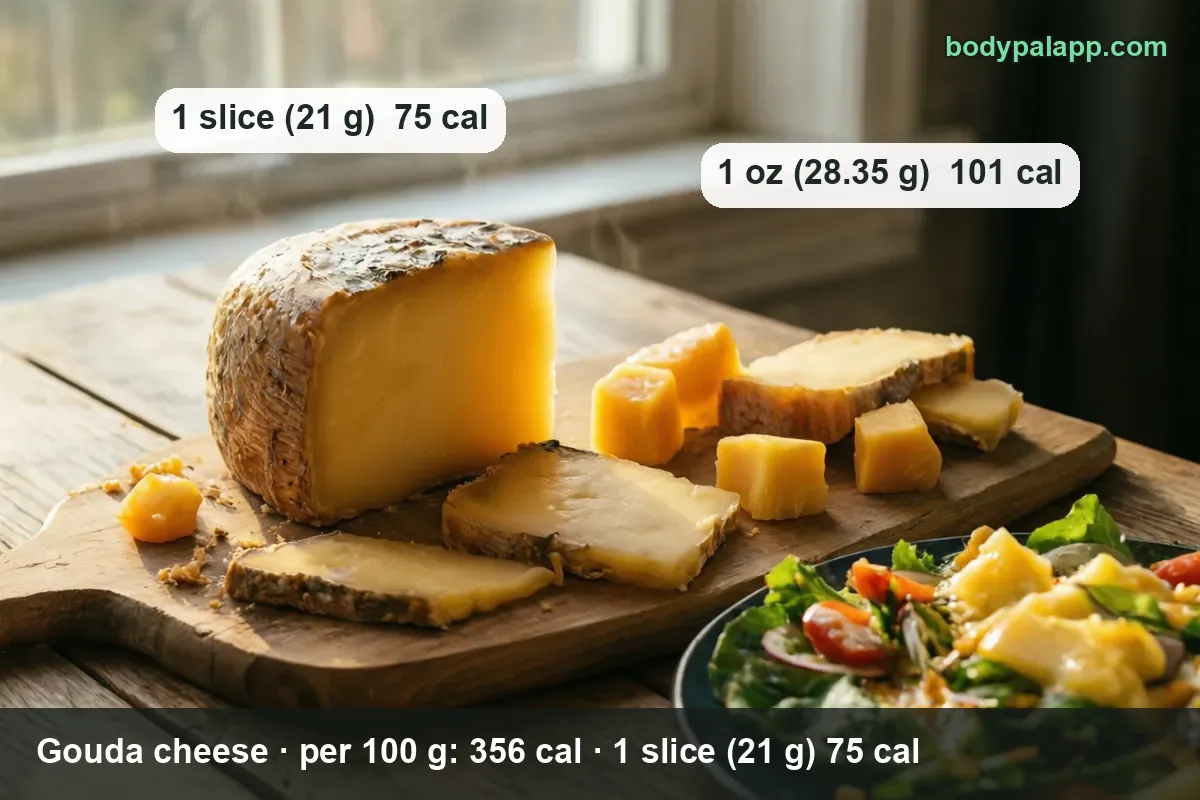
Gouda comes in five shapes on an American shelf, and only one of them changes the underlying numbers.
| Form | Serving | Calories |
|---|---|---|
| USDA slice | 21 g | 75 |
| Packaged deli slice | 22 g | 80 |
| Cracker-size slice | 9 g | 32 |
| Snack cube | 17 g | 61 |
| Cube pack, 7 cubes | 28 g | 100 |
| Shredded, 1/4 cup | 28 g | 100 |
| Diced, 1 cup | 132 g | 470 |
Sliced gouda is the most common form and the least surprising. USDA's slice is 21 g and 75 calories; the pre-sliced packages sold in American stores cut theirs a gram thicker at 22 g and print 80 calories. A gram of gouda is worth 3.6 calories, so the two agree.
Cubed gouda is where the label and the kitchen part company. One cubic inch is 17 g and 61 calories, but a snack pack sells you seven smaller cubes to make up a 28 g serving at 100 calories. Both are honest. They just are not the same cube, so counting cubes without knowing whose cube it is will not work.
Shredded gouda carries the trap in its own measure. A quarter cup of shreds weighs 28 g and is 100 calories, but a cup of diced gouda weighs 132 g and is 470. Shreds trap air, so a quarter cup of them is nowhere near a quarter of a cup of dice. When a recipe says a cup of gouda, the answer depends entirely on the knife.
Smoked gouda has no separate USDA record, and it does not need one. Smoke adds flavor, not energy, and the American smoked labels land in the same 357 to 364 calories per 100 g corridor as the plain cheese. Use the numbers above.
Aged gouda is the one real exception. There is no USDA line for it either, but the harder, older wheels sold in the United States print up to 393 calories per 100 g on their labels, because aging drives water out and concentrates what is left. That is about 10% more than young gouda for the same weight, or roughly 111 calories in an ounce instead of 101.
One last piece of housekeeping: gouda and edam share a single USDA survey code with identical values, so both are 356 calories per 100 g and 101 per ounce. The difference between them is taste and rind, not arithmetic.
The sodium arrives quietly
Cheese is a salted food that nobody thinks of as salty, and gouda is a good example of the problem.
- One ounce, 28.35 g: 232 mg of sodium — 10% of the day
- Three slices, 63 g: 516 mg — 22%, our own scaling of USDA's 21 g slice
- A 7 oz package, 198 g: 1,621 mg — around 70%
The Daily Value is 2,300 mg, and the CDC notes that most Americans already exceed it, largely from foods nobody would describe as salty. An ounce of gouda is roughly a tenth of a teaspoon of table salt.
Look at the three-slice line again, because it is the realistic one. Three slices on crackers are 224 calories and 516 mg of sodium — 22% of the day's salt before anything is spread underneath them, and before the crackers contribute their own. The calorie cost of that plate is modest. The sodium cost is not.
Per 100 g, gouda holds 819 mg. That is ordinary for a firm cheese and it is also the reason a cheese board reaches a third of your sodium faster than it reaches a fifth of your calories. If sodium is the number you watch, the lever is portion size, not cheese choice.
Almost no carbs, and no fiber either
An ounce of gouda has 0.6 g of carbohydrate, and every gram of it is sugar. That is not a contradiction: total carbohydrate and total sugars are the same 2.22 g per 100 g in USDA's record, which means the only carbohydrate in this cheese is residual lactose left over from the milk. Nothing was added; USDA publishes no added sugars figure for this line at all, and there is nothing in aged curd for it to describe.
Fiber is zero, exactly and unarguably. Cheese is an animal product and contains none, so the 28 g Daily Value for fiber is untouched by anything on this page. Gouda will not move your blood sugar and it will not help your fiber total either.
What it does deliver is protein: 7.1 g in an ounce, 14% of the Daily Value, from 5% of the day's calories. MyPlate counts cheese in the dairy group and gouda earns its place there — the protein-to-calorie ratio is genuinely good, at just over 7 g of protein per 100 calories. The price is on the saturated fat line, and you already know what it is.
How does gouda compare?
Five firm cheeses from the same USDA family, at the same weight:
| Cheese | Per 100 g | Per 1 oz (28.35 g) | Protein | Carbs | Fat |
|---|---|---|---|---|---|
| Gouda | 356 | 101 | 7.1 g | 0.6 g | 7.8 g |
| Provolone | 357 | 101 | 6.6 g | 0.7 g | 8.0 g |
| Muenster | 368 | 104 | 6.6 g | 0.3 g | 8.5 g |
| Blue or Roquefort | 353 | 100 | 6.1 g | 0.7 g | 8.1 g |
| Goat cheese | 364 | 103 | 6.1 g | 0.0 g | 8.5 g |
Four calories separate the lightest cheese here from the heaviest. That is the useful finding: at the counter, choosing a cheese is not a calorie decision at all, and anyone swapping gouda for goat cheese to save energy is saving nothing.
Our take: if protein is what you want from an ounce of cheese, gouda is the pick on this list, with 7.1 g against 6.1 g for blue and goat — 16% more protein for the same calories. If you want the lowest number on the board, blue at 100 calories per ounce wins by a single calorie and is not worth crossing the room for. And if you are cutting fat, none of these five is your answer; every one of them runs between 7.8 g and 8.5 g of fat per ounce, and the way to spend less is to cut a thinner slice.
Most popular gouda cheese brands in the United States
Ranked by how widely each product appears among foods sold in the United States, from the BodyPal food database of over 3.3 million products. Calories are the figures printed on each Nutrition Facts label, checked against USDA FoodData Central.
| Product | Calories (per 100 g) |
|---|---|
| Frigo Gouda Cheese | 363 cal |
| Tropical Gouda Cheese | 357 cal |
| California Select Farms Gouda Cheese | 357 cal |
| Cheese Crafters Gouda Cheese | 357 cal |
| Hautly Cheese Company Gouda Cheese | 393 cal |
| Herbert Excentrique Gouda Cheese | 393 cal |
Brand popularity: BodyPal food database. Nutrition: manufacturer labels / USDA FoodData Central.
Gouda FAQs
How many calories are in gouda cheese?
101 calories in one ounce, 28.35 g, and 356 calories per 100 g. A 21 g deli slice is 75 calories and a 17 g cube is 61. A cup of diced gouda reaches 470, and a whole 7 oz package is 705.
How many calories are in a slice of gouda cheese?
75 calories for USDA's 21 g slice. Packaged deli slices are cut slightly thicker at 22 g and print 80 calories, while a thin cracker-size slice of 9 g is only 32. Three slices come to 224 calories and 516 mg of sodium.
How many calories are in an ounce of gouda?
101 calories, using USDA's true ounce of 28.35 g. Packages round the ounce to 28 g and print 100 calories, which is the same cheese and a label convention. That ounce also carries 7.1 g of protein, 232 mg of sodium and 5.0 g of saturated fat.
What are the nutrition facts for gouda cheese?
Per ounce: 101 calories, 7.8 g of total fat, 5.0 g of saturated fat, 0.6 g of carbohydrate, 0.6 g of sugars, 7.1 g of protein and 232 mg of sodium. Per 100 g the same cheese is 356 calories, 27.44 g of fat and 24.94 g of protein.
Is gouda cheese healthy?
It depends on which number you spend: an ounce gives 7.1 g of protein for 14% of the Daily Value from only 5% of a 2,000-calorie day, which is efficient. The same ounce is 25% of the Daily Value for saturated fat, and the Dietary Guidelines put that limit at under 10% of daily calories.
How many calories are in smoked gouda?
The same 101 calories per ounce as plain gouda. USDA has no separate record for smoked gouda because smoking adds flavor rather than energy, and American smoked labels sit in a 357 to 364 calories per 100 g band around the 356 of the standard line.
Does gouda have more calories than other cheeses?
No — gouda is 356 calories per 100 g, right in the middle of the group: 353 for blue, 357 for provolone, 364 for goat cheese and 368 for muenster. Per ounce the whole group spans four calories, from 100 to 104, so the cheese you choose barely changes the total.
How much protein is in gouda cheese?
24.94 g per 100 g, which is 7.1 g in a one-ounce serving and 14% of the Daily Value. That works out to just over 7 g of protein per 100 calories, the best ratio of the five firm cheeses compared on this page. A 21 g slice carries 5.2 g.
Similar foods
- Babybel Cheese — 100 cal per oz
- Provolone Cheese — 98 cal per slice
- Cotija Cheese — 102 cal per ounce
- Cream Cheese — 103 cal for 2 tbsp
- Philadelphia Cream Cheese — 103 cal for 2 tbsp
- Toast with butter — 100 cal per slice with butter
Count it without the math
Point the camera at the board and BodyPal works out the slices, the ounces and the saturated fat before you find the scale.


How long does it take to burn off gouda cheese?
A 1 oz (28.35 g) serving is 101 kcal. Enter your weight and the amount you ate to see how long it takes you to burn that off:
lb
| Activity | Time to burn 101 kcal |
|---|---|
| Walking, brisk | 20 min |
| Cycling, moderate | 13 min |
| Swimming, moderate | 14 min |
| Jogging | 12 min |
| Weight training, moderate | 22 min |
Times are for a 155 lb adult at a steady pace; change the weight to see yours. The amount is set to the portion in the text (28.35 g); change it to what you actually ate. BodyPal works this out from your steps automatically.
Burning it off is one side of it. The other is knowing your number: work out how many calories you need a day, with macros and a goal date.