Babybel cheese calories come to 100 per 1 oz (28 g) and 357 per 100 g, using USDA values for Edam, the style Babybel is made in. Fat supplies 71% of those calories, and sodium runs high at 272 mg per ounce, 12% of the daily value. Portions climb faster than the small wheels suggest.
100kcal
1 ounce · 28 g, Edam style, ready to eat
28%protein
7 gProtein
0 gCarbs
8 gFat
How to burn off 100 kcal
—Walking, brisk
—Jogging
—Cycling, moderate
—Swimming
Skip the math. BodyPal counts these calories from your steps and workouts automatically.
Nutrition facts
Edam style, ready to eat · per 28 g
Calories
100 kcal
Protein
7 g
Carbohydrate
0.4 g
Fat
8 g
Saturated fat
5.2 g
Cholesterol
25 mg
Sodium
272 mg
Potassium
53 mg
Iron
0.1 mg
Source: USDA FoodData Central
🛡️
Verified nutrition data
Numbers on this page come from USDA FoodData Central, the U.S. Department of Agriculture’s food composition database, and from manufacturer labels where a branded product is named. Last verified September 2026. How we verify our data →
Babybel cheese: calories, protein and sodium by serving
Percent of daily value uses the FDA reference of 2,000 kcal a day.
Serving
kcal
Protein
Carbs
Fat
Sodium
% DV kcal
1 oz (28 g)
100
7 g
0.4 g
8 g
272 mg
5%
100 g
357
25 g
1.4 g
28.6 g
973 mg
18%
3 oz portion (85 g)
303
21.2 g
1.2 g
24.3 g
827 mg
15%
3 × 1 oz (28 g)
300
21 g
817 mg
5 × 1 oz (28 g)
500
35 g
1,362 mg
Each ounce adds about 100 calories
The numbers here are measured by weight. One ounce (28 g) of the Edam-style cheese gives 100 calories, 7 g of protein, 8 g of fat and just 0.4 g of carbs, none of it sugar. Against daily values, that is 5% of calories, 14% of protein and 12% of sodium. For a snack, those are modest numbers.
The catch is the wheel itself. A single wax-wrapped mini weighs less than an ounce, so one wheel lands under the 100 mark, while a lunchbox habit of several wheels passes it quickly. Check the net weight on the pack and scale from 357 calories per 100 g.
Here is how the total moves. Two ounces (56 g) come to 200 calories, three ounces (84 g) to 300, and five ounces (140 g) to 500, with 35 g of protein along for the ride. A 3 oz portion (85 g) is 303 calories, 15% of the daily value, which is light-meal territory from cheese alone. Few people sit down to eat that much on purpose, but grazing from a mesh bag is exactly how it happens.
Fat supplies 71% of the calories
Per 100 g, Babybel's Edam profile reads 28.6 g fat, 25 g protein and 1.4 g carbs. Converted to calories, that is 71% fat, 28% protein and 2% carbs. Fiber and sugars both sit at 0.
So this is a fat food first and a protein food second. The protein is still worth counting: 7 g per ounce covers 14% of the daily value, and 100 g covers 50%. For a snack with almost no carbs and no sugar, that is a fair return, especially next to crackers or chips that bring carbs and little protein.
The trade-off is density. At 357 calories per 100 g, Babybel packs a lot of energy into a small, easy-to-eat piece, and there is no fiber to slow you down. That is why counting wheels, or better, weighing them once, matters more here than with most snacks. A few extra bites change the total more than they seem to.
Saturated fat and sodium are the rows to watch
Saturated fat is the standout row. Babybel's Edam profile carries 18.7 g per 100 g, against a daily value of 20 g, so 100 g of cheese uses up most of a day's allowance. It is the number that grows fastest as wheels pile up, and it gets far less attention than calories.
Sodium comes next. One ounce holds 272 mg, 12% of the daily value, and the 3 oz portion reaches 827 mg, or 36%. Five ounces (140 g) push it to 1,362 mg. The cheese tastes mild, which makes the salt easy to overlook.
Cholesterol sits at 89 mg per 100 g, against a 300 mg daily value, and potassium is low at 188 mg. If you track any of these rows, log the cheese by weight rather than by wheel count so the totals stay honest. On a day already heavy in salty foods, one wheel is a far easier fit than a handful.
Pair it with fiber and water-rich foods
Babybel brings protein and fat but 0 g of fiber and only 1.4 g of carbs per 100 g. That makes it an easy partner for foods that supply what it lacks: apple slices, grapes, pear, cucumber, snap peas or whole-grain crackers. The cheese adds staying power; the produce adds volume and crunch.
The pairing changes the shape of the snack more than its size. One ounce at 100 calories next to a piece of fruit fills a plate in a way that two ounces of cheese alone, at 200, does not. If you want more protein without leaning only on cheese, a side of plain yogurt spreads the load.
In a packed lunch, a wheel or two works as the protein piece beside a sandwich or salad. If sodium is a concern, skip salty partners like pretzels, olives or cured meats. BodyPal can log the cheese from a photo, so the snack lands in your day without a manual search.
How does babybel cheese compare?
Here is how Babybel's Edam-style cheese stacks up against gouda, provolone and cotija, per 100 g and per usual serving.
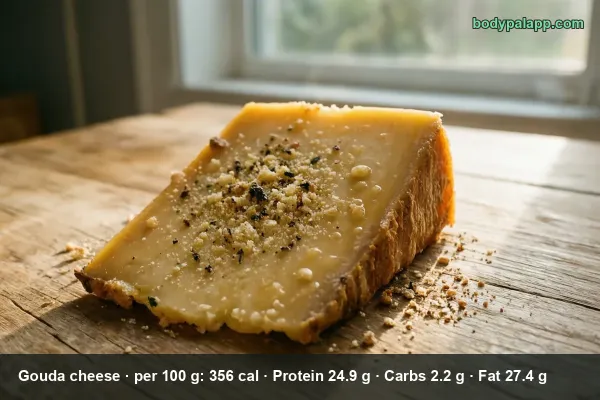
Verdict: Calories barely separate these cheeses, from 351 per 100 g for provolone to 366 for cotija, so choose on sodium, where provolone wins at 727 mg per 100 g. Skip cotija if you watch salt, since it packs 1,400 mg per 100 g, and treat gouda, at 819 mg, as the closest match to Babybel's Edam profile.
Babybel cheese FAQs
How many calories are in Babybel cheese?
About 100 calories per ounce (28 g), using Edam cheese values. Per 100 g it is 357 calories.
Is Babybel cheese good for weight loss?
One ounce has 100 calories, 7.0 g of protein, 8.0 g of fat and 0.4 g of carbs. It also carries 272 mg of sodium per ounce.
Babybel vs gouda: which has fewer calories?
They are almost the same: 357 calories per 100 g for Babybel (Edam) and 356 for gouda.
How much protein is in Babybel cheese?
About 7.0 g of protein per ounce (28 g), or 25.0 g per 100 g.
How many calories are in a single Babybel wheel?
One ounce (28 g) of Babybel-style Edam has 100 calories. A single mini wheel weighs less than an ounce, so one wheel comes in under that. Check the net weight on the pack and scale from 357 calories per 100 g.
What are the macros in Babybel cheese?
Per 100 g, Babybel's Edam profile has 28.6 g fat, 25 g protein and 1.4 g carbs, with 0 g sugars. By calories that is 71% fat, 28% protein and 2% carbs, so it fits low-carb eating easily.
How many calories are in 100 g of Babybel?
100 g of Babybel-style Edam has 357 calories, 18% of the daily value. The same amount carries 973 mg of sodium, 42% of the daily value, plus 18.7 g of saturated fat, so it is a lot of cheese for one sitting.
How much protein do you get for the calories in Babybel?
Each 1 oz (28 g) serving gives 7 g of protein for 100 calories, and 100 g gives 25 g for 357. Protein supplies 28% of the calories, so fat, at 71%, still does most of the work.