
How many calories are in an egg?
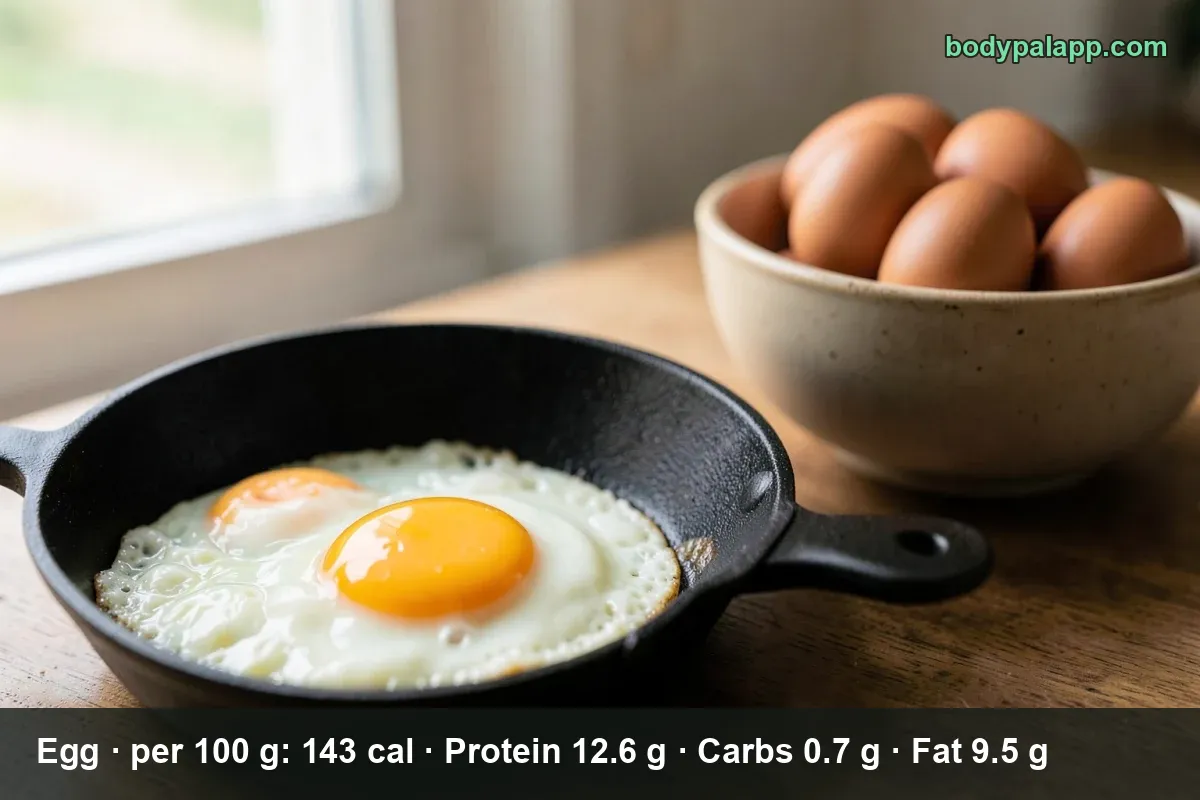
One large egg is 72 calories. That is a 50 g egg, raw and whole, from a food measured at 143 calories per 100 g. Two of them make a 143-calorie breakfast before anything hits the pan. The protein is 6.3 g per egg, the carbohydrate only 0.4 g.
On this page
- Egg quick facts
- US servings, from one ounce to a cup
- Boiled, scrambled, fried: what the pan does
- Egg white vs egg yolk
- Cholesterol is the row that jumps
- How does an egg compare?
- Most popular egg brands
- FAQ
Egg quick facts
The numbers below come from SR Legacy 171287, "Egg, whole, raw, fresh". It is the record for the thing you actually pick up: a whole shell egg, yolk and white together, before any heat. It is also the only whole-egg record that carries a complete panel, sugars and trans fat included, and the only one with US household portions broken out by egg size — medium, large, extra large, and a cup of shelled eggs.
USDA has a newer measurement of the same raw egg, Foundation 748967, at 148 calories per 100 g. It is five calories higher and stops short of sugars and portion sizes, so it stays out of the table below. The two are not averaged. Cooked eggs are separate records with their own numbers, and they get their own section further down.
| Nutrient | Per 100 g | Per 1 large egg (50 g) | % Daily Value |
|---|---|---|---|
| Calories | 143 | 72 | — |
| Total fat | 9.51 g | 4.8 g | 6% |
| Saturated fat | 3.13 g | 1.6 g | 8% |
| Carbohydrate | 0.72 g | 0.4 g | 0% |
| Dietary fiber | 0 g | 0 g | 0% |
| Total sugars | 0.37 g | 0.2 g | — |
| Protein | 12.56 g | 6.3 g | 13% |
| Sodium | 142 mg | 71 mg | 3% |
| Cholesterol | 372 mg | 186 mg | 62% |
| Potassium | 138 mg | 69 mg | 1% |
% Daily Value is based on a 2,000-calorie diet.
Verified nutrition data
Numbers on this page come from USDA FoodData Central, the U.S. Department of Agriculture’s food composition database, and from manufacturer labels where a branded product is named. Last verified September 2026. How we verify our data →
There is no added sugars row here, because SR Legacy does not carry that field and a shell egg has no added sugar to report. Potassium is modest at 69 mg per egg, 1% of the Daily Value. One more oddity: shell eggs are sold without a Nutrition Facts panel, so the only branded egg records in the USDA database are liquid products — Bob Evans 100% Liquid Egg Whites, for instance, is 54 calories per 100 g and 25 calories for its 46 g (3 Tbsp) label serving.
US servings, from one ounce to a cup
Egg size is the whole game here, and the gap between a medium and an extra large is 17 calories — small on one egg, meaningful over a three-egg omelet.
| Serving | Weight | Calories |
|---|---|---|
| 1 oz | 28 g | 41 kcal |
| 1 medium egg | 44 g | 63 kcal |
| 1 large egg | 50 g | 72 kcal |
| 1 extra large egg | 56 g | 80 kcal |
| Two large eggs | 100 g | 143 kcal |
| 1 cup, shelled | 243 g | 347 kcal |
| Per 100 g | 100 g | 143 kcal |
The medium, large, extra large and cup weights are USDA household measures for this record; the cup works out to 4.86 large eggs, which is why 347 calories looks so odd for a round measure. The 1 oz line and the two-egg line are our own arithmetic from the USDA 100 g figure, not USDA servings.
That two-egg line is the useful one. A large egg is 50 g, so two of them weigh exactly 100 g, and the per-100-g column doubles as a standard breakfast. Whenever you see 143 calories per 100 g of raw egg quoted anywhere, that is two eggs on your plate.
Boiled, scrambled, fried: what the pan does
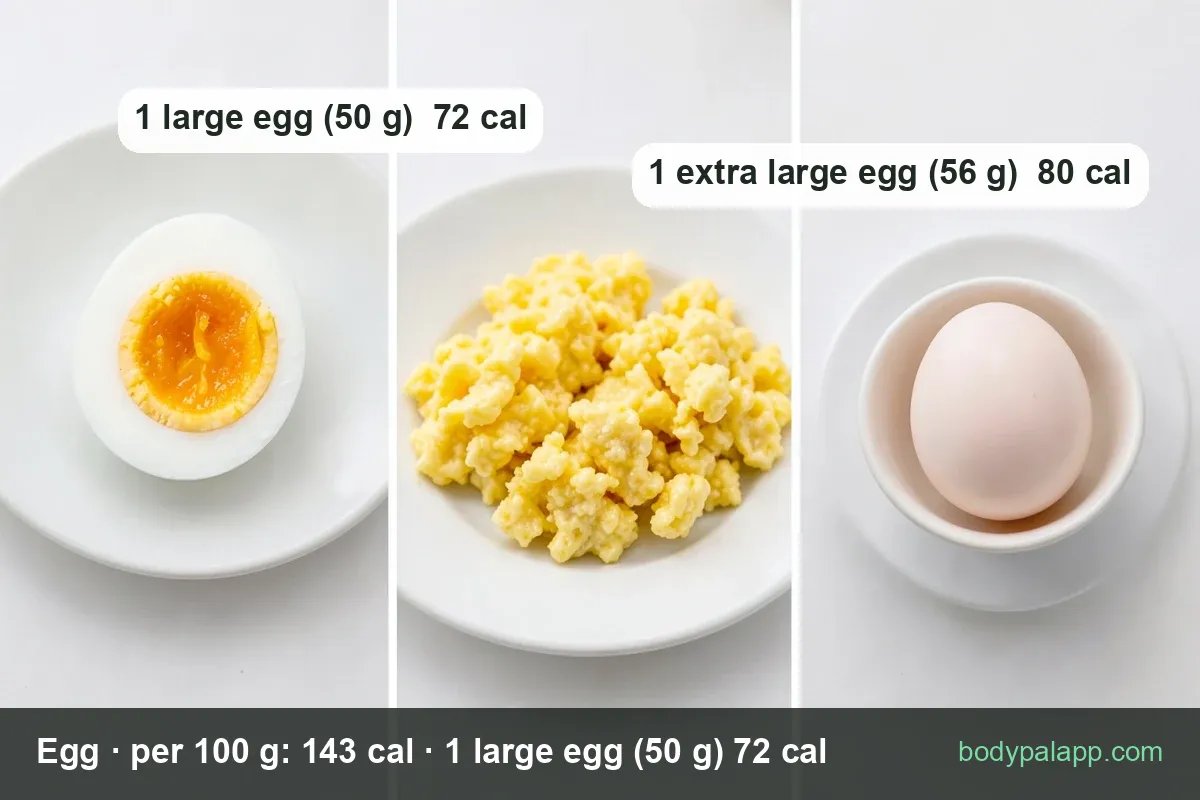
Cooking an egg does not add calories on its own — boiling adds nothing at all. What changes is water. A hard-boiled egg reads 155 calories per 100 g against 143 raw, because water leaves through the shell during cooking and what remains is slightly denser. Per egg the move is small: 72 raw to 78 boiled.
Frying is a different story, and there the number moves because of what goes into the pan.
| Version | Per 100 g | Typical serving | Calories |
|---|---|---|---|
| Raw, whole | 143 kcal | 1 large, 50 g | 72 kcal |
| Hard-boiled | 155 kcal | 1 large, 50 g | 78 kcal |
| Scrambled | 149 kcal | 1 large, 61 g | 91 kcal |
| Omelet | 154 kcal | 1 large, 61 g | 94 kcal |
| Fried | 196 kcal | 1 oz, 28 g | 56 kcal |
| Egg white, raw | 52 kcal | 1 oz, 28 g | 15 kcal |
| Egg yolk, raw | 322 kcal | 1 oz, 28 g | 91 kcal |
Scrambled and omelet servings weigh 61 g rather than 50 g because milk and fat go in with the egg, and USDA weighs the finished food. That is why scrambled eggs come out at 91 calories a piece while boiled sits at 78 — the extra 13 calories are dairy and pan fat, not egg.
Fried is the one to watch. At 196 calories per 100 g it is 37% denser than raw egg, since the egg soaks up oil or butter. USDA gives no per-egg portion for fried egg, so both the ounce line above and the 98 calories in a 50 g serving are our own arithmetic from the 196 figure. Sodium moves with it: fried egg runs 207 mg per 100 g against 142 mg raw.
Egg white vs egg yolk
Split the egg and the two halves barely look related. The white is 52 calories per 100 g with 10.9 g of protein and 0.17 g of fat. The yolk is 322 calories per 100 g with 26.54 g of fat and 9.55 g of saturated fat. Six times the calories, in the smaller half.
That is the arithmetic behind every egg-white omelet on a diner menu. An ounce of white is 15 calories; an ounce of yolk is 91. Both figures are our own scaling from the USDA 100 g rows, since neither record lists a per-egg portion. You keep most of the protein and drop almost all of the fat — along with the vitamins that ride in the fat, which is why a whites-only habit is a trade, not a free win. For most people counting a normal breakfast, whole eggs at 72 calories each are not the problem.
Cholesterol is the row that jumps
Run down the Daily Value column for one large egg and almost nothing stands out. Fat 6%. Saturated fat 8%. Sodium 3%. Protein 13%, which is genuinely good for 72 calories. Then cholesterol: 186 mg, or 62% of the 300 mg Daily Value the FDA uses on the Nutrition Facts label. It is the only row on the panel that clears half the DV, and two eggs put you at 372 mg, past the whole day's value.
Worth knowing what that number means now. The Dietary Guidelines for Americans no longer set a hard numeric cap on dietary cholesterol; the advice is to keep it as low as you can while still eating a healthy pattern. Saturated fat is the number they do cap, at under 10% of calories, and one egg contributes 1.6 g of it — 8% DV.
The protein side is the reason eggs earn their spot. MyPlate counts one egg as one ounce-equivalent of protein foods, and at 6.3 g of protein for 72 calories that is one of the cheapest protein buys in the refrigerator. Two eggs put 12.6 g of protein on the plate for 143 calories.
How does an egg compare?
| Egg, by preparation | Per 100 g | US serving | Calories |
|---|---|---|---|
| Raw, whole | 143 kcal | 1 large, 50 g | 72 kcal |
| Hard-boiled | 155 kcal | 1 large, 50 g | 78 kcal |
| Scrambled | 149 kcal | 1 large, 61 g | 91 kcal |
| Omelet | 154 kcal | 1 large, 61 g | 94 kcal |
Our take: if you are counting, hard-boiled is the pick. It costs six calories over raw, needs nothing added, and travels — two boiled eggs are a 156-calorie snack with 12.6 g of protein and no packaging to read. Scrambled and omelet both land in the low 90s per egg, and every one of those extra calories comes from milk, butter or oil rather than the egg itself, so they are the ones you can actually shrink. Fried is the outlier at 196 calories per 100 g, and it is the pan doing it, not the egg.
Most popular egg brands in the United States
Ranked by how widely each product appears among foods sold in the United States, from the BodyPal food database of over 3.3 million products. Calories are the figures printed on each Nutrition Facts label, checked against USDA FoodData Central.
| Product | Calories (per 100 g) |
|---|---|
| Bob Evans 100% Liquid Egg Whites | 54 cal |
Brand popularity: BodyPal food database. Nutrition: manufacturer labels / USDA FoodData Central.
Egg FAQs
How many calories are in one large egg?
One large egg is 72 calories. That is a 50 g raw shell egg, from a USDA record measured at 143 calories per 100 g. It brings 6.3 g of protein, 4.8 g of fat and 0.4 g of carbohydrate. Sodium is low at 71 mg, just 3% of the Daily Value.
How many calories are in 2 eggs?
Two large eggs are 143 calories. They weigh exactly 100 g together, so the per-100-g figure is literally a two-egg breakfast: 12.6 g of protein, 9.5 g of fat, 0.7 g of carbohydrate. Cholesterol adds up faster than calories here, at 372 mg for the pair, or 124% of the Daily Value.
How many calories are in a hard-boiled egg?
A hard-boiled large egg is 78 calories, six more than the same egg raw. Boiling adds nothing to the food; water escapes through the shell, so what is left reads denser, 155 calories per 100 g against 143. Two boiled eggs come to 156 calories with 12.6 g of protein.
How many calories are in a scrambled egg?
Scrambled egg is 91 calories per large egg. USDA weighs that serving at 61 g rather than 50 g, because milk and pan fat go in with the egg and stay in the finished dish. Per 100 g it is 149 calories. The 13-calorie gap against boiled is dairy and fat, not egg.
How many calories are in a fried egg?
Fried egg is 196 calories per 100 g, the densest way to cook one, because the egg absorbs oil or butter. USDA lists it by weight rather than per egg, so 50 g of fried egg works out to 98 calories, our own arithmetic from the 100 g figure. Sodium also climbs, to 207 mg.
How many calories are in an egg white?
Raw egg white is 52 calories per 100 g, or 15 calories an ounce by our own scaling from that figure. It carries 10.9 g of protein per 100 g and almost no fat, 0.17 g. The yolk is the other story entirely: 322 calories per 100 g and 26.54 g of fat.
How much protein is in one egg?
One large egg has 6.3 g of protein, 13% of the Daily Value, for 72 calories. Two eggs give 12.6 g. MyPlate counts each egg as one ounce-equivalent of protein foods, and by calories it is one of the better protein buys in the refrigerator at roughly 11 calories per gram of protein.
How much cholesterol is in one egg?
One large egg has 186 mg of cholesterol, 62% of the FDA Daily Value of 300 mg, and it all rides in the yolk. It is the only row on the egg panel that clears half the DV. Current Dietary Guidelines set no hard numeric cap, advising instead that you keep dietary cholesterol as low as practical.
Similar foods
- Poached Egg — 72 cal per large egg
- Soft Boiled Egg — 72 cal per large egg
- Egg Noodles — 221 cal per cup cooked
- Boiled Egg — 78 cal per egg
- Hard-Boiled Egg — 78 cal per egg
- Egg Foo Young — 219 cal per cup
Count it without the math
Point the camera at the plate and BodyPal counts the eggs for you, yolks and all.


How long does it take to burn off an egg?
One large egg (50 g) is 72 kcal. Enter your weight and the amount you ate to see how long it takes you to burn that off:
lb
| Activity | Time to burn 72 kcal |
|---|---|
| Walking, brisk | 14 min |
| Cycling, moderate | 9 min |
| Swimming, moderate | 10 min |
| Jogging | 8 min |
| Weight training, moderate | 16 min |
Times are for a 155 lb adult at a steady pace; change the weight to see yours. The amount is set to the portion in the text (50 g); change it to what you actually ate. BodyPal works this out from your steps automatically.
One food is easy to picture; a whole day is harder. See how many calories you need a day and what a deficit actually looks like.