
How many calories are in egg noodles?
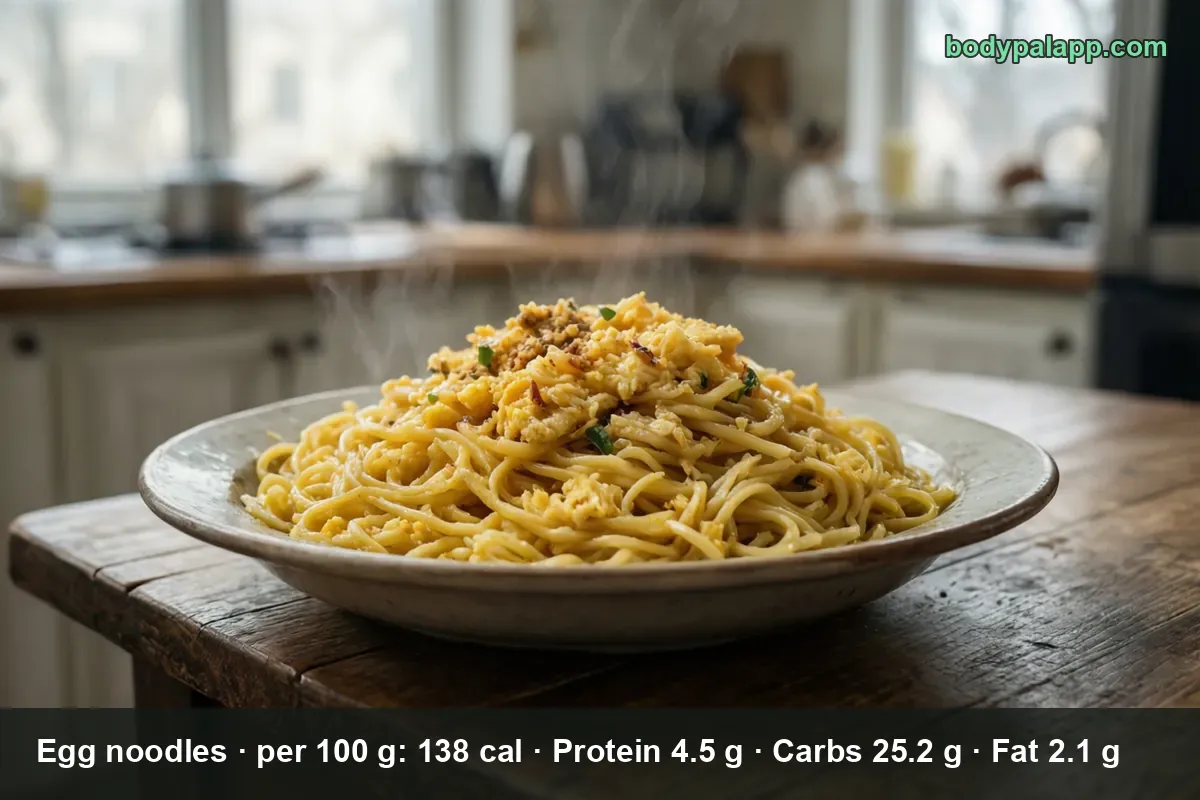
A 1-cup serving of cooked egg noodles weighs 160 grams and carries 221 calories. Per 100 grams the drained noodles run 138 calories, which is lighter than most people expect from a bowl of pasta. The weight of the water they soak up does most of that work.
On this page
- Egg noodle quick facts
- US servings from one ounce to two cups
- Dry cooked salted and spinach versions
- The cup trap that ruins the math
- Cholesterol is the row to watch
- How do egg noodles compare?
- Most popular egg noodles brands
- Egg noodle FAQs
Egg noodle quick facts
The number on this page comes from SR Legacy 169732, "Noodles, egg, enriched, cooked". That is the record for what is actually on your plate: boiled, drained, no salt in the water. Enriched is the US default, since nearly every domestic box is enriched with iron and B vitamins.
If you are reading a box instead of a plate, you want the dry record, and that section is further down. Dry and cooked differ by a factor of nearly three by weight, and mixing them up is the single most common way people miscount a pasta dinner.
| Nutrient | Per 100 g | Per 1 cup cooked (160 g) | % Daily Value |
|---|---|---|---|
| Calories | 138 | 221 | — |
| Total fat | 2.07 g | 3.3 g | 4% |
| Saturated fat | 0.42 g | 0.7 g | 3% |
| Carbohydrate | 25.16 g | 40.3 g | 15% |
| Dietary fiber | 1.2 g | 1.9 g | 7% |
| Total sugars | 0.4 g | 0.6 g | — |
| Protein | 4.54 g | 7.3 g | 15% |
| Sodium | 5 mg | 8 mg | 0% |
| Cholesterol | 29 mg | 46 mg | 15% |
| Potassium | 38 mg | 61 mg | 1% |
% Daily Value is based on a 2,000-calorie diet.
Verified nutrition data
Numbers on this page come from USDA FoodData Central, the U.S. Department of Agriculture’s food composition database, and from manufacturer labels where a branded product is named. Last verified September 2026. How we verify our data →
There is no added sugars row here: the SR Legacy edition does not publish added sugars for cooked pasta, so the line is left out rather than guessed. Total sugars have no Daily Value of their own, which is why that cell shows a dash. The percentages follow the FDA Daily Values used on every US label.
US servings from one ounce to two cups
| Serving | Weight | Calories |
|---|---|---|
| 1 oz cooked | 28 g | 39 kcal |
| 1/2 cup cooked | 80 g | 110 kcal |
| 1 cup cooked | 160 g | 221 kcal |
| 4 oz cooked | 113 g | 156 kcal |
| 2 cups cooked | 320 g | 442 kcal |
| Per 100 g | 100 g | 138 kcal |
Only the 1-cup line is a USDA household measure. The half cup, the two cups, the 4-ounce plate and the single ounce are our own arithmetic from the USDA 100 g figure, not USDA servings, scaled at 1.38 calories per gram.
Two cups is the honest number for a dinner plate of buttered noodles or the base under beef stroganoff. That is 442 calories before a single spoon of sauce, which is why the noodles alone can quietly own two thirds of a 700-calorie meal. A half cup, on the other hand, is the side portion that fits next to a piece of chicken and costs 110 calories.
Dry cooked salted and spinach versions
| Version | Per 100 g | Typical serving | Calories |
|---|---|---|---|
| Cooked, enriched | 138 kcal | 1 cup (160 g) | 221 kcal |
| Cooked with added salt | 138 kcal | 1 cup (160 g) | 221 kcal |
| Dry, enriched | 384 kcal | 2 oz (57 g) | 219 kcal |
| Spinach, cooked | 132 kcal | 1 cup (160 g) | 211 kcal |
| Spinach, dry | 382 kcal | 2 oz (57 g) | 218 kcal |
| Noodles with cheese and egg | 185 kcal | 1 cup (230 g) | 426 kcal |
Salting the water changes nothing but sodium. USDA keeps a separate record for noodles boiled with added salt, and every macro matches the plain version to the decimal; only sodium moves, from 5 mg to 165 mg per 100 grams.
Spinach egg noodles are the one version with a real nutritional difference, and it is not the calories. A cooked cup is 211 calories instead of 221, close enough to ignore, but fiber climbs from 1.9 g to 3.7 g per cup, or 13% of the Daily Value. Unenriched noodles, cooked or dry, carry the same calories and macros as the enriched ones; the difference is added iron and B vitamins, not energy.
The last row is a different food. "Macaroni or noodles with cheese and egg" is a finished casserole at 426 calories a cup, and it shows what sauce does to a noodle base. Dry US brands sit above the USDA dry record in places: labels run from 375 calories per 100 grams for Creamette, Light 'N Fluffy and Kroger wide noodles up to 411 for Amish Kitchens homestyle. Nearly all of them print a 56-gram serving somewhere between 210 and 230 calories.
The cup trap that ruins the math
A cup of dry egg noodles weighs about 38 grams. A cup of cooked egg noodles weighs 160 grams. Same word, same measuring cup, and a gap that no amount of careful logging can fix afterward.
Run the numbers and the dry cup comes to roughly 146 calories (our own arithmetic from the USDA dry figure of 384 per 100 grams, not a USDA serving). The cooked cup is 221 calories. That is 51% more for what looks like the same measurement, and it is the reason a "1 cup egg noodles" entry can be wrong by a third.
The cleaner habit runs the other way. Two ounces of dry noodles is 57 grams and 219 calories; cooked, that same 57 grams comes out at roughly 160 grams, one cup, 221 calories. The calorie count barely moves, because boiling adds only water. Weigh the box, not the bowl, and the arithmetic stops fighting you.
Cholesterol is the row to watch
Egg noodles are the rare pasta with cholesterol in it, and a cooked cup carries 46 mg, or 15% of the Daily Value. That comes from the egg solids in the dough. It ties carbohydrate and protein as the highest percentage on the panel for this serving, which is not what most people expect from a bowl of noodles.
Sodium goes the other way. Boiled in plain water, a cup holds 8 mg of sodium, which rounds to 0% of the Daily Value. Salt the pot and the same cup lands at 264 mg, or 11% — the equivalent of a bit over a tenth of a teaspoon of table salt reaching the noodles. If you are watching sodium, the pot is a smaller problem than the sauce, but the salted record is the honest one to log when you cook the way most people cook.
Protein is the pleasant surprise: 7.3 g a cup, 15% of the Daily Value, with the egg in the dough adding to what the wheat brings. Fiber is the weak spot at 1.9 g, 7% of the Daily Value, which is why MyPlate pushes half of your grains toward whole grain sources; enriched egg noodles are a refined grain, and the Dietary Guidelines treat them that way.
How do egg noodles compare?
| Food | Per 100 g | US serving | Calories |
|---|---|---|---|
| Egg noodles, cooked | 138 kcal | 1 cup (160 g) | 221 kcal |
| Spinach egg noodles, cooked | 132 kcal | 1 cup (160 g) | 211 kcal |
| Egg noodles, dry | 384 kcal | 2 oz (57 g) | 219 kcal |
| Noodles with cheese and egg | 185 kcal | 1 cup (230 g) | 426 kcal |
Our take: for weight loss, cook the noodles plain and stop at one cup — 221 calories with 7.3 g of protein is a reasonable starch base, and the spinach version saves you ten calories while nearly doubling the fiber. For fullness, the two-cup plate at 442 calories does the job but leaves little room for anything else on it. The row that should change behavior is the casserole: at 426 calories a cup, the cheese roughly doubles the cost of the same volume of noodles, and no portion size fixes that.
Most popular egg noodles brands in the United States
Ranked by how widely each product appears among foods sold in the United States, from the BodyPal food database of over 3.3 million products. Calories are the figures printed on each Nutrition Facts label, checked against USDA FoodData Central.
| Product | Calories (per 100 g) |
|---|---|
| Blue Dragon Cantonese Egg Noodles | 380 cal |
| Creamette Enriched Wide Egg Noodles | 375 cal |
| Light 'N Fluffy Enriched Egg Noodles Wide | 375 cal |
| Amish Kitchens Homestyle Wide Egg Noodles | 411 cal |
| Anthony's Extra Wide Egg Noodles | 393 cal |
| Kroger Whole Wheat Wide Egg Noodles | 375 cal |
Brand popularity: BodyPal food database. Nutrition: manufacturer labels / USDA FoodData Central.
Egg noodle FAQs
How many calories are in 1 cup of cooked egg noodles?
221 calories for a 1-cup serving of cooked enriched egg noodles, weighing 160 grams. That works out to 138 calories per 100 grams. The same cup brings 40.3 grams of carbohydrate, 7.3 grams of protein and 3.3 grams of fat, so the noodles alone are mostly a starch serving.
How many calories are in 2 oz of dry egg noodles?
219 calories in 2 ounces of dry enriched egg noodles, which is 57 grams and close to the 56-gram serving printed on most US boxes. Dry noodles run 384 calories per 100 grams because none of the cooking water is in them yet. Boiled, that same 2 ounces fills about one cup.
How much does 2 oz of dry egg noodles weigh cooked?
About 160 grams, or one cup. Two ounces of dry noodles is 57 grams and 219 calories; a cup of cooked enriched egg noodles is 160 grams and 221 calories. The calories barely move because nothing is added, but the weight nearly triples as the noodles absorb water.
How many carbs are in egg noodles?
40.3 grams of carbohydrate in a 1-cup cooked serving, which is 15% of the Daily Value, and 25.16 grams per 100 grams. Only 0.6 gram of that cup is total sugars and 1.9 grams is fiber, so the rest is starch. Dry noodles hold 71.27 grams per 100 grams.
How much protein is in egg noodles?
7.3 grams of protein in a 1-cup cooked serving, 15% of the Daily Value, from 4.54 grams per 100 grams. The egg in the dough helps, but this is still a grain, not a protein food. A dry 2-ounce portion carries 8.1 grams before it ever meets water.
Do egg noodles have cholesterol?
Yes, 46 milligrams in a 1-cup cooked serving, or 15% of the Daily Value, from 29 milligrams per 100 grams. It is one of three rows that reach 15% here, alongside carbohydrate and protein, and it comes from the egg solids in the dough, not from anything added in the pot.
Are egg noodles high in sodium?
Only 8 milligrams in a 1-cup cooked serving when you boil them in plain water, which rounds to 0% of the Daily Value. Salt the pot and USDA's salted record puts the same cup at 264 milligrams, or 11%. The sauce usually adds far more than either number.
What is the difference between wide and extra wide egg noodles?
Roughly nothing, since USDA publishes a single dry enriched egg noodle record at 384 calories per 100 grams that covers every width. US boxes of wide and extra wide alike print a 56-gram serving at 210 to 230 calories. Width changes texture and how tightly the noodles pack a cup.
Similar foods
- Egg — 72 cal per large egg
- Poached Egg — 72 cal per large egg
- Soft Boiled Egg — 72 cal per large egg
- Egg Foo Young — 219 cal per cup
- Egg Foo Yung — 108 cal per patty
- Boiled Egg — 78 cal per egg
Count it without the math
Point the camera at the bowl and BodyPal counts the noodles for you, sauce and all.


How long does it take to burn off egg Noodles?
A 1-cup (160 g) cooked serving is 221 kcal. Enter your weight and the amount you ate to see how long it takes you to burn that off:
lb
| Activity | Time to burn 221 kcal |
|---|---|
| Walking, brisk | 44 min |
| Cycling, moderate | 28 min |
| Swimming, moderate | 32 min |
| Jogging | 26 min |
| Weight training, moderate | 49 min |
Times are for a 155 lb adult at a steady pace; change the weight to see yours. The amount is set to the portion in the text (160 g); change it to what you actually ate. BodyPal works this out from your steps automatically.
One food is easy to picture; a whole day is harder. See how many calories you need a day and what a deficit actually looks like.