
How many calories are in egg foo young?
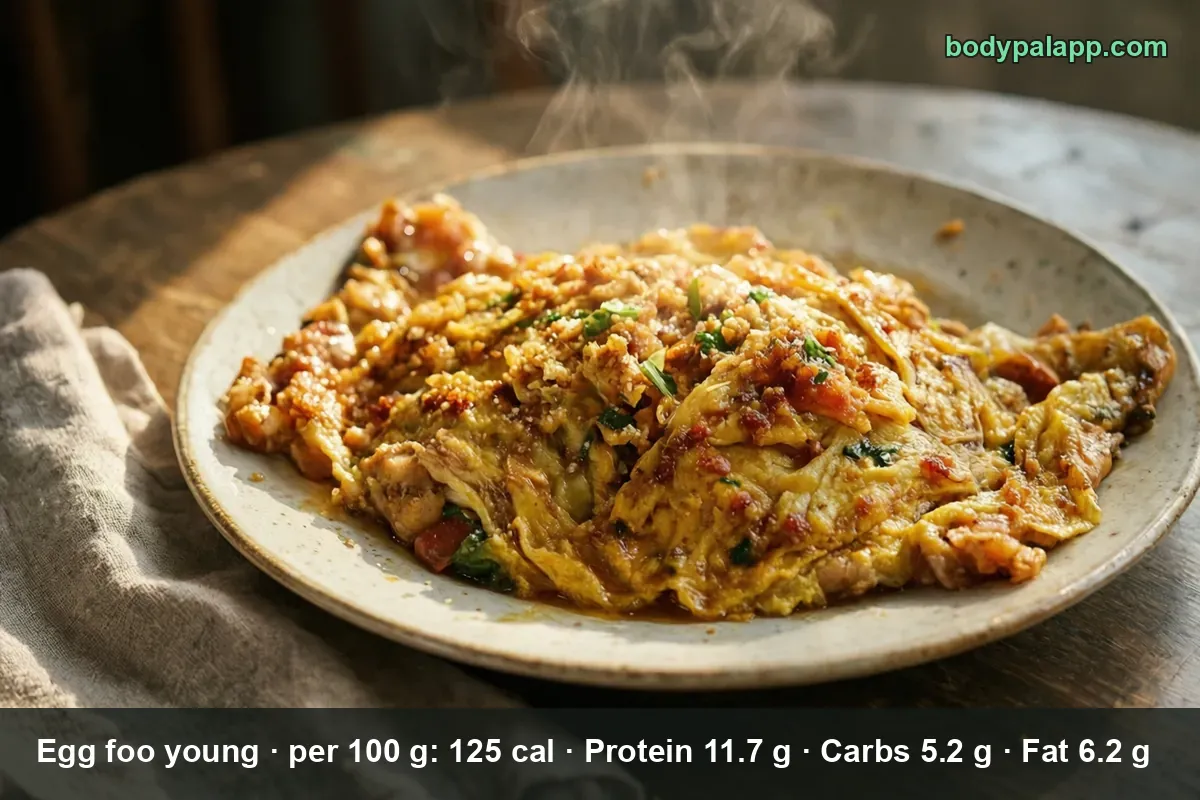
A 1-cup serving of egg foo young weighs 175 g and carries 219 calories. Per 100 g the dish runs 125 calories, which makes it one of the lighter mains on a Chinese takeout menu by weight. The catch isn't the calorie count at all. It's the 410 mg of cholesterol riding along with it.
On this page
- Egg foo young quick facts
- US servings, from one patty to a full cup
- Pork, beef, chicken and shrimp egg foo young
- Cholesterol is the row to watch
- How does egg foo young compare?
- Egg foo young FAQs
Egg foo young quick facts
The numbers below come from the USDA record FNDDS 2707193, "Egg foo yung, NFS". NFS means "not further specified", and that is exactly the plate most people are looking at: egg, bean sprouts, green onion and whatever meat the kitchen had, without anyone naming the meat. USDA spells the dish "yung", which is why a search for "egg foo young" in FoodData Central comes back empty even though the record is right there.
The four named versions (pork, beef, chicken, shrimp) sit further down this page. They differ from this row only by the protein stirred into the egg, not by the source of the data, so there is nothing to average out.
| Nutrient | Per 100 g | Per 1 cup (175 g) | % Daily Value |
|---|---|---|---|
| Calories | 125 | 219 | — |
| Total fat | 6.16 g | 10.8 g | 14% |
| Saturated fat | 1.71 g | 3.0 g | 15% |
| Carbohydrate | 5.2 g | 9.1 g | 3% |
| Dietary fiber | 0.3 g | 0.5 g | 2% |
| Total sugars | 3.07 g | 5.4 g | — |
| Protein | 11.69 g | 20.5 g | 41% |
| Sodium | 340 mg | 595 mg | 26% |
| Cholesterol | 234 mg | 410 mg | 136% |
| Potassium | 143 mg | 250 mg | 5% |
% Daily Value is based on a 2,000-calorie diet.
Verified nutrition data
Numbers on this page come from USDA FoodData Central, the U.S. Department of Agriculture’s food composition database, and from manufacturer labels where a branded product is named. Last verified September 2026. How we verify our data →
Two rows you would expect on a package label are missing here: added sugars and trans fat. This edition of FNDDS doesn't publish either value for these records, so rather than guess, they stay off the table. The 5.4 g of total sugars in a cup come from the vegetables and the small amount of sugar in a stir-fry sauce, and total sugars have no Daily Value to compare against.
One more line worth reading twice: 595 mg of sodium is about a quarter teaspoon of table salt, dissolved into a single cup of egg.
US servings, from one patty to a full cup
Egg foo young gets served two ways in the US, and they don't measure the same. A restaurant plates round patties, usually three to an order. A home cook or a buffet tray scoops it loose, and then the honest unit is a cup.
| Serving | Weight | Calories |
|---|---|---|
| 1 oz | 28.4 g | 36 kcal |
| One patty | 86 g | 108 kcal |
| Half a cup | 87.5 g | 109 kcal |
| Two patties | 172 g | 215 kcal |
| One cup | 175 g | 219 kcal |
| Per 100 g | 100 g | 125 kcal |
The cup and the single patty are USDA household measures for this record. The half cup, the two-patty line and the ounce are our own arithmetic from the USDA 100 g figure, not USDA servings.
That table hides a neat coincidence: one cup and two patties land within four calories of each other, 219 against 215. So a cup is roughly two patties, and the standard three-patty restaurant order comes to about 324 calories (three times the 86 g patty, again our own arithmetic).
Then there's the gravy. The brown sauce ladled over the patties in a takeout container is a separate food and it is not in this USDA record. Whatever you log from this page is the egg, the vegetables and the meat only.
Pork, beef, chicken and shrimp egg foo young
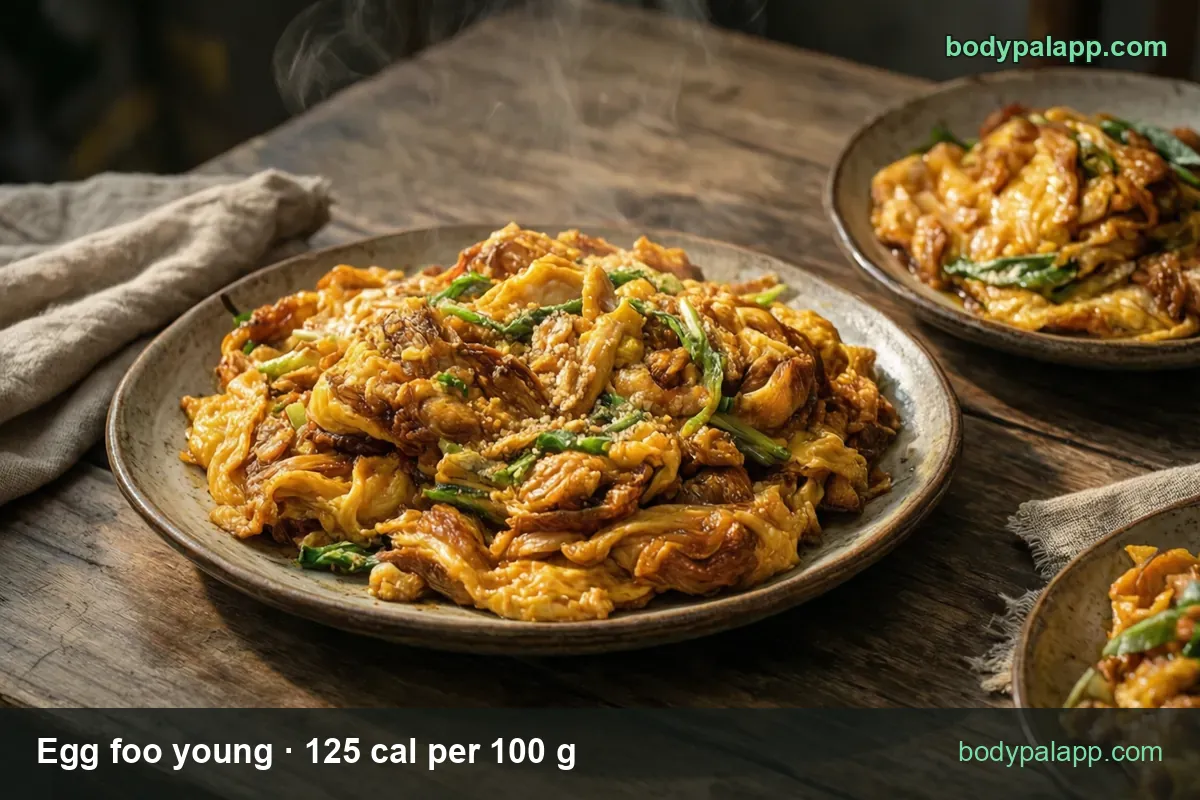
USDA publishes four named versions alongside the unspecified one. The spread between the lightest and the heaviest cup is 42 calories, which is less than most people expect.
| Version | Per 100 g | 1 cup (175 g) | USDA record |
|---|---|---|---|
| Unspecified (NFS) | 125 kcal | 219 kcal | 2707193 |
| Shrimp | 125 kcal | 219 kcal | 2707196 |
| Chicken | 137 kcal | 240 kcal | 2707194 |
| Beef | 147 kcal | 257 kcal | 2707197 |
| Pork | 149 kcal | 261 kcal | 2707195 |
Shrimp egg foo young matches the unspecified row value for value in this edition, right down to the 3.07 g of sugars, so if shrimp is your usual order you can log the plain figure and be done.
Pork is the heaviest cup at 261 calories, and it earns that the boring way. It carries 8.25 g of fat per 100 g against 6.16 g for the base row, while protein only climbs from 11.69 g to 13.29 g. Pork buys you fat, not protein.
Beef is the protein pick: 13.82 g per 100 g, which works out to about 24.2 g in a cup by our own arithmetic, four grams more than the plain version for 38 extra calories.
Chicken looks like the sensible middle at 137 calories per 100 g, and on calories it is. On salt it isn't. Chicken egg foo young carries 401 mg of sodium per 100 g, the highest of the five records, or roughly 702 mg in a cup scaling from that figure ourselves. That is 31% of a day's sodium in one scoop, before soy sauce or gravy.
Store-bought egg foo young barely exists in the US. A search of USDA's branded database turns up frozen egg-patty breakfast sandwiches and nothing else, which is a different food entirely. This is a restaurant and home-kitchen dish, so the numbers on this page are the ones to use.
Cholesterol is the row to watch
A cup of egg foo young delivers 410 mg of cholesterol against a Daily Value of 300 mg, so 136% of the day sits in a 219-calorie serving. Nothing else on the label comes close to that ratio.
That happens because the dish is mostly egg. The meat is a garnish by weight, which is also why the protein number is so good relative to the calories, and why the Dietary Guidelines advice to keep dietary cholesterol as low as possible while still eating a healthy pattern is the relevant frame here rather than the calorie count. If your doctor has you tracking cholesterol, this is a dish to portion rather than to skip.
The protein side deserves credit too. At 20.5 g per cup, egg foo young covers 41% of the protein Daily Value for 219 calories, which is the kind of ratio MyPlate puts in the protein-foods group for a reason. Very few takeout mains give you two fifths of the day's protein for a tenth of the day's calories.
How does egg foo young compare?
The three neighbors below are also FNDDS records, and USDA doesn't publish a cup weight for any of them, so this comparison runs on 100 g where every dish is measured the same way.
| Dish | Per 100 g | Protein | Fat |
|---|---|---|---|
| Egg foo young | 125 kcal | 11.69 g | 6.16 g |
| Shrimp teriyaki | 120 kcal | 21.62 g | 1.56 g |
| Kung pao chicken | 129 kcal | 9.76 g | 6.98 g |
| Chicken, rice and vegetables in soy sauce | 131 kcal | 9.36 g | 6.92 g |
Our take: on calories these four are effectively the same dish, separated by 11 calories per 100 g across the whole table, and only shrimp teriyaki is lighter than egg foo young. Protein is where they split. Shrimp teriyaki nearly doubles egg foo young's protein at a quarter of the fat, so if you're eating for fullness on a calorie budget, that's the order. If egg foo young is what you want, it still beats kung pao chicken and the rice-and-vegetable plate on protein per calorie by a clear margin. Take it as a cup with steamed vegetables rather than as three patties over fried rice, and skip the gravy that isn't in any of these numbers.
Egg foo young FAQs
How many calories are in egg foo young?
A 1-cup serving of 175 g has 219 calories, based on the USDA record for egg foo yung, NFS. Per 100 g the dish runs 125 calories. That figure covers the egg, vegetables and meat only, so any brown gravy ladled over a restaurant order sits on top of it.
How many calories in one egg foo young patty?
One patty weighs 86 g and carries 108 calories, so the usual three-patty restaurant order comes to about 324 calories by our own arithmetic. Two patties, 172 g, land at 215 calories, which is within four calories of a full cup of the loose version at 219.
How much protein is in egg foo young?
A cup gives you 20.5 g of protein, which is 41% of the Daily Value for 219 calories. Per 100 g that's 11.69 g. Beef egg foo young is the highest of the named versions at 13.82 g per 100 g, roughly 24.2 g in a cup by our own scaling.
Is egg foo young high in cholesterol?
Yes: 410 mg in a 1-cup serving, or 136% of the 300 mg Daily Value, from 234 mg per 100 g. That's the highest percentage on the whole label and it comes from the egg base rather than the meat. Half a cup still carries about 205 mg.
Does egg foo young have a lot of sodium?
A cup has 595 mg of sodium, 26% of the 2,300 mg Daily Value, or about a quarter teaspoon of table salt. Chicken egg foo young is saltier at 401 mg per 100 g, roughly 702 mg per cup by our own arithmetic. Gravy and soy sauce add more on top.
Are the calories with the brown gravy included?
No. The 219 calories per cup cover the egg patty mixture only, because the USDA record for egg foo yung doesn't include a sauce. Restaurant gravy is a separate item and has to be logged separately. The same applies to the fried rice that usually shares the plate.
Which is lighter, chicken or pork egg foo young?
Chicken, by 21 calories a cup: 240 against 261, or 137 versus 149 calories per 100 g. Pork carries 8.25 g of fat per 100 g against 7.38 g for chicken. Chicken pays for it in salt though, with 401 mg of sodium per 100 g versus 325 mg for pork.
Is egg foo young healthy for weight loss?
It fits well: 219 calories a cup with 20.5 g of protein is a strong ratio for fullness, and only 9.1 g of carbohydrate. Keep it to a cup, order it without the gravy and pair it with steamed vegetables rather than fried rice, and watch the 410 mg of cholesterol if you're tracking it.
Similar foods
- Egg — 72 cal per large egg
- Omelet — 305 cal for 3-egg omelet
- Crepe — 179 cal per crepe
- Pancake — 423 cal for 3 medium pancakes
- Toast with butter — 100 cal per slice with butter
- Injera — 118 cal per injera (12 in)
Count it without the math
Point the camera at the plate and BodyPal counts the egg foo young for you, patty by patty.


How long does it take to burn off egg foo young?
A 1-cup (175 g) serving is 219 kcal. Enter your weight and the amount you ate to see how long it takes you to burn that off:
lb
| Activity | Time to burn 219 kcal |
|---|---|
| Walking, brisk | 44 min |
| Cycling, moderate | 27 min |
| Swimming, moderate | 31 min |
| Jogging | 26 min |
| Weight training, moderate | 49 min |
Times are for a 155 lb adult at a steady pace; change the weight to see yours. The amount is set to the portion in the text (175 g); change it to what you actually ate. BodyPal works this out from your steps automatically.
This table assumes you know your daily total. If you do not, the daily calorie calculator works it out from five numbers.